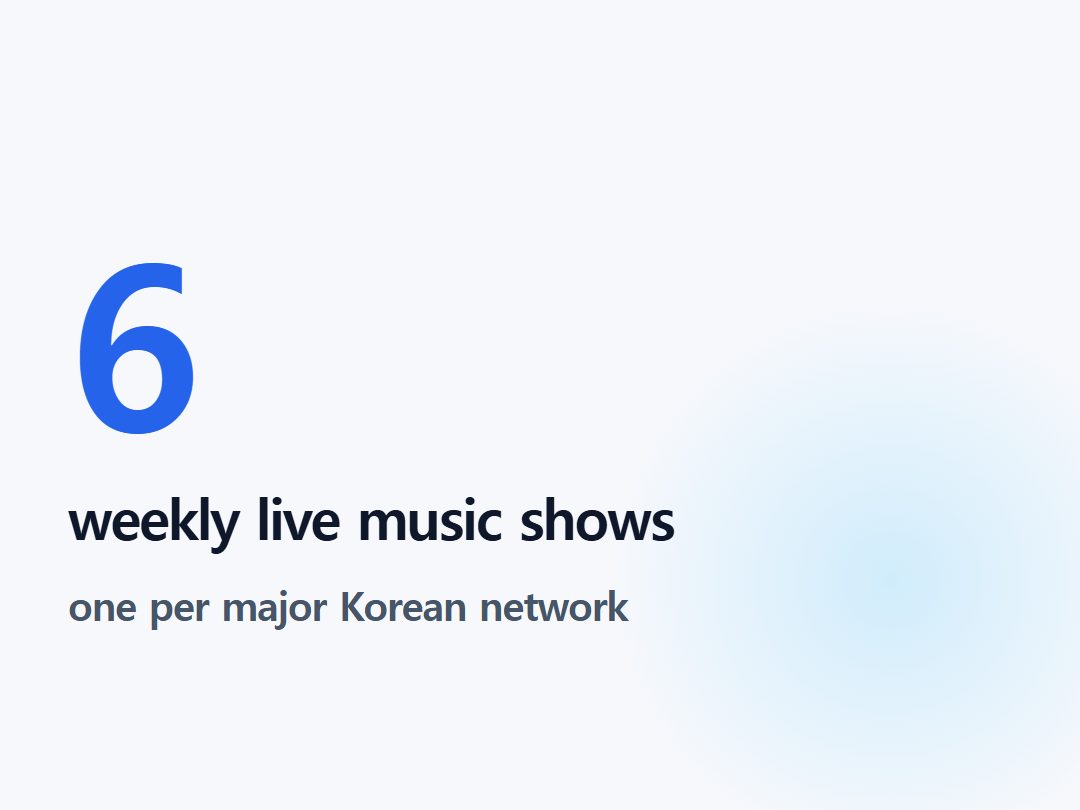
Every week, six Korean television networks put on a live ranking show where the biggest names in K-pop perform their newest singles in front of a studio audience, and a winner is announced on air.
For viewers in Korea, tuning in is second nature: the shows have aired at the same time slots for decades and are covered like sports fixtures.
For international fans, the actual obstacle is different: working out which show airs when, and which of the many apps and channels claiming to stream it is the legitimate one, rather than an unlicensed reupload.
This is a practical, evergreen guide to the current, official options, and to the part of the picture — why these broadcasts carry weight — that rarely gets explained outside Korea.
The short version
- Fan votes cast through official apps directly affect who wins each week.
- The Show relaunched in June 2026 as a free, TikTok-based global broadcast.
- Simply K-Pop ended in 2025; check each show's own official channel to watch.
Why no single platform covers all six shows
Nothing broke this week — that is the point. This is a standing weekly system, not a news event, and it has quietly changed shape over the past year.
Two long-running shows shut down in 2025, and one of them, The Show, came back in mid-2026 under a new production company with a global-first streaming model built around free access rather than a paid app.
Meanwhile the five other shows continue on their usual schedule, each with its own separate official channel abroad rather than one shared platform. That fragmentation, and the recent shakeout behind it, is a useful entry point for understanding how the whole system works.
Does fan voting from abroad actually count?
To an outsider, these look like ordinary televised performance segments. What is missing for international readers is that each broadcast is also a live chart.
In Korean fan communities these programs are called eumak bangsong (음악방송, literally “music broadcast”), and every episode ends with a ranking segment that names a winner for that week.
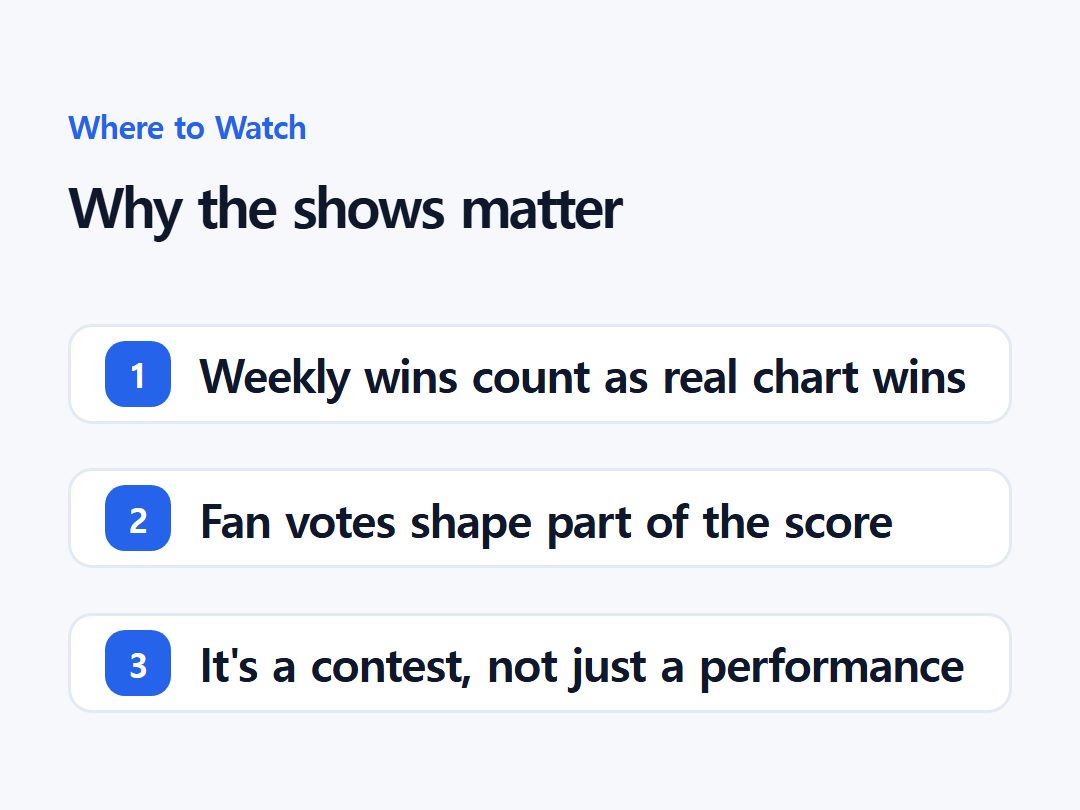
Taking first place, referred to as 1wi (1위, “number one”), is treated by agencies, fan communities and entertainment press as a real, citable achievement — reported in headlines the same way a Billboard chart entry would be, and commemorated with an extra performance called an encore stage, where the winning act performs the song a second time.
The ranking is not a simple popularity poll.
KBS's Music Bank, for example, calculates its weekly “K-Chart” from a fixed formula: roughly 60% digital sales and streaming, 20% broadcast airplay, 10% pre-show fan voting, 5% physical album sales and 5% social media activity, based on data compiled through Korea's Circle Chart, the industry's official sales-tracking body.
The other networks run comparable, if not identical, systems, each with its own weighting and its own voting app.
The fan-voting slice is what makes this relevant to someone watching from outside Korea: since 2023, Music Bank's pre-voting has counted as a global fan vote, cast through an official app called Fancast, rather than a domestic-only poll.
In practice, an international fan who votes and streams through the correct official channels is not just watching a show — they are contributing a measurable input to whether their favorite act wins that week.
That is also the reason platforms keep building real-time features rather than settling for next-day replays: Mnet's live global simulcast, KOCOWA+'s synchronized 24-hour countdown clock, and The Show's new global voting system all exist because timing is not incidental to the format, it is the format.
This is also why the term comeback matters, and why it shows up constantly around these broadcasts: it refers to a group's return with a new single or album after a period of inactivity, not a comeback from failure.
Comebacks are almost always timed to these Wednesday-through-Sunday-plus-Tuesday broadcasts, because a strong first week of chart performance depends on hitting as many of the ranking shows as possible while the release is still new — which is why a single group can appear on three or four different shows in the same week.
None of this requires an agency (the entertainment company that manages a K-pop act's training, releases and day-to-day schedule) to explain to fans why the shows matter; Korean audiences absorb it by osmosis, through years of exposure to chart talk on television and social media.
It is exactly the layer that does not translate automatically for a new international fan encountering a livestream link for the first time: the show is not just a performance clip circulating on social media, it is a weekly contest with real stakes for the artist, and watching or voting through official channels is a way of participating in that contest rather than observing it from outside.
How legal streaming grew, then shrank in 2025
The current lineup of weekly ranking shows took shape mostly in the late 1990s and 2000s: SBS's Inkigayo and KBS's Music Bank both date to 1998, while Mnet's M Countdown premiered in July 2004.
For most of their history, none of these were built with an international audience in mind — overseas fans relied on fan-recorded clips, unofficial reuploads and, later, unlicensed livestream aggregators, since regional licensing meant a show broadcasting live from a Seoul studio was often invisible outside Korea entirely.
That began changing as broadcasters built out their own international arms: KBS World was already carrying programming to overseas cable and satellite audiences, and official YouTube channels for each show followed through the 2010s as the “Hallyu wave” (the international spread of Korean pop culture) made overseas demand too large to ignore.
The bigger structural shift came in 2016, when KBS, MBC and SBS — competitors on air but jointly exposed to the same overseas piracy problem — formed a joint venture with SK Telecom called Korea Content Platform.
It launched in the United States in 2017 under the brand KOCOWA, the first subscription service built specifically to give overseas fans a legal alternative to pirated reruns of all three networks' shows, including next-day replays with multi-language subtitles.
KOCOWA, later rebranded KOCOWA+, expanded into Europe and Oceania in 2024, extending official access well beyond its original North and South American footprint and turning what had been a patchwork of fan-run streams into a licensed catalog of roughly 30,000 hours of content.
2025 then delivered a sharp contraction. Arirang TV's Simply K-Pop, a fixture for smaller and rookie acts since 2012, ended after 13 years.
Months later, in November 2025, The Show — then produced by SBS's in-house entertainment arm SBS Medianet — ended its 14-year run when the parent company exited entertainment production entirely, taking a long-running Tuesday broadcast off the air with little warning after 393 episodes.
It returned in June 2026, but not as a straightforward revival: production was handed to an outside entertainment-technology startup, BIGC, with SBS LIFE providing only the domestic broadcast slot.
The rebuilt version streams live worldwide for free through TikTok Live and BIGC's own app, BIGC ON, and runs a global fan-voting system built on data from millions of registered overseas members — a deliberate break from the paid, broadcaster-owned app model that KOCOWA and Mnet Plus had established as the norm for legal international access over the previous decade.
The free model might not spread beyond The Show
Two things remain genuinely unresolved. First, whether BIGC's free, TikTok-first, data-driven approach to The Show becomes a template other networks copy, or stays a one-off experiment by an outside operator brought in only because SBS Medianet had already withdrawn.
If it works, it would reverse the industry's decade-long drift toward paid, broadcaster-owned apps like KOCOWA+ and Mnet Plus, and push the other four networks toward free, social-platform-native distribution instead.
Second, whether Simply K-Pop's post-2025 relaunch under a changed format stabilizes into a permanent fixture or fades out for good, which matters most for smaller and rookie acts that relied on it as an accessible entry point when the bigger five shows were harder to book.
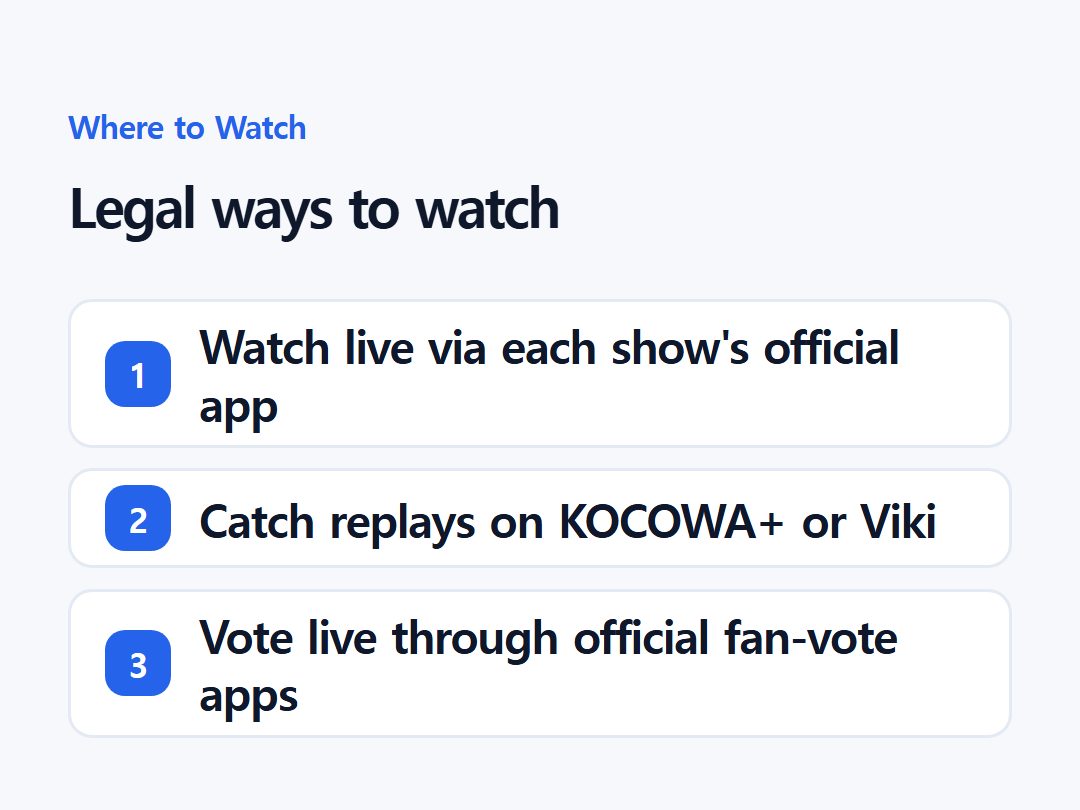
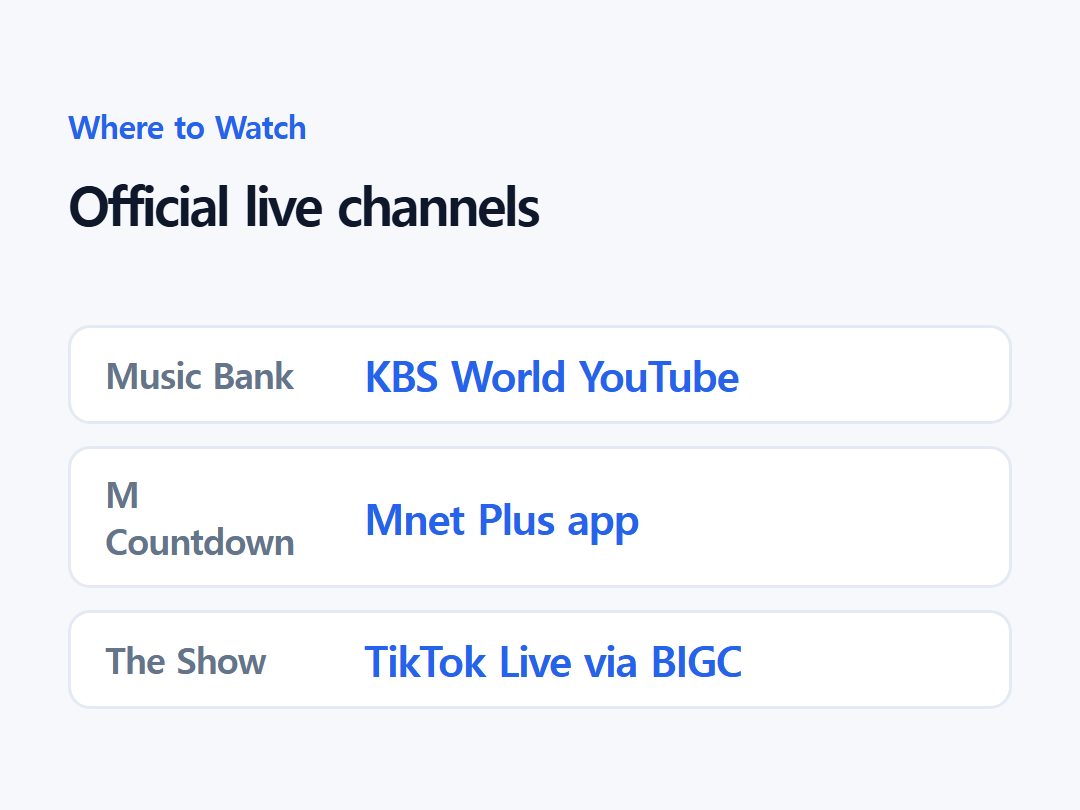
For now, the practical answer to “how do I watch” is: check each show's own official channel rather than assuming one platform covers all of them, since the six shows currently split across five separate distribution systems — KBS World, Mnet Plus, MBC's international channels, SBS's own YouTube presence, and BIGC's new setup for The Show — with KOCOWA+ and Viki serving as the common replay option after the fact, for anyone content to watch a few hours behind Seoul rather than in real time.
Where do I watch each show live?
| Show | Network | Official platform |
|---|---|---|
| Music Bank | KBS | KBS World |
| Inkigayo | SBS | SBS's own YouTube presence |
| M Countdown | Mnet | Mnet Plus |
| The Show | BIGC / SBS LIFE | TikTok Live and BIGC ON, free |
| Simply K-Pop | Arirang TV | Ended in 2025 after 13 years |
Frequently asked
How do I watch Korean music shows outside Korea?
Check each show's own official channel — KBS World, Mnet Plus, MBC's international channels, SBS's YouTube, or BIGC ON for The Show — since no single platform covers all six; KOCOWA+ and Viki offer replays a few hours behind Seoul.
What happened to The Show K-pop program?
The Show ended its 14-year run in November 2025 after SBS Medianet exited entertainment production, then returned in June 2026 under BIGC with a free, TikTok-first livestream and global voting system.
Does fan voting on K-pop music shows actually count?
Yes — on Music Bank, pre-show fan voting makes up 10% of the weekly ranking formula, and since 2023 it has counted as a global vote cast through the official Fancast app.
Sources
Every factual claim above is traceable. We do not translate articles — we gather facts from multiple outlets and write them ourselves.
- KBS WORLD TV official YouTube channel — KBS World
- Mnet Plus — official global live streaming platform — Mnet Plus (CJ ENM)
- K-POP LIVE! Offers International Fans Ability to Watch Select Programs in Real-Time — KOCOWA+
- Streaming media platform Kocowa launches in the United States, offering access to Korean TV Programs — PR Newswire
- K-content streaming service Kocowa to launch services in Europe, Oceania — The Korea Herald
- 'The Show' officially ends after 14 years of K-pop music broadcasting — allkpop
- BIGC Revamps SBS LIFE's Iconic Music Show 'THE SHOW' as a Tech-Driven 'Global Music Show' — GlobeNewswire / BIGC
- SBS 'The Show' to resume broadcast on June 2, comeback after six months — StarNews
- THE SHOW: Voting for international fans is open — KStation TV
- 'Simply K-pop' announces final broadcast after 13 years — Shining Awards
- Music Bank / K-Chart scoring formula — NamuWiki