Click a K-pop music video from a link a friend sent, and instead of the song you get a gray screen: "This video is not available in your country." No explanation, no timeline for when it might change.
This happens often enough with Korean releases that international fans have built entire habits — VPNs, mirror uploads, fan-subbed reposts — around getting past it. The mechanism behind that gray screen has nothing to do with censorship and everything to do with how music rights are sold.
The short version
- A private rights holder blocks the video, not YouTube or your government.
- Two separate rights — recording and composition — can carry different territory rules.
- Korean distributors keep shifting: HYBE left Dreamus in 2021, SM moved to Kakao in 2023.
Who really decides which country gets blocked?
There is no single incident behind this — it is a standing feature of how YouTube distributes music, and K-pop runs into it more than most genres, because Korean agencies license so many territories and platforms at once.
When a viewer sees a video blocked or gets a message citing a specific rights holder (a common one reads, roughly, "this video contains content from SME, who has blocked it in your country on copyright grounds"), that block was set by the copyright owner or their distributor, not by YouTube or by the viewer's government.
YouTube's own support documentation is explicit on this point: content owners define where a video can be watched, monetized, or blocked at all, using a system called Content ID, and YouTube simply enforces whatever territory rules the rights holder has entered.
The same video can carry different rules for different owners, so a comeback title track can be freely watchable in one country, monetized-but-viewable in another, and fully blocked in a third — all at the same moment, all set by the same upload.
A K-pop video hides two separate rights holders
The confusion starts because most viewers assume a music video is one piece of content with one owner. It is not.
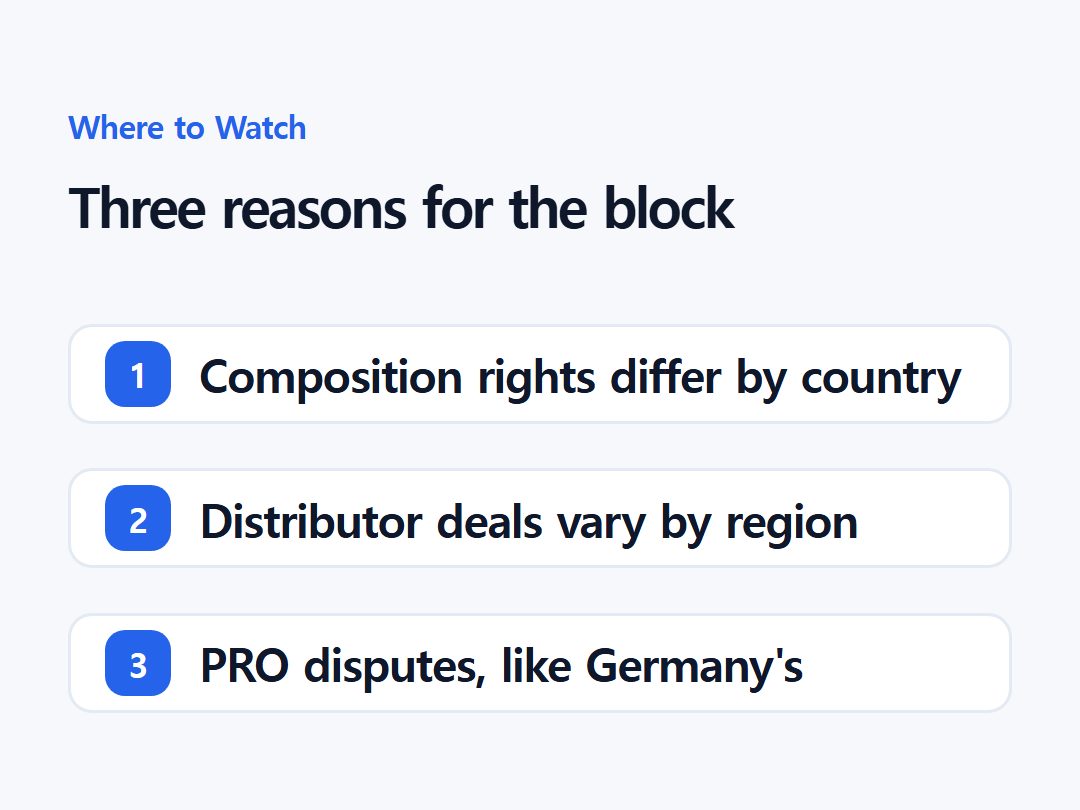
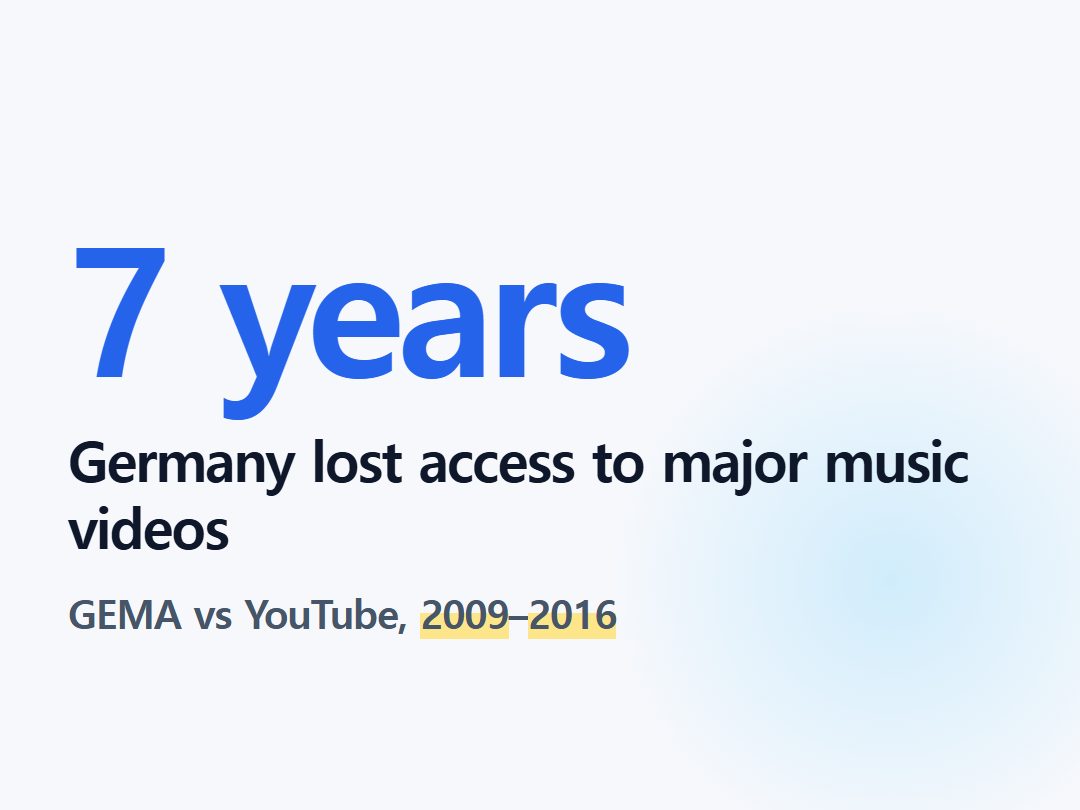
A K-pop title track typically carries at least two separate bundles of rights: the sound recording (the finished audio and video, usually controlled by the agency, such as HYBE, SM, YG, or JYP) and the composition, or the underlying melody and lyrics, which is often controlled separately by a publisher and administered through a performance rights organization, or PRO — a body like ASCAP in the US or KOMCA in Korea that collects royalties on behalf of songwriters.
Each of these can be licensed to different companies in different countries, and each license can specify a different set of allowed territories.
Content ID does not decide any of this; it is a detection system that matches uploaded audio against a registered catalog and then applies whatever "match policy" the rights holder attached to that catalog, which can be as narrow as "monetize in the US, block everywhere else." As Google's own Content ID documentation puts it, match policies apply only in the territories where the partner has registered ownership of that asset — outside those territories, the same content can default to blocked.
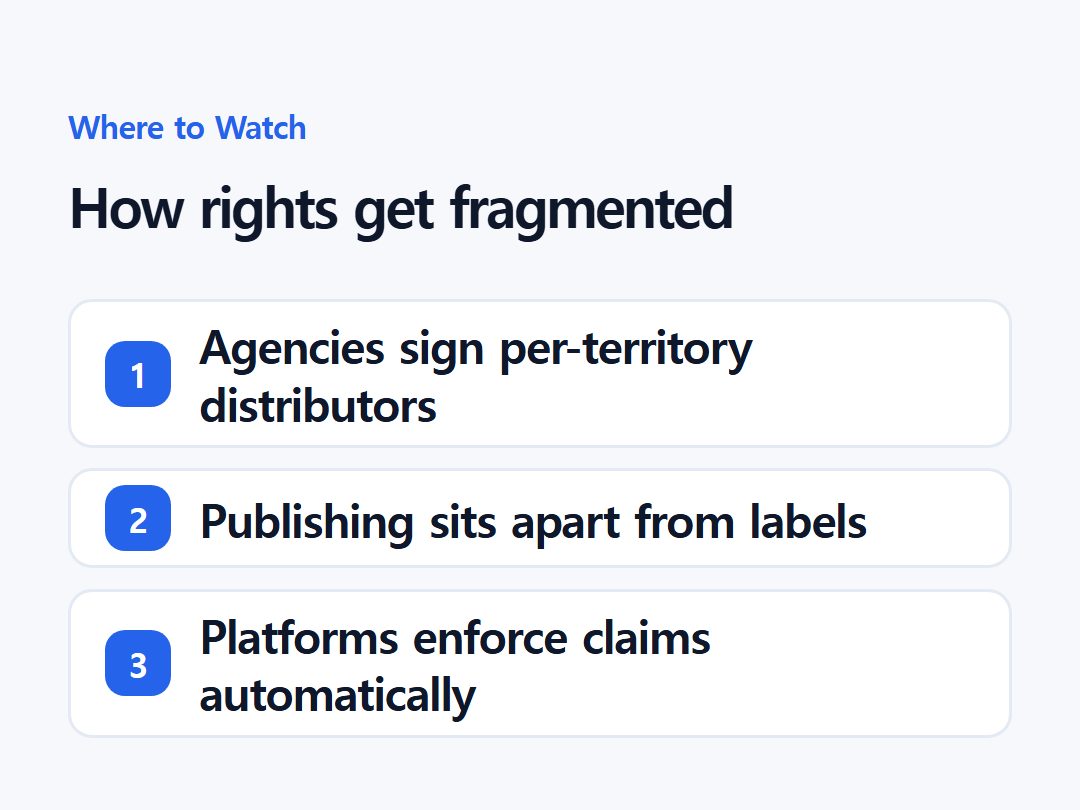
Korean agencies add another layer on top of this. None of the major agencies handle global distribution directly; they contract it out, and the contracts differ by region.
Domestically, Korean digital distribution runs through a small number of companies — Kakao Entertainment, YG PLUS, and Dreamus (formerly iRiver) are the three largest.
Which company distributes which agency's catalog has shifted more than once: Dreamus distributed both SM Entertainment's and JYP Entertainment's music from 2018, HYBE (then Big Hit) left Dreamus for YG PLUS in 2021, and SM moved its distribution to Kakao Entertainment, its largest shareholder, in 2023.
Overseas, agencies layer on separate deals again — for example, JYP Entertainment licensed its catalog to China's NetEase Cloud Music in 2024 specifically to cover digital distribution inside China, a market where YouTube itself is blocked entirely for unrelated reasons and where music rights had to be cleared through a domestic platform instead.
Every one of these deals can carry its own territory list, its own start and end date, and its own renewal terms. A video that plays fine in Seoul, Los Angeles, and London can still be blocked in Berlin or Manila simply because nobody has yet signed, or has let lapse, the specific piece of paper covering that country.
It is worth separating this from a different problem entirely: countries where YouTube itself is inaccessible, such as China, or where governments actively restrict access to the platform. That is state-level blocking, and no K-pop-specific licensing fix changes it.
The "not available in your country" message discussed here is a business decision made by a private rights holder, applied automatically and uniformly through Content ID, wherever YouTube itself is reachable.
Germany's seven-year YouTube blackout set the pattern
Territorial music licensing predates streaming by decades — record labels have always sold distribution rights market by market, the same way film studios sell theatrical rights.
When YouTube scaled globally, it inherited that fragmented system rather than replacing it, and built Content ID, launched in 2007, as the tool that lets thousands of individual rights holders apply their own territory rules automatically instead of negotiating one global agreement.
The clearest illustration of how badly this can go wrong for viewers is not K-pop specific, but it shaped how the whole industry thinks about geo-blocking.
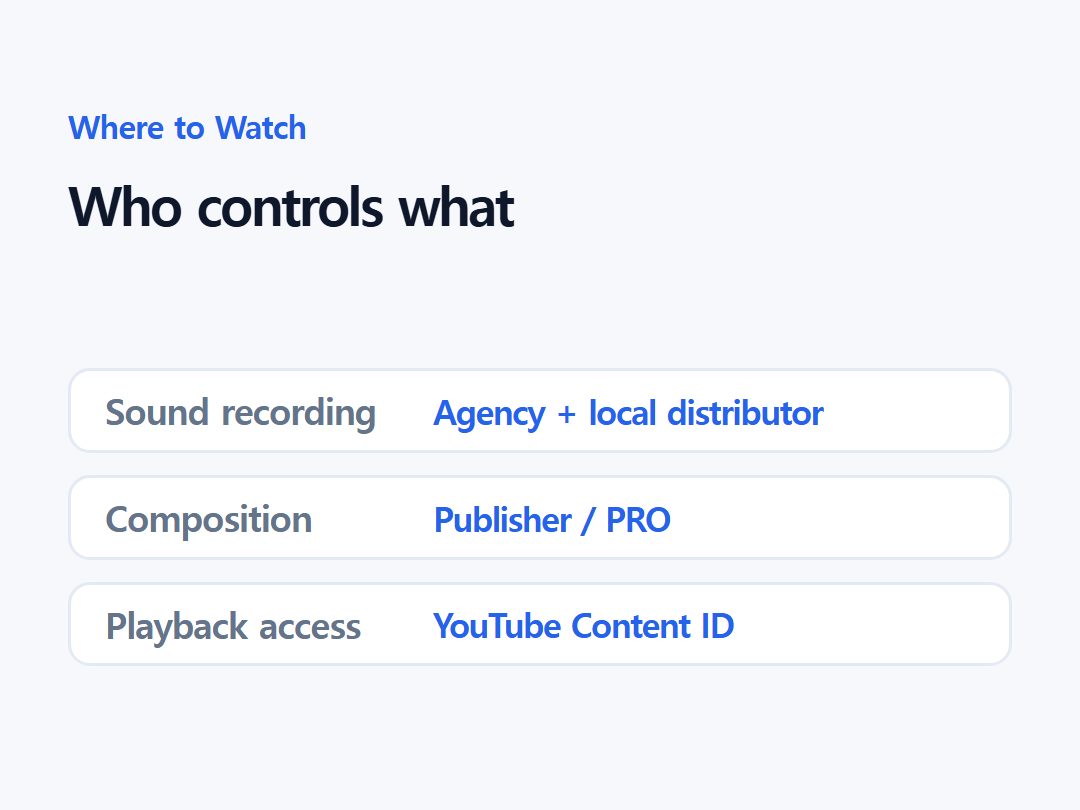
In 2009, negotiations between YouTube and GEMA, the German performance rights organization representing composers and publishers, broke down over per-stream royalty rates.
YouTube responded by geo-blocking essentially all major-label music videos in Germany. The standoff lasted seven years; researchers studying the period noted that Germany had less accessible popular music on YouTube than almost anywhere else in the world.
A licensing agreement was finally reached in November 2016, restoring access.
The dispute had nothing to do with Korean music, but it is the reference case every music-rights conversation about YouTube blocking still points back to, because it showed that an entire country's audience could be locked out of an entire catalog over one unresolved contract.
K-pop's version of this plays out in smaller, quieter pieces — one distributor contract ending here, one publishing deal not yet signed there — rather than one dramatic national standoff. But the underlying cause is the same: licensing is still negotiated territory by territory, and Content ID simply automates the result at global scale.
Will blocked K-pop videos ever become watchable?
Korea's distribution landscape is still consolidating, which could eventually simplify some of this fragmentation.
Dreamus, one of the three major domestic distributors, became the subject of a competitive acquisition process in 2025, with YG PLUS among the bidders — a deal that would further concentrate K-pop distribution into fewer hands.
Separately, YG PLUS struck a global partnership with Netflix Korea to distribute soundtracks from Korean Netflix originals, a sign that agencies and distributors are starting to build distribution deals designed for international reach from the outset rather than adding territories one at a time after the fact.
None of this points toward a single global license appearing soon. Composition and publishing rights remain legally tied to national PROs, and there is no mechanism forcing every territory's rights to be cleared simultaneously — a distributor merger fixes the recording side of the business, not the songwriting side.
For now, the most reliable way to know whether a specific video is licensed in a specific country is simply to try watching it — YouTube's Content ID enforcement updates automatically whenever a rights holder changes an underlying deal, with no public announcement attached.
That also means a video blocked today is not necessarily blocked for good: it can start working again the moment an agency and a local distributor or publisher finally sign the missing paperwork, with no notice to viewers at all.
Who distributed K-pop's biggest agencies, and when it changed
| Year | Agency | Distribution change |
|---|---|---|
| 2018 | SM & JYP | Distributed domestically by Dreamus |
| 2021 | HYBE (then Big Hit) | Left Dreamus for YG PLUS |
| 2023 | SM | Moved from Dreamus to Kakao Entertainment |
| 2024 | JYP | Licensed catalog to NetEase Cloud Music for China |
Frequently asked
Why does YouTube say a K-pop video is not available in my country?
The copyright owner or their distributor set that territory restriction through Content ID, and YouTube just enforces whatever rules the rights holder entered — it has nothing to do with your government.
Is China blocking K-pop videos on YouTube?
No — YouTube itself is inaccessible in China for unrelated state-level reasons, which is why JYP licensed its catalog to China's NetEase Cloud Music in 2024 to reach that market instead.
Will a K-pop video that's blocked in my country ever become available?
Yes — Content ID enforcement updates automatically the moment an agency and a local distributor or publisher sign the missing paperwork, with no public announcement or notice to viewers.
Sources
Every factual claim above is traceable. We do not translate articles — we gather facts from multiple outlets and write them ourselves.
- Block videos in specific territories — YouTube Help (Google)
- Restrictions on claimed music — YouTube Help (Google)
- FAQs for YouTube Content Uploaders — ASCAP
- Blocking of YouTube videos in Germany — Wikipedia
- YouTube Signs Landmark Deal to End Music Video Blocking in Germany — TorrentFreak
- The Economics of K-pop – part 12: Music Streaming Services in South Korea — Music Business Research
- Cloud Music Inc. Adds Expansive K-Pop Portfolio with JYP Entertainment Agreement — Nasdaq (press release)