
In July 2009, three members of TVXQ — Kim Jaejoong, Park Yoochun and Kim Junsu — asked a Seoul court to void their contract with SM Entertainment. They called it a “slave contract.”
The short version
- A 2009 lawsuit by TVXQ's three members reshaped K-pop contracts industry-wide.
- Regulators, not judges, set the seven-year contract cap in July 2009.
- JYJ won in court but stayed off Korean TV for a decade.
The case took three years to resolve and never produced a final verdict on the merits. Yet the K-pop industry that exists today, where a debut exclusive contract almost never runs longer than seven years, is a direct result of what happened around that lawsuit — just not because a judge ruled on it.

A 13-year contract, one filing, three names
Under Korea's agency system, a trainee signs an exclusive contract before debut, giving one company control over their training, scheduling and earnings for years. TVXQ's three members had signed a contract reported to run 13 years.
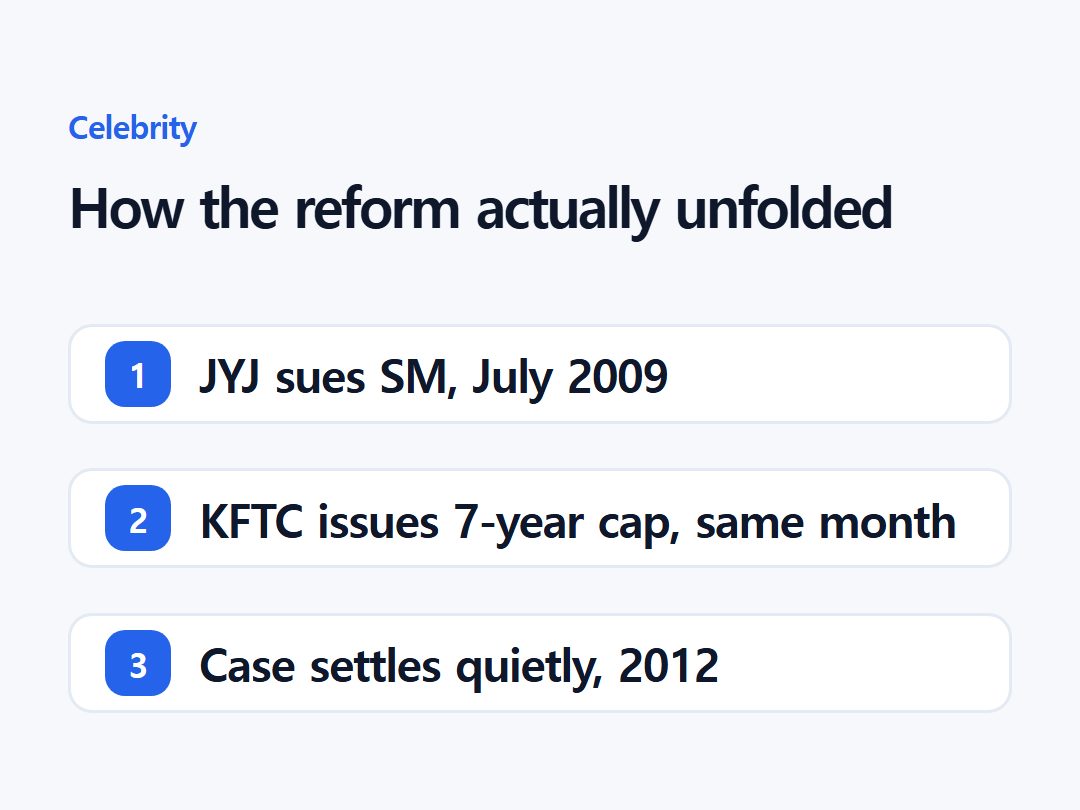
On July 31, 2009, they filed for a preliminary injunction at the Seoul Central District Court, arguing the contract's length and terms were unreasonable and violated their right to choose an occupation. In October 2009, the court partially agreed, allowing them to pursue outside activities while the case continued (Korea Herald).
What made contracts like theirs so extreme
TVXQ's contract was not an isolated case. The same year, the KFTC reviewed exclusive contracts covering 230 entertainers at 20 small and medium-sized agencies and found unfair clauses in nearly every one of them (Korea.kr policy briefing).
Clauses the regulator flagged as standard practice at the time included:
- Requiring performers to report their whereabouts to the agency at all times
- Needing agency approval to travel abroad, retire, or even take a break
- Obligating unpaid appearances in the agency's own promotional material
Against that backdrop, a 13-year deal was unusual mainly in its length — the underlying terms were close to industry standard, which is part of why regulators moved on the whole sector rather than one company.
Why it matters: the seven-year rule came from a regulator, not a judge
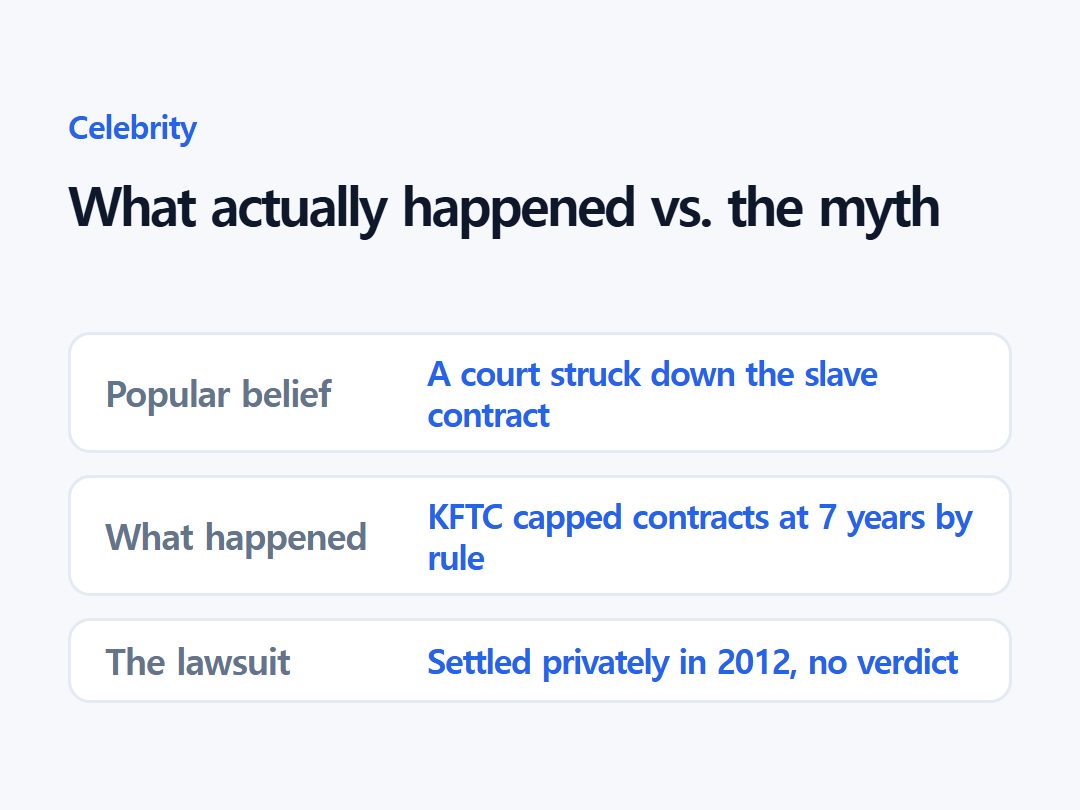
This is the part international coverage usually skips. The court's 2009 order was an interim injunction, not a ruling that the contract was illegal. The lawsuit itself dragged on for three more years and ended in a private settlement, not a landmark judgment.
The seven-year cap that now defines K-pop contracts came from a separate body entirely: the Korea Fair Trade Commission (KFTC), the government's antitrust regulator. On July 7, 2009 — while the TVXQ case was still in its opening weeks — the KFTC issued a new “Standard Exclusive Contract” for singers and actors, setting a maximum term of seven years.
In other words, the number every K-pop fan now associates with idol contracts is a piece of administrative rule-making, released in the same news cycle as the JYJ dispute but not a product of it winning in court. The lawsuit supplied the public pressure; the KFTC supplied the rule.
The court case that settled instead of ending
SM continued fighting after the 2009 injunction, at one point seeking its own order to block sales of JYJ's debut album and to suspend JYJ's new contract with CJeS Entertainment. In February 2011, the Seoul court dismissed SM's request, citing the unequal bargaining power between the company and its artists (Korea Herald).
Even that ruling did not end the case. SM and JYJ finally reached a court-mediated settlement on November 28, 2012 — three years after the filing — agreeing that their contract had effectively ended on July 31, 2009, the date the lawsuit was filed (Korea Observer). No court ever issued a final verdict declaring the original contract a “slave contract” in law.
A second, harsher scandal made reform unavoidable
The KFTC's timing was not a coincidence. In March 2009, four months before the standard contract was issued, actress Jang Ja-yeon died by suicide, leaving a note alleging her agency had forced her into unpaid sexual servicing of industry figures. Her agency's CEO was later convicted of abuse and sentenced to prison (Korea Times).
A KFTC official said at the time that “Jang's letter aroused concern toward the unfairness of entertainers' contracts once again.” The regulator was already reviewing agency contracts before TVXQ's members filed suit — the JYJ case added a second, simultaneous, and far more visible example of the same problem.
How the cap spread agency by agency
The standard contract was not compulsory. Agencies had to choose to adopt it, and adoption came slowly. JYP Entertainment became the first agency approved to use the KFTC's template in November 2009, months after it was published.
By 2014, a Korea Times investigation found that only about 40 percent of management agencies actually used the official standard contract; many still relied on their own versions. A JYP spokesperson called the standard version “much fairer” than typical industry contracts, but its adoption remained voluntary rather than required by law.
Winning the lawsuit didn't put JYJ back on TV
Even after JYJ prevailed in court, the group found itself effectively frozen out of Korean broadcast television — a “silent” blacklisting that outlasted the lawsuit itself. Investigators later found the pattern was neither accidental nor limited to one network.
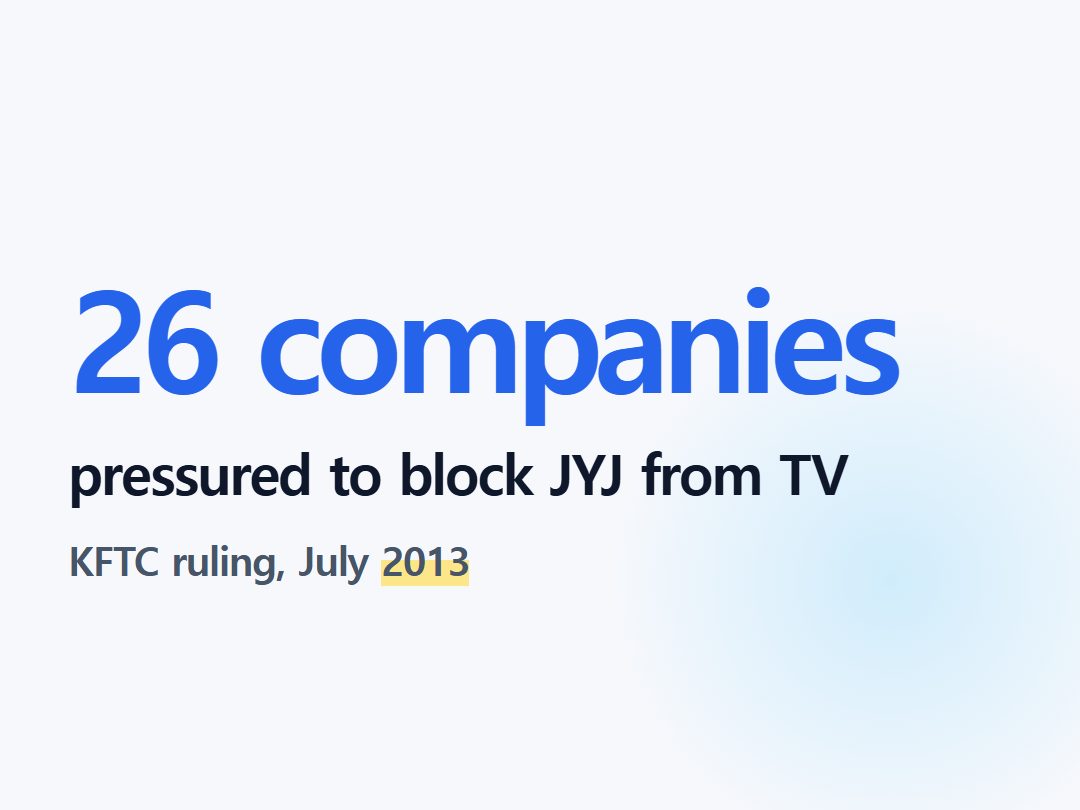
In July 2013, the KFTC ruled that SM Entertainment and the Korea Federation of Pop Culture and Arts Industry had pressured 26 companies — including broadcasters KBS, SBS and MBC, along with music distributors and cable channels — to restrict JYJ's appearances and album circulation (hellokpop). A petition supporting JYJ had gathered roughly 180,000 signatures from fans in 118 countries.
The “JYJ law” closed the broadcast loophole — eventually
The 2013 ruling did not immediately fix the problem. In 2015, lawmaker Choi Min-hee introduced an amendment to the Broadcasting Act specifically because broadcasters were still keeping JYJ off music shows despite the KFTC's order. The National Assembly passed the bill, nicknamed the “JYJ law,” in December 2015 (KpopStarz), allowing fines against broadcasters that unfairly exclude performers.
Even so, member Kim Junsu's return to a Korean terrestrial network did not happen until 2019 — a full decade after the original dispute began.
A cap that became a curse
The seven-year rule reshaped more than contract paperwork. Because most debut deals now run exactly seven years, that anniversary became the point where groups either re-sign or quietly stop working together. Fans and Korean media started calling it the “seven-year curse.”
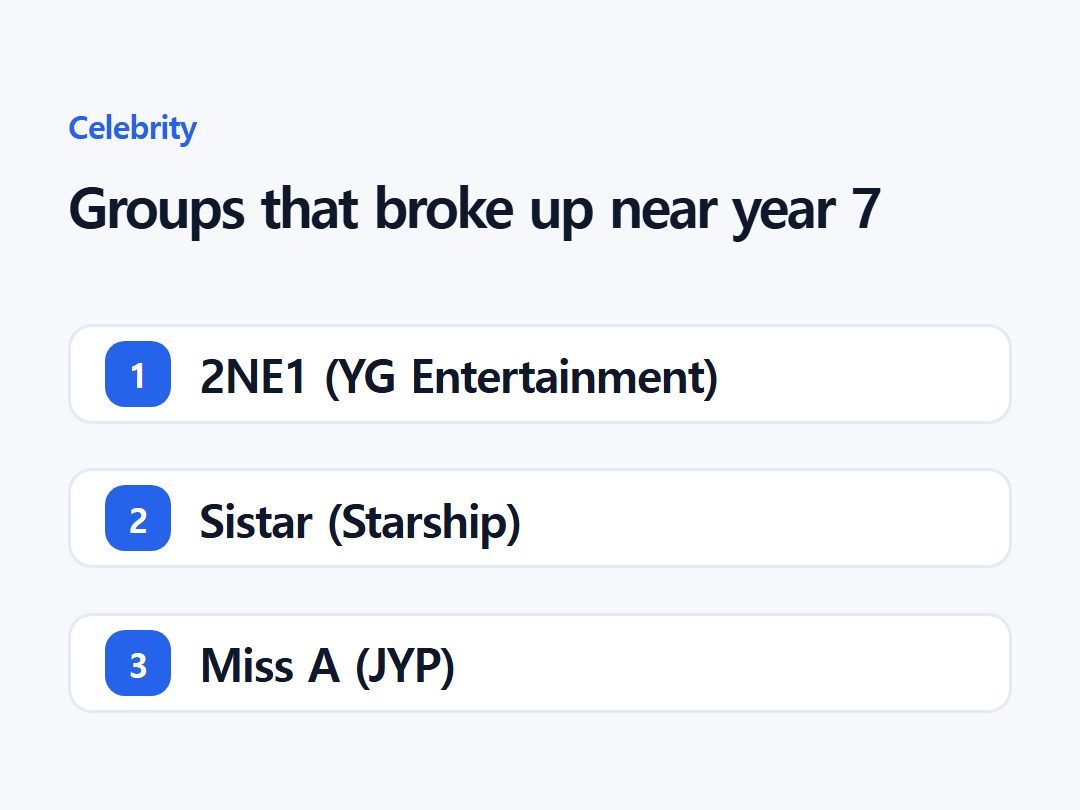
Several well-known groups broke up close to their seventh year, including:
- 2NE1, under YG Entertainment
- Sistar, under Starship Entertainment
- Miss A, under JYP Entertainment
More recently, groups such as Itzy, Tomorrow X Together and Ateez have renewed contracts past the seven-year mark, which industry commentators attribute to larger, more stable global fan bases that make continuing more profitable than disbanding (Korea Herald).
What the seven-year rule still doesn't fix
The standard contract capped duration, but it left the actual split of earnings between artist and agency for each company to negotiate — a gap critics say still favors agencies with more leverage.
It also carved out an exception: agencies and artists can agree to extend beyond seven years for international activities, which large companies with overseas touring schedules can use to keep the cap from applying in practice.
The broadcast-access problem the JYJ law targeted has also resurfaced. In March 2025, former EXO member Xiumin said he was blocked from appearing on KBS's music show after leaving SM, and both MBC and Mnet reportedly told him he could not appear during a comeback week — reviving the same allegations of network pressure that JYJ faced over a decade earlier (Korea Times).
Timeline: From Lawsuit to Reform
| Date | Event |
|---|---|
| July 7, 2009 | KFTC issues standard contract capping terms at seven years |
| July 31, 2009 | TVXQ's three members file injunction against SM Entertainment |
| October 2009 | Court allows the members to pursue outside activities |
| November 2009 | JYP becomes first agency approved to use the KFTC's template |
| February 2011 | Court dismisses SM's bid to block JYJ's new contract |
| November 28, 2012 | SM and JYJ reach a court-mediated settlement |
| July 2013 | KFTC rules SM pressured 26 companies to block JYJ |
| December 2015 | "JYJ law" passed to fine broadcasters that exclude performers |
| 2019 | Kim Junsu returns to a Korean terrestrial network |
Frequently asked
What is the seven-year rule in K-pop contracts?
It's a maximum contract length the Korea Fair Trade Commission set for entertainer contracts starting July 2009, after finding unfair clauses in nearly every agency contract it reviewed.
Did JYJ actually win their lawsuit against SM Entertainment?
No court ever issued a final verdict; SM and JYJ settled in November 2012, agreeing their contract had effectively ended back on July 31, 2009.
Why couldn't JYJ appear on Korean TV after leaving SM?
The KFTC found in 2013 that SM had pressured 26 broadcasters and distributors, including KBS, SBS and MBC, to restrict JYJ's appearances even after the group won its case.
Sources
Every factual claim above is traceable. We do not translate articles — we gather facts from multiple outlets and write them ourselves.
- Unfair terms found in trainee/artist contracts of 230 entertainers at 20 agencies — Korea.kr (Ministry of Culture, Sports and Tourism policy briefing)
- Court rules in favor of JYJ in a dispute with SM Entertainment — The Korea Herald
- Is the 'seven-year itch' a thing of the past? — The Korea Herald
- K-pop stars punished by unfair contracts — The Korea Times
- Calls Growing for Overhaul of Showbiz Slave Contracts — The Korea Times
- Fair Trade Commission orders SM Entertainment to lift broadcast ban on JYJ — hellokpop
- Korean National Assembly Passes 'JYJ Law' To Prevent Broadcast Bans — KpopStarz
- JYJ, SM Entertainment settle to end 3-year legal dispute — Korea Observer
- SM faces renewed allegations for blocking former artists' TV appearances — The Korea Times