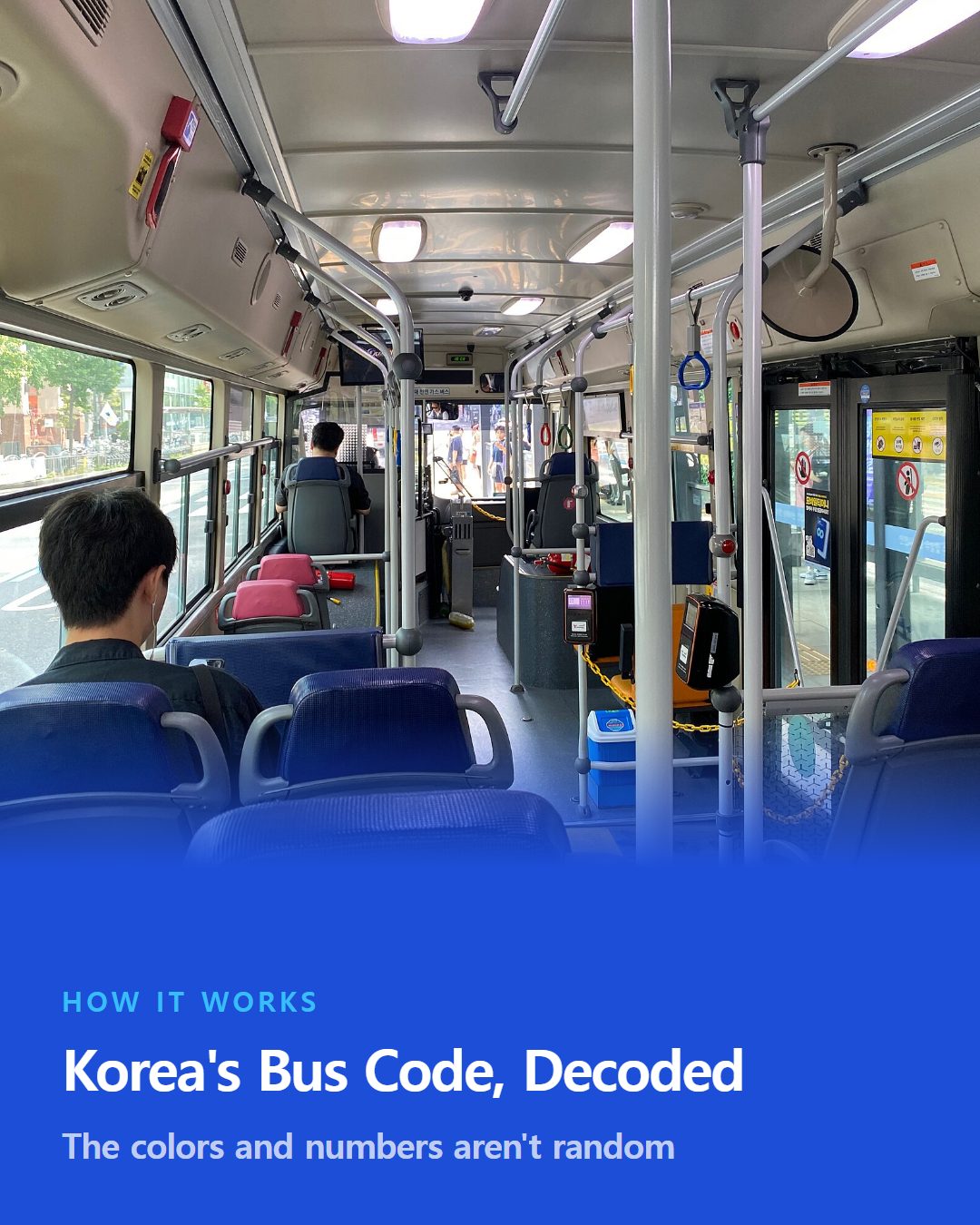
Step off a plane in Seoul and the bus stop looks like sensory overload: buses in four different colors, route numbers with two to four digits, and a card reader that beeps twice — once getting on, once getting off. None of it is random.
The short version
- Bus color signals range: blue trunk, green branch, red express, yellow loop.
- A trunk bus's number encodes its start and end zone, not random.
- Skip the second tap and your next ride bills as a brand-new trip.
Every color, every digit, and that second beep are part of a routing and fare system Seoul spent years engineering on purpose. Korean commuters read it without thinking twice. Here is what they actually know that visitors don't.
The color tells you the bus's job, not just its route
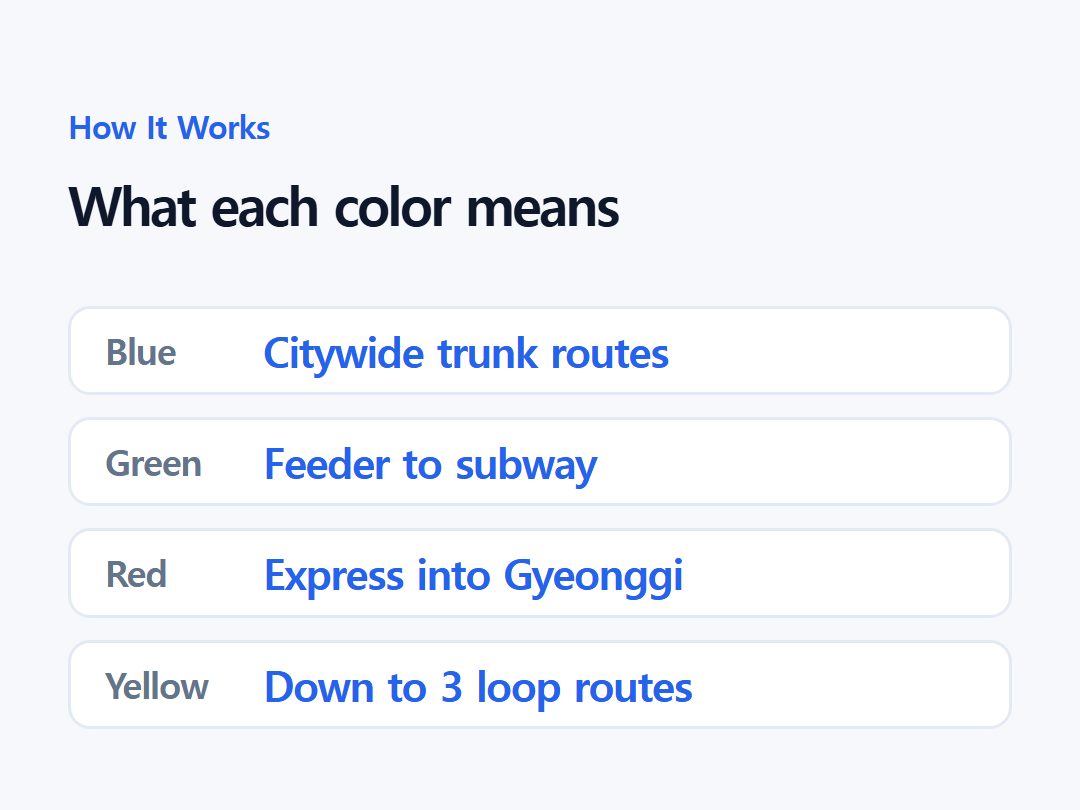
Seoul's city buses come in four colors, and each one signals a range, not just a paint job. Blue buses are trunk routes (간선버스, gansun-beoseu) that cross the whole city, often running in center-lane, bus-only corridors. Green buses are branch routes (지선버스), shorter feeders built to connect neighborhoods to the nearest subway station.
- Blue — trunk routes, citywide, three-digit numbers
- Green — branch routes, feed subway stations
- Red — express routes into Gyeonggi Province, higher fare
- Yellow — downtown loop routes, now down to three
Red buses connect Seoul to satellite cities, built for highway speed with fewer stops. Yellow buses were meant to loop through downtown business districts, but that category has nearly disappeared — only three routes still circle Namsan mountain.
Decoding a route number the way locals do
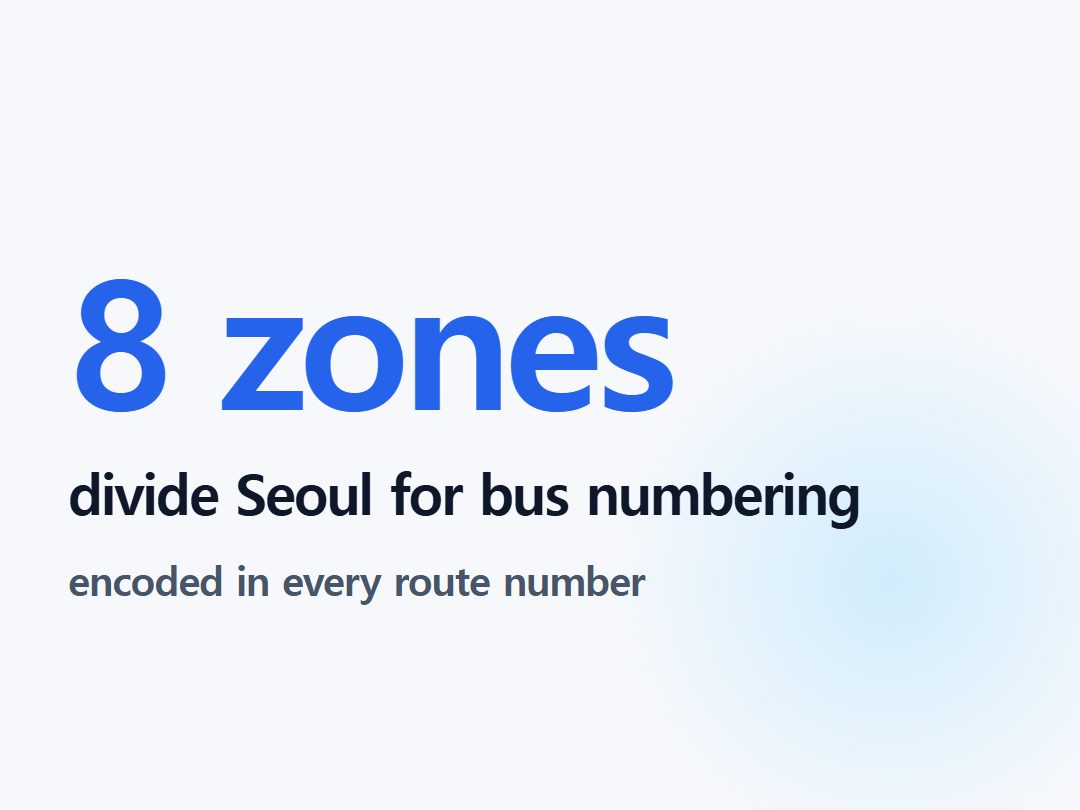
Seoul is divided into eight numbered zones, 0 through 7, arranged clockwise from the city center outward. A trunk bus's number encodes its own journey: the first digit is the zone it starts in, the second is the zone it ends in, and the last digit is just a serial number for that pair.
Bus 721 starts in zone 7 (Eunpyeong, Mapo, Seodaemun) and ends in zone 2 (Dongdaemun, Jungnang, Seongdong, Gwangjin). A resident doesn't memorize a route map — they decode the number on sight.
| Color | Digits | Example |
|---|---|---|
| Blue (trunk) | 3 | 721 |
| Green (branch) | 4 | 5714 |
| Red (express) | 4, starts with 9 | 9401 |
| Yellow (loop) | 2 | 02 |
Three more categories the four colors don't cover
Below the main four colors sit categories most visitors never learn to spot, each solving a gap in the main network.
- Village buses (마을버스) — small, two-digit routes run by local operators through streets too narrow for a full-size bus
- M-buses — nonstop express routes linking outer Gyeonggi towns directly to central Seoul
- Owl buses (N-buses) — nine night routes running roughly midnight to 4 a.m., when subways and regular buses have stopped
The Owl Bus routes weren't drawn up by committee. Seoul built them in 2013 using cell-tower location data licensed from telecom carrier KT, mapping where late-night demand actually clustered rather than guessing.
Why one fare card erases the line between bus and subway
The part that actually confuses visitors isn't the color — it's the fare. Korea's T-money smart card treats a bus-then-subway trip, or any combination of up to five rides, as one continuous journey rather than several separate fares.
The system charges for total distance traveled, not per boarding. A base fare covers the first 10 km; each additional 5 km up to 50 km adds about 100 won, and each additional 8 km beyond that adds another 100 won. Switch modes within 30 minutes — 60 minutes overnight — and the next leg only ever costs the difference.
The one rule visitors always break
On the subway, you tap once entering the turnstile and once exiting. On a bus, you have to tap twice: once boarding at the front, once again at the back door before you step off.
Skip that second tap and the system has no way to calculate your distance or register a transfer. The next ride gets billed as a brand-new trip — the single most common way visitors end up paying more than they expected.
Before 2004, switching between bus and subway cost double
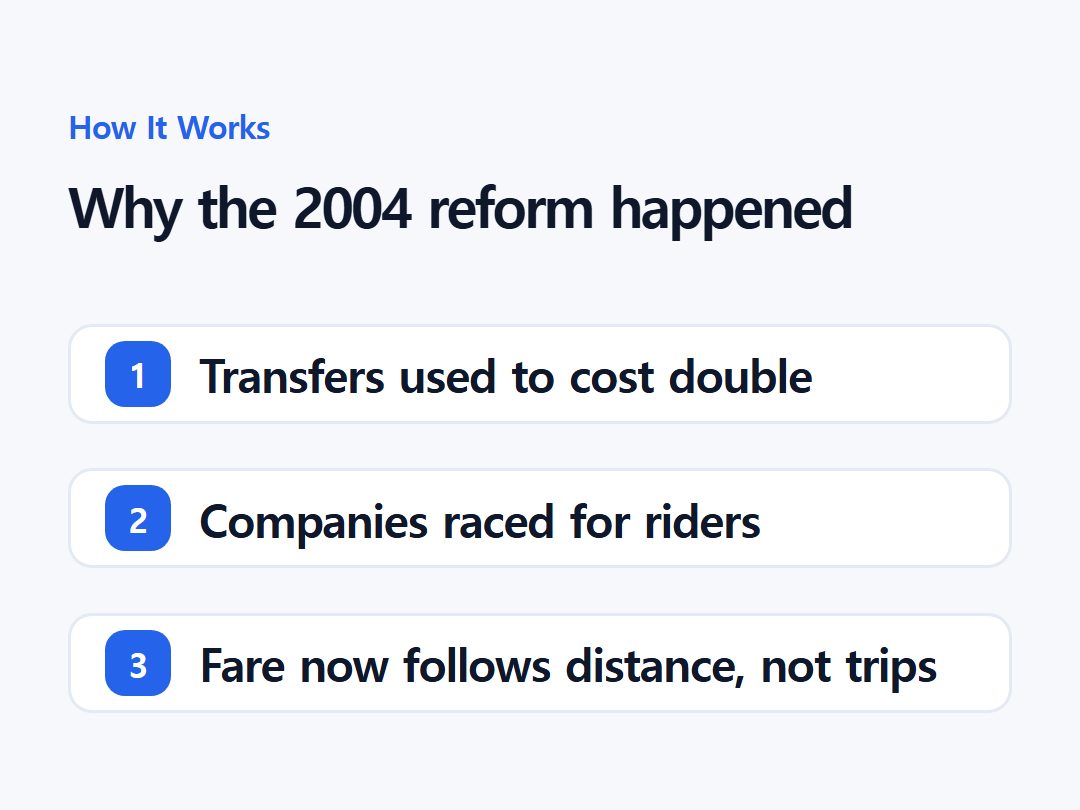
None of this existed before July 2004. Seoul's bus network used to be run entirely by competing private companies, each free to design its own routes and set its own pace — drivers were known to speed and cut off rivals to reach fare-paying passengers first on profitable corridors, while quieter routes were neglected.
There was no shared card between bus and subway operators, so a rider connecting from one to the other paid full fare twice. Roughly 400,000 daily commuters from Gyeonggi Province were shut out of any transfer discount entirely.
A mayor's traffic pilot became a citywide overnight switch
Seoul Mayor Lee Myung-bak, later President of South Korea, made bus reform his flagship city policy, testing it on a single corridor in 2003 before flipping the entire network on July 1, 2004. Rides were free that day so people would try the new system without hesitation.
The reform bundled three changes at once: buses moved into center-lane corridors instead of curb lanes clogged by illegal parking, operators shifted to a semi-public model where the city pools fare revenue and pays companies by distance driven rather than passengers carried, and the T-money integrated fare launched to end double-charging.
The result was measurable within months. On the pilot corridor tested a year earlier, average bus speed nearly doubled — from 11 km/h to 22 km/h — once buses moved out of general traffic and stopped weaving between lanes to compete for passengers.
Keeping fares low is now the city's biggest transit bill
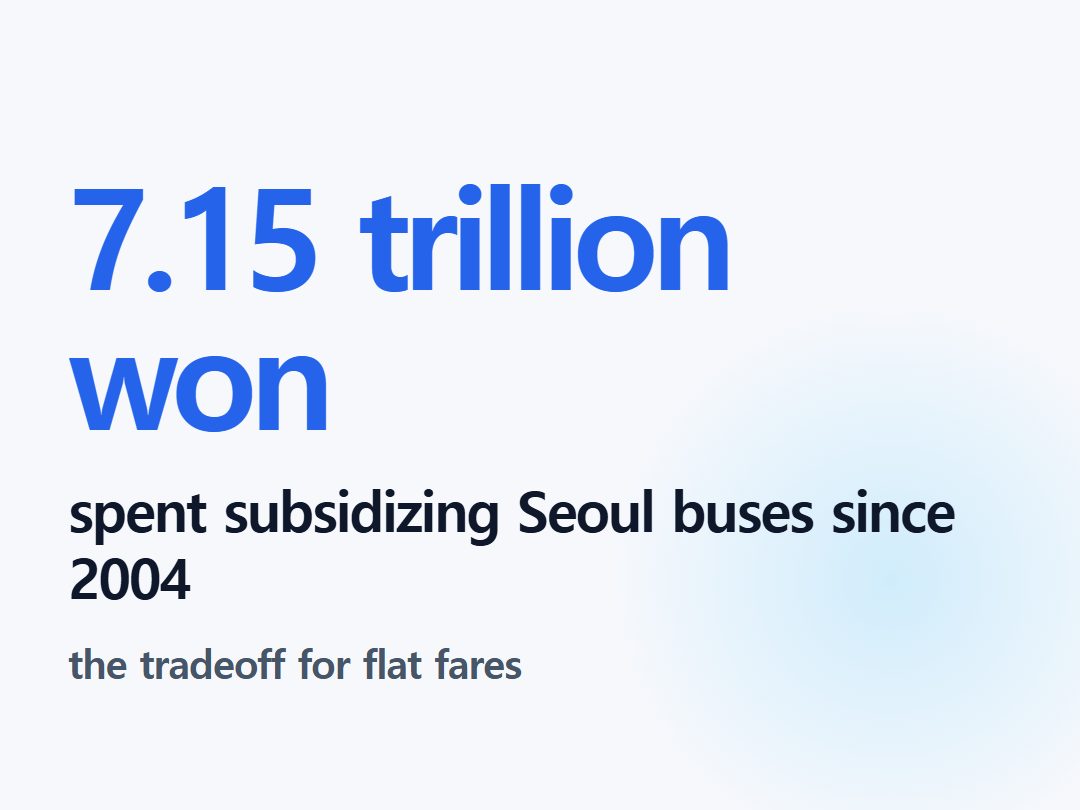
The semi-public model fixed the coordination problem, but it created a new one: because the city covers the gap between fare revenue and operating costs, operators carry little built-in incentive to control spending. Seoul's cumulative deficit subsidies for city buses reached 7.148 trillion won from mid-2004 through 2025.
Driver labor costs more than doubled over that period, rising 107.9% since 2004 versus 78.6% for the average industry worker.
A 2025 Supreme Court ruling added fresh pressure by requiring that regular bonuses count as ordinary wages. Seoul estimates the resulting pay hike alone could add roughly 200 billion won a year to an already record subsidy bill — a dispute that fed into a citywide bus strike ahead of local elections before wage talks were settled.
Ridership keeps falling even as subsidies climb
Average daily bus ridership fell 19% over the decade from 2014 to 2024, from 4.57 million passengers to 3.73 million. Village buses lost even more ground, dropping a third over the same stretch.
Over 92% of Seoul's bus routes now operate at a loss, up from 85% in 2012, while the city still runs more than a thousand buses beyond what current demand would justify. Seoul answered by shifting, starting in 2026, from covering deficits after the fact to a pre-set budget model meant to give operators an actual reason to cut costs.
What the four-color map no longer shows
The color system every guidebook teaches is already partly out of date. Yellow loop buses, once meant to circle every major business district, have shrunk to three routes — a category that exists more in tourist explainers than on the street.
The routing logic and the distance-based fare have held up since 2004. Whether the financing model underneath them survives its own math, without another round of fare increases, is the part Seoul is still working out.
How the T-money distance fare climbs
| Distance traveled | Fare change |
|---|---|
| First 10 km | Base fare |
| Next 10–50 km, every 5 km | +100 won |
| Beyond 50 km, every 8 km | +100 won |
Frequently asked
What do the different colors of Seoul buses mean?
Blue buses run citywide trunk routes, green buses are shorter feeders into subway stations, red buses are express routes into Gyeonggi Province, and yellow buses are downtown loop routes now down to just three.
Why do you have to tap your card twice on a Seoul bus?
You tap once boarding at the front and again at the back door before exiting; skipping that second tap means the system can't calculate your distance or register a transfer, so the next ride gets billed as a brand-new trip.
Does switching from bus to subway cost extra in Seoul?
No — T-money treats up to five rides within 30 minutes (60 overnight) as one continuous journey and charges only for total distance, so the next leg only ever costs the difference.
Sources
Every factual claim above is traceable. We do not translate articles — we gather facts from multiple outlets and write them ourselves.
- Bus System in Seoul and Korea — Kojects
- Integrated Distance-based Fare System — Seoul Solution (Seoul Metropolitan Government)
- Reforming Public Transportation in Seoul — Seoul Solution (Seoul Metropolitan Government)
- 숫자에 숨겨진 비밀을 찾아봐! (feat. 서울 버스와 지하철) — Seoul Metropolitan Government Media Hub
- Bus fares in Seoul to rise to 1,500 won; subway to 1,400 won — The Korea Herald
- Seoul bus ridership drops 19% in 10 years even as city spends billions in subsidies — The Korea Herald
- Seoul Bus Labor Costs Double in 20 Years, Fueling Calls to Reform Semi-Public System — Seoul Economic Daily
- Seoul City overhauls bus system after 20 years: routes reorganized, subsidy structure reformed — The Korea Times
- Travel Safely Around the City Even at Night With Seoul's "Owl Bus" — Seoul Metropolitan Government