Every idol's 6 a.m. call time, every airport dash, every late-night practice room run — someone else is driving, scheduling, and paying for it before the artist even wakes up. That someone is a manager, and outside Korea almost nobody knows what the job actually pays — or how differently it is structured from the version most international fans assume.
The short version
- Entry-level road managers earn about $885–$1,327 a month, near minimum wage.
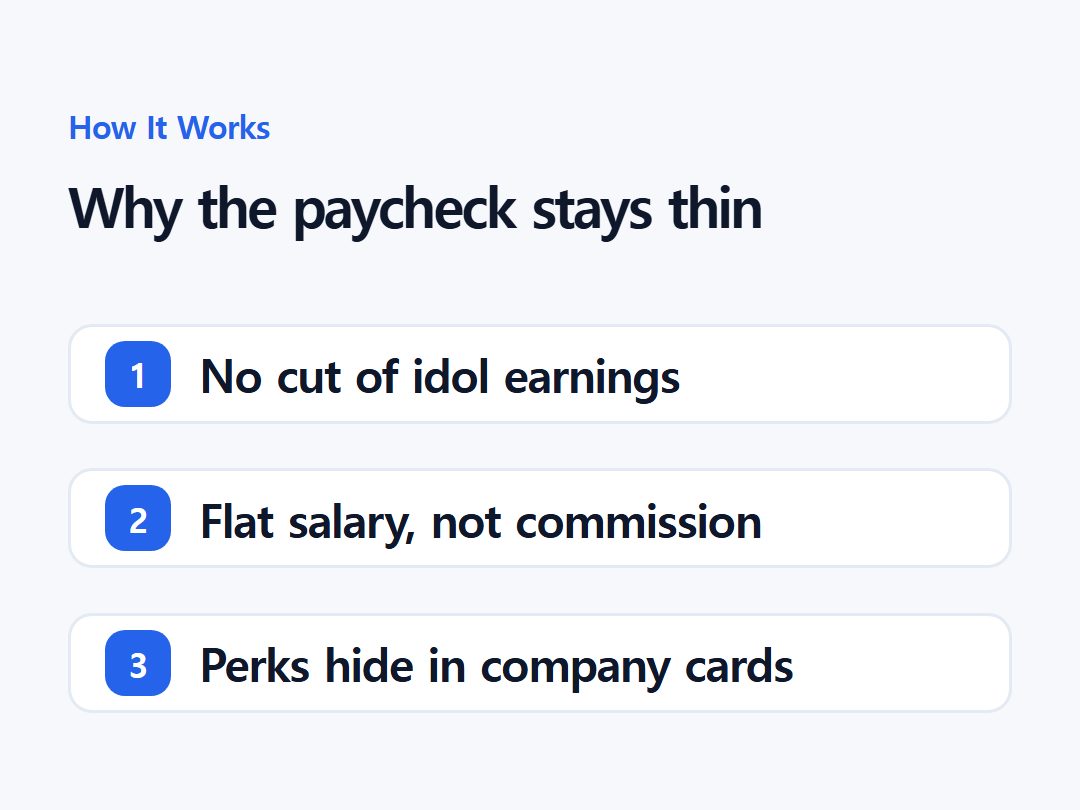
- Managers take no cut of an idol's earnings — pay is a flat salary.
- A 2022 audit found 24.1% of road managers worked over 52 hours weekly.
The job behind every idol's day
In the US and UK, an artist manager is usually an independent operator who takes a cut of an artist's earnings. In Korea, a manager is an employee of the agency — hired, salaried, and ranked like staff at any ordinary company.
The role covers driving, scheduling, luggage, meals, and the small emergencies that come with putting a person in front of cameras dozens of times a month, so the artist has to think about none of it.
A three-tier ladder, not a straight climb
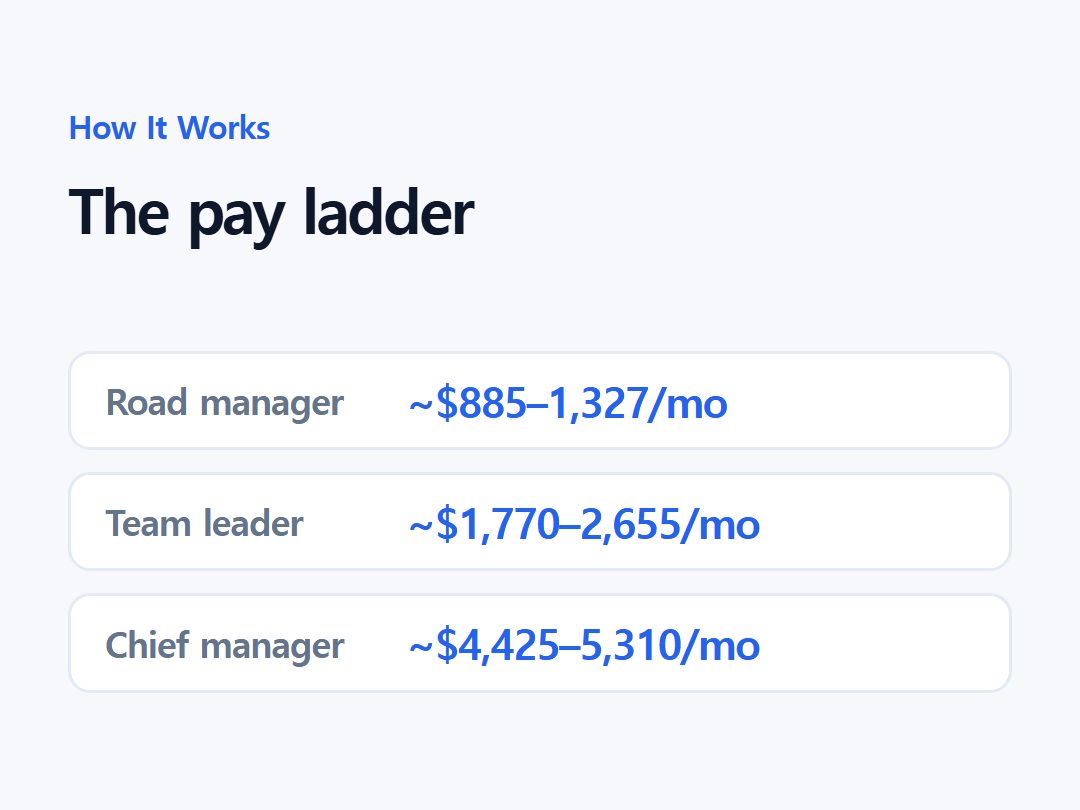
Korean entertainment agencies generally run managers through three ranks, according to industry references compiled on Korea's Namu Wiki encyclopedia.
- Road manager (로드매니저) — daily driving, scheduling, and on-site logistics
- Team leader / chief manager (팀장·치프매니저) — supervises junior staff, gains scheduling authority
- Executive manager (실장급) — negotiates appearance fees and contracts
Only the top rank starts to resemble what a Western manager does. Everyone below that is closer to operations staff than to a business representative.
Road managers often start at minimum wage
A 2018 JTBC segment profiling celebrity managers put entry-level road manager pay at roughly 1 million to 1.5 million KRW a month — about $885 to $1,327 at the time.
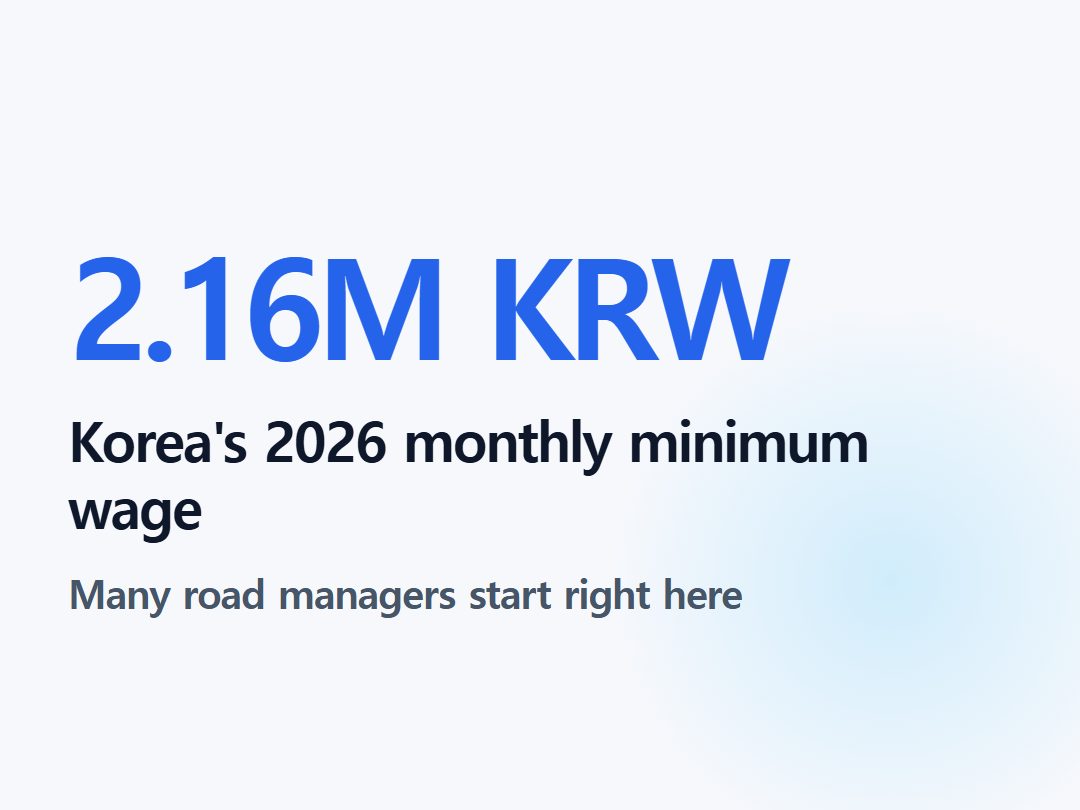
That range sits close to Korea's current minimum wage. The rate rose to 10,320 KRW per hour for 2026, according to the Ministry of Employment and Labor, which works out to 2,156,880 KRW a month for a standard 40-hour week. Several Korean industry write-ups place newer hires' starting pay in the same narrow band.
Road managers are known inside the industry for four hours of sleep during comeback weeks — hours a flat minimum-wage rate was never designed to absorb.
Pay has still climbed over time. Industry accounts of the profession describe entry-level pay roughly tripling over the past decade, from around $500–$700 a month ten years ago to today's $1,000–$1,500 range at many agencies — real progress that still leaves new hires clustered near the legal floor.
The company card matters more than the paycheck
Base pay alone undersells the job, because so much of a manager's daily cost is absorbed by the agency rather than the manager's own salary.
Former managers Baek Kyung Jae and Nam Yoon Jae, speaking to Koreaboo about their years in the industry, said agencies typically hand over a company card for fuel, meals, and emergency purchases during promotions, along with a company vehicle.
Nam said he was "never stressed and struggled because of money" specifically because of that card, despite an official salary he considered too low for the hours worked.
Without those benefits, both men said, the base pay alone would not have added up to a living wage.
Pay climbs slowly, and only with rank
Promotion is where the numbers start to move. The same JTBC report put team leaders at roughly 2 million to 3 million KRW a month (about $1,770–$2,655), and chief managers at 5 million to 6 million KRW (about $4,425–$5,310).
A 15-year manager for comedian Park Myung Soo, cited in the same segment, said his pay had reached 6 million to 8 million KRW a month — without a separate transportation allowance, since the company car already covers that. Reaching that level takes over a decade.
The paycheck also depends on the agency's size
Ministry of Employment and Labor findings on the industry pointed to underfunded subcontracting arrangements and resource constraints as a driver of poor conditions at smaller operators, distinct from the specific violations found during its audit of larger agencies.
Large agencies increasingly issue corporate cards for fuel and meals and apply Korea's four mandatory social insurance programs alongside severance pay and paid leave. Smaller agencies, the same reporting found, often still don't — so two road managers with identical titles can end up with very different real income.
Why Korean managers don't take a cut of an idol's earnings
This is the structural difference international fans usually miss. In the US and UK, a talent manager typically earns 15% to 20% of an artist's gross income, a commission that rises and falls with the artist's success, according to industry guides on artist-management agreements.
A Korean idol's manager earns none of that. The manager is paid a flat company salary regardless of how a comeback performs, because the agency — not the manager — holds the contract with the artist and captures the upside.
That is also why a manager's income depends far more on rank and years at the company than on which artist they happen to be assigned to. A road manager driving a chart-topping group and one driving a rookie act are, on paper, paid the same.
A 2022 labor inspection found what agencies don't advertise
The gap between the job's demands and its pay has drawn government attention. A Ministry of Employment and Labor inspection covering entertainment agencies and styling companies, reported by Nocutnews, found 12 labor law violations at the two agencies it audited, including unpaid overtime and missing written employment contracts.
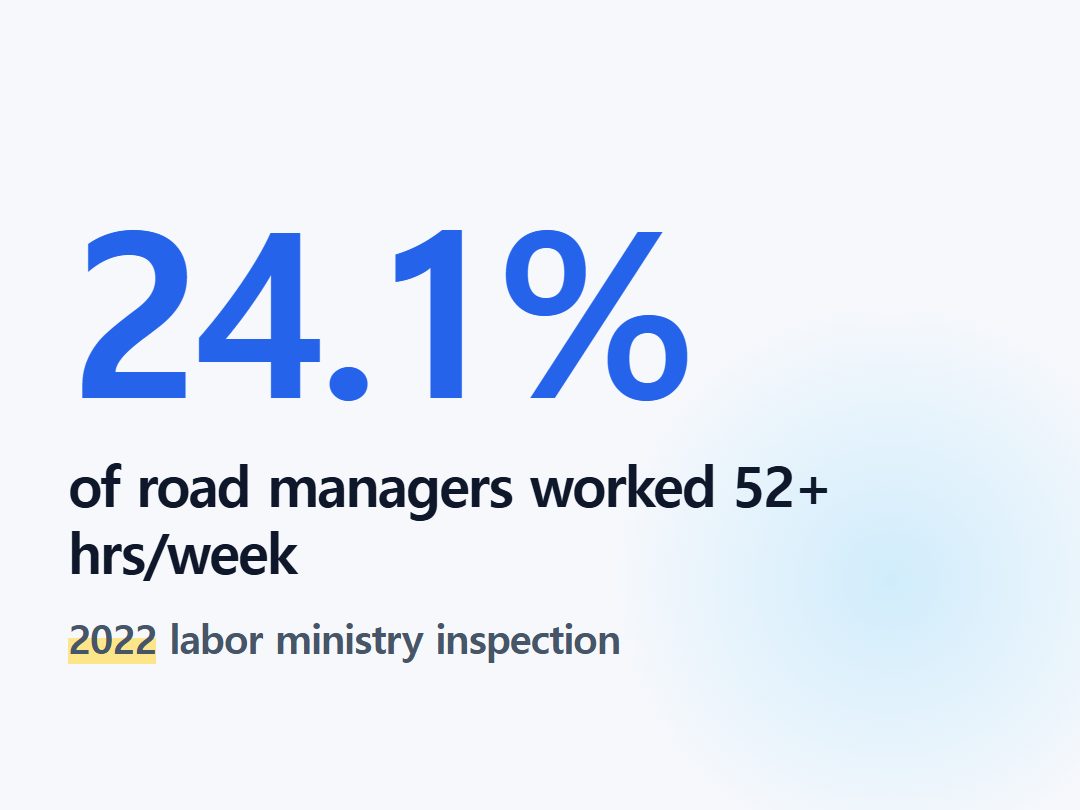
The same inspection found that 24.1% of road managers had worked more than 52 hours in a week — Korea's statutory weekly cap — and that some were operating without a signed contract at all.
A companion survey of 69 industry workers found harassment reports were far less common among road managers (1.9%) than among stylists on the same productions, where the rate topped 20%.
Even by the industry's own low bar, the road-manager track looked comparatively more structured than the support roles working alongside it.
What "passion pay" still means
Baek Kyung Jae and Nam Yoon Jae both pointed to $4,000 a month as a symbolic ceiling that road-manager-track staff rarely reach quickly.
"It's not that you can never get $4,000 USD a month, but that's a salary you can get when you work for 10 to 15 years," Baek said. Nam compared that figure to what "a general manager at a large company receives" — an ordinary benchmark salary in most white-collar fields, not a rare one.
Both men eventually left the industry. Their accounts echo a broader pattern in Korean coverage of the profession: the hours are treated as a given, and the pay is treated as something you eventually grow into rather than something the job is worth from day one.
The gap between the stage and the paycheck
None of this touches idols' own exclusive contracts with their agencies, which are a separate and far more publicly scrutinized system. Managers are staff, not the featured talent, and their pay reflects that distinction more than most fans realize.
For an international audience used to a manager who profits when their client does, the Korean model runs almost in reverse: the person arranging every hour of an idol's day is paid nearly the same whether that day ends in a chart record or a quiet rehearsal.
Korean idol manager pay by rank
| Rank | Monthly Pay (KRW) | Monthly Pay (USD approx.) |
|---|---|---|
| Road manager (entry-level) | 1,000,000–1,500,000 | $885–$1,327 |
| Team leader | 2,000,000–3,000,000 | $1,770–$2,655 |
| Chief manager | 5,000,000–6,000,000 | $4,425–$5,310 |
| 15-year veteran manager | 6,000,000–8,000,000 | — |
Frequently asked
How much does a K-pop manager make?
Entry-level road managers start around 1–1.5 million KRW ($885–$1,327) a month, while chief managers earn 5–6 million KRW ($4,425–$5,310), and veterans of 15+ years can reach 6–8 million KRW.
Do Korean managers get a percentage of an idol's earnings?
No. Unlike US/UK managers who typically earn 15% to 20% of an artist's income, Korean managers are salaried employees of the agency and are paid a flat rate regardless of how a comeback performs.
What is the highest-ranking manager role at a K-pop agency?
The executive manager (실장급) is the top tier, the only rank that negotiates appearance fees and contracts, resembling a Western-style manager more than the road manager or team leader roles below it.
Sources
Every factual claim above is traceable. We do not translate articles — we gather facts from multiple outlets and write them ourselves.
- How Much K-Pop Idols' Managers Make In A Month Will Shock You — Koreaboo
- K-Pop Idol Managers Comment On Their Salary And Just How Little They Get Paid — Koreaboo
- 매니저 (Manager) — Namu Wiki
- 화려한 연예인들에 가려진 매니저·코디…"근로계약서도 없이 일해요" — Nocutnews
- 2026년 적용 최저임금 시간급 10320원 — Ministry of Employment and Labor
- Understanding Artist Management Agreements, Part 3: How Are Managers Paid, and How Much? — Sonicbids