
In 2026, a K-pop agency's "legal update" post reads like a routine memo: a count of people sued, a range of fines, a line promising "no settlement, no leniency." A move that used to appear once after a bad news cycle now shows up almost every quarter.
The short version
- Korean agencies now file dozens to hundreds of complaints in one announcement.
- Online insults are criminal cases in Korea, not private civil lawsuits.
- Fines typically run ₩200,000 to ₩7 million per case.
The shift isn't image management. It reflects a specific, criminal legal tool that Korean agencies have learned to use at volume.
For fans outside Korea, the confusing part is the scale. These aren't isolated lawsuits against one obsessive stalker — they are dozens or hundreds of cases filed in a single announcement, often against people who assumed a comment on X or a fan cafe post was too small to matter.
A one-year snapshot of who is suing whom
Between September 2025 and August 2026, at least six major acts filed or reported criminal complaints over online posts.
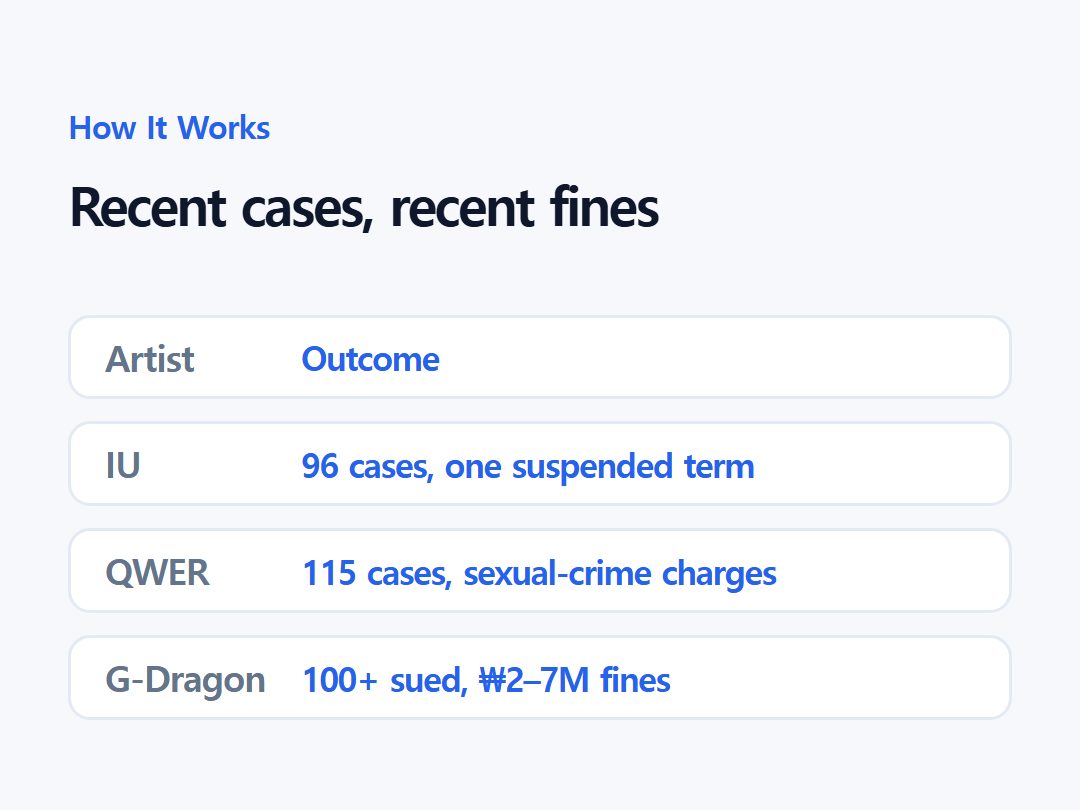
- IU's agency EDAM Entertainment disclosed 96 legal cases from 2025, resulting in multiple fines and one suspended prison sentence
- QWER's agency filed complaints over 115 posts, some charged under sexual-crimes statutes rather than ordinary insult law
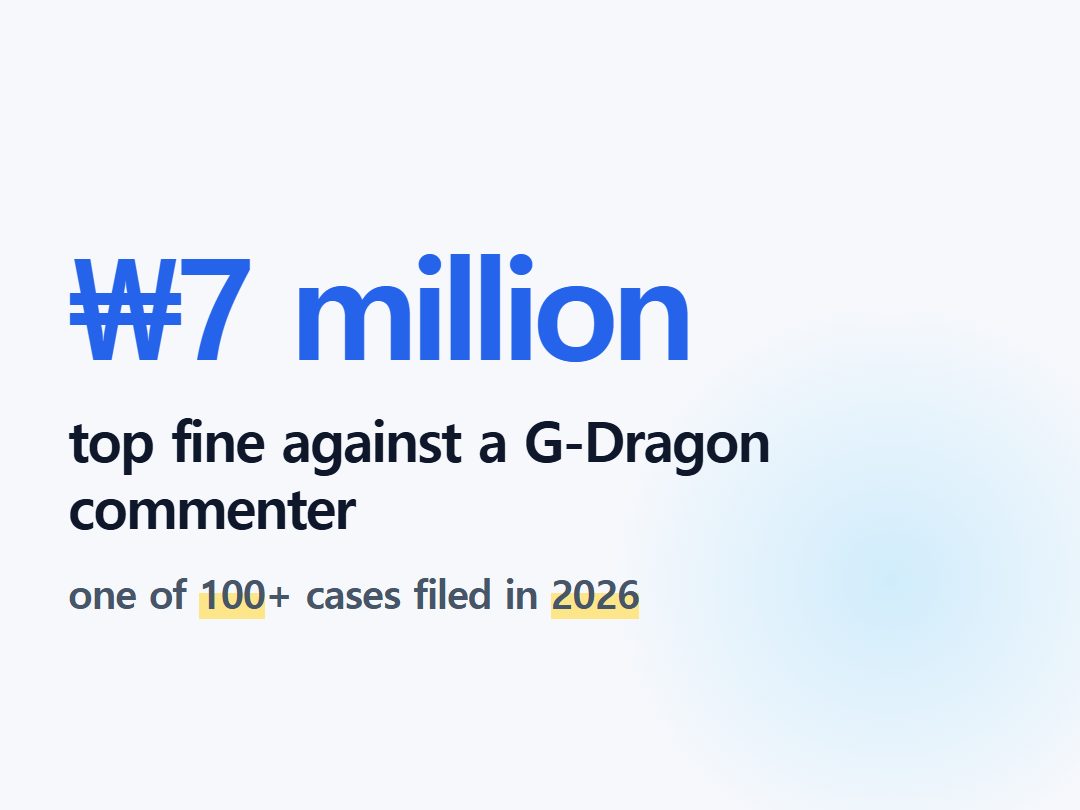
- G-Dragon's agency, Galaxy Corporation, sued more than 100 people in February 2026; by August, courts had issued fines of ₩2 million to ₩7 million (roughly $1,500–$5,300)
- Park Bo Gum's agency, The Black Label, reported a ₩2 million fine against one commenter and a second case forwarded to prosecutors
BigHit Music, BTS's label, now issues a quarterly legal report covering everything from stalking to online insults, stating it pursues cases with "no settlement or leniency."
Insulting a celebrity is a criminal case in Korea, not a private lawsuit
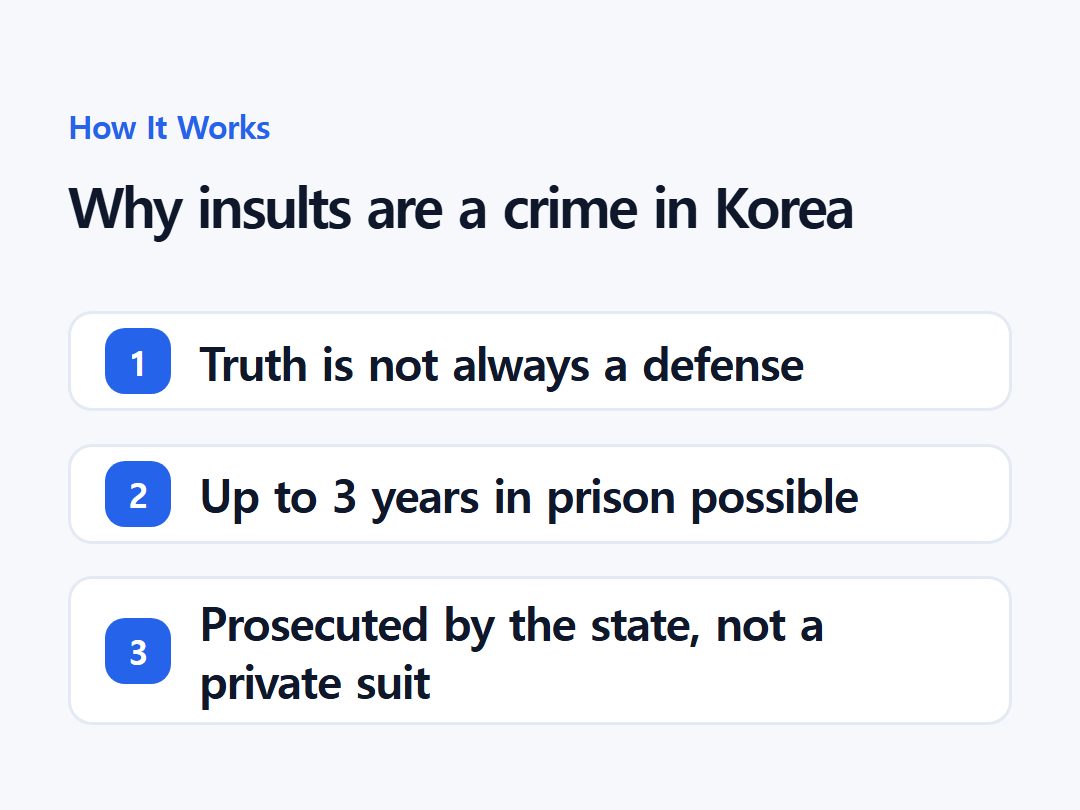
Agencies can do this at scale because of how Korean law treats online reputational harm. Under the Act on Promotion of Information and Communications Network Utilization — usually called the Information and Communications Network Act — damaging someone's reputation online is a criminal offense that police and prosecutors handle, not a civil claim a celebrity has to fund alone.
The law punishes online defamation with up to three years in prison or a ₩30 million fine — even when the statement is true, if it damages the person's social standing. If the statement is false, the maximum rises to seven years or ₩50 million. A separate, older insult provision in the Criminal Act covers abusive comments that don't assert specific facts at all.
This is a sharper instrument than what most international fans have at home, where celebrity defamation usually means a slow, expensive civil suit the star has to bring personally. In Korea, a single police report can open a criminal file.
Why a warning letter turned into a ₩7 million invoice
Most of these cases never reach a public trial. Korean courts routinely resolve minor offenses through a "summary order" (약식명령) — a fine issued on the paperwork alone, without a courtroom hearing, once investigators have built a file and the defendant doesn't contest it.
That process explains why fines cluster in a specific range. A single insulting comment might draw ₩200,000–500,000. Repeated, targeted posts — the kind agencies compile into a case file — push into the millions of won. Busan prosecutors sought fines of ₩200,000 to ₩700,000 in NewJeans-related cases over doctored images, while one IU-related case brought a ₩3 million fine over four comments.
Because the process is cheap and fast for prosecutors, agencies can file dozens of complaints at once instead of picking a single high-profile example to make a point.
Fans get charged too, not only anonymous trolls
International fans often assume these complaints target obvious "anti" accounts or professional rumor channels. Some cases complicate that picture. QWER's complaints, filed under sexual-crimes statutes rather than ordinary insult law, reportedly reached posts originating inside fan spaces, not only from hostile outsiders.
Agencies describe this as content-based enforcement: a post becomes prosecutable because of what it says, regardless of whether the account posting it also follows the group. For readers used to fandom being treated as reflexively supportive, it's a reminder that Korean agencies now draw the line at specific conduct, not group membership.
A court ruling that covers even a virtual idol's avatar
The clearest sign of how far this legal logic extends involves PLAVE, a virtual idol group performed by real people behind digital avatars. A district court ordered a commenter to pay ₩500,000 for insulting the group's virtual members — establishing that abuse aimed at an avatar counts as abuse aimed at the performer behind it.
That precedent reaches beyond one group. It signals Korean courts are willing to extend defamation and insult protections to newer performance formats as the industry experiments with virtual idols and digital personas.
How Sulli's death made "malicious comment" a policy problem
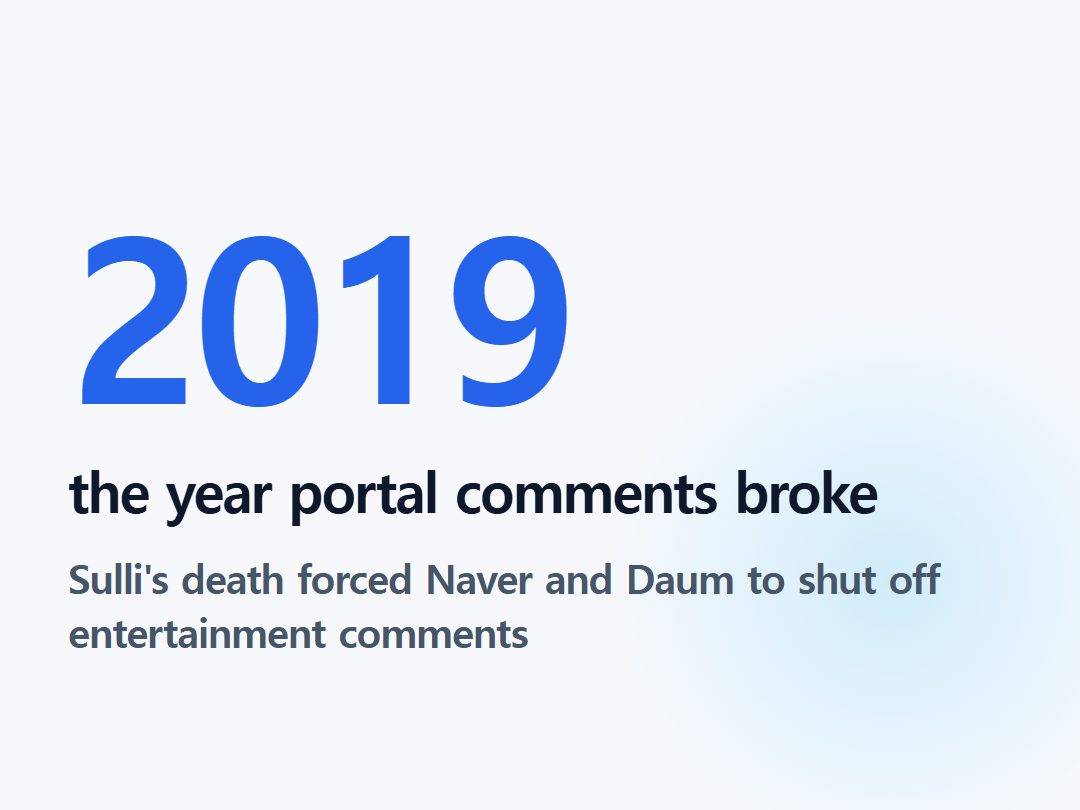
None of this was standard practice a decade ago. The shift traces to October 2019, when singer and actress Sulli (Choi Jin-ri) died after years of documented online harassment. Within weeks, portal Daum shut off comments on its entertainment news section.
Naver followed in March 2020, and Nate in July 2020, removing comments from the country's three biggest news portals entirely. A Korea Press Foundation survey that December found 85% of respondents supported the shutdown. For a few years, closing the comment box was the industry's main answer to online abuse.
Comments didn't disappear — they moved somewhere agencies could trace them
Closing portal comments didn't end the abuse; it relocated it. Industry sources have since said abuse aimed at artists' personal social media and agencies' own posts increased once portal comment sections went dark, because that traffic needed somewhere else to land.
That relocation mattered legally. A comment on an artist's own Instagram post or inside a fan community is easier to screenshot, timestamp, and trace back to an account than one buried in an old portal comment thread — part of why agencies pivoted from blocking access to filing complaints.
The 2024 lawsuit that proved the tactic could scale
One case reset expectations about what agencies would pursue. In 2024, Starship Entertainment sued the YouTube channel "Sojang," seeking Google's cooperation to identify the anonymous account behind years of unverified claims about its artists.
By industry accounts, it was an unusually determined pursuit of one large anonymous channel rather than a scattershot list of small commenters. It functioned as a proof of concept: platforms could be compelled to hand over identifying data, and a channel with a large following was not too big to sue.
The mass complaints seen through 2025 and 2026 — 96 cases here, 115 there, 100-plus elsewhere — apply that same logic at volume.
What agencies admit the strategy still can't fix
Agencies describe legal action as damage control, not prevention. As one industry source put it, lawsuits can only begin after content is already written, shared, and read — the harm happens first, and the case follows.
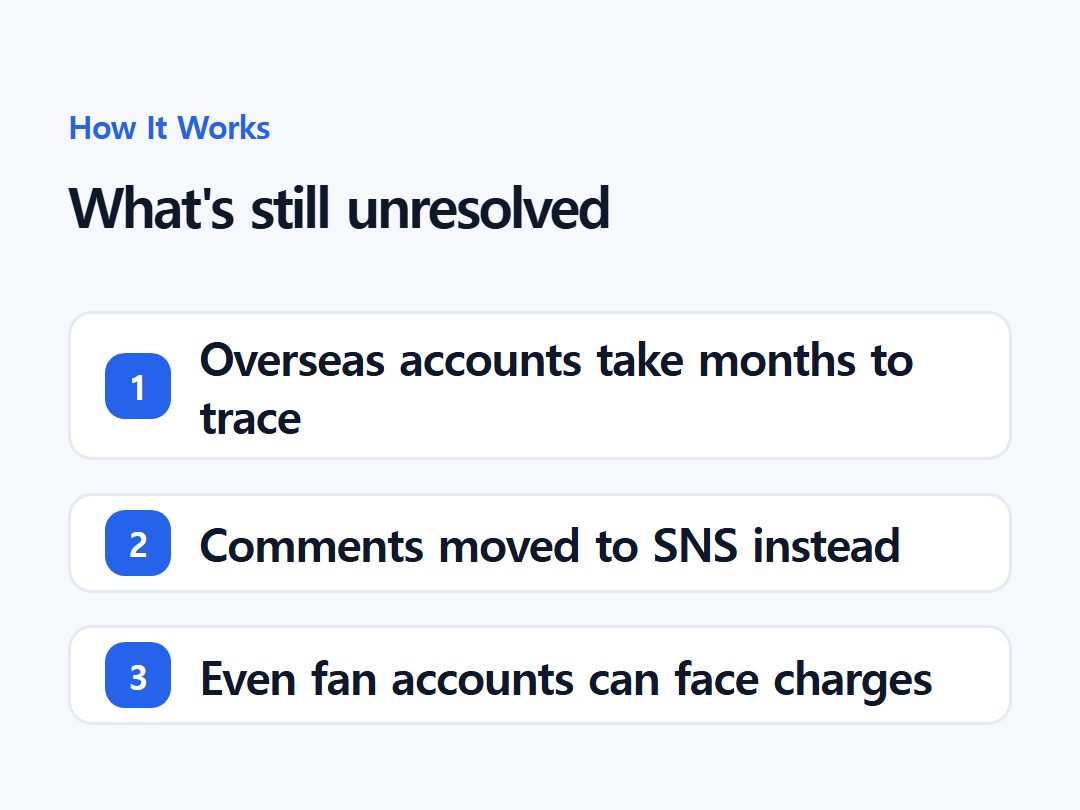
- Cross-border enforcement is the weakest point: getting account data from overseas platforms can take months
- Hybe's pursuit of an international poster through subsidiary label Belift Lab was notable specifically because it's still rare
- Most "zero tolerance" statements carry an unstated asterisk — reach still ends at the border in practice
Whether more fines actually mean less abuse
What's left unclear is whether prosecuting individuals one fine at a time changes the volume of abuse, or simply changes who eventually pays for it. Agencies keep filing because the law makes filing straightforward and inexpensive compared with a defamation trial abroad.
Whether ₩200,000–₩7,000,000 fines meaningfully deter the next commenter is a question none of these agencies has answered with data — only with more complaints.
K-pop agencies' legal actions against fans and trolls, 2025–2026
| Artist / Agency | Cases Filed | Outcome |
|---|---|---|
| IU (EDAM Entertainment) | 96 cases (2025) | Multiple fines, one suspended prison sentence |
| QWER | 115 posts | Some charged under sexual-crimes statutes |
| G-Dragon (Galaxy Corporation) | 100+ people | Fines of ₩2 million–₩7 million |
| Park Bo Gum (The Black Label) | 1 commenter + 1 case | ₩2 million fine; second case forwarded to prosecutors |
| PLAVE (virtual idol group) | 1 commenter | ₩500,000 fine for insulting a virtual member |
Frequently asked
Why do K-pop agencies sue fans for comments?
Korea's Information and Communications Network Act makes damaging someone's reputation online a criminal offense, so agencies can file police reports instead of funding a civil suit, and prosecution applies even to true statements that harm someone's standing.
How much are the fines for insulting K-pop idols online?
A single insulting comment can draw ₩200,000–500,000, while repeated targeted posts push into the millions, such as the ₩2 million–₩7 million fines in Galaxy Corporation's cases against G-Dragon's harassers.
Can you get sued for insulting a virtual idol?
Yes — a Korean court ordered a commenter to pay ₩500,000 for insulting a member of PLAVE, ruling that abuse aimed at a virtual avatar counts as abuse of the real performer behind it.
Sources
Every factual claim above is traceable. We do not translate articles — we gather facts from multiple outlets and write them ourselves.
- K-pop agencies fight malicious comments — why it's not enough — The Korea Herald
- The Criminal Cost of a Comment: Korea's War on K-pop Malice — Seoulz
- Park Bo Gum's agency announces legal action results against malicious commenters — allkpop
- G-DRAGON's agency fines malicious commenters up to 7 million won — allkpop
- QWER files mass lawsuits against malicious commenters "No exceptions in legal responsibility" — allkpop
- EDAM files 96 legal cases over malicious posts targeting South Korean singer IU — The Online Citizen
- K-Pop group BTS' agency announces legal action against 'malicious activities' — Gulf News
- 댓글 없어진 포털 연예뉴스…네이버·다음·네이트 중단(종합) — Financial News (Korea)
- 인터넷 명예훼손 > 인터넷 명예훼손의 처벌 등 — Ministry of Government Legislation (easylaw.go.kr)