Every K-pop comeback comes with one dance move fans master within days: the point choreography. It looks spontaneous on stage, but nothing about it is. It is commissioned, drafted, and approved as one of the last steps in a decision made weeks or months earlier — which song, out of everything an agency has on hand, gets to be the title track.
The short version
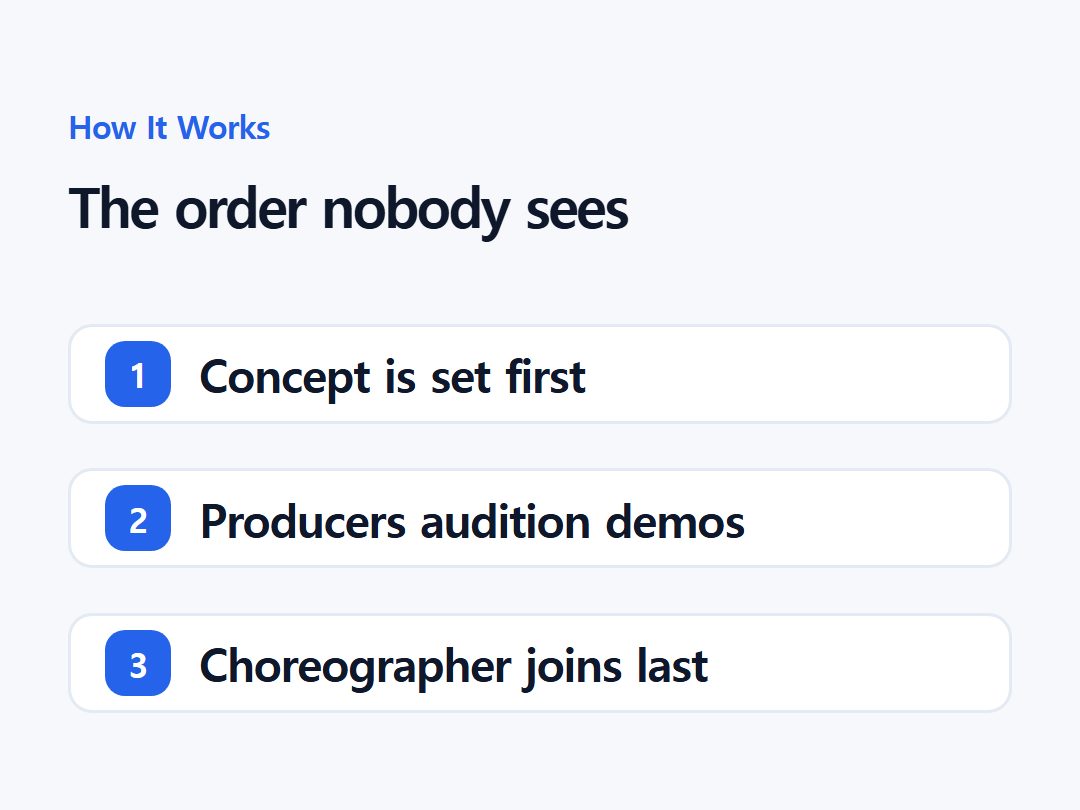
- Agencies fix the concept before any song is written.
- SM's camp pits roughly 500 producers against each other for one slot.
- NewJeans' 'Ditto' beat both title tracks, charting for 99 straight days.
International fans often assume the title track is simply the best song on the album, picked after the fact. Korean fans know the order runs the other way: the concept comes first, songs are written to fit it, and choreography is the final layer applied to a decision that was settled long before any dancer entered a studio.
A title track is not what the English phrase suggests
In English, "title track" usually means the song that shares its name with the album. In K-pop, 타이틀곡 (title track) means something else: the one song from an album or EP that gets a music video, promotion, and weekly performances on TV music shows, while the rest — b-sides — mostly go unpromoted.
The distinction is commercial, not critical. Agencies also plan a "follow-up" promotion, 후속곡, for a second song in case the title track underperforms — an option built into the release plan from the start, not an improvised rescue.
The concept is fixed before the songs are
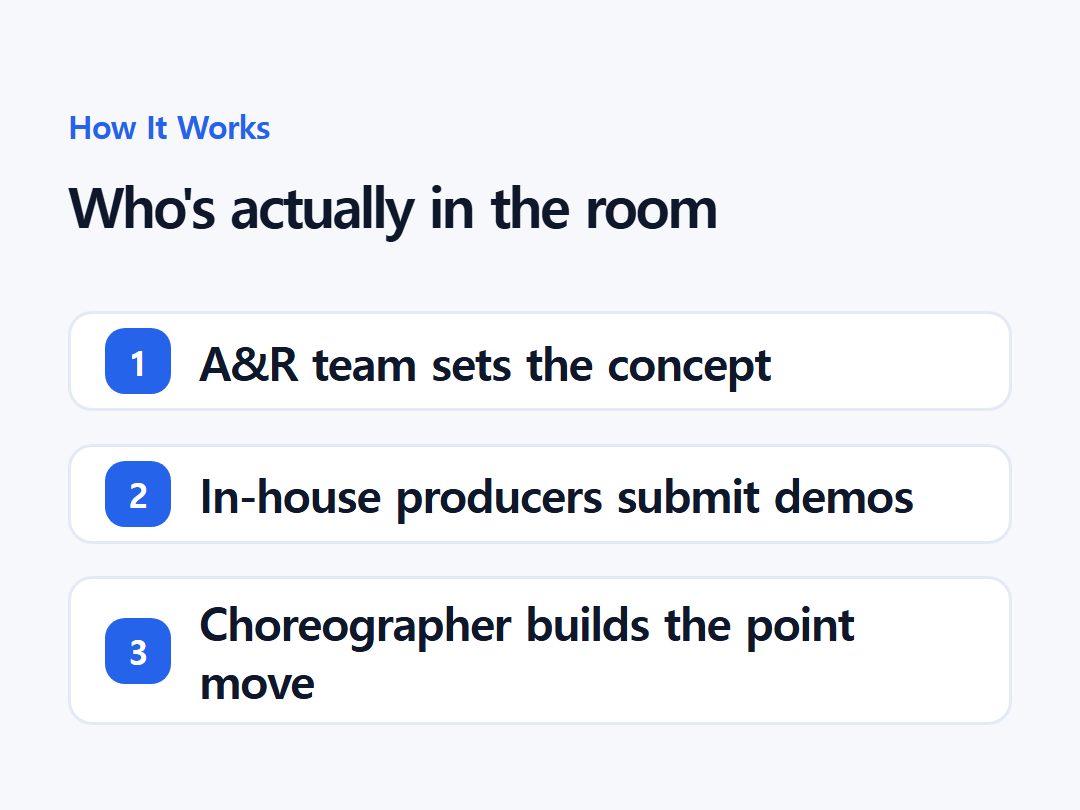
Song submissions are not open calls for a writer's best work. Agencies brief songwriters on the concept first — mood, tempo, reference tracks — and producers write toward that brief. As songwriter Son Yeong Jin has put it: "It depends on the company, but it's rare that they pick just one title track out of all the tracks."
Producers who work with K-pop labels describe agencies circulating detailed release-plan documents that specify exactly what kind of song is needed — a dance-pop track, a ballad, a club beat — often with reference-song links attached, before a single demo is written.
Producers effectively audition for the slot
Inside JYP and SM, the process resembles a competition more than a commission. JYP producer Lee Woo-min has compared it to an audition directly: "The agency announces something like 'Submit one song that fits as a new single for GOT7 or TWICE's new album.' Then we producers submit songs that are later chosen after monitoring and numerous meetings."
SM runs a similar system at larger scale. Its songwriting camp pools roughly 500 international producers, and A&R staff hand out only a concept and mood — not the artist's name. Production duo LDN Noise has said a song they wrote intending it for SHINee was instead taken by EXO's team, becoming the single "Lucky One."
Not even the CEO's own song is exempt
The review process applies even to a label founder's own material. JYP's A&R representative Bae Soo Jung has said that Park Jin-young's songs still need clearance: "just because it's Park Jin Young's own album doesn't mean he can release it as he pleases — he has to get confirmation from the A&R department."
BTS member RM has described the same discipline at HYBE: "We don't choose a title song of many songs that we've worked on so far. We make the title song with a clear picture and concept. So we fix the title song in the beginning." Only once tempo and melody are finalized, he added, can choreographers build the dance.
The choreographer only enters once the song is locked
Point choreography is commissioned, not improvised in rehearsal. Choreographer Kyle Hanagami, who built routines for BLACKPINK and TWICE, is contracted directly by entertainment companies for a specific artist and song. Of BLACKPINK's debut choreography, he has said the brief was differentiation: "This group needs to look different than everyone else."
Choreographer May J. Lee, who co-created TWICE's "Knock Knock" routine, has described building movements from the finished lyrics outward. Her definition of success is explicit: "When it all comes together and a song immediately brings to mind its dance, even before the song's singer — that's the best kind of choreography."
A "point" move is built to be filmed and copied
What separates a point move from the rest of a routine is repeatability. It is usually short, tied to one lyric or hook, and simple enough for a fan with no training to reproduce on camera.
Choreographer Bada Lee, who built aespa's "Next Level" routine, has called it the work that made the wider industry recognize her by name — proof that one commissioned move can carry a choreographer's career the way a title track carries a group's.
That repeatability is the point commercially, not just creatively. Every fan-shot cover or dance-challenge clip is promotion the label did not have to buy.
Digital streams and video clips decide who actually "wins"
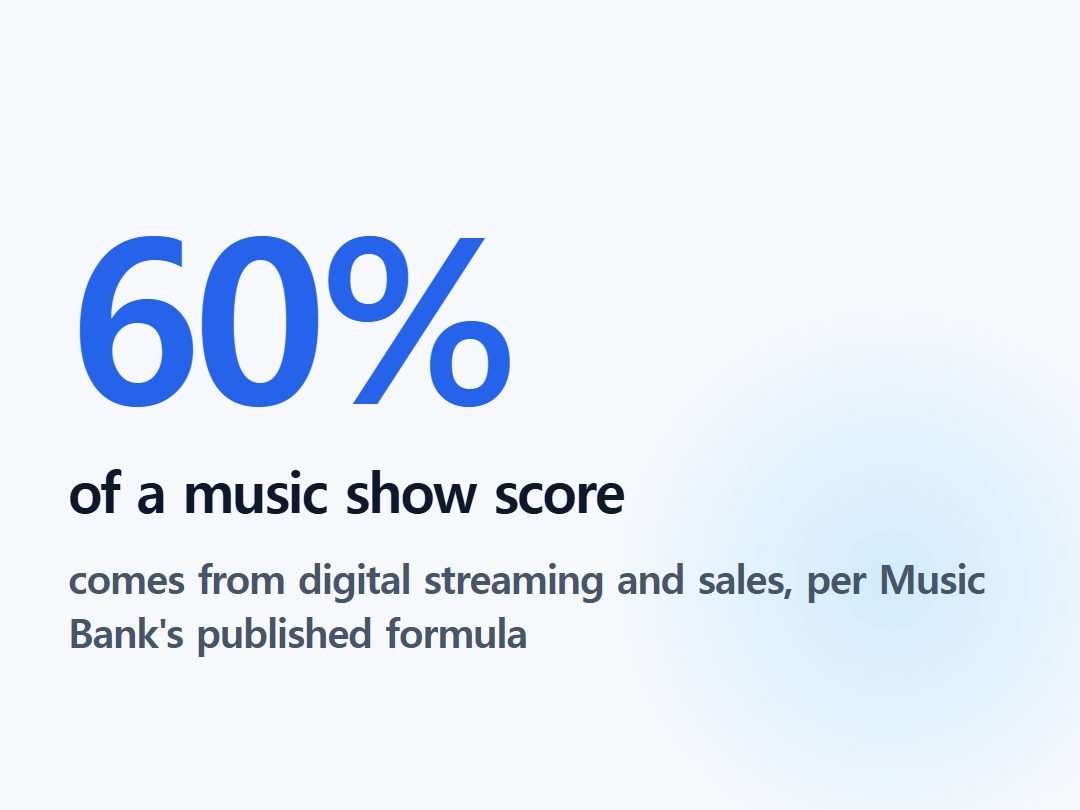
Weekly music-show wins are calculated from a published formula, not audience applause. Music Bank's score, for example, runs 60% digital performance, 20% broadcast plays, 10% pre-voting, and 5% each for album sales and social media activity. Other shows weight the categories differently, but digital and social consistently make up most of the total.
Social-media scoring is where point choreography earns its keep: dance covers, fancams, and challenge clips built around one recognizable move all feed the same metric labels are chasing when they commission it in the first place.
When the b-side wins instead of the title track
The system is built to make the title track the hit — but it does not always work out that way. Several of the industry's best-known chart stories involve a b-side or pre-release track outperforming the song designed to lead.
| Group / song | What happened |
|---|---|
| EXID, "Up & Down" (2014) | Failed to chart at release; a fan-shot member fancam went viral months later and pulled the song to No. 5 on Gaon's digital chart |
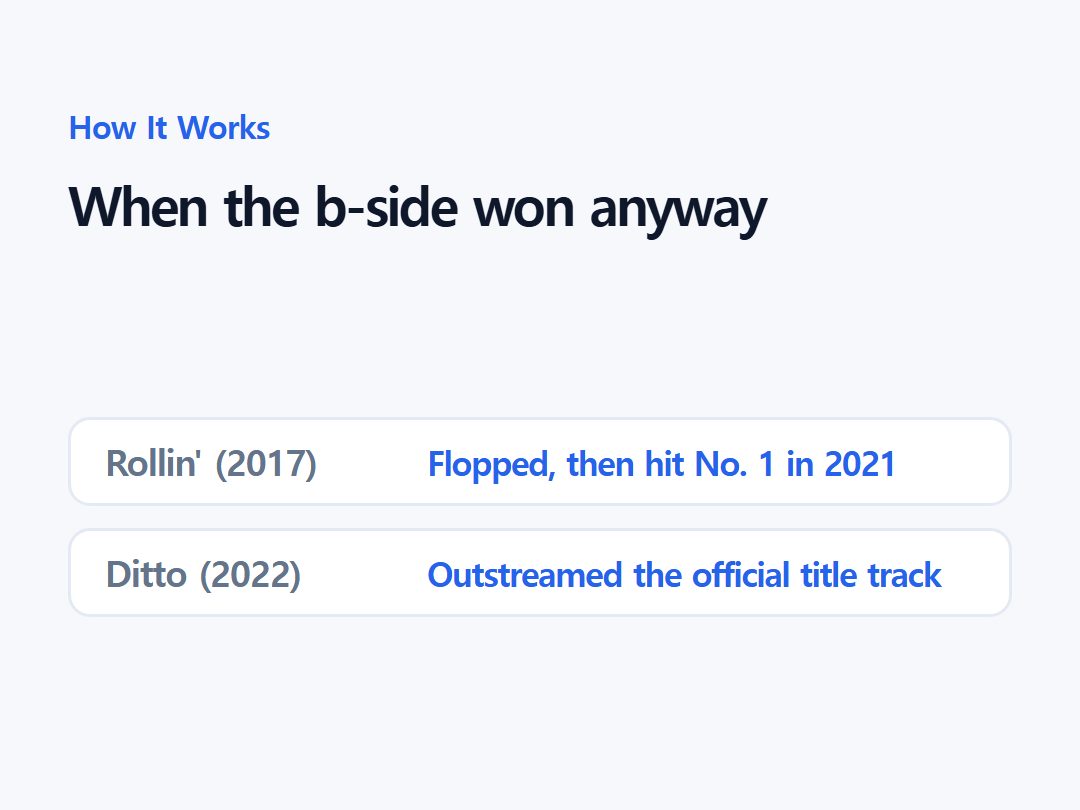
| Brave Girls, "Rollin'" (2017) | Flopped on release; a compilation of military-base fancams went viral in 2021 and pushed it to No. 1, four years after promotion had ended |
| BLACKPINK, "Forever Young" (2018) | Released as a sub-title track behind "DDU-DU DDU-DU," it later became the first B-side by a girl group reported to pass 5.1 million unique Melon listeners |
| NewJeans, "Ditto" (2022) | Released as a pre-release B-side, it topped Melon's daily chart for 99 straight days — longer than either official title track from the same era |
None of these songs had weaker point choreography or a smaller promotional push than their group's actual title track. What changed the outcome was audience behavior the label could not fully script — a viral clip, a wave of covers, a moment nobody scheduled.
What agencies still don't explain publicly
No major agency has published an official glossary defining "point choreography" or disclosed the exact criteria used to choose between competing demos beyond the general audition-style process producers describe in interviews. Choreographers confirm they are commissioned after a song is finished, but there is no public, dated case of a company confirming it swapped a title track shortly before release.
What is confirmed, repeatedly, by songwriters, producers, and idols themselves is the order of operations: concept, then song, then choreography — followed by a chart and a social-media cycle the agency can influence but never fully control.
How a title track gets picked, from concept to chart
| Stage | What happens |
|---|---|
| Concept set | Agency briefs songwriters on mood, tempo, and reference tracks before any song exists |
| Producers submit demos | Writers compete for the slot; SM alone draws from ~500 international producers per camp |
| A&R selects the track | Chosen after monitoring and meetings — even a CEO's own song needs clearance |
| Choreographer commissioned | Enters only once tempo and melody are locked, per RM's account |
| Point move built | Kept short and tied to one hook so fans can film and copy it |
| Chart score tallied | Music Bank: 60% digital, 20% broadcast, 10% pre-voting, 5% album, 5% social |
Frequently asked
What does title track mean in K-pop?
It's the one song from an album that gets a music video, promotion, and weekly TV performances, while the other songs (b-sides) mostly go unpromoted.
Who decides which song becomes the title track?
The agency's A&R department picks it from songs producers submit to fit a concept set in advance — even a label founder's own song needs their clearance.
What is point choreography in K-pop?
It's the short, easy-to-copy dance move tied to one lyric, commissioned only after the title track's tempo and melody are already finalized.
Sources
Every factual claim above is traceable. We do not translate articles — we gather facts from multiple outlets and write them ourselves.
- K-Pop Culture Glossary — Soompi
- Here's How A K-Pop Title Track Is Picked, According To Professional Songwriters — Koreaboo
- What It Actually Takes To Make A K-Pop Song — mixed feelings
- A&R Representative Bae Soo Jung Comments On Working On Tracks For GOT7, TWICE, and More — Soompi
- The Minds Behind K-Pop's Biggest Hits: Top Agencies Develop In-House Songwriting Teams To Churn Out Hits — Korea JoongAng Daily
- [Video] Exploring the art of K-pop dance — The Korea Herald
- Meet the Choreographer Behind Your Favorite K-Pop Moves — Billboard
- The K-Pop Dance That Choreographer Bada Lee Considers Her 'Biggest Hit' — Koreaboo
- RM Reveals What 'Fake Love' Almost Sounded Like — Koreaboo
- Guide To K-Pop Music Show Wins: What You Need To Know — Soompi
- EXID's Hani Thanks Fan Who Uploaded Viral Fancam — Soompi
- Brave Girls Shares Their Thoughts On Sudden Chart Resurgence Of Their Song 'Rollin' — Soompi
- BLACKPINK Sets Record With 'Forever Young' — allkpop
- NewJeans Hit No. 1 On Emerging Artists Chart Thanks To 'Super Shy' — Billboard