
Every winter, Korean television runs a string of music award ceremonies that hand out a prize called the Daesang (대상), literally "grand prize." It is the single most prestigious title in the K-pop calendar, above the more common Bonsang (본상, "main prize"), which is usually given to ten or so top-performing acts each year.
International fans often assume the Daesang works like a chart-topping record: whoever sold or streamed the most, wins. It does not. Each show calculates it differently, using its own private mix of sales figures, streaming data, fan voting and a panel of judges whose identities and scoring are rarely made public.
The short version
- Each Daesang show uses its own private mix of sales, streaming, voting and judges.
- Judge panels are never disclosed — no identities, no individual scores, ever.
- MAMA's judge weighting jumped from 20% to 40% between 2024 and 2025.
Award shows only reveal their formulas under pressure
There is no single news event behind this explainer — it is a recurring feature of the K-pop calendar that international coverage rarely unpacks.
Every year between November and January, Korea's major music shows air their Daesang ceremonies: the Mnet Asian Music Awards (MAMA), the Melon Music Awards (MMA), the Golden Disc Awards (GDA), the Seoul Music Awards (SMA) and the Circle Chart Music Awards.
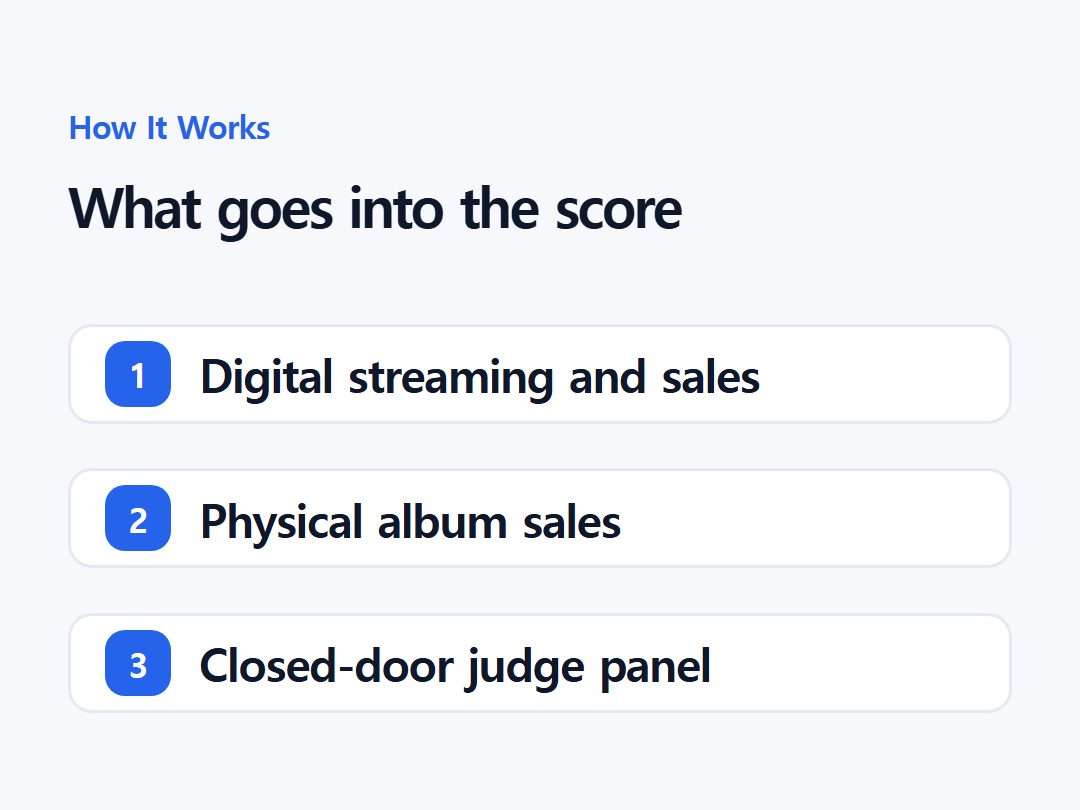
Each publishes, often only after fan pressure, a breakdown of what percentage of the final score comes from digital performance, physical album sales and a judging panel. Those percentages differ from show to show, change from year to year, and in most cases the judges' individual scores are never released at all.
Why did some idols win despite weak sales?
To understand why the Daesang process confuses outsiders, it helps to compare it with the one part of the K-pop award system that is transparent: the weekly music shows, such as SBS's Inkigayo or MBC's Show! Music Core.
These broadcast a #1 winner most Sundays or Saturdays, and their scoring formulas are published in detail.
Inkigayo's 2024 system, for instance, weights domestic digital performance at 50%, social media activity at 20%, physical album sales at 10%, broadcast score at 10%, and viewer voting at the remaining 10% — figures the network updates and announces publicly (Creatrip).
International fans who follow music shows already understand this logic: it is close to a real-time chart, and its inputs are fixed and disclosed.
Year-end Daesang scoring works nothing like that.
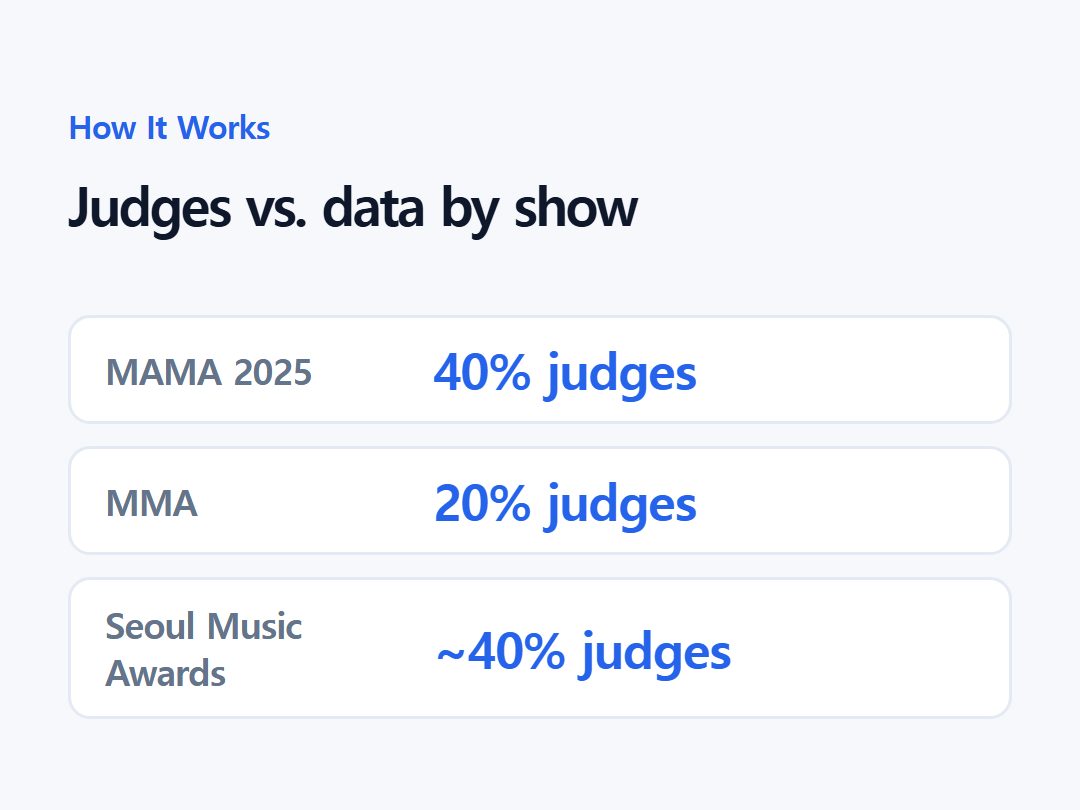
It layers in two elements that weekly shows either downweight or exclude entirely: cumulative annual sales and a subjective judging panel, often called "jury evaluation." The Melon Music Awards, for example, has used roughly 60% digital sales and streaming, 20% online voting and 20% judge evaluation for its main Daesang-track categories in recent years, though the exact split has moved before — it was closer to 70/30 digital-to-voting with no judge component at all in 2016 (Wikipedia; kpopping).
The Golden Disc Awards has historically leaned even harder on quantitative data, at one point splitting sales and judges 80/20, before shifting toward roughly 60% data and 40% judges by its 37th ceremony (Golden Disc Awards reporting, cited above).
The Seoul Music Awards, by contrast, has publicized a three-way split of about 30% online voting, 40% judges and 30% sales for its main prize tier — a formula in which the judging panel actually carries the single largest weight (Seoul Music Awards, Wikipedia; kcontenthub).
MAMA's Artist of the Year criteria for 2025 moved to 40% judge evaluation, 30% streaming and downloads, and 30% physical album sales — a jump in judge weighting from just 20% the year before (Soompi).
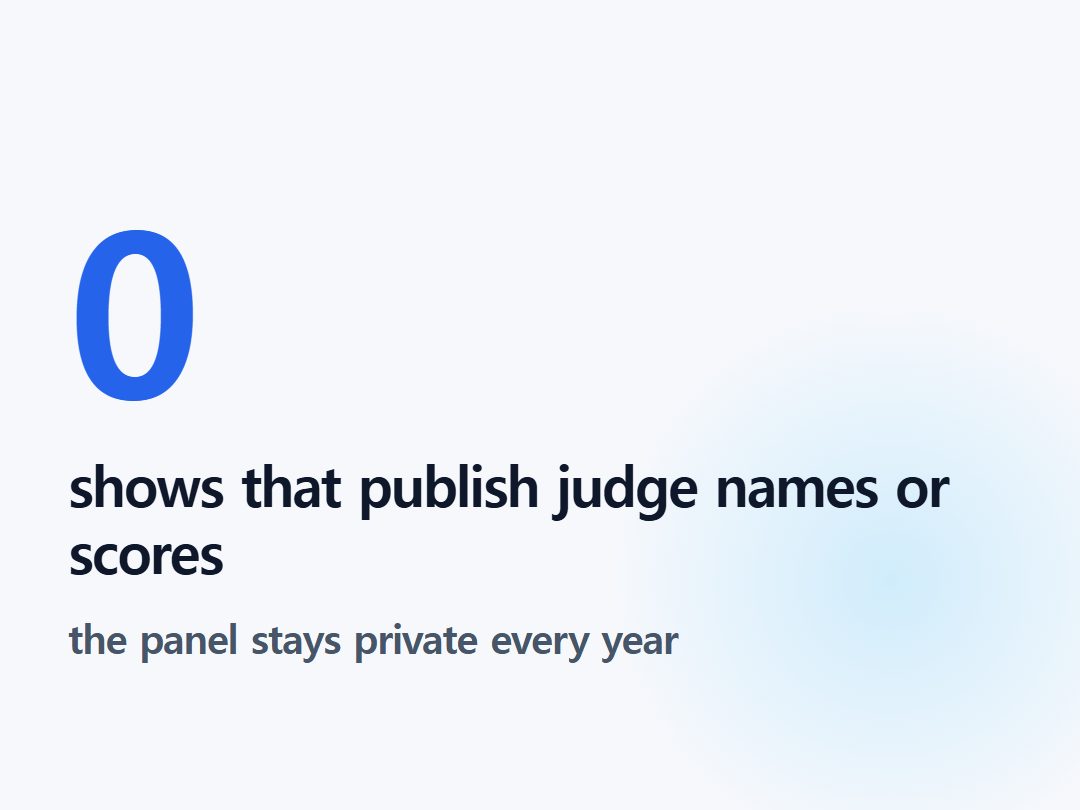
None of these shows disclose who sits on the judging panel for a given year, how individual judges score, or how ties and edge cases are resolved. That opacity is the actual source of most Daesang controversies.
Korean fan communities have flagged repeated cases where an act won a Daesang despite a comparatively weak chart year, attributing the gap to the judge score.
Commentators pointed to NCT Dream's 2022 Genie Music Awards win and NCT 127's 2022 Seoul Music Awards Daesang — for a song that reportedly didn't even chart on the annual streaming rankings — as examples where the judge component appeared to outweigh measurable performance (allkpop).
Korean online communities have also periodically scrutinized whether shifting criteria year to year has coincided with outcomes that favor artists from a specific agency — the companies (like HYBE, SM, JYP or YG) that manage, train and promote K-pop acts under multi-year contracts — though no show has ever published data that would confirm or refute such claims (allkpop).
This is also why award season regularly produces two winners for what looks like one prize: shows that split the Daesang into a "Digital" or "Song of the Year" track and a separate "Album" or physical-sales track, because an act can dominate streaming without moving comparable album units, or vice versa.
The Golden Disc Awards has run this two-track system since splitting its Daesang in its 21st year, and for its 40th ceremony in January 2026 it added a third Daesang tier altogether — a new "Artist Daesang" scored 40% by judges and 60% by combined streaming, album sales and global chart data.
Some fans read the addition as recognition of how globalized K-pop's audience has become; others criticized it for diluting what a Daesang is supposed to mean and for introducing yet another set of undisclosed judging criteria (allkpop).
For an international reader used to a music industry where a Grammy nominating committee's rules, or a Billboard chart's methodology, are published in detail, the Korean system can look arbitrary.
It isn't arbitrary so much as privately governed: each broadcaster or platform (Mnet/CJ ENM for MAMA, Kakao's Melon for MMA, Sports Seoul/Segye Ilbo interests for Golden Disc and Seoul Music Awards, the Korea Music Content Association for Circle Chart) sets its own weightings, changes them at will, and treats the judge panel's actual deliberations as proprietary.
The result is that "who deserved the Daesang" is a live debate among Korean fans every single year, not a settled question of who had the most streams.
Why do Daesang shows even have judge panels?
Korea's music award tradition predates the streaming era by decades. Broadcasters began handing out year-end "Top Singer" honors as far back as the 1960s and 70s, when the only meaningful metric was physical record sales tallied by the broadcaster itself.
The Seoul Music Awards, launched in 1990 by the newspaper Sports Seoul, and the Golden Disc Awards, which trace back even further, both built their prestige on being sales-based successors to that older tradition.
The 2000s and 2010s forced every show to add a digital component as physical album sales collapsed relative to streaming and paid downloads.
The Melon Music Awards, run by Korea's largest music streaming platform, was built around digital data from the start and became the show most associated with a heavily streaming-weighted formula.
The Golden Disc Awards responded to the same shift by formally splitting its Daesang into separate Digital and Album prizes, an acknowledgment that a song's streaming success and an album's physical sales had become different competitions with different fan bases — since roughly the mid-2010s, physical album sales have been driven disproportionately by dedicated fan-club purchasing of multiple copies, while streaming reflects broader casual listenership.
Judge panels were layered in as a corrective, ostensibly to reward artistic merit, cultural impact or a strong "body of work" that raw sales numbers might not fully capture — and to give shows a lever to recognize a veteran act or an artistically significant record over one that simply sold the most units in a calendar year.
In practice, because judges' individual scores are not published, this same mechanism is what fan communities point to whenever a result looks disconnected from public chart performance.
The formulas keep changing, the judges stay hidden
Two things remain genuinely unresolved. First, transparency: no major Korean music award show currently publishes judge identities or individual panel scores, and there is no indication any of them plan to, despite recurring public criticism each award season.
Second, the direction of the criteria itself is still shifting — MAMA's 2025 pivot toward heavier judge weighting, and the Golden Disc Awards' addition of a third Daesang category for 2026, both suggest shows are actively experimenting with how much weight raw data versus panel judgment should carry, not converging on a shared standard.
Until a show discloses its full methodology and judging record, the honest answer to "why did that act win the Daesang" will keep depending on which portion of an undisclosed formula mattered most that year.
How major shows weight their Daesang score
| Show | Sales / Streaming | Fan Voting | Judge Panel |
|---|---|---|---|
| Melon Music Awards (MMA) | 60% digital sales & streaming | 20% online voting | 20% judge evaluation |
| Golden Disc Awards, 37th ceremony | ~60% data | — | 40% judges |
| Seoul Music Awards (SMA) | 30% sales | 30% online voting | 40% judges |
| MAMA Artist of the Year (2025) | 30% streaming/downloads + 30% physical sales | — | 40% judge evaluation |
Frequently asked
What's the difference between Bonsang and Daesang?
Bonsang is a 'main prize' given to roughly ten top-performing acts each year, while the Daesang is the single most prestigious grand-prize title.
Why do some K-pop shows give out two Daesang awards?
Because an act can dominate streaming without moving comparable album units (or vice versa), so shows like the Golden Disc Awards split the prize into separate Digital and Album tracks.
Are the judges who decide the Daesang made public?
No — no major Korean music award show discloses who sits on the judging panel or how individual judges score, which fan communities point to as the main source of Daesang controversies.
Sources
Every factual claim above is traceable. We do not translate articles — we gather facts from multiple outlets and write them ourselves.
- 2025 MAMA AWARDS Announces Nominees + Fans' Choice Voting Begins — Soompi
- Melon Music Awards — Wikipedia
- 2026 Golden Disc Awards: Full Winners List — Forbes
- Three Daesangs for Golden Disc Awards Causes A Stir Among Fandoms: Here's A Look At Why — allkpop
- Seoul Music Awards — Wikipedia
- Netizens scrutinize the history of award show criteria to investigate SM Entertainment's possible hand in securing Daesang for their artists — allkpop
- Guide to Korean Music Show Wins: How the Scores are Calculated — Creatrip
- Circle Chart Music Awards — Wikipedia