International fans who follow K-pop online often notice something odd: the same fandoms that argue over comebacks and setlists will also organize military-precision "streaming parties," complete with shared spreadsheets, timed schedules, and instructions to play a song on repeat at specific hours.
To an outsider, it can look like overkill for a song that's already popular. To understand why fans do it, you have to understand that Korean music charts are not one single ranking — they are several different formulas running at once, and each one rewards a different kind of listening behavior.
The short version
- Korean charts reward different behaviors, so fans coordinate mass-streaming pushes called chongong.
- Music show scores weigh streaming and downloads 45–65%, more than any other factor.
- Melon killed its hourly real-time chart in 2020 after repeated manipulation scandals.
Melon, Korea's largest music streaming service, is the best example.
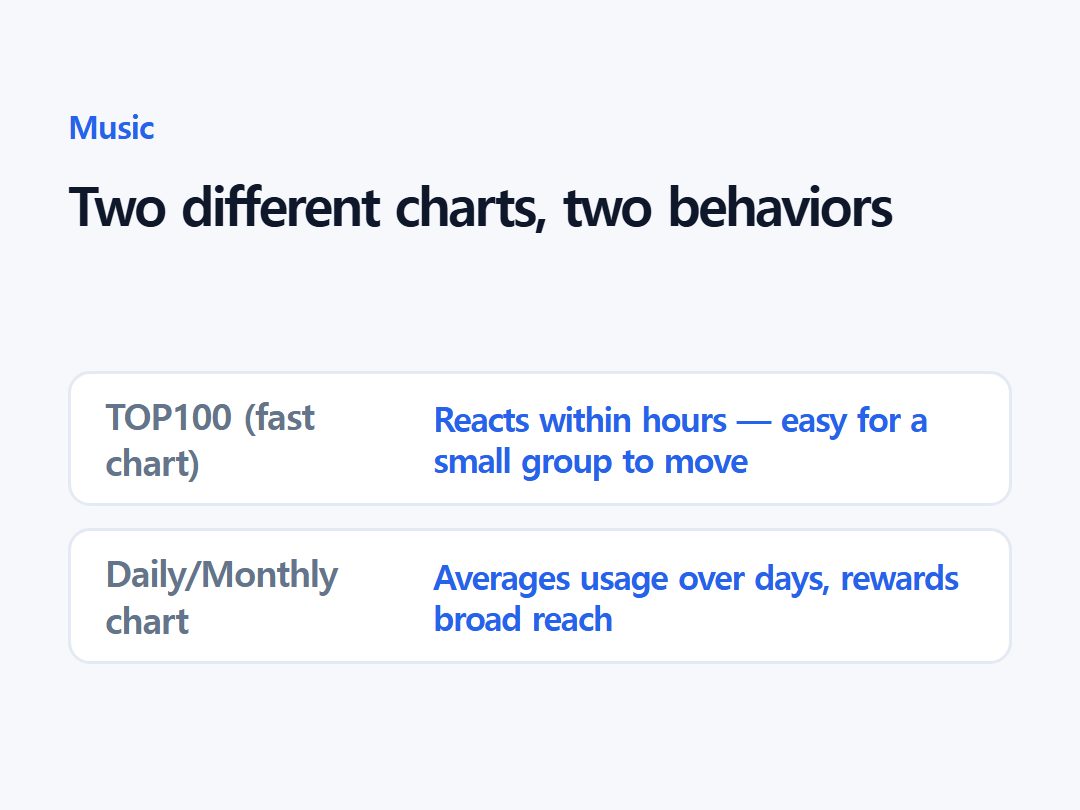
It currently runs a fast-moving chart called TOP100, which updates based on very recent listening activity, alongside separate daily, weekly and monthly "comprehensive" charts that average out usage over a much longer window and weigh downloads more heavily than plays.
Other services — Genie, Bugs, FLO — run comparable systems, and an industry-wide chart called Circle Chart (formerly Gaon Chart) compiles data across all of them for the official record.
Because these charts measure different things, a small but intensely coordinated fanbase can move one of them far more easily than the others.
That gap is the origin of what Korean fans call 총공 (chongong, short for 총공격, or "total attack") — a coordinated, scheduled mass-streaming push timed to a chart's most gameable window.
How much do streams decide a music show win?
To an international listener, a chart position might look like a simple measure of popularity, similar to how Spotify's Global Top 50 works. Korean charts don't work that way, and the difference explains a huge amount of fan behavior that otherwise looks baffling.
Until July 2020, Melon ran an hourly real-time chart (실시간차트) that reset and re-ranked songs roughly every 60 minutes based on plays in that narrow window.
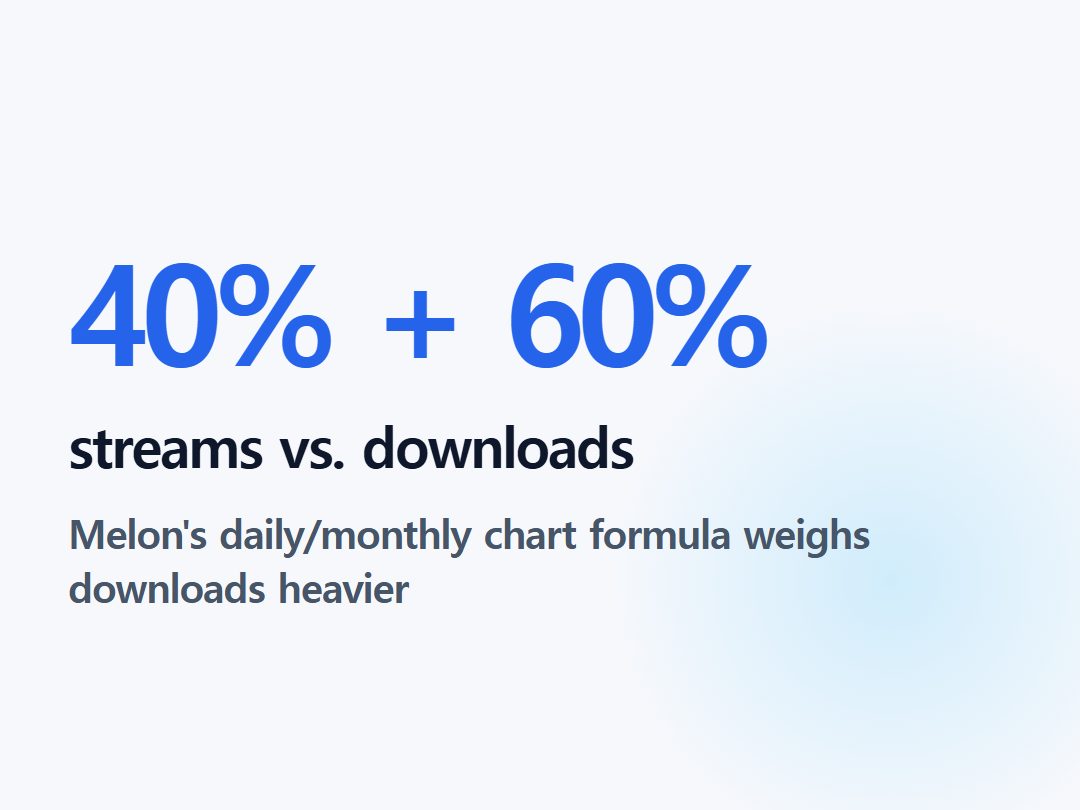
Alongside it sat the comprehensive chart (종합차트) — daily, weekly and monthly rankings that Melon calculated by weighting a song's streaming activity at 40% and its downloads at 60% of total usage across that whole period.
The real-time chart rewarded intensity: a few thousand dedicated fans replaying a song for a single hour could push it to the top. The comprehensive chart rewarded breadth: it needed sustained interest, and heavy downloads, from a much larger and more varied listener base over days or weeks. A song could sit at No.
1 on the real-time chart while barely cracking the top 100 on the daily chart — a mismatch that was reported on repeatedly in Korean media as clear evidence of fandom-driven distortion rather than organic popularity.
That mismatch is precisely what turned streaming into a competitive, organized activity. If the most visible, most screenshotted chart on the app's homepage could be moved by a disciplined few thousand people acting in the same hour, then organizing those few thousand people became a rational fan strategy.
Fan communities began publishing 총공 schedules — timetables telling members exactly when to log in, which song to queue, and how many times to repeat it — timed to hours when overall listening volume (and therefore competition) was lowest, so a coordinated push would have maximum visible effect.
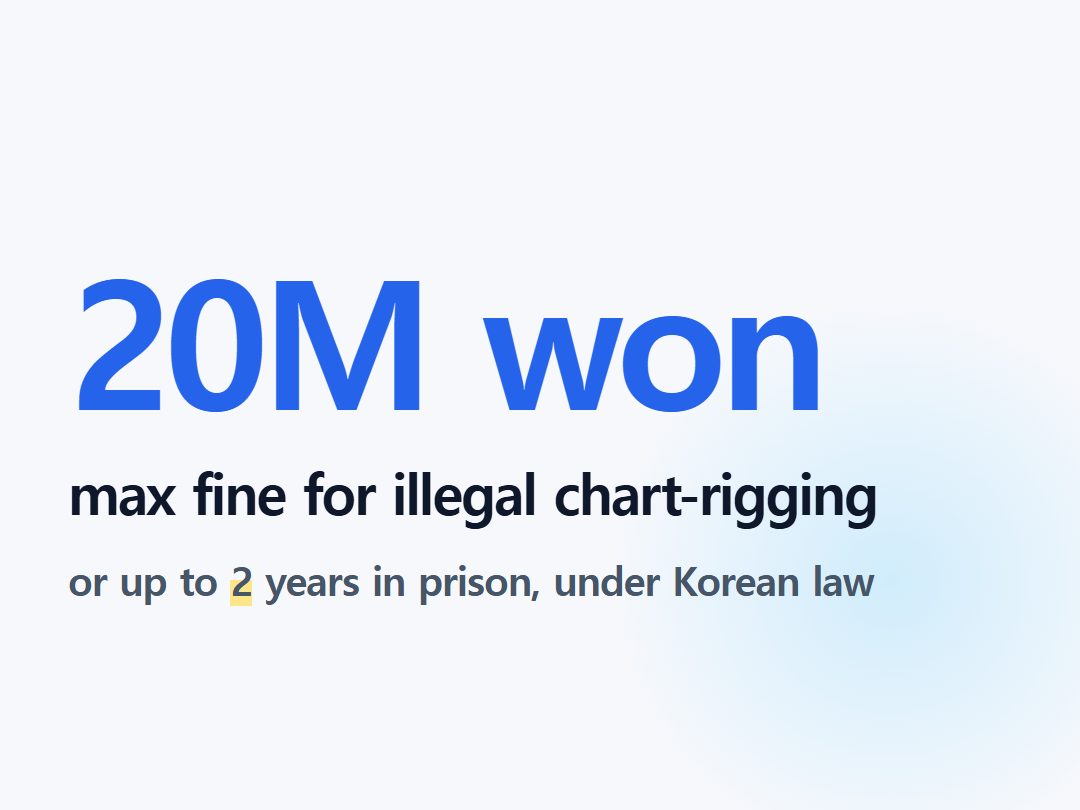
This is distinct from, but sits uncomfortably close to, 사재기 (sajaegi) — outright illegal chart manipulation using bots or bulk-purchased accounts, which carries real legal penalties in Korea (fines up to 20 million won, or roughly $16,800, and up to two years in prison).
Fans generally argue that one person streaming all day on one device is legitimate support, not manipulation; where organized chongong shades into something closer to sajaegi — multiple accounts, shared devices, purchased ID pools — has been a genuinely contested question in Korean pop culture for over a decade.
There's also a second, less visible reason streaming numbers matter so much: they don't just decide app rankings.
The same streaming and download data feeds directly into the scoring formulas used by Korea's weekly music shows — Music Bank, Inkigayo, M Countdown, Show Champion and others — where artists compete for a physical trophy each week.
Across these shows, digital performance (streaming and downloads, usually pulled from the Circle Chart data pool) is consistently the single largest scoring category, typically 45–65% of an act's total score, ahead of physical album sales, broadcast airtime, YouTube views and fan voting combined.
A music show win is treated as a meaningful achievement inside the industry — it's cited in press releases, celebrated on fan accounts, and can factor into how an agency evaluates a comeback's success.
So when fans stream, they are not only trying to move an app ranking; they are trying to move the actual scoreboard that determines whether their favorite act stands on a soundstage holding a trophy that week.
That stakes-raising is a large part of why chongong culture became so organized and so normalized rather than dying out.
International fans face a structural wrinkle here too: streaming from outside Korea on Korean domestic platforms generally doesn't count toward these Korean charts or show scores the way in-country streams do, which is one reason global fanbases lean so heavily on YouTube view counts, physical album purchases, and app-based voting instead — different levers for essentially the same goal.
Two scandals that ended Melon's real-time chart
Concern about chart manipulation in Korea is not new.
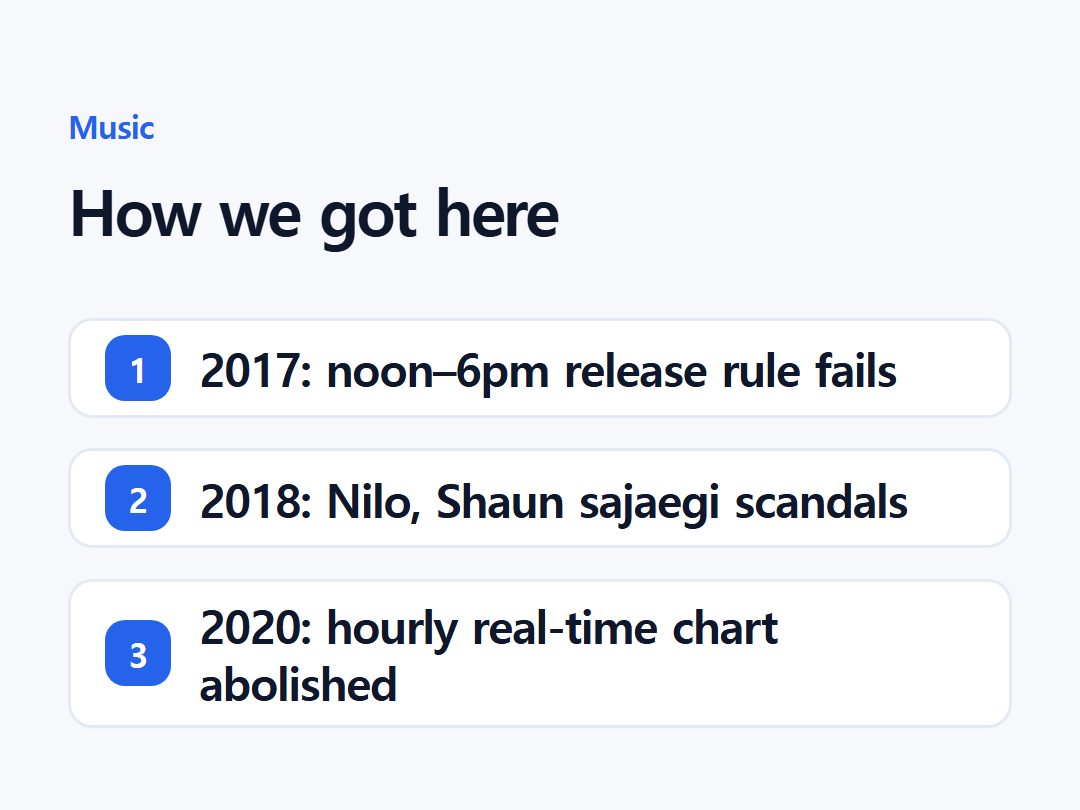
As early as February 2017, major services including Melon, Bugs and Genie jointly restricted their real-time charts so that only songs released between noon and 6 p.m. could be freshly ranked, an attempt to blunt the advantage of coordinated midnight or early-morning streaming pushes.
The reform was widely seen as ineffective — dedicated fandoms simply adapted their timing — and was criticized by idol fanbases as unfairly targeting them while doing little to stop actual bot-driven manipulation.
The issue exploded into public controversy in 2018, when relatively unknown singers Nilo and Shaun each suddenly topped Melon's real-time chart, beating established acts including TWICE and Mamamoo. Both cases triggered formal sajaegi accusations and government inquiries; both investigations ultimately proved inconclusive, but the episodes cemented public distrust of the real-time chart format itself.
Melon responded in May 2020 by announcing it would abolish the hourly real-time chart entirely.
On July 6, 2020, it was replaced with a chart called 24Hits, which ranked songs on a rolling 24-hour window instead of a single hour, and — critically — capped each user account at counting only once per song per day, directly neutralizing the value of looped, repeat streaming from a small group of accounts.
Melon also stripped away the ranking numbers, rise/fall arrows, and five-minute real-time graph that had made chart movement so easy to track and compete over.
The redesign proved unpopular with some users who missed the drama of the old chart, so in January 2021 Melon added a supplementary "Latest 24Hits" chart for new releases — which brought back some real-time visual elements and, with them, a renewed burst of fan competition.
Following Melon's 2021 merger into Kakao Entertainment, the chart was overhauled again on August 9, 2021, into the TOP100 chart still in use today, which blends 24-hour listening data with the most recent hour's activity in an effort to stay responsive to genuine trends without reopening the old vulnerabilities.
Alongside the platform-level charts, Korea has an official industry chart, Circle Chart (renamed from Gaon Chart in July 2022), overseen by the Ministry of Culture, Sports and Tourism and the Korea Music Content Industry Association.
It aggregates data across Melon, Genie, Bugs and other domestic services and, since 2021–2022, has folded in Spotify Korea and Apple Music Korea as well.
Circle Chart supplies the data behind Korea's official sales certifications, the Circle Chart Music Awards and the Golden Disc Awards, functioning as a check on any single platform's chart being treated as the definitive word on a song's popularity.
Is Korea's streaming arms race finally ending?
The core tension hasn't gone away.
Even under the current per-ID-capped TOP100 system, chart-related controversy resurfaced in 2025, when Korean fans and outlets raised concerns about suspicious streaming patterns tied to a SEVENTEEN member's solo release, with suspicion again falling on coordinated, non-organic account activity.
As long as chart position and music show wins carry real commercial and reputational weight for artists and agencies, the incentive to push those numbers — by legitimate fan organizing or otherwise — isn't going away.
What's likely to keep evolving is the technical arms race: platforms tightening per-account caps and algorithm weighting, fandoms adapting their coordination to whatever loophole remains, and Circle Chart's continued expansion to include more global platforms as a way of diluting any one service's vulnerability.
Whether that produces a chart genuinely resistant to organized pushes, or just a more sophisticated version of the same cycle, remains an open question in the Korean music industry.
Every change to Melon's chart since 2017
| Date | What changed |
|---|---|
| Feb 2017 | Melon, Bugs and Genie jointly restrict real-time charts to only rank songs released noon–6 p.m. |
| 2018 | Nilo and Shaun top the real-time chart, triggering sajaegi probes and lasting distrust of the format |
| May 2020 | Melon announces it will abolish the hourly real-time chart entirely |
| July 6, 2020 | Real-time chart replaced by 24Hits: a rolling 24-hour window, capped at one count per user per song per day |
| Jan 2021 | "Latest 24Hits" supplementary chart added for new releases, reviving some real-time competition |
| Aug 9, 2021 | 24Hits overhauled into today's TOP100 chart, blending 24-hour data with the most recent hour |
| July 2022 | Gaon Chart renamed Circle Chart, later folding in Spotify Korea and Apple Music Korea data |
Frequently asked
What is chongong (총공) in K-pop fandoms?
Chongong, short for 총공격 or "total attack," is a coordinated, scheduled mass-streaming push that fans organize to move a chart during its most gameable window, such as low-traffic overnight hours.
Why did Melon get rid of its real-time chart?
After the 2018 Nilo and Shaun controversies raised sajaegi suspicions and eroded public trust, Melon announced in May 2020 it would abolish the hourly real-time chart, replacing it on July 6, 2020 with 24Hits, which caps each account at one count per song per day.
Does streaming from outside Korea count toward Melon or Circle Chart rankings?
Generally no — streaming from outside Korea on Korean domestic platforms doesn't count toward these charts or music show scores the way in-country streams do, which is why international fans lean more on YouTube views, physical album sales, and app voting.
Sources
Every factual claim above is traceable. We do not translate articles — we gather facts from multiple outlets and write them ourselves.
- melon chart (English) — NamuWiki
- 멜론차트 — NamuWiki
- Korea Moves to Stop Real-Time Chart Manipulation — Billboard
- Inside Sajaegi, K-Pop's Open Secret — NPR
- Just How Rampant is Chart Manipulation in South Korea? — Digital Music News
- Melon Music will update their system again and delete the '24 Hits' chart from their home tab — allkpop
- Melon announces to rebrand music ranking system with new 'Top 100' chart — Korean Vibe
- Circle Digital Chart — Wikipedia
- Guide To K-Pop Music Show Wins: What You Need To Know — Soompi
- news: fans streaming, internet reacts to allegations over SEVENTEEN member's solo song chart manipulation by Chinese fans — Sportskeeda