Every week, five Korean television networks each hand out a music trophy, and international fans watching the clips online can be forgiven for assuming it works like a chart position on Spotify. It does not.
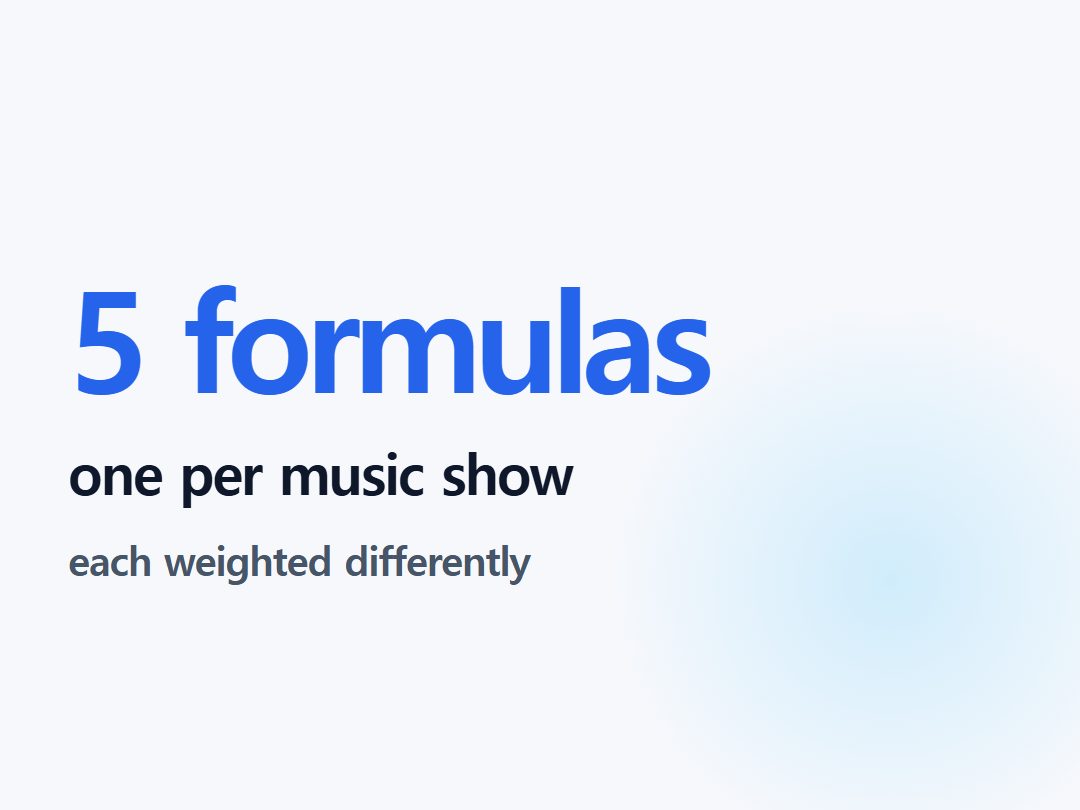
Each show runs its own formula that blends streaming numbers, physical album sales, television airtime, video views, and fan voting into a single weekly score, and no two shows weight those categories the same way.
Understanding that formula explains a lot of what looks, from the outside, like strange or excessive behavior from K-pop fandoms during a comeback week.
The short version
- Five networks each run different weekly formulas blending streaming, sales, airtime, and voting.
- Digital streaming sales usually count for 50 to 60 percent of the score.
- Fans openly coordinate 'chonggong' campaigns to boost every input the formula counts.
How Long Do Comebacks Stay Eligible To Win?
Five weekly programs currently crown a winner: Mnet's M Countdown airs Thursdays, KBS's Music Bank airs Fridays, MBC's Show! Music Core airs Saturdays, SBS's Inkigayo airs Sundays, and MBC M's Show Champion airs Wednesdays.
A sixth show, SBS funE's The Show, ended a 14-year run in November 2025 before returning in a revamped, more globally oriented format on SBS Life in June 2026 — a reminder that the whole system keeps getting rebuilt.
Every “comeback” — the term for a new single or album release, since K-pop acts promote in cycles rather than releasing continuously — becomes eligible for these trophies for roughly two to three weeks.
Agencies (the companies that recruit, train, and manage K-pop idols under multi-year contracts, a structure often called the agency system) plan promotion schedules around this window, because it is the only period a song can actually win.
How Do Korean Music Shows Decide A Winner?
The number read out on stage at the end of each show is not a single metric. It is a weighted sum of several scores, and the weighting is exactly what most international coverage skips over.
The largest component almost everywhere is digital sales, meaning streaming and download activity on Korea's domestic music services — Melon, Genie, Bugs, Flo, and Naver Vibe — as aggregated by Circle Chart, the industry-standard data body (formerly called Gaon Chart).
This typically accounts for 50–60% of the total score. Physical album sales, tracked through Circle Chart and the Hanteo Chart, contribute another 5–15%; this is the category responsible for K-pop's famously large CD sales, since a single fan can buy dozens of copies of one album, each counted as a sale.
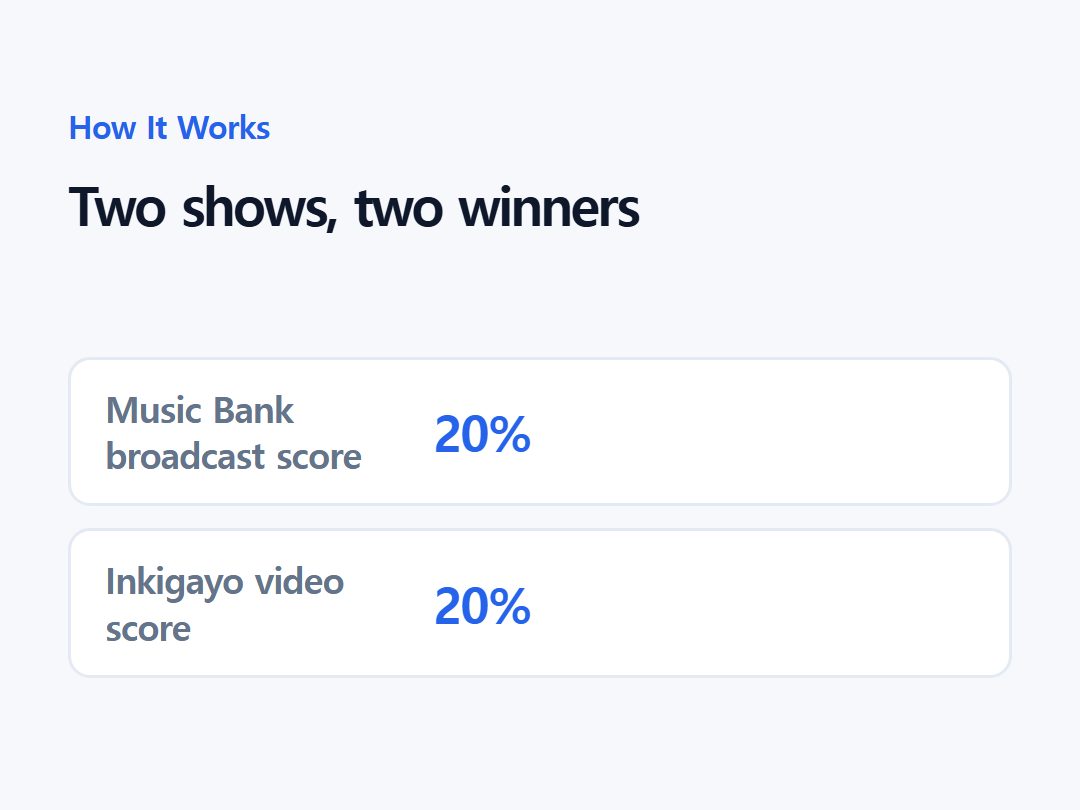
A broadcast score, usually worth 10–20%, measures how often an act appeared on that specific network's television and radio output that week — which is why the same song can score differently on KBS's Music Bank than on MBC's Show!
Music Core. Video views, mostly YouTube and short-form social clips, add another 10–20%. The remainder is voting, usually split between an advance “pre-vote” conducted over several days through an app and a same-day “live vote” cast during the broadcast.
| Show | Digital | Physical | Broadcast | Video | Voting |
|---|---|---|---|---|---|
| M Countdown | 50% | 15% | 10% | 10% | 20% |
| Music Bank | 60% | 5% | 20% | 5% | 10% |
| Inkigayo | 50% | 10% | 10% | 20% | 10% |
| Show! Music Core | 50% | 10% | 10% | 10% | 20% |
| Show Champion | 35% | 15% | 20% | 10% | 20% |
These differences are not cosmetic. A group with a large, internationally distributed fanbase but modest Korean radio presence tends to perform better on Inkigayo, where video views count for 20%, than on Music Bank, where broadcast score carries 20% and video only 5%.
A group whose fandom is skilled at bulk album purchasing has more room to make up ground on M Countdown or Show Champion than on Music Bank, where physical sales are worth just 5%. Agencies and fans both know this, and it shapes how comebacks are planned and promoted show by show.
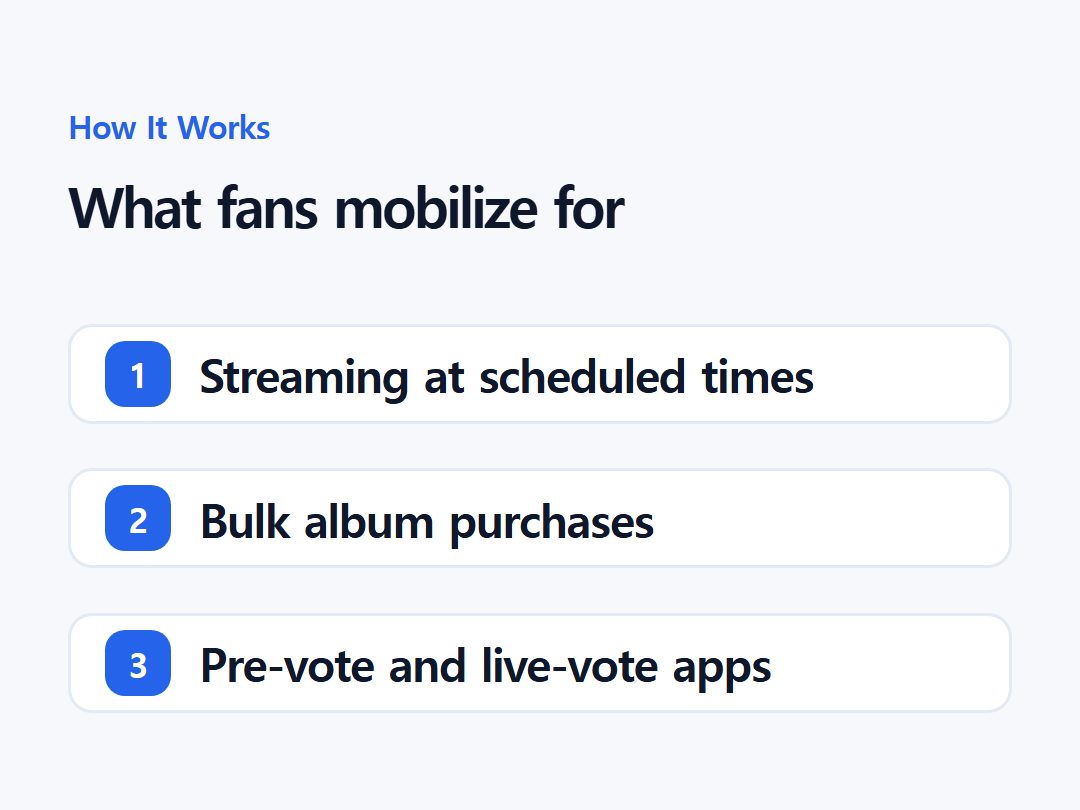
This is also the direct cause of what Korean fandoms call chonggong (촜공, short for “total attack”): a coordinated, often minute-by-minute campaign in which a fandom streams a title track on specific platforms at scheduled times, organizes group purchases of physical albums, and mobilizes members to complete pre-voting and live-voting windows on apps such as Mubeat. None of this is against any rules; it is fans directly manipulating the inputs to a formula they understand in detail, because a music-show win has real value to an artist's career — it becomes a permanent line in press coverage and a milestone tracked across an act's discography.
A win is also, deliberately, not the same claim as “biggest hit of the week.” It can just as easily reflect a light competition week, an unusually well-organized fandom, or a formula that happens to favor that act's strengths.
Wins also compound. On Inkigayo and Show Champion, a song that takes first place three broadcasts in a row earns what fans call a “triple crown” and is then retired from further competition on that chart to let other releases compete.
A separate, unofficial metric called a “Perfect All-Kill” tracks something different again: a song simultaneously sitting at number one on every major real-time, daily, and weekly digital chart at once, counted by the hour it holds that position.
It is compiled by outside chart aggregators rather than any single broadcaster, and fans watch it closely because, unlike a music-show trophy, it cannot be secured through one broadcaster's voting app or broadcast-count quirk — it requires sustained dominance across every platform at the same time.
Not every release is even eligible to compete in the first place. Most shows require a song to already place on a Top 200 weekly digital chart before it can be scored at all, and soundtrack singles or brand-collaboration tracks are typically excluded outright.
That threshold matters for how international readers should interpret a loss: a song absent from these weekly rankings did not necessarily underperform commercially, it may simply not have been entered into that week's competition.
From Gaon Chart To A Vote-Rigging Scandal
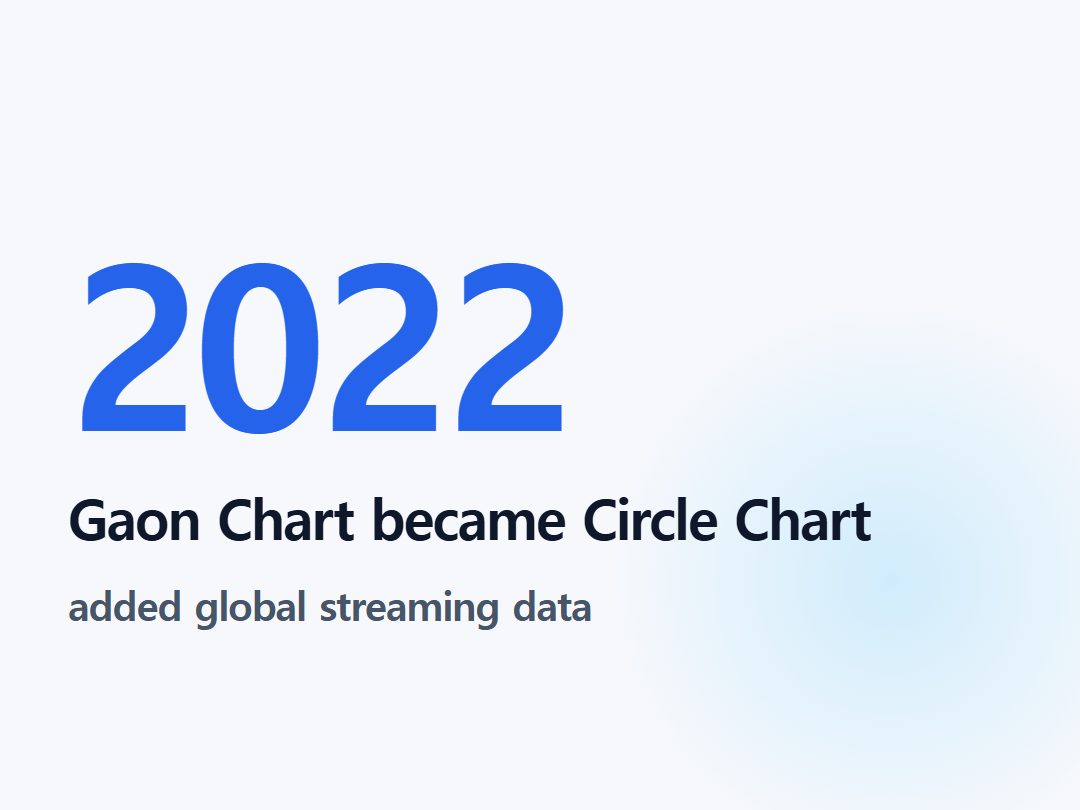
The data infrastructure behind all of this is Circle Chart, which began in 2010 as Gaon Chart, established by the Korea Music Content Association as the country's first standardized, industry-wide chart — explicitly modeled on the U.S. Billboard and Japan's Oricon.
It was rebranded Circle Chart in July 2022, alongside the launch of a Global K-pop Chart, as the association began incorporating data-sharing agreements with YouTube, TikTok, Spotify, and Apple Music, reflecting how much of the fandom generating these numbers now lives outside Korea.
The scoring formulas themselves have been revised repeatedly, almost always in the same direction: away from physical-only, terrestrial-broadcast metrics and toward streaming, and more recently toward global platforms.
Music Bank and M Countdown both updated their formulas in January 2024; Inkigayo followed in October 2024, explicitly folding a Circle Global K-pop Chart component into its digital score to account for international streaming rather than only Korea's domestic services. Show!
Music Core and Show Champion's current weightings date to 2021, themselves the product of several earlier revisions going back to 2019.
Trust in these systems was badly damaged by a real scandal.
In 2019, producers of Mnet's Produce 101 survival franchise — a separate, competition-based show that used public voting to select debut group members rather than crown a weekly single — were found to have manipulated final vote totals to favor certain trainees.
Two producers were criminally convicted in 2020, one group formed through the rigged vote (X1) disbanded after a single album, and Korea's broadcast regulator later fined all four seasons of the franchise.
That case involved a different kind of voting than the weekly music-show trophies, but it is the reason Korean broadcasters have since faced sustained public pressure to keep their scoring criteria published and their vote totals auditable.
The Scoring Formulas Are Still Being Rewritten
Two things remain unsettled. First, exactly how much weight global, non-Korean platforms should carry inside formulas historically built around domestic services is still being renegotiated show by show, and Inkigayo's 2024 revision will likely not be the last.
Second, The Show's 2025 shutdown and 2026 relaunch as a globally formatted program on SBS Life suggests networks are still experimenting with whether a traditional Korean weekly-trophy format even makes sense as K-pop's audience becomes majority non-Korean.
Whether the other four shows eventually follow with their own overhauls, or whether chonggong culture adapts faster than the formulas can be rewritten, is the open question for the next few comeback cycles.
How Each Show Weights Its Weekly Score
| Show | Digital | Physical | Broadcast | Video | Voting |
|---|---|---|---|---|---|
| M Countdown | 50% | 15% | 10% | 10% | 20% |
| Music Bank | 60% | 5% | 20% | 5% | 10% |
| Inkigayo | 50% | 10% | 10% | 20% | 10% |
| Show! Music Core | 50% | 10% | 10% | 10% | 20% |
| Show Champion | 35% | 15% | 20% | 10% | 20% |
Frequently asked
Does winning a Korean music show mean a song was the most popular that week?
Not necessarily — the win reflects a weighted formula of streaming, sales, broadcast time, and voting, so it can just as easily reflect a light competition week or an unusually well-organized fandom as it can raw popularity.
What is chonggong in K-pop fandom culture?
Chonggong ('total attack') is a coordinated, often minute-by-minute fan campaign that streams a title track on schedule, organizes bulk album purchases, and mobilizes pre-voting and live-voting, all aimed at the exact categories a music show's formula scores.
What is a Perfect All-Kill in K-pop charts?
It's an unofficial metric, tracked by outside chart aggregators rather than any broadcaster, showing a song sitting at number one on every major real-time, daily, and weekly digital chart at once, counted by the hour it holds that position.
Sources
Every factual claim above is traceable. We do not translate articles — we gather facts from multiple outlets and write them ourselves.
- List of M Countdown Chart winners (2025) — Wikipedia
- List of Music Bank Chart winners (2025) — Wikipedia
- List of Inkigayo Chart winners (2025) — Wikipedia
- Show Champion/Chart — NamuWiki (English)
- show! Music Core/Chart — NamuWiki (English)
- Guide to Korean Music Show Wins: How the Scores are Calculated — Creatrip
- Guide To K-Pop Music Show Wins: What You Need To Know — Soompi
- 총공 (chonggong) — NamuWiki
- Circle Chart (formerly Gaon chart) introduces its new 'Global K-Pop Chart' + new vision, updates, and more — allkpop
- Mnet vote manipulation investigation — Wikipedia
- Korea Communications Standards Commission Announces Total Of Fine For "Produce 101" Series Vote Manipulation — Soompi
- “The Show” To Reportedly Conclude In November + SBS funE Clarifies — Soompi
- Idol Stars who swept a Triple Crown on all three of the Main Music Shows — allkpop
- The Only Four Songs that Achieved the Coveted Perfect All-Kills in 2025 — allkpop