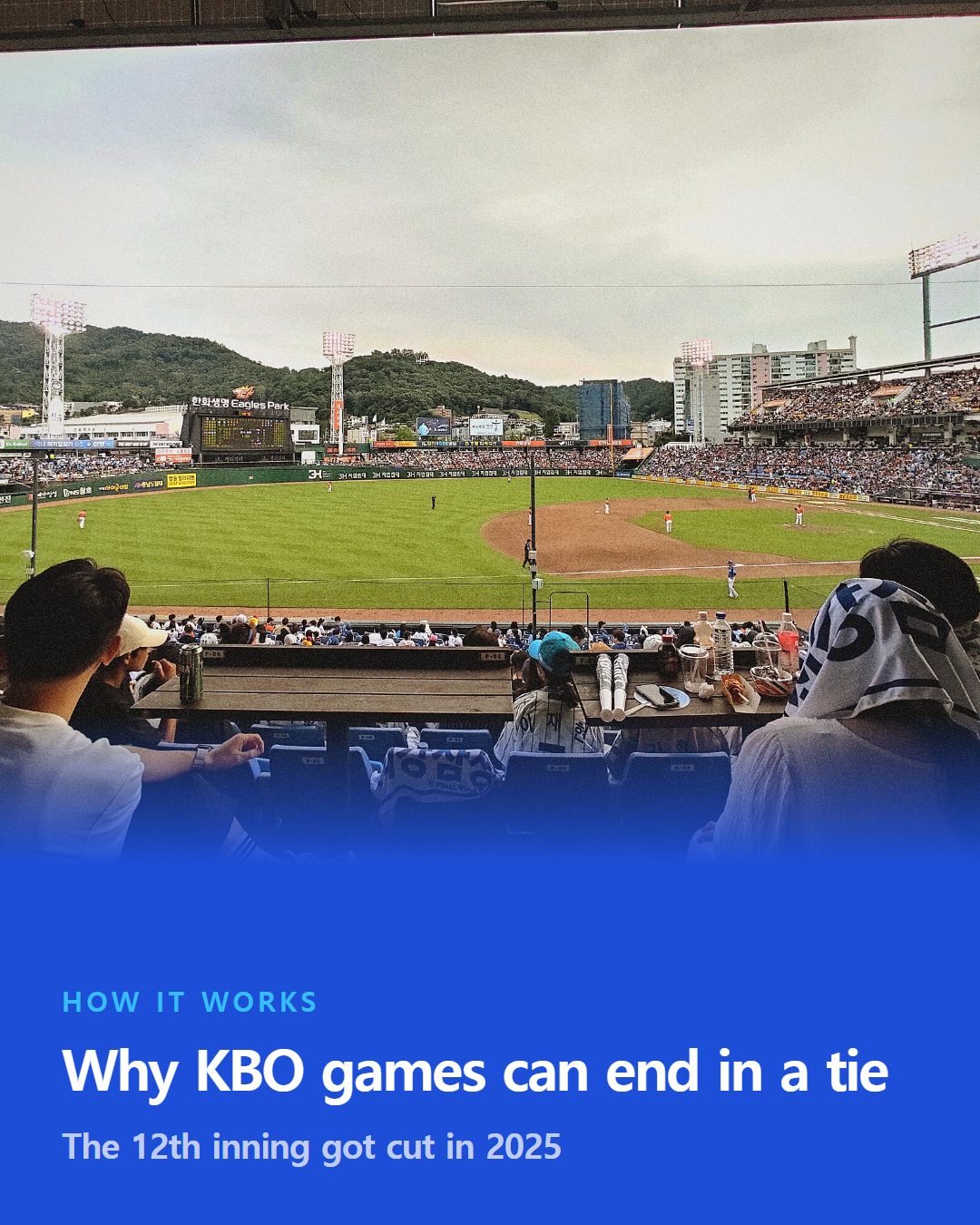
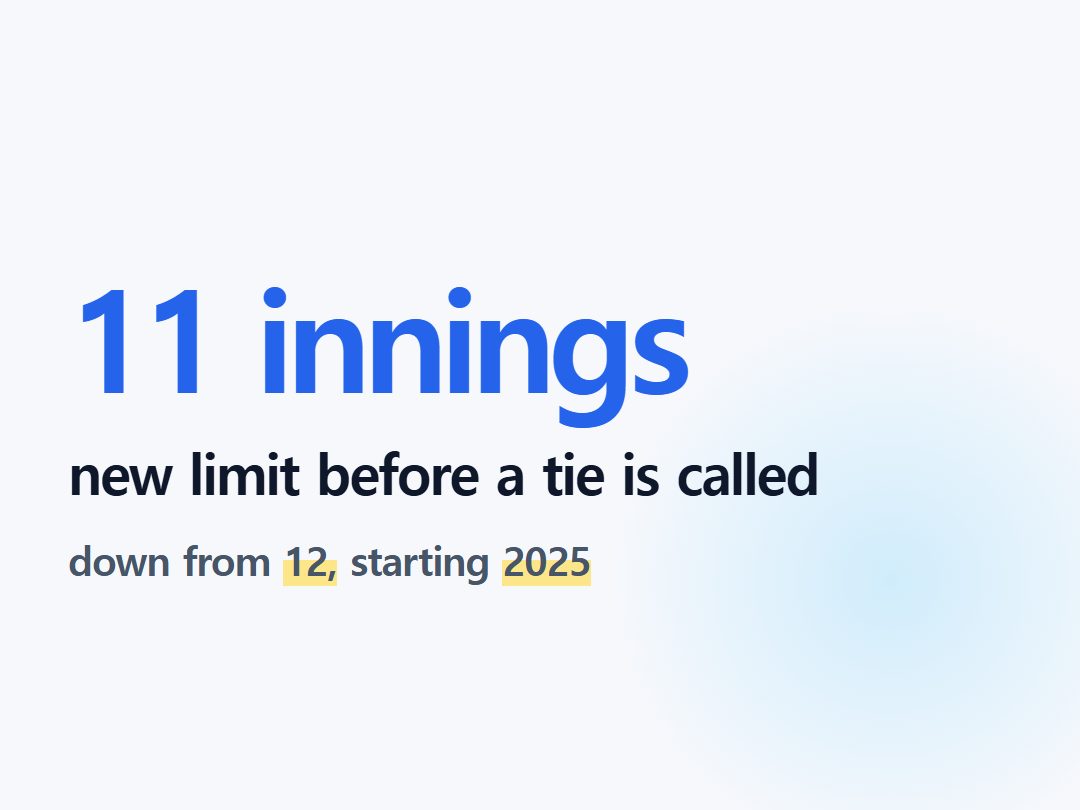
Since the 2025 season, the Korea Baseball Organization (KBO), South Korea's top professional baseball league, declares a regular-season game an official tie if the score is still level after 11 innings. Before 2025, teams played through the 12th inning before a tie was called.
The short version
- KBO now calls regular-season ties after 11 innings, not 12, since 2025.
- A new pitch clock helped shrink average game time to just 3 hours.
- In 2026, a walks surge is already erasing those time savings.
KBO's ten teams play 144 games each between March and October, and most finish in regulation nine innings. The rule only matters for the small share of games that are still tied after nine — but it changed the first time it applied, when the Lotte Giants and KT Wiz finished 4-4 after 11 innings on March 30, 2025, at Sajik Stadium in Busan.
Three hours flat — the shortest average nine-inning game since 1998
The shorter overtime window arrived alongside a bigger change: a pitch clock, used in the KBO for the first time in 2025. Together, the two rules cut the league's average nine-inning game from 3 hours 10 minutes in 2024 to 2 hours 57 minutes in 2025.
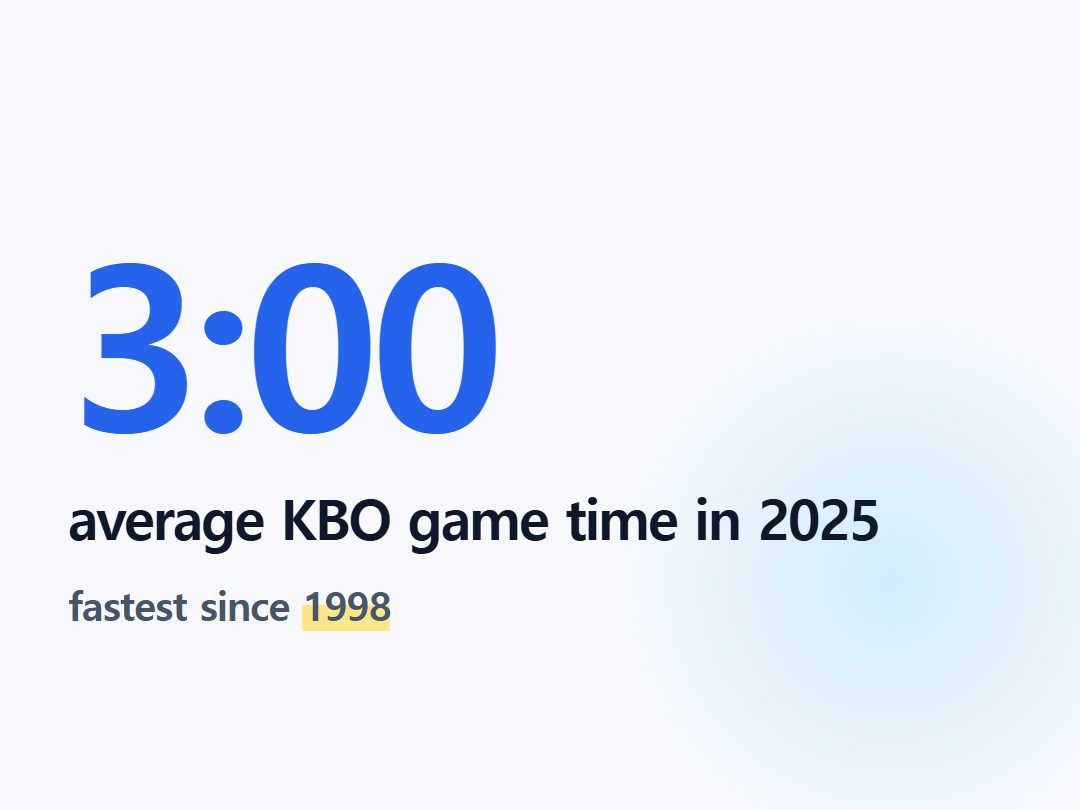
Once extra-inning games are folded in, the league's overall average dropped from 3 hours 13 minutes to exactly 3 hours 0 minutes. That is the fastest KBO has played since 1998, the year before the league expanded past its original run of teams.
A countdown clock and a shorter overtime, working on different problems
A pitch clock is a visible timer, similar in concept to a shot clock in basketball, that forces a pitcher to begin his throwing motion within a set number of seconds. Miss the deadline and the umpire calls an automatic ball, whether or not a pitch was thrown.
The pitch clock speeds up every half-inning of every game. The 11-inning cap works on a separate lever entirely: it removes one full inning from the smaller number of games that reach overtime at all.
The two effects are measured separately in KBO's own numbers. The extra-innings change alone is credited with cutting 13 minutes off the average length of games that needed overtime — on top of whatever the pitch clock saved in every game.
Why a tie counts as neither a win nor a loss
KBO ranks its ten teams by winning percentage — wins divided by wins plus losses. Ties are removed from that formula entirely, so a team that finishes several games level still has its percentage calculated only from decisive results.
That is a different assumption than many international readers bring to a league table, and it is why Korean fans and columnists argue about ties more than casual observers might expect.
A tie changes nothing in a team's loss column, but it also denies both sides a chance at a win — which is closer to why club managers, not fans, pushed hardest for a rule that produces slightly more of them.
The 20-second and 25-second countdown behind every pitch
The 2025 pitch clock rules that pair with the shorter overtime window are specific:
- Pitchers get 20 seconds to start their delivery with the bases empty
- Pitchers get 25 seconds to start their delivery with a runner on base
- Batters must be set in the box, ready, within 33 seconds
- Batters get two timeouts per plate appearance, not unlimited timeouts
Enforcement turned out to be light in practice. The league recorded just 0.4 pitch clock violations per game across 2025, and 98 percent of batters used only a single timeout per at-bat.
46 of 59 extra-inning games were already over by the 11th
The case for cutting the 12th inning was built on one season of data. In 2024, 59 KBO games went to extra innings, and 46 of them — 78 percent — were already decided by the end of the 11th.
Put another way, the 12th inning was rarely doing much work. It mostly extended a small number of already-long nights without changing how most extra-inning games actually ended, which made it an easy inning for managers to argue away.
From an unlimited 2008 season to a hard cap the year after
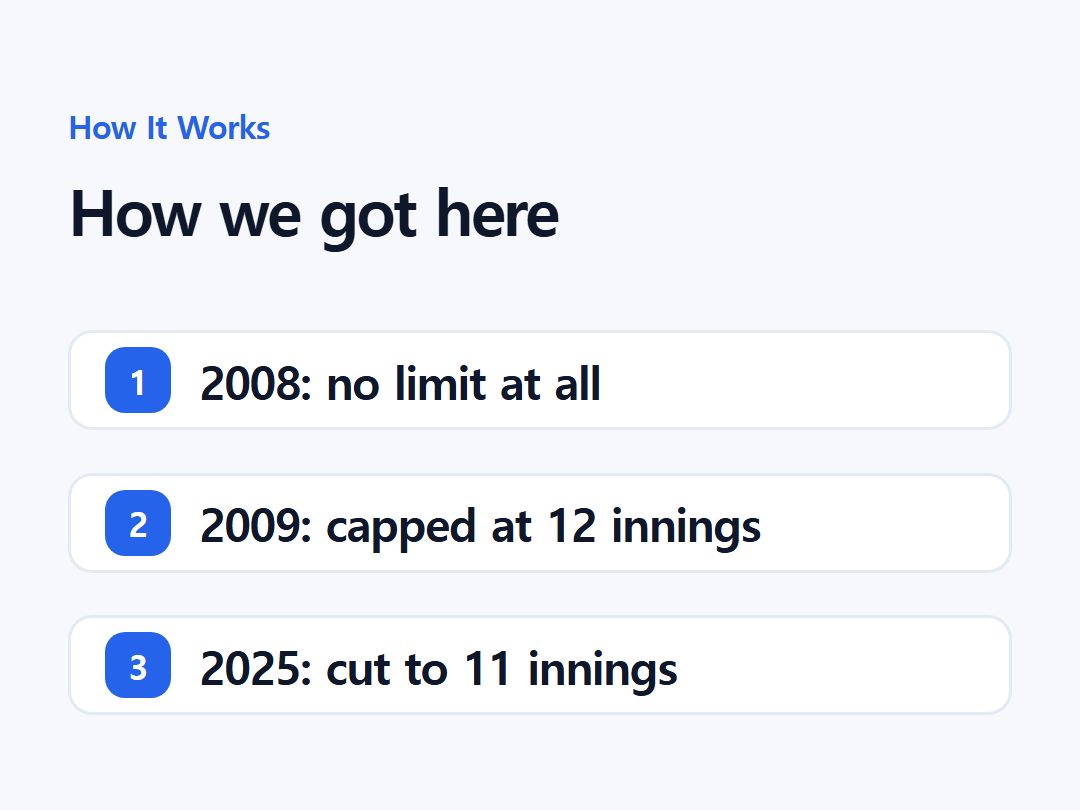
The 11-inning rule is the third version of KBO's tie policy in under two decades. Before 2008, the league had no innings cap at all; games simply ended at a fixed curfew of 10:30 p.m., regardless of the score or the inning.
For the 2008 season only, KBO scrapped limits entirely and let every game run until someone won. Most nights this changed little, but a Woori Heroes–KIA Tigers game on June 12, 2008 ran 14 innings and 6 hours 17 minutes, finishing after midnight — still the longest game in KBO history by playing time.
Team managers pushed back hard. At a meeting with the league commissioner after the season, they briefly floated an Olympic-style tiebreaker — runners placed on first and second with no outs to start extra innings — and tested it in exhibition games and the All-Star Game.
For the regular season, though, the league chose a simpler fix: a 12-inning cap starting in 2009, the limit that held until 2025.
The postseason still plays on to the 15th inning
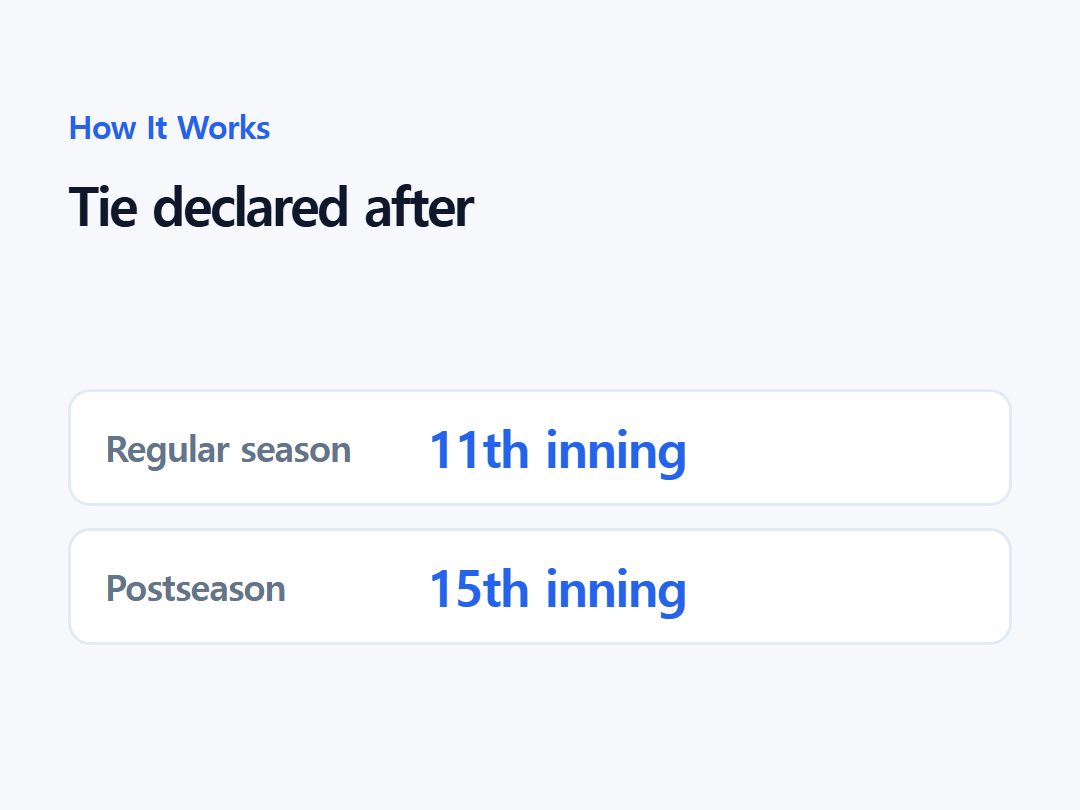
The 2025 change touches only the regular season. In the postseason, including the Korean Series, KBO still allows extra innings up to the 15th before calling a tie — a gap that exists because a tied elimination game is a bigger problem than a tied game in June.
| Tie declared after | |
|---|---|
| Regular season | 11th inning (since 2025) |
| Postseason | 15th inning |
A tied postseason game does not stand as a completed result — it is replayed from the first inning. That is part of why the league still protects extra postseason innings that it was willing to cut from the regular season.
A walks epidemic is already eating back the time savings
Early in the 2026 season, KBO's own tracking shows the 2025 gains have not held. Nine-inning games averaged 3 hours 12 minutes through the first 40 games of 2026 — 10 minutes longer than the same point in 2025.
The problem is not the clock; it is the pitching. Walks rose roughly 30 percent, from 7.5 per game in early 2025 to 9.6 in early 2026, and league ERA climbed from 4.35 to 5.20 over the same stretch, with individual pitchers like KT's Matt Sauer issuing seven walks against four strikeouts in a single 11-inning outing.
More walks mean more pitching changes, and pitching changes are the one thing a pitch clock cannot speed up — it only limits how long each individual pitcher can stall. KBO's response was to tighten the clock further for 2026, to 18 seconds with the bases empty and 23 with runners on, but that adjustment targets seconds, not the innings pitchers are struggling to get through.
What the current fix still doesn't settle
Two questions stay open even after the 2025 change. One is whether 11 innings is the right long-term number, or simply a smaller version of the same compromise the league made in 2009: shrinking the marathon-game problem without removing the possibility of a tie.
The other is whether ties belong outside the winning-percentage formula at all. Korean commentators have raised that objection for years, arguing that a ranking system which quietly excludes some completed games is an unusual way to decide a champion — and the 2025 change, by design, produces slightly more ties, not fewer.
For now, KBO has treated an 11th-inning tie as an acceptable outcome rather than a problem still waiting to be solved, and the league's attention in 2026 has shifted to a different fix: getting pitchers to throw strikes fast enough for the clock to matter.
KBO's tie rule over time
| Period | Tie called after |
|---|---|
| Before 2008 | No cap — games ended at a 10:30 p.m. curfew |
| 2008 season | No limit — games played until decided |
| 2009–2024 | 12th inning |
| 2025–present | 11th inning |
| Postseason (all years) | 15th inning |
Frequently asked
Why do KBO baseball games end in a tie now?
Since 2025, KBO declares a regular-season game an official tie if the score is still level after 11 innings, down from the 12-inning cap used from 2009 to 2024.
How long do KBO postseason games play before a tie is called?
Postseason games, including the Korean Series, still allow extra innings up to the 15th before a tie is declared, and a tied postseason game is replayed from the first inning rather than standing as a final result.
What are the KBO pitch clock time limits?
Starting in 2025, pitchers got 20 seconds to begin their delivery with the bases empty and 25 seconds with a runner on base, with batters required to be set within 33 seconds; for 2026 those pitcher limits were tightened to 18 and 23 seconds.
Sources
Every factual claim above is traceable. We do not translate articles — we gather facts from multiple outlets and write them ourselves.
- 2025 규정∙규칙 변화 (2025 Rule Changes) — KBO (Official)
- Average KBO game time drops 13 minutes in 1st year of pitch clock — The Korea Times
- KBO preseason to open Saturday with pitch clock, other rule changes in play — The Korea Herald
- KBO Implements Intriguing Rule Changes for the 2025 and 2026 Seasons — World Baseball
- With walks aplenty, KBO games taking longer despite pace-of-play rules — The Korea Times
- KBO to take 2 ticks off pitch clock in 2026 — The Korea Times
- KBO Leaders Want to Scrap No-Limit Rule in Extra Innings — The Korea Times