
On January 30, 2026, host Jeon Hyun-moo appeared on the 300th-episode special of KBS Joy's talk show Rooftop Room's Problem Kids and did the math on his own workload out loud. "I'm currently hosting 11 fixed programs," he said. "At the most, I've had 13 running at once, and on the heaviest days I record up to four of them."
The short version
- Jeon Hyun-moo hosts 11 shows and tapes up to four in one day.
- Studio reaction segments take a few hours, not a full location shoot.
- Hosts react to footage shot without them, letting one day cover many shows.
Four tapings in one day sounds physically impossible until you look at what "taping" actually means on several of those shows. A large share of Jeon's schedule, and of other high-volume Korean hosts, is not spent filming a full day of activity. It is spent sitting in a studio, watching footage someone else already shot, and reacting to it on camera.

A workload that adds up to four tapings a day
Jeon's current lineup, according to a January 2026 report picked up by Star News, includes:
- I Live Alone
- 사장님 귀는 당나귀 귀, a workplace-observation show
- 프리한19
- 톡파원 25시
- Omniscient Interfering View (전지적 참견 시점)
- 전현무계획, his own talk show
By July 2026, a twelfth program had joined the list, and outlet TenAsia reported that Jeon's voice sounded strained during its first broadcast, prompting questions in the entertainment press about how sustainable the pace really is.
Jeon has said in several interviews that he only takes four or five days off a month, and that free time makes him anxious rather than relaxed. What rarely gets spelled out for readers outside Korea is the production detail that makes his number plausible at all: most of those 11 shows do not require him on a film set for a full day.
Two different things both get called "filming a variety show"
A traditional Korean variety shoot built around games, missions, or travel requires a full crew, a full day of a host's calendar, and however long the activity itself takes. It is the model that made stars of hosts like Yoo Jae-suk on shows built around outdoor challenges.
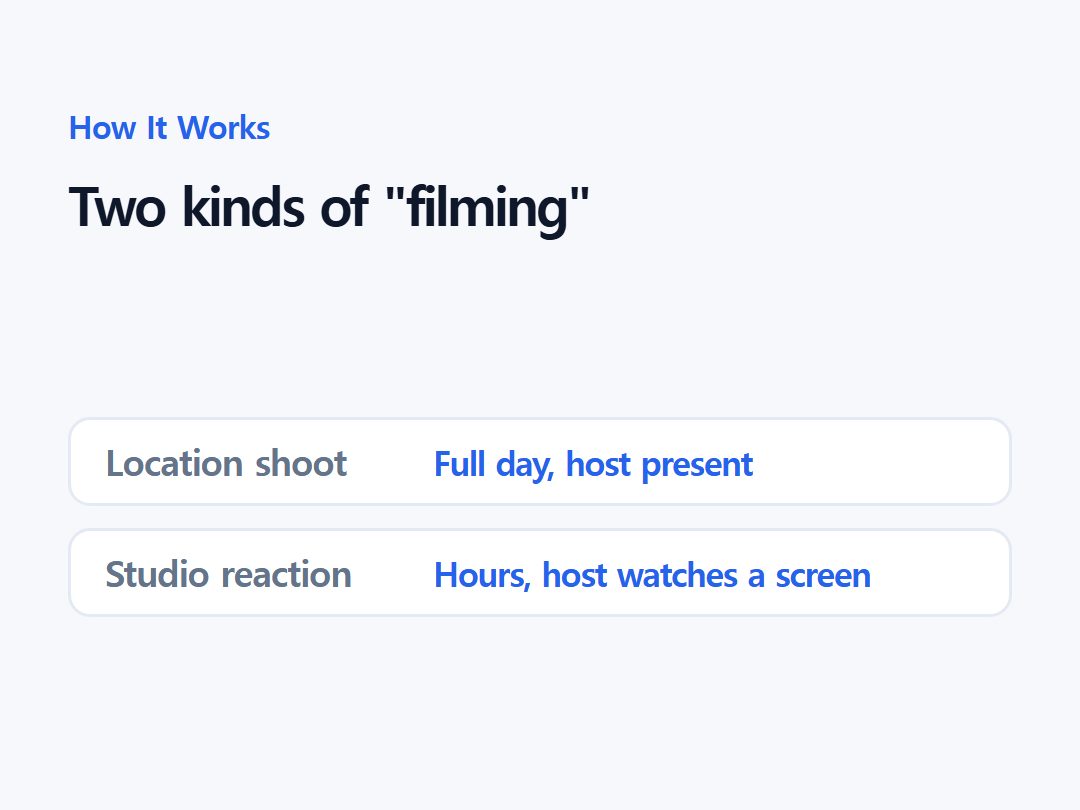
A second, much shorter kind of taping has become just as common: a host sits in a studio, watches a package of footage recorded earlier by a separate crew, and records a live reaction to it. Casting reports and Jeon's own count both call these "recordings," but they cost a host a completely different amount of time.
| Location shoot | Studio reaction taping | |
|---|---|---|
| Crew | Full production crew on site | One studio crew, no location team |
| Time needed | A full day or more | A few hours |
| Host's role | Performs the activity live | Watches and reacts to a finished video package |
A studio taping runs about half as long as a location shoot
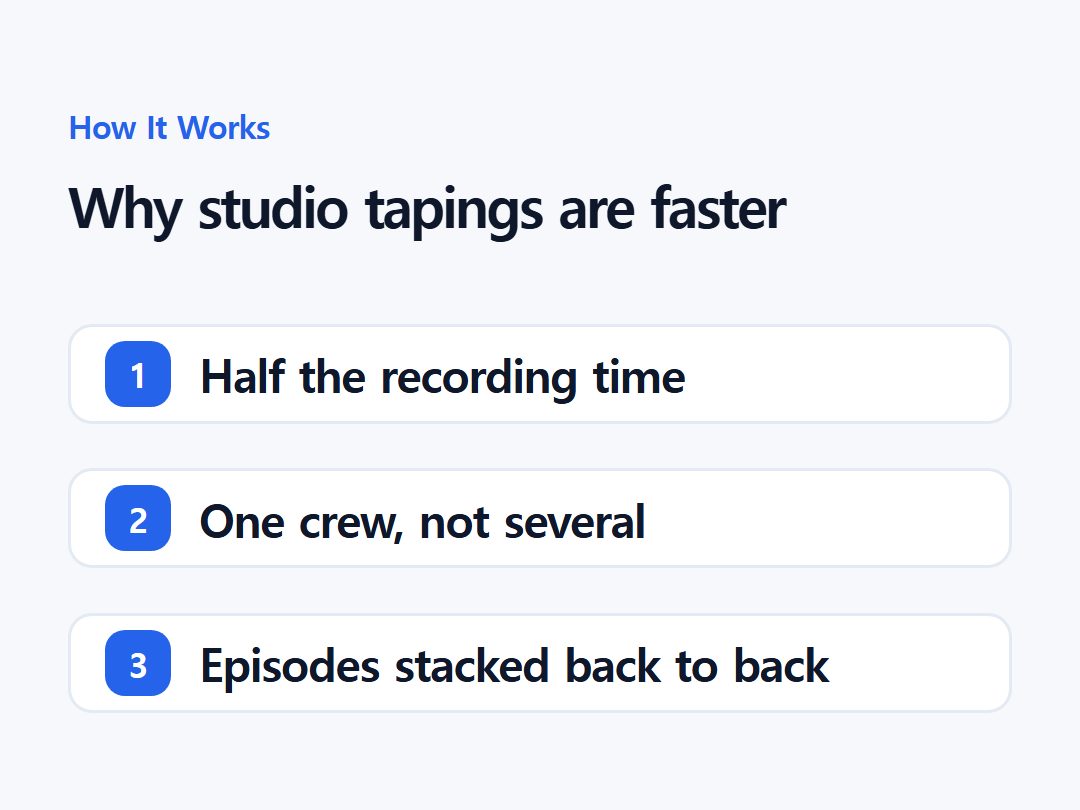
CJ E&M producer Park Jong-hoon put a number on that gap in a 2014 interview with Sports Kyunghyang, explaining why cable networks were shifting toward studio formats. Studio programs take roughly half the recording time of an outdoor production, and one camera crew can shoot in a single continuous session instead of the several teams a location shoot needs. That same efficiency is why a single studio day can often produce more than one episode's worth of material at once.
The shift was not confined to cable's smaller budgets. The same report noted that Yoo Jae-suk and Kang Ho-dong, both built on years of outdoor, mission-driven variety, had by then launched new studio-format shows pairing them with non-celebrity guests — evidence that the time savings were reshaping choices across the whole industry, not just for hosts trying to fit in more bookings.
The footage a host reacts to was often shot without any host present
Studio reaction segments move fast because someone else already did the slower work first.
In Korea's observational variety shows, a separate field crew films a cast member's ordinary day using fixed or remote-controlled cameras — camera operators sometimes hide inside boxes or furniture to stay out of frame, according to reporting by Kyunghyang Shinmun on how the format is actually shot.
A nearby monitoring room watches the footage live, but no host and no studio panel is anywhere near the set.
That raw footage is edited into a finished package before anyone in a studio ever sees it. Only then does a host sit down to watch it, for what is staged as the first time, while cameras record the reaction. The host's segment has nothing to do with the day the field footage was shot — it is a separate, self-contained taping that can be scheduled on its own.
My Little Old Boy turns that separation into the whole format
SBS's My Little Old Boy, airing since August 2016, pushes the split furthest. Field footage follows adult celebrity sons through their daily routines, but the sons themselves are not in the room when the reaction segment is filmed. Instead their real mothers gather in studio, watch the footage together, and react to it live, guided by hosts Shin Dong-yup and Seo Jang-hoon.
Hosting that segment requires no travel, no waiting on a subject's schedule, and no coordination with the celebrities actually on screen. A studio session can be booked, run, and wrapped in the time it takes to watch and discuss one pre-cut video package — precisely the kind of taping that fits between a host's other commitments on a busy day.
I Live Alone reserves a whole day just for the reaction
MBC's long-running I Live Alone shows the same logic from a different angle. Since 2017, the cast has recorded a dedicated weekly studio segment, nicknamed 무지개 라이브 ("Rainbow Live"), in which members gather to watch the individually filmed footage of each other's week and react to it together.
The field footage of each member's actual week is shot on its own separate schedule. The Monday studio day exists only to record everyone's reactions to it. That structure means a cast member's real "day at work" for the week can be a few hours of studio conversation, layered on top of footage a much smaller crew captured days earlier on its own timeline.
Fewer hours per episode is what makes a volume career possible
None of this changes what viewers watch — the finished episode still looks like one continuous conversation. But it changes what a per-episode hosting fee is actually paying for, and that distinction is the real reason a small group of Korean hosts can carry a dozen programs where a location-based host manages only a handful.
A host built around outdoor, mission-driven variety is paid a premium rate for a format that fills a full day, cannot be split across other bookings, and cannot easily be doubled up.
A host built around studio reaction segments is paid per shorter, stackable session, and can fill a single day with several of them back to back — close to what Jeon Hyun-moo described when he said his busiest days include four separate recordings.
Neither approach is more demanding than the other in any simple sense. They are two different ways of surviving inside a broadcasting system that pays by the episode: one host maximizes what a single appearance is worth, the other maximizes how many appearances a single day can hold, and the studio-reaction format is what makes that second strategy physically possible.
What a packed reaction schedule doesn't fix
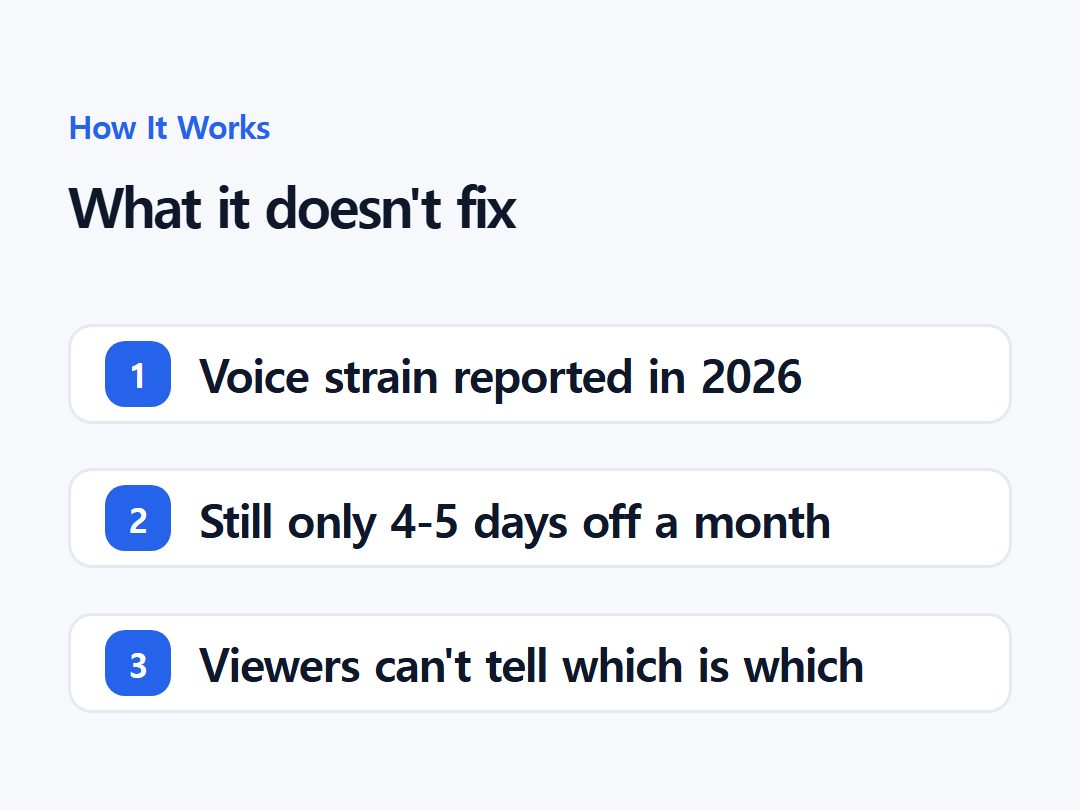
The format's efficiency has a ceiling. TenAsia's July 2026 report on Jeon Hyun-moo's newest show noted concern among viewers after his voice sounded noticeably strained during its debut broadcast — a detail outlets connected directly to the size of his existing schedule rather than to the new show itself.
Jeon has also said publicly that he takes only four or five days off a month, and that he keeps broadcasting partly because he does not know how else to spend free time. Whether that pace holds up over years, rather than months, is a question no production efficiency can answer on its own.
There is also a gap the format leaves for international viewers specifically. A subtitled episode gives no visual cue about which segments a host filmed on location and which they recorded afterward, alone in a studio, reacting to a screen. The two kinds of "hosting" look identical in the final cut, even though one costs a production crew a full day and the other costs a host a single stackable hour.
Location shoot vs. studio reaction taping
| Location shoot | Studio reaction taping | |
|---|---|---|
| Crew | Full production crew on site | One studio crew, no location team |
| Time needed | A full day or more | A few hours |
| Host's role | Performs the activity live | Watches and reacts to a finished video package |
Frequently asked
How many shows does Jeon Hyun-moo host?
As of January 2026 he was hosting 11 fixed programs, up from a peak of 13, and by July 2026 a twelfth show had joined his lineup.
How can Korean TV hosts film so many shows at once?
Many of their tapings are short studio sessions where the host watches footage shot earlier by a separate crew and reacts to it, rather than spending a full day on location.
How does My Little Old Boy film its studio reaction segments?
The celebrity sons' mothers gather in a studio to watch pre-shot footage of their sons' daily routines and react to it live, guided by hosts Shin Dong-yup and Seo Jang-hoon, with the sons not present.
Sources
Every factual claim above is traceable. We do not translate articles — we gather facts from multiple outlets and write them ourselves.
- 전현무, 고정 프로그램 11개…"한 달에 4-5일 쉴 땐 무조건 여행" [옥문아] — Star News (via Daum)
- 전현무, 고정프로만 11개 "'사이코패스' 흥미로워, 내 알고리즘은 스릴러" — News1
- 전현무, 12개 고정 괜찮나…'내사패' 첫방부터 쉰 목소리에 몰입 '뚝'→컨디션 '우려'[TEN피플] — TenAsia
- 짜고 치는 스튜디오 예능? 요즘엔 달라요! — Sports Kyunghyang
- [B급 질문을 하다] '관찰예능' 어떻게 찍나 — Kyunghyang Shinmun
- 관찰 예능 — Namuwiki
- 나 혼자 산다 — Namuwiki
- My Little Old Boy — Wikipedia