
South Korea's New Trainee Contract Rules for 2026
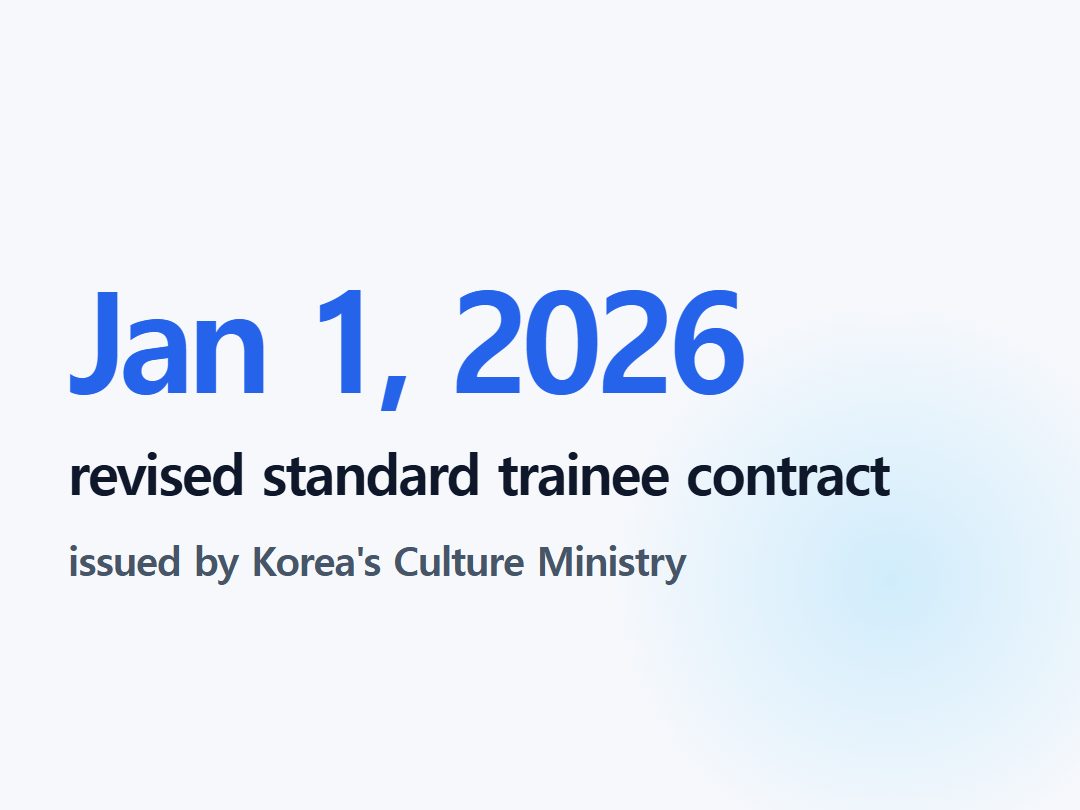
On January 1, 2026, South Korea's Ministry of Culture, Sports and Tourism brought a revised standard contract for K-pop and acting trainees into force.
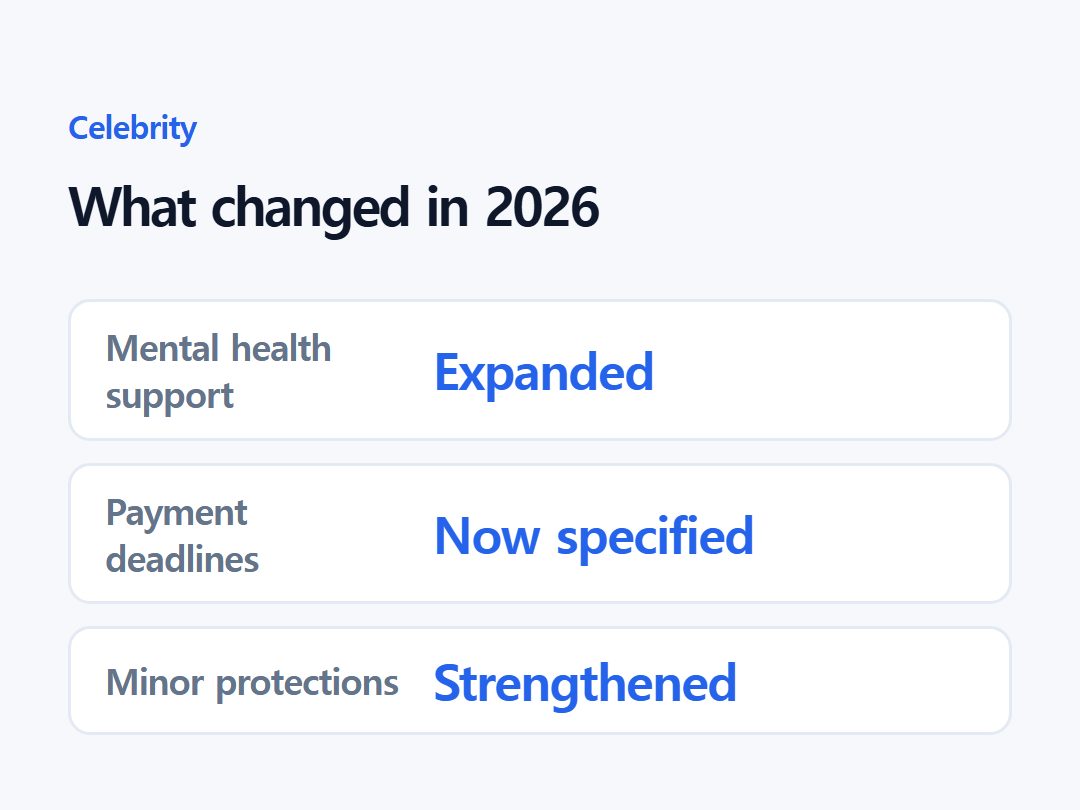
The update, a follow-up to a broader entertainment-industry law that took effect in August 2025, expands mental health support obligations, sets clearer deadlines for agencies to pay compensation, and adds specific protections against coercion, harassment, and interference with a minor's education.
It is the latest in a series of legal adjustments to a system that has existed, largely unchanged in its basic shape, since the mid-1990s: the trainee system, through which Korean entertainment agencies recruit teenagers, sometimes children, and train them for years with no guarantee that any of them will ever debut.

The short version
- South Korea's revised trainee contract took effect January 1, 2026, expanding protections.
- Most trainees never debut; debut rates run in the low single digits.
- A 2009 ruling capped agency contracts at seven years, reshaping industry norms.
For readers outside Korea, a "trainee" is easy to misread as an intern or a reality-show extra. In the Korean system it is a distinct legal and social category: a person, often a minor, who has signed a contract with an agency such as HYBE, SM, JYP, or YG, and who spends anywhere from one to seven years training in singing, dancing, rap, and stage presence before the company decides whether to debut them at all.
How Does the K-Pop Trainee System Actually Work?
The trainee system is the part of K-pop that international fans see the least of, yet it explains almost everything about how the genre looks and sounds. Groups debut with synchronized choreography, foreign-language fluency, and performance polish that most Western pop acts only develop over a career, because idols have typically already spent years rehearsing before their first single is released.
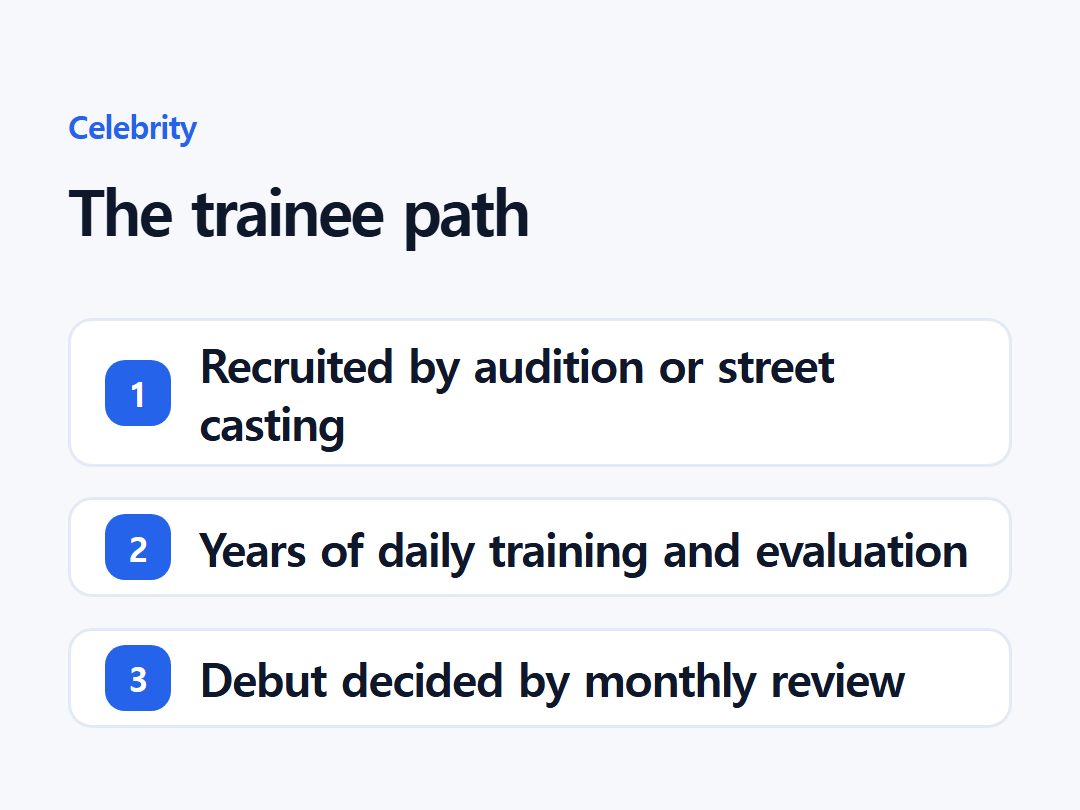
Recruitment. Agencies find trainees through three main channels: open auditions held in Korea and abroad, "street casting" by company scouts in schools and shopping districts, and televised competition shows. Some trainees are recruited as young as 11 or 12; others join in their late teens or early twenties.
Auditions weigh two things above current skill: trainability, meaning how much a candidate is likely to improve, and attitude, since agencies are effectively signing a multi-year bet on a child's potential rather than a finished performer.
Daily life. Most trainees live in company-run or company-subsidized dormitories, several to a room, on a schedule built around school.
A typical day runs through regular classes in the morning, then vocal, dance, and language lessons at the agency from the afternoon into the evening, with 8- to 12-hour training days common during intensive periods.
Trainees are also expected to build fluency in Korean delivery and, at larger agencies with global ambitions, in Japanese, English, or Mandarin.
Evaluation. The defining feature of the system is that training does not end with a fixed curriculum; it ends with a decision.
Most agencies hold monthly evaluations, known in Korean as wolmal pyeongga, where trainees perform in front of vocal coaches, choreographers, and company executives and are scored on singing, dancing, and stage presence.
A strong evaluation can fast-track a trainee toward debut; a weak one, even after years of training, can end a trainee's contract. There is no tenure in the system. A trainee who has spent three or four years with a company can still be cut the month before a group's lineup is finalized.
Cost and debt. Training is expensive, and agencies typically treat it as an advance rather than a gift. Housing, food, lessons, styling, and, for competition-show trainees, production costs are tracked against a trainee's future earnings.
Industry estimates put annual training costs per trainee in the tens of thousands of dollars, with a debuting idol sometimes carrying accumulated costs equivalent to tens of thousands more by the time a group releases its first single.
If a trainee never debuts, that debt is generally not collected, but the years of unpaid training are not compensated either. Reforms since 2009 have gradually reclassified some of these costs as company investment rather than personal debt, though practices still vary by agency.
Odds. Not debuting is the normal outcome, not the exception. Agencies train far more people than they ever put on stage, and accounts from former trainees and industry analysts describe debut rates in the low single digits as a share of everyone who signs a trainee contract.
Some who don't debut move to smaller labels, some pursue music independently, and most leave the industry and return to ordinary school and work life, often after several years built entirely around one goal.
Survival shows. Since the mid-2010s, part of the trainee pipeline has become public. Programs such as Mnet's Produce 101 franchise put dozens of trainees from competing agencies on television, where viewers vote members into a temporary project group.
Contestants are typically unpaid for their appearances, and any earnings that do result flow through their home agency's existing contract, meaning the show adds visibility to the trainee system without changing its underlying economics.
From Lee Soo-man's System to Today's Contract Laws
The modern trainee system is usually traced to Lee Soo-man, the producer who founded SM Entertainment in 1989.
After studying in the United States, Lee combined the American model of tightly managed pop acts with Japan's idol-training culture into a single pipeline: scout young talent, train them in-house for years, and debut only a finished, market-tested group.
SM's H.O.T. in 1996 and S.E.S. in 1997 were early proofs the model worked, and rival agencies, including what became JYP and YG, built comparable systems through the late 1990s and 2000s.
The system's harshest period, and the one that produced most of its current legal guardrails, centered on contract length rather than training itself.
In 2009, three members of the group TVXQ sued SM Entertainment to void a 13-year exclusive contract, arguing it gave the agency near-total control over their schedules and earnings while returning little of the profit to the group.
The case, widely covered in Korea as an example of a "slave contract," ended in a 2012 settlement, but its legal impact arrived sooner: later in 2009, Korea's Fair Trade Commission introduced a standard exclusive contract capping entertainment deals at seven years, following an investigation that found unfair clauses affecting 230 entertainers across 19 agencies.
JYP Entertainment became the first major agency to formally adopt the standard contract, in November 2009.
That seven-year cap is why so many K-pop groups face a well-known contract-renewal moment, sometimes called the "seven-year itch" in fan communities, around a group's seventh anniversary, when members individually decide whether to re-sign.
Protections for trainees who are minors developed on a separate, slower track. The Popular Culture and Arts Industry Development Act, passed in 2014, first set formal limits on how many hours underage entertainers could work and required continued schooling.
A 2023 amendment, prompted by a financial dispute in which singer Lee Seung-gi said he had gone unpaid for years of work under an 18-year contract, added requirements for agencies to disclose earnings statements at least annually and to appoint a designated "youth protection officer" at companies that manage minors.
How Many Hours Can Child Trainees Legally Work?
The system keeps being renegotiated in real time rather than settled once.
The contract revision that took effect on January 1, 2026 focuses specifically on trainees rather than debuted artists, a signal that regulators see the pre-debut years, not just post-debut contracts, as the part of the system still most in need of oversight.
Its provisions on mental health support and payment deadlines respond directly to complaints that had circulated for years without a clear legal remedy.
Separately, proposals to further tighten working-hour limits for underage performers, including a 2024 bill that would set age-tiered weekly caps as low as 15 hours for the youngest child performers, remain contested.
Major entertainment companies have publicly opposed subdividing work hours by age so finely, arguing it would hinder training, while child-welfare advocates say existing limits still allow for a demanding schedule for children as young as six or seven.
How that debate resolves will shape how young the next generation of trainees can legally begin.
Key legal milestones for K-pop trainee protections
| Year | Development | Effect |
|---|---|---|
| 2009 | Fair Trade Commission standard contract | Capped exclusive agency contracts at seven years |
| 2014 | Popular Culture and Arts Industry Development Act | Set work-hour limits and schooling requirements for minors |
| 2023 | Amendment to the 2014 Act | Required annual earnings disclosures and a youth protection officer |
| 2026 | Revised standard trainee contract | Expanded mental health support and payment deadlines |
Frequently asked
What is a K-pop trainee?
In Korea, a trainee is a person, often a minor, under contract to an agency like HYBE, SM, JYP, or YG, training for one to seven years before the company decides whether to debut them.
How long do K-pop trainees train before debuting?
Training typically lasts one to seven years, with monthly evaluations, called wolmal pyeongga, determining who advances toward debut.
What percentage of K-pop trainees actually debut?
Accounts from former trainees and industry analysts describe debut rates in the low single digits as a share of everyone who signs a trainee contract.
Sources
Every factual claim above is traceable. We do not translate articles — we gather facts from multiple outlets and write them ourselves.
- Bill proposes stricter limits on work hours for child idols, actors — The Korea Herald
- S. Korea: New bill aims to further limit work hours of minor K-pop idols — Business & Human Rights Resource Centre
- Is There a Solution for 'Slave Contracts'? — The Korea Times
- JYP adopts new entertainer contracts — Korea JoongAng Daily
- Strengthening Trainee Rights Protection: Culture Ministry to Announce Standard Contracts on January 1 — Asia Economy (Asiae)
- New Bill To Protect Underage K-Pop Idols Approved By Ministry Of Culture — Koreaboo
- "Produce 101" Contract Terms Revealed, Trainees Get Paid Nothing for Appearance — Soompi