Walk through a busy transfer station like Gangnam or Hongdae in Seoul and you'll pass lightbox ads selling nothing. A photo of a K-pop idol, a date, and a line like “생일 축하해” — happy birthday. No album, no brand, no QR code.
The short version
- A single fan crowdfunds and organizes each birthday ad, not the agency.
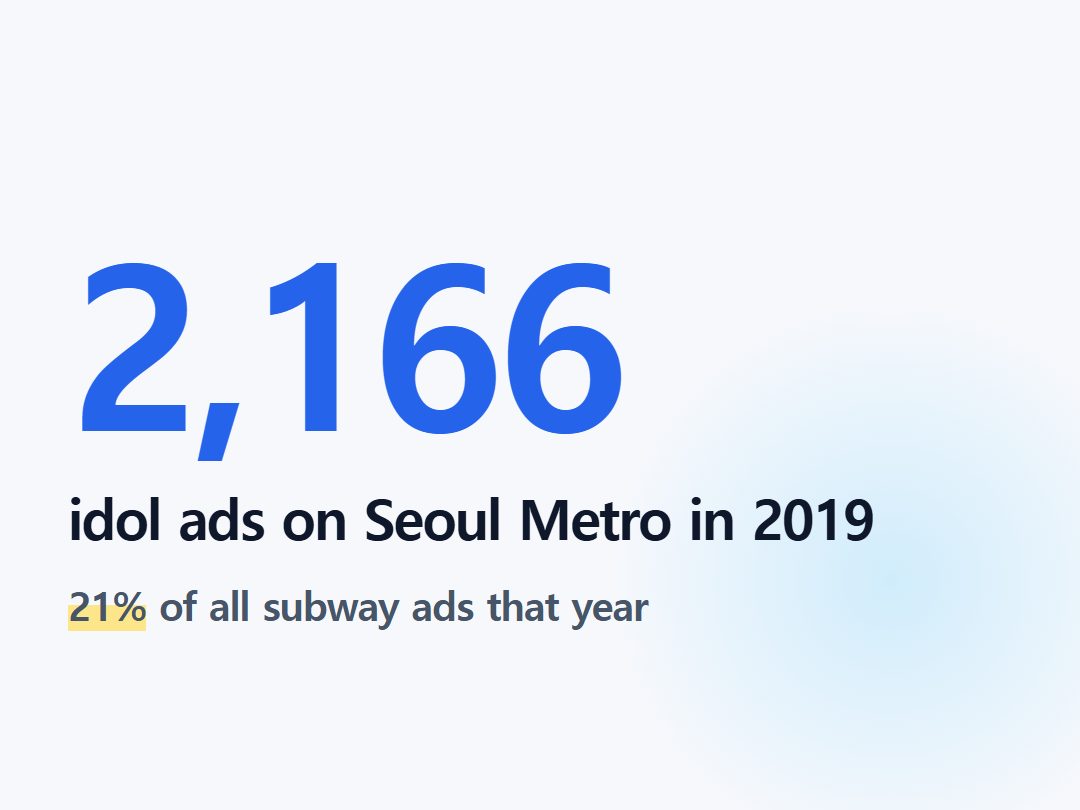
- Idol subway ads hit 2,166 in 2019, 21% of all ads placed.
- Line contract changes can raise prices 50%+, pushing fans to cheaper stations.
These are called 생일광고, birthday ads, and no entertainment company pays for them. A fan does.
A subway ad with nothing to sell
Unlike a comeback poster or an endorsement billboard, a 생일광고 promotes nothing except affection. The message is almost always the same: a birthday, a debut anniversary, or a comeback, paired with a thank-you.
Fans call this category 응원광고, support ads, and it now covers subway lightboxes, poster frames, wrapped buses, and pop-up cafes — anywhere a fan can rent space to say thank you in public.
The buyer is a fan, not the agency
This is the detail international readers most often miss: the idol's management company has no role in these ads and does not confirm they exist. Agencies don't design them, don't pay for them, and don't officially endorse them.
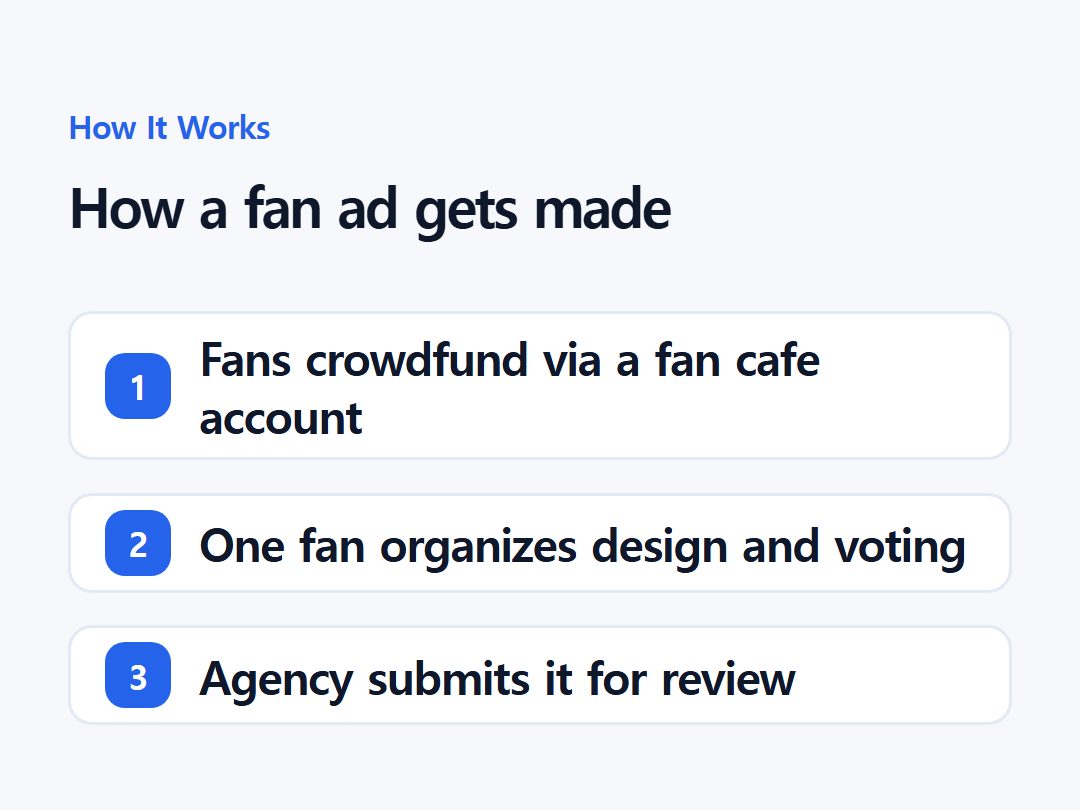
The advertiser of record is a private individual — usually one fan who volunteers to organize the project, collect money, and deal with the ad agency directly.
How a few thousand won each becomes millions
Funding is crowdsourced in small amounts. Fans transfer anywhere from a few thousand to tens of thousands of won each into a bank account posted on a fan cafe, fan Twitter/X account, or blog.
The organizing fan then runs a vote among contributors on which station, which design, and which of the idol's own fan-taken photos to use. The finished file is sent to an advertising agency for booking — the same commercial process any business would use.
Roughly a fifth to a third of buyers are based outside Korea, agencies say, with Chinese fan bases historically among the biggest spenders — one birthday campaign for EXO's Chanyeol reportedly ran into the tens of millions of won across buses, billboards, and theater screens.
A month of ad space can cost more than a used car
Prices depend entirely on station foot traffic. In 2018, a month on a subway lightbox ran from roughly 1.5 million to 4.5 million won (about $1,300–$4,000), according to Korea Herald reporting at the time.
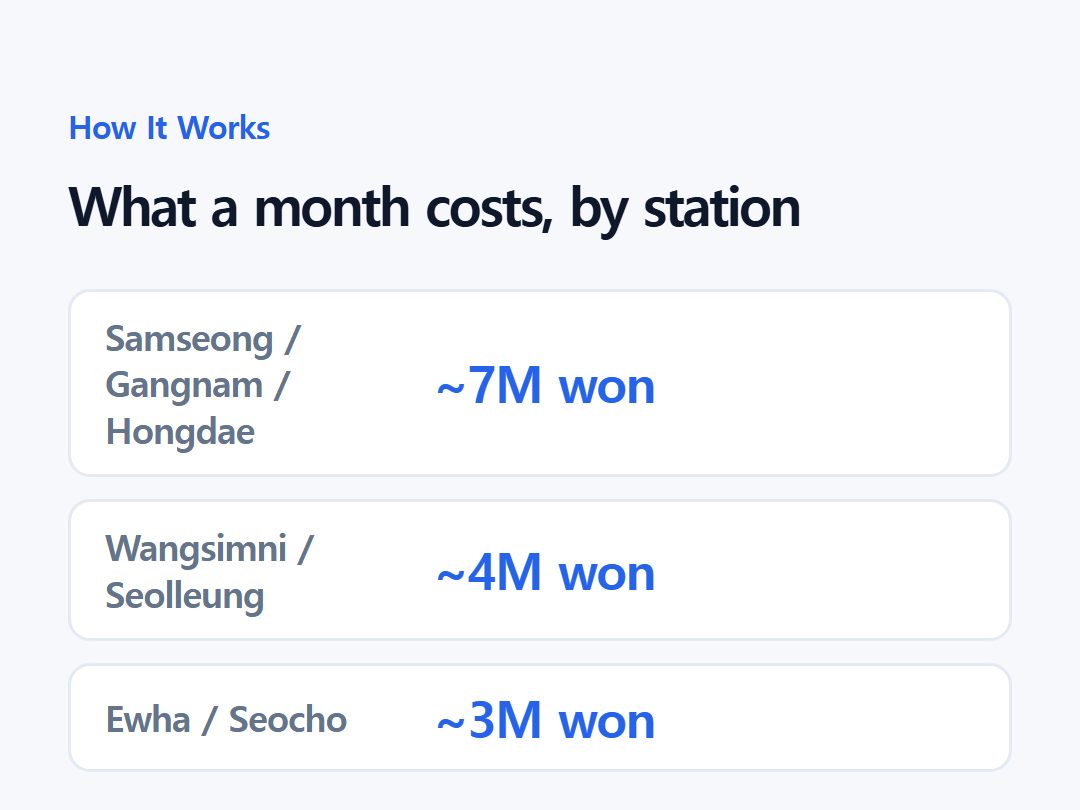
By 2022, the most requested stations had roughly doubled:
| Stations | Approx. monthly cost (2022) |
|---|---|
| Samseong, Gangnam, Hongdae | ~7 million won |
| Euljiro 1(il)-ga, Konkuk Univ., Jamsil, Kyodae | ~5 million won |
| Wangsimni, Seolleung, Yeoksam | ~4 million won |
| Ewha, Yeongdeungpo-gu Office, Seocho | ~3 million won |
Seoul Metro's own count shows how large this got
Seoul Metro, which operates most of the city's subway lines, has periodically released tallies of these ads because fan traffic through stations became visible enough to matter.
The trajectory: 76 idol-related ads in 2014, 1,038 by the end of 2017 (more than double the roughly 400 counted in 2016), and 1,576 by September 2018. In 2019, celebrity and idol ads reached 2,166 — 21% of all 10,468 subway ads placed that year, per Seoul Metro figures reported by Soompi.
The most-advertised acts that year, by Seoul Metro's own count:
- BTS — 227 ads (about 10.5% of all idol ads that year)
- EXO — 165 ads
- Wanna One — 159 ads
Individually, BTS's Jungkook led with 46 ads, ahead of EXO's Baekhyun (35) and BTS's V (31) — a reminder that these campaigns are often organized member-by-member, not just group-wide.
Girl groups trailed the top boy groups that year but still placed dozens of ads each, led by IZ*ONE (40), TWICE (22), and BLACKPINK (22). Long-running acts stayed active too: Super Junior fans bought 40 ads in 2019, more than a decade after the group's debut, alongside smaller totals for H.O.T, Shinhwa, and T-ara.
Money moves at a similar scale. In one separate month-by-month snapshot cited by Korean outlets, idol-fan ads alone accounted for 7.6% of all subway ad revenue and over 80 million won — from a category that, by definition, sells nothing back.
It started with one fan community in 2011
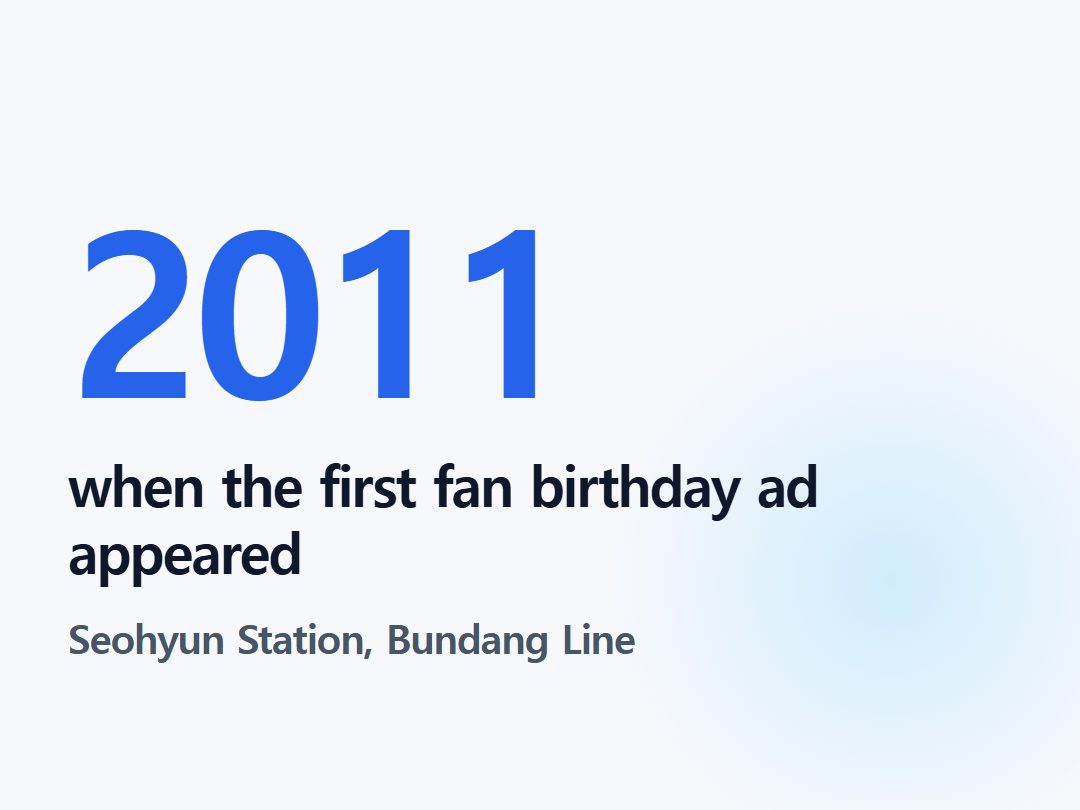
The commonly cited first case dates to 2011, when fans of Girls' Generation's Seohyun and CNBLUE's Jung Yong-hwa put up a congratulatory ad at Seohyun Station on the Bundang Line, marking Seohyun's 성년의 날 (Coming-of-Age Day, a Korean holiday honoring 19-year-olds).
Because the ad shared the idol's own station name, it drew media attention — and gave other fandoms a template: buy space, mark an occasion, make it visible to the public rather than just online.
Birthdays outgrew the subway
The same fan-organizing model now funds formats beyond stations:
- Birthday cafes — pop-up cafes fans rent for a day, decorated with the idol's photos and merchandise
- Birthday buses — fully wrapped buses that run fixed routes through Hongdae, Gangnam, Itaewon, or Jamsil
- Overseas billboards — including Times Square, where a week of screen time has run around 32.4 million won (roughly $30,000)
None of these require the idol's agency to sign off, and none are officially confirmed by it either.
Winning a subway line's ad contract can double what fans pay overnight
Seoul Metro doesn't sell ad space directly — it awards each line's advertising rights to a private agency through competitive bidding, and that agency then sets prices for individual buyers.
In February 2022, a new agency took over Line 2's contract and raised prices across its most fan-heavy stations by more than 50% within weeks. Samseong Station's flagship lightbox jumped from about 4.5 million to 7 million won in a single pricing update.
The agency told reporters the increase was necessary: it had bid aggressively to win the line, and the old rates no longer covered the contract. That explanation traces the real cause back to the bidding system itself, not to any single company's markup.
Fan communities reacted by shifting bookings to cheaper stations or extending fundraising periods to cover the gap. Several were unrelated to K-pop — fans of actor Shin Ha-kyun, EBS mascot Pengsoo, and volleyball player Kim Yeon-koung were all cited in coverage at the time, showing this is a fandom-wide dynamic, not a K-pop-only one.
Online reaction was largely negative. Some fans described the sudden hikes as treating fandoms as an easy source of revenue, since organizers can't easily walk away once a fundraiser and design vote are already underway.
The same jump happened again in 2025, and fans left instead of adjusting
Hapjeong Station, long one of the busiest fan-ad locations on Line 6, saw a similar spike in June 2025 after its line contract changed hands: a 3-meter illuminated ad went from roughly 1 million won to over 3 million won, a 1.5- to 2-times increase.
This time the response was different. By mid-June, only one or two fan ads remained on a wall that previously held around 20, with organizers relocating entirely to Hongdae or Gangnam rather than absorbing the cost.
Some commentary framed the shift as “advertising gentrification” — pricing rising until the original community that made a space desirable can no longer afford to use it.
Who actually checks these ads before they go up?
Once a fan books space through a line's ad agency, the design isn't posted automatically. For most lines, it goes to the Korea Advertising Self-Regulation Organization, an outside body that reviews content and can reject submissions.
That external review only became standard around July 2022 — before that, Seoul Metro reviewed subway ads internally, a system criticized for inconsistency. Even now, other rail operators in the Seoul area use different reviewing bodies, so standards can vary depending on which line a fan chooses.
What remains unresolved is structural: because pricing sits with agencies that win bidding contracts, not with Seoul Metro itself, there's no fixed ceiling on what a birthday campaign might cost a fandom from one contract cycle to the next.
Idol-related subway ads counted by Seoul Metro
| Year | Idol ad count |
|---|---|
| 2014 | 76 |
| 2016 | ~400 |
| 2017 | 1,038 |
| 2018 (Sept) | 1,576 |
| 2019 | 2,166 (21% of all subway ads) |
Frequently asked
Who pays for K-pop birthday ads in the subway?
A fan volunteers to crowdfund the ad, collect money from other fans, and book it directly with an advertising agency — the idol's management company has no role and doesn't pay for or officially confirm these ads.
How much does a K-pop birthday subway ad cost?
It depends on the station: in 2018 a month ran about 1.5 to 4.5 million won, and by 2022 the busiest stops like Samseong and Gangnam cost around 7 million won a month.
When did K-pop birthday subway ads start?
The commonly cited first case was in 2011, when fans of Girls' Generation's Seohyun and CNBLUE's Jung Yong-hwa bought a congratulatory ad at Seohyun Station for Seohyun's Coming-of-Age Day.
Sources
Every factual claim above is traceable. We do not translate articles — we gather facts from multiple outlets and write them ourselves.
- Seoul Metro Reveals List Of Idol Groups + Individuals With The Most Subway Advertisements In 2019 — Soompi
- [Video] K-pop ads taking over Seoul subway — The Korea Herald
- K-Pop Fans Are Paying Out of Pocket for Public Space Ad — Korea Bizwire
- Ad rates for celebrity birthday subway ads jump from 4.5 million to 7 million won — Daum (news syndication)
- Subway ad rates surge 50%, fandoms scramble — Segye Ilbo
- Hapjeong Station, once covered in birthday ads, sees fandoms leave as ad prices surge — Financial News (fnnews.com)
- K-pop ads taking over Seoul subway — The Jakarta Post