Scroll through K-pop discourse long enough and idols get sorted into "generations" the way historians sort decades. NewJeans is "4th gen." BTS is "3rd gen." H.O.T. is "1st gen." Everyone uses the label like it comes from somewhere official.
The short version
- No agency or chart has ever officially assigned a K-pop generation.
- Critic outlet Idology's June 2020 essay shaped today's four-generation framework.
- A 'fifth generation' is used casually, but no one has formalized it.
It doesn't. No chart, no awards show, and no agency — the management company that recruits, trains, and produces a K-pop act — has ever issued a ruling on where one generation ends and the next begins.
There is no committee that assigns a generation
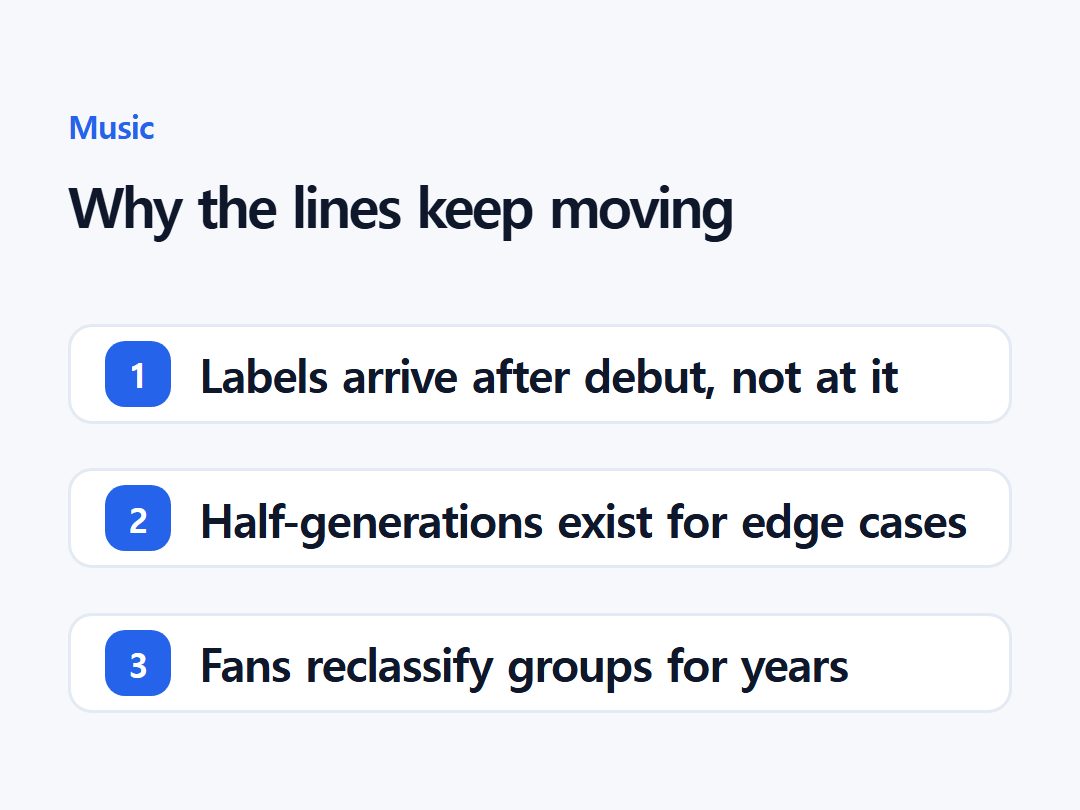
The generation system is built after the fact. Music critics, entertainment journalists, and fans argue over which groups changed something about the industry and which ones simply arrived once the trend was already set.
That means the lines move. A group treated as cutting-edge at its debut can get quietly reclassified years later, once critics decide a different act actually opened the era.
The label also travels into places that look official — chart write-ups, awards recaps, fan wiki pages — without ever flagging that its source was a critic's essay or a fandom consensus, not a decision by any agency or industry body.
For Korean fans, that gap is intuitive: everyone grew up watching the argument happen in real time, on forums and music shows, so the informality is obvious. International fans who discover K-pop mid-cycle often meet the finished label first and the argument behind it never, which is why "generation" reads as a fact rather than a running debate.
The webzine that gave the label its current shape
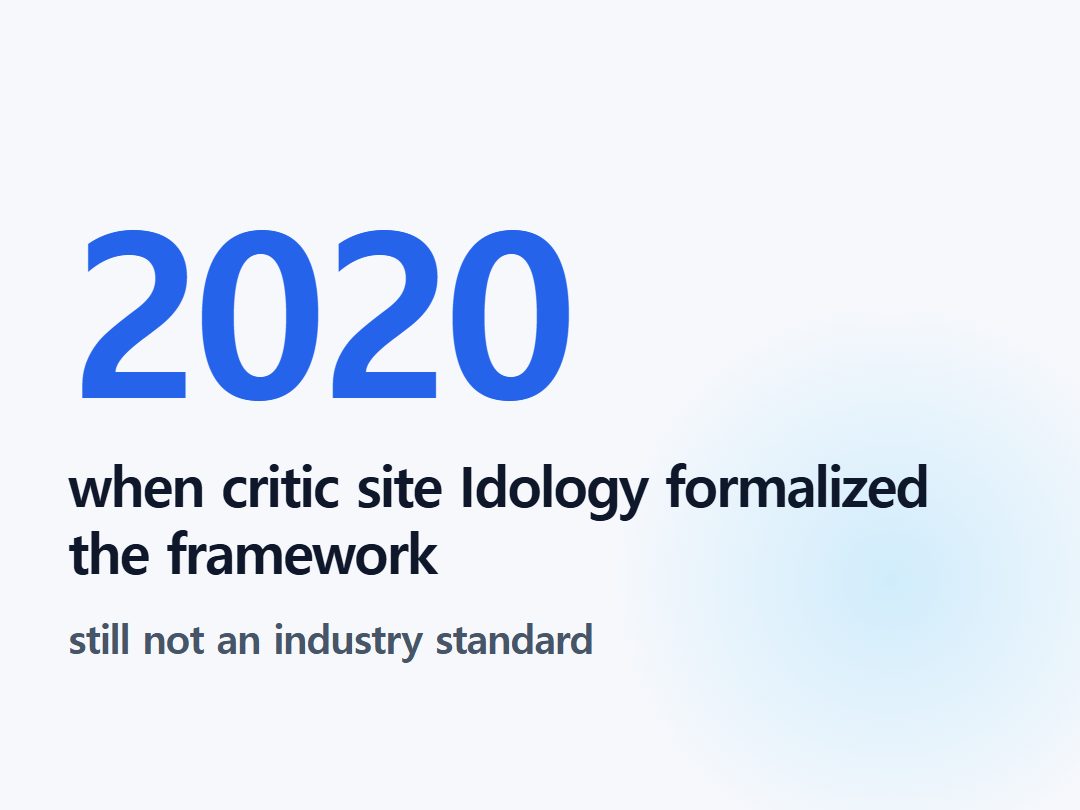
Much of today's four-generation framework traces to Idology, one of Korea's longest-running K-pop critic outlets, which published a widely cited genealogy of the industry in June 2020.
Idology split K-pop into first, second, third, and fourth generations, then added "1.5," "2.5," and "3.5" tiers for acts that debuted between the neat boundaries. The outlet was explicit that the framework was a critical tool, not a verdict:
"It is not to draw lines and divide — but rather to see where the lines go and evolve."
That caveat gets lost once the labels spread. By the time "4th generation" reaches an international fan's timeline, it usually arrives stripped of the hedge that came with it.
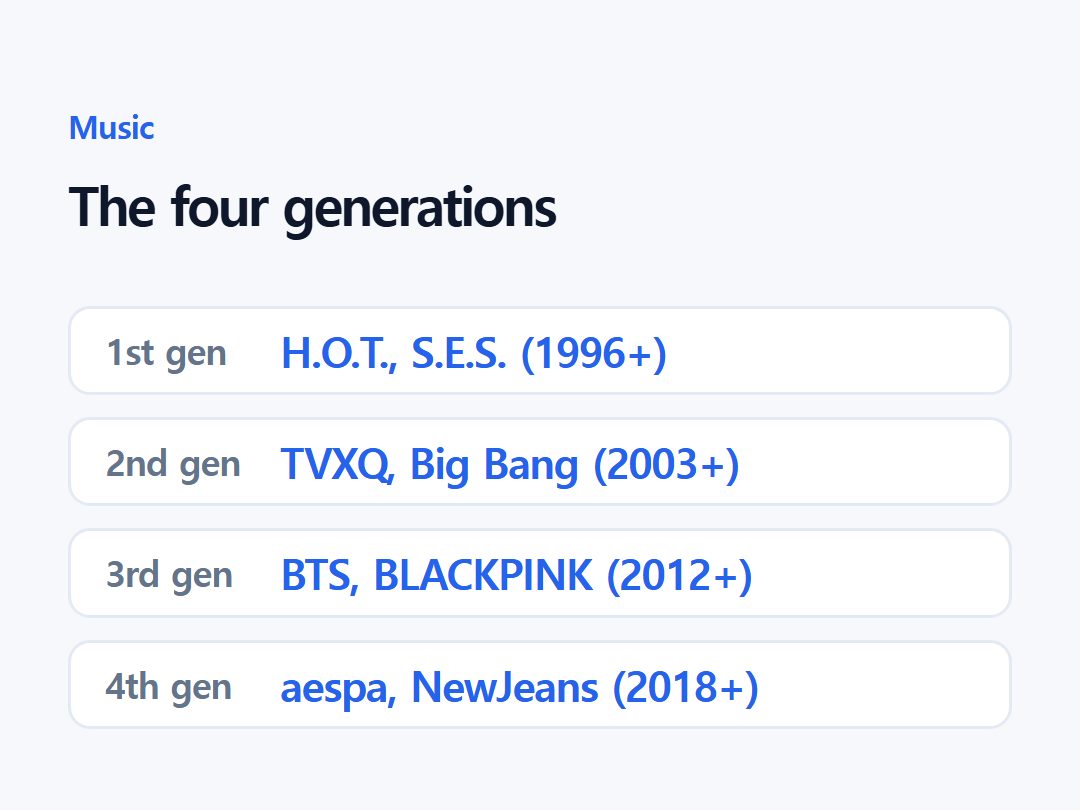
Four generations, roughly, as most outlets describe them
Coverage varies by a year or two at each boundary, but the broad shape is consistent across Korean and international outlets:
| Generation | Approx. years | Groups often cited | What changed |
|---|---|---|---|
| 1st | 1996–early 2000s | H.O.T., S.E.S., Sechs Kies, Fin.K.L, Shinhwa, g.o.d | The idol system itself: training, synchronized choreography, organized fan clubs |
| 2nd | Mid-2000s–2011 | TVXQ, Super Junior, Big Bang, Girls' Generation, Wonder Girls | Export across Asia under the "Hallyu" label |
| 3rd | 2012–2018 | EXO, BTS, TWICE, BLACKPINK | Global breakout driven by YouTube and social platforms |
| 4th | 2018/19–early 2020s | Stray Kids, ITZY, aespa, IVE, NewJeans | Global-from-debut strategy built around short-form video |
Even sources that agree on this table disagree on the exact turning point. The Korea Herald places the fourth generation's rise specifically after the pandemic; several fan timelines set it a year or two earlier, tied to different debuts entirely.
Training happens on contract; the label arrives afterward
International readers unfamiliar with the agency system sometimes assume "generation" is something an agency assigns at debut, alongside a concept and a debut single. It isn't, and the two processes don't overlap.
Agencies like SM, YG, JYP, and HYBE sign trainees to multi-year contracts, then spend that time shaping vocal style, choreography, and public image before a group is allowed to debut at all. None of that process involves numbering an era.
The generation label only attaches once outsiders — critics first, then fans, then eventually the trade press — can look back and describe what a group's peers had in common.
Seo Taiji broke the format; Lee Soo-man industrialized it
The commonly cited starting point actually predates "1st generation" as a term. On April 11, 1992, the group Seo Taiji and Boys performed "I Know" on a televised talent contest — a song now widely credited as the first recognizably modern K-pop record, built on rap and dance styles Korean broadcast television had not featured before.
SM Entertainment founder Lee Soo-man took note of the teenage audience that response revealed and built a company around reproducing it on a schedule. The result, H.O.T., debuted in 1996 as the first group made through what became the standard idol-training model — the act most classifications now treat as the actual start of "1st generation" K-pop.
A Beijing concert turned a local trend into an export
H.O.T.'s 2000 concert in Beijing is the moment most histories point to for "Hallyu" — the Korean Wave — becoming a named phenomenon, after Chinese media coverage of the show popularized the term.
Second-generation acts built directly on that opening. TVXQ, Big Bang, Wonder Girls, and Girls' Generation added larger lineups, Japanese-language releases, and coordinated promotion across other Asian markets through the mid-to-late 2000s.
Social platforms, not a new sound, split off the third generation
The third generation's defining shift wasn't a genre change. EXO, BTS, TWICE, and BLACKPINK largely inherited group formats their predecessors had already established.
What changed was distribution. These groups promoted directly to fans through YouTube and social platforms rather than relying mainly on Korean or Japanese broadcast television — the shift most often credited with enabling BTS's later US chart breakthroughs.
Half-generations exist because acts refuse to sit in one box
Idology's "1.5" and "2.5" and "3.5" tiers exist for a practical reason: plenty of groups debuted between the neat boundaries and don't fit either side cleanly.
- Shinhwa, g.o.d, and BoA (1.5) — debuted after H.O.T. but before the second generation's export push
- SHINee, 2PM, and 2NE1 (2.5) — arrived alongside major second-gen acts but sound and market closer to the third
- SEVENTEEN, NCT, and Wanna One (3.5) — still argued over by fans deciding which cohort they belong to
The pattern repeats every cycle, which is part of why the "generation" conversation never actually settles.
One company built a group specifically to dodge the label
SM Entertainment's NCT, launched in 2016, was built around the idea of "limitless" membership: new members and city-based subunits keep debuting years apart under one shared name, rather than locking in a fixed lineup at a single debut date.
That structure makes NCT resistant to a single generation by design. Some members joined in years usually associated with "4th generation" acts, while the group's core promotional identity dates back to 2016 — squarely inside "3rd generation" territory by every other measure.
Is a fifth generation already here?
Groups debuting from 2023 onward are increasingly described as "5th generation" in casual coverage, but no critic outlet has yet published an Idology-style framework formalizing that boundary the way one exists for the previous four.
ZEROBASEONE (ZB1), assembled through Mnet's 2023 survival show Boys Planet, and BABYMONSTER, which YG Entertainment debuted the same November, both get filed under "5th gen" in most fan usage. Neither has been formally certified as such by anyone with the authority to do it — because no one has that authority.
KATSEYE complicates the count further. Formed through a 2023 HYBE-Geffen competition show that combined K-pop-style training with a US-based label, some coverage lists it as "5th generation," while other outlets have pushed back that it is a global pop act built on K-pop methodology rather than a K-pop group itself.
The disagreement isn't a footnote — it's the same unresolved question the whole "generation" framework was invented to paper over.
What the number is actually useful for
None of this makes the label meaningless. It's a genuinely useful shorthand for describing how K-pop's promotion, sound, and global reach have shifted roughly every five to seven years since 1996.
What it isn't is a credential. No group has ever been formally awarded a generation, and the boundary a fan cites today may not match what critics settle on five years from now — which is exactly how it worked the last four times.
K-pop's four generations, roughly, as most outlets describe them
| Generation | Approx. years | Groups often cited | What changed |
|---|---|---|---|
| 1st | 1996–early 2000s | H.O.T., S.E.S., Sechs Kies, Fin.K.L, Shinhwa, g.o.d | The idol system itself: training, synchronized choreography, organized fan clubs |
| 2nd | Mid-2000s–2011 | TVXQ, Super Junior, Big Bang, Girls' Generation, Wonder Girls | Export across Asia under the "Hallyu" label |
| 3rd | 2012–2018 | EXO, BTS, TWICE, BLACKPINK | Global breakout driven by YouTube and social platforms |
| 4th | 2018/19–early 2020s | Stray Kids, ITZY, aespa, IVE, NewJeans | Global-from-debut strategy built around short-form video |
Frequently asked
What generation is NewJeans?
NewJeans is commonly labeled '4th generation,' the cohort that debuted from 2018/19 into the early 2020s around a global-from-debut, short-form-video strategy.
Who decides K-pop generations?
No one officially does — the labels come from critics, journalists, and fans arguing after the fact, most influentially Idology's June 2020 genealogy of the industry.
Is there a 5th generation of K-pop?
Groups like ZEROBASEONE and BABYMONSTER are often called '5th generation' in casual coverage, but no critic outlet has yet published a formal framework the way Idology did for the previous four.
Sources
Every factual claim above is traceable. We do not translate articles — we gather facts from multiple outlets and write them ourselves.
- K-pop generations — The Korea Herald
- Here's The Breakdown of K-Pop's 4 Generations, According To IDOLOGY Webzine — Koreaboo
- The Most Influential K-pop Groups And How They Defined Their Generations — Billboard Philippines
- K-pop's Early Milestone: H.O.T. and the Rise of the Idol System — Korean Culture and Information Service
- Seo Taiji and Boys, 'I Know' — Rolling Stone Australia
- NCT (group) — Wikipedia
- Zerobaseone — Wikipedia
- YG's new group Babymonster to debut on Nov. 27 — The Korea Herald
- A Reminder That KATSEYE Is A Global Group, Not K-Pop — Forbes