
When a K-pop agency announces a 'hiatus,' it is not a vague gesture. It is a dated, named statement, posted under the company's own account, that triggers concrete changes: a canceled broadcast slot, a revised tour lineup, sometimes a rewritten set list for the remaining members.
The short version
- A hiatus is an official agency statement, not a rumor or guess.
- Korean law caps idol contracts at seven years, since 2009.
- Hiatus doesn't mean leaving — 탈퇴 (withdrawal) is the permanent exit term.
That is a different event from an idol simply going quiet — no post, no explanation, just an absence fans are left to interpret. The Korean term is 활동중단 (hwaldong jungdan), literally 'activity suspension,' and understanding what it actually commits an agency to explains why Korean fans read these announcements so differently than international ones do.
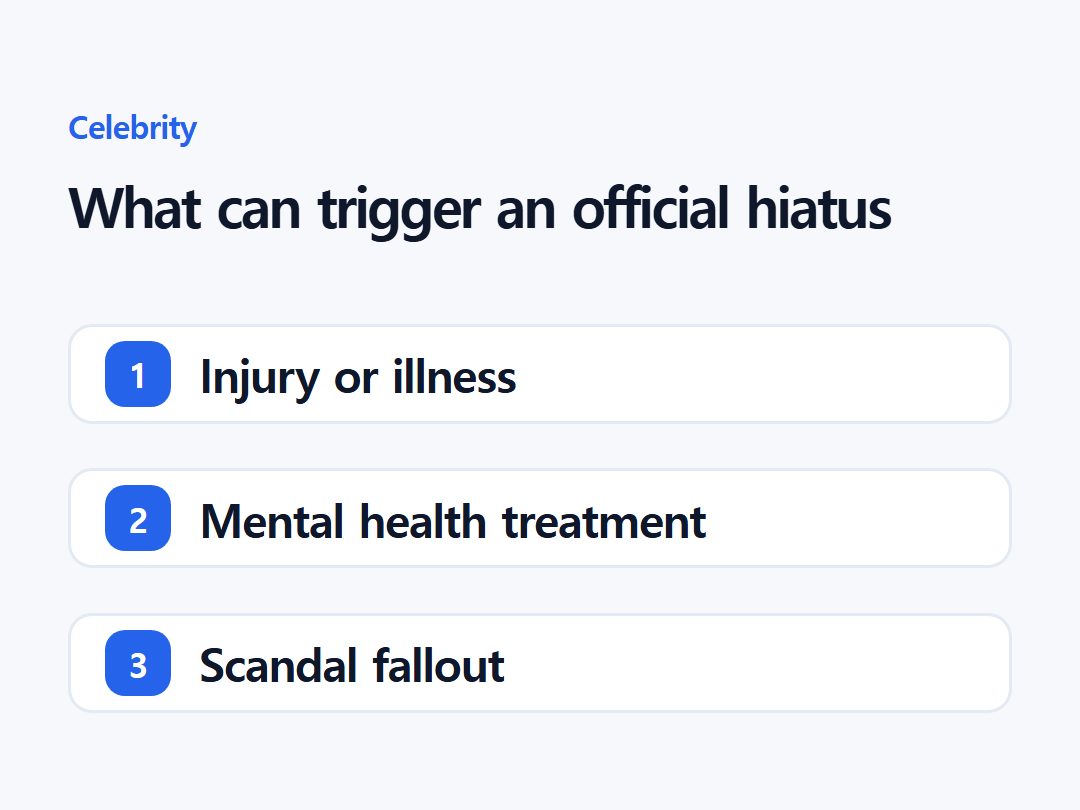
A hiatus is an agency statement, not a rumor
The announcement itself is what makes a hiatus official. There is no ambiguity built in — either the management company has issued one, or what a reader is looking at is speculation.
When Katseye's Manon Bannerman stepped back from the group in February 2026, the label (HYBE x Geffen, a joint venture between HYBE and Geffen Records) posted the news itself: "Manon will be taking a temporary hiatus from group activities to focus on her health and wellbeing." The group added that they "fully support this decision" and that activities would continue without her in the meantime.

Two injuries, two statements, one tour that kept going
The logistics show up clearly in TWICE's case. Member Dahyun fractured her ankle during a February 2026 tour stop, and JYP Entertainment confirmed a full hiatus on March 25, stating that "sufficient rest and recovery should be prioritized over activities at this time."
One day later, JYP issued a nearly identical statement for member Chaeyoung, who had injured her back. Both statements named a specific cause and a specific decision. Neither one paused the tour: TWICE performed on with seven of nine members, because the schedule itself — venues booked, tickets sold, broadcast slots reserved — does not stop for one person's recovery.
Why the seven-year contract makes silence a liability
To understand why agencies bother with statements at all, it helps to know what an idol's contract actually is. Every Korean idol operates under a 전속계약 (exclusive contract) with their agency — a legal document, not an informal understanding, that the agency negotiated and that a court can enforce.
Since 2009, Korea's Fair Trade Commission has capped these exclusive contracts at seven years, a rule that traces directly back to a lawsuit filed by members of the group TVXQ against SM Entertainment over a 13-year deal they argued was excessive.
The case produced the government's "Standard Exclusive Contract Form for Pop Culture Artists," jointly issued by the Ministry of Culture, Sports and Tourism and the Fair Trade Commission.
An agency that lets an idol's absence go unexplained is not just risking fan backlash — it is inviting the kind of scrutiny that, historically, has ended in lawsuits and government intervention. A dated statement is, among other things, a paper trail.
A comeback is booked a year out — one member can't just sit it out quietly
K-pop promotion runs on a synchronized calendar: choreography is set for a fixed lineup, broadcast appearances are booked months ahead, and international tour dates are locked in with venues long before rehearsals start. A member's absence has to be accounted for somewhere in that machine, which is part of why agencies formalize it rather than let it play out informally.
A hiatus announcement typically has to answer, at minimum:
- Which activities the member will skip
- Whether the group continues without them
- Whether a return date exists at all
Agencies rarely go further than that. Even in health-related cases, companies do not disclose exact diagnoses or treatment details — idols are not obligated to share private medical information, and the vagueness in these statements is a boundary the industry generally respects, not evidence of a cover-up.
Kang Daniel's 2019 statement set the template for mental health cases
Before 2019, agencies rarely used the word 'hiatus' for psychological reasons at all. That changed when KONNECT Entertainment announced that Kang Daniel, formerly of Wanna One, had been diagnosed with depression and panic disorder after months of cyberbullying, and would be suspending all activities.
The agency's statement was unusually direct for the time: "We reached the conclusion that sufficient rest and stability is of the highest priority for the artist's health and safety." It also apologized to fans and pledged to take responsibility for his care.
That statement is widely treated as a turning point. Mental-health hiatuses are no longer unusual — ATEEZ, BOYNEXTDOOR, and Monsta X have all issued comparable statements in recent years — and they now follow roughly the same structure as an injury announcement: a named cause, a company decision, no promise of a return date.
Four Korean terms international fans tend to mix up
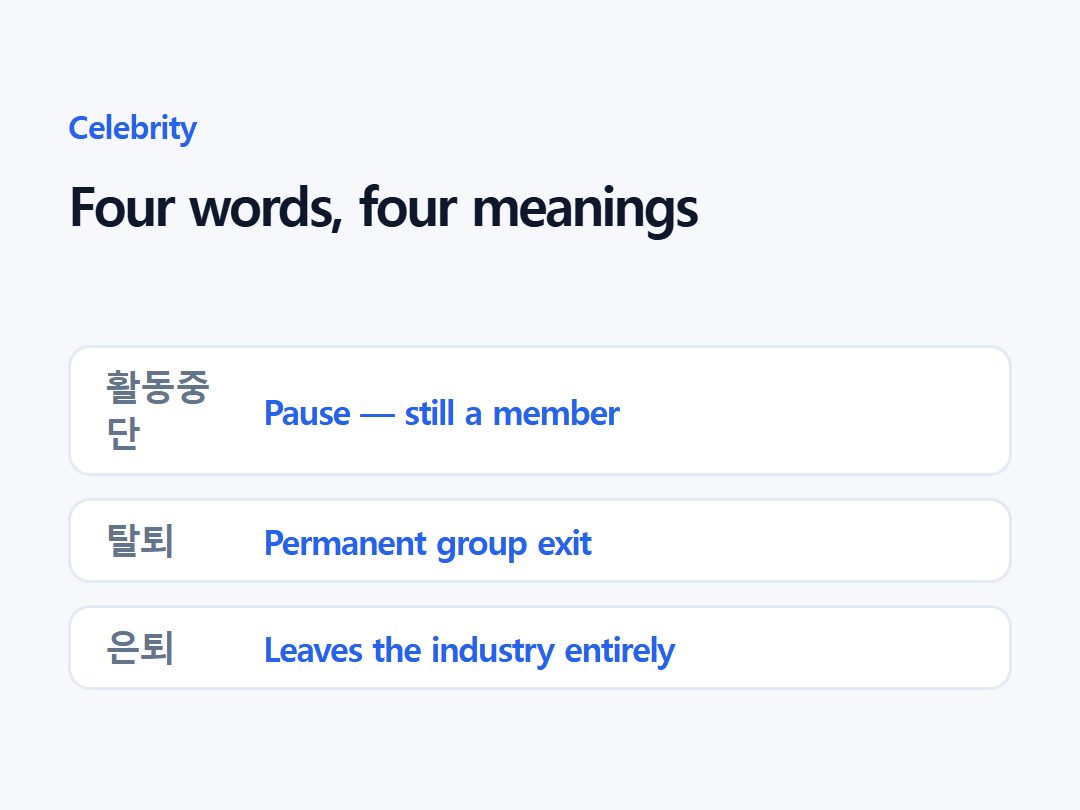
Coverage in English sometimes flattens several distinct Korean terms into the single word 'hiatus,' which erases a meaningful hierarchy. Korean entertainment reporting keeps these separate on purpose.
| Term | What it actually means |
|---|---|
| 활동중단 (hwaldong jungdan) | Activities paused; still a member, still under contract |
| 잠정 중단 (jamjeong jungdan) | Explicitly framed as temporary; return is expected |
| 탈퇴 (taltoe) | Formal, permanent exit from the group |
| 은퇴 (euntoe) | Retirement — leaving the industry, not just the group |
In practice, the boundary between the first two and 탈퇴 can blur. Some members who start on a 'temporary' suspension never return; the agency simply announces withdrawal later, sometimes close to a year afterward.
When 'hiatus' is the word an agency reaches for during a scandal
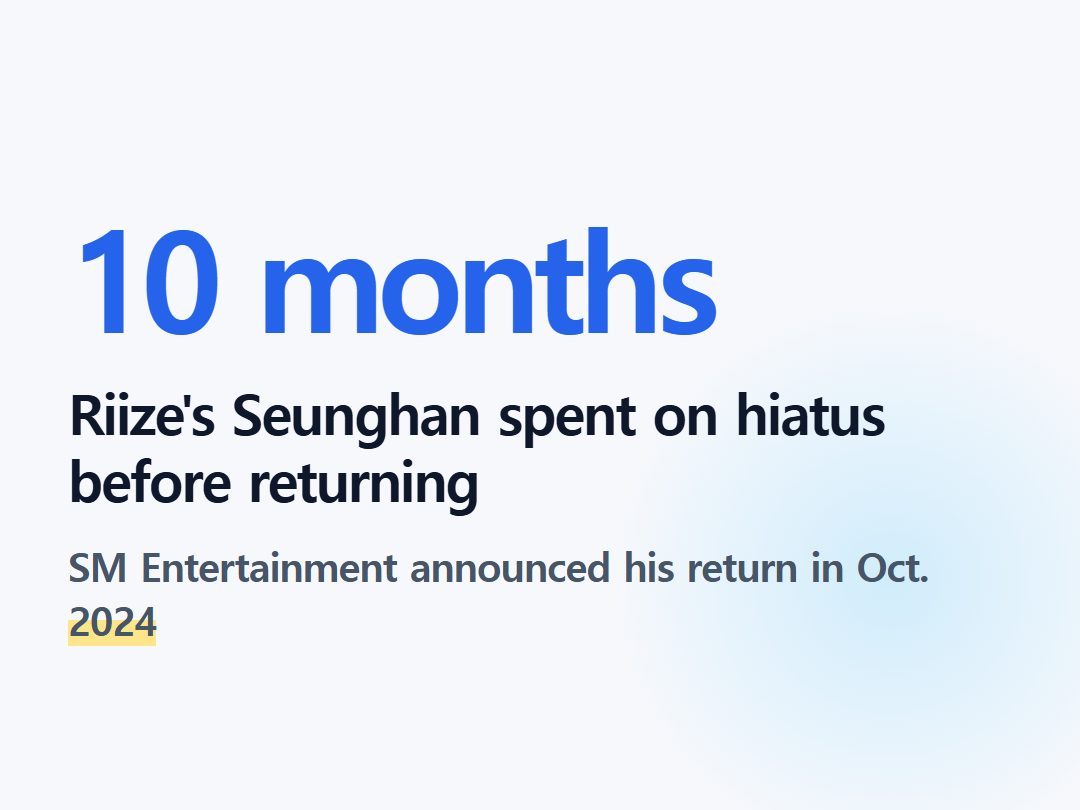
Not every hiatus is medical. In November 2023, SM Entertainment removed Riize member Seunghan from group activities after private, pre-debut photos and videos leaked online — a case the agency also described using hiatus language rather than a disciplinary term.
Ten months later, in October 2024, SM announced his return to the group. The episode illustrates that 'hiatus' functions in Korean entertainment as a broad procedural label — it covers illness, injury, and controversy alike — rather than a term reserved for any single cause.
What an agency statement is not required to say
No law or industry code obliges a Korean agency to give a return date, a diagnosis, or a reason beyond a general category like 'health.' Practices also vary sharply by company size: major agencies such as HYBE, JYP, and SM run in-house counseling and medical support, while smaller companies frequently do not, and industry reporting has noted there is still no formal, industry-wide standard defining what an agency owes an idol during a hiatus.
That gap means two idols with comparable conditions can receive very different levels of disclosure and support, entirely depending on which company holds their contract — a structural inconsistency that remains unresolved even as hiatus announcements themselves have become more frequent and more detailed since 2019.
Industry reporting has also flagged a wider contradiction behind these statements: agencies have posted record revenues even as more idols step back for health reasons. That is part of why outlets and fans increasingly read a hiatus announcement as one data point in a larger pattern, not an isolated story about a single artist.
Does a hiatus mean an idol is leaving the group?
Not by itself. A hiatus keeps the exclusive contract and group membership intact; it is a pause, not an exit. Whether it becomes permanent depends on what the agency announces next — a return, a 탈퇴 (withdrawal), or, less often, silence that stretches on until fans stop expecting an update at all.
Four Korean terms for leaving a K-pop group, from least to most permanent
| Term | What it actually means |
|---|---|
| 활동중단 (hwaldong jungdan) | Activities paused; still a member, still under contract |
| 잠정 중단 (jamjeong jungdan) | Explicitly framed as temporary; return is expected |
| 탈퇴 (taltoe) | Formal, permanent exit from the group |
| 은퇴 (euntoe) | Retirement — leaving the industry, not just the group |
Frequently asked
Does a K-pop hiatus mean the idol is leaving the group?
No — a hiatus keeps the exclusive contract and group membership intact; it's a pause, not an exit, unless the agency later announces 탈퇴 (withdrawal).
What's the difference between 활동중단 and 탈퇴?
활동중단 (hwaldong jungdan) means activities are paused while the idol stays under contract, while 탈퇴 (taltoe) is a formal, permanent exit from the group.
Why did TWICE keep touring during Dahyun and Chaeyoung's hiatus?
Because tour venues, tickets, and broadcast slots were already booked, so TWICE performed on with seven of nine members instead of pausing the schedule.
Sources
Every factual claim above is traceable. We do not translate articles — we gather facts from multiple outlets and write them ourselves.
- Manon Taking a Hiatus From KATSEYE to 'Focus on Her Health & Wellbeing' — Billboard
- Update: Kang Daniel To Take Break From Activities + Agency Releases Statement On His Mental Health — Soompi
- TWICE's Dahyun To Take Hiatus From "THIS IS FOR" Tour Due To Injury — Soompi
- 'Twice' the injuries: Chaeyoung joins Dahyun on hiatus from girl group after back problems — Korea JoongAng Daily
- We ask generous understanding: KOZ Entertainment announces BOYNEXTDOOR Leehan's hiatus following idol's health concerns — Sportskeeda
- SM Entertainment announce the return of Kpop idol Seunghan to boyband Riize after 10-month hiatus — Malay Mail
- K-pop stars punished by unfair contracts — The Korea Times
- K-pop idols halt, quit careers over health concerns while agencies post record revenues — The Korea Herald