It's 12:41 a.m. on a Seoul subway platform, and the chime before the doors close sounds slightly more final than usual. That was the last train. For a first-time visitor, this can feel like a small crisis. For most Seoul residents, it's a Tuesday.
The short version
- Seoul's last train time varies by line — there's no single citywide cutoff.
- Night buses, taxi surcharges, and 24-hour bathhouses form one backup system.
- Taxi surcharges can stack up to 60% between 11 p.m. and 2 a.m.
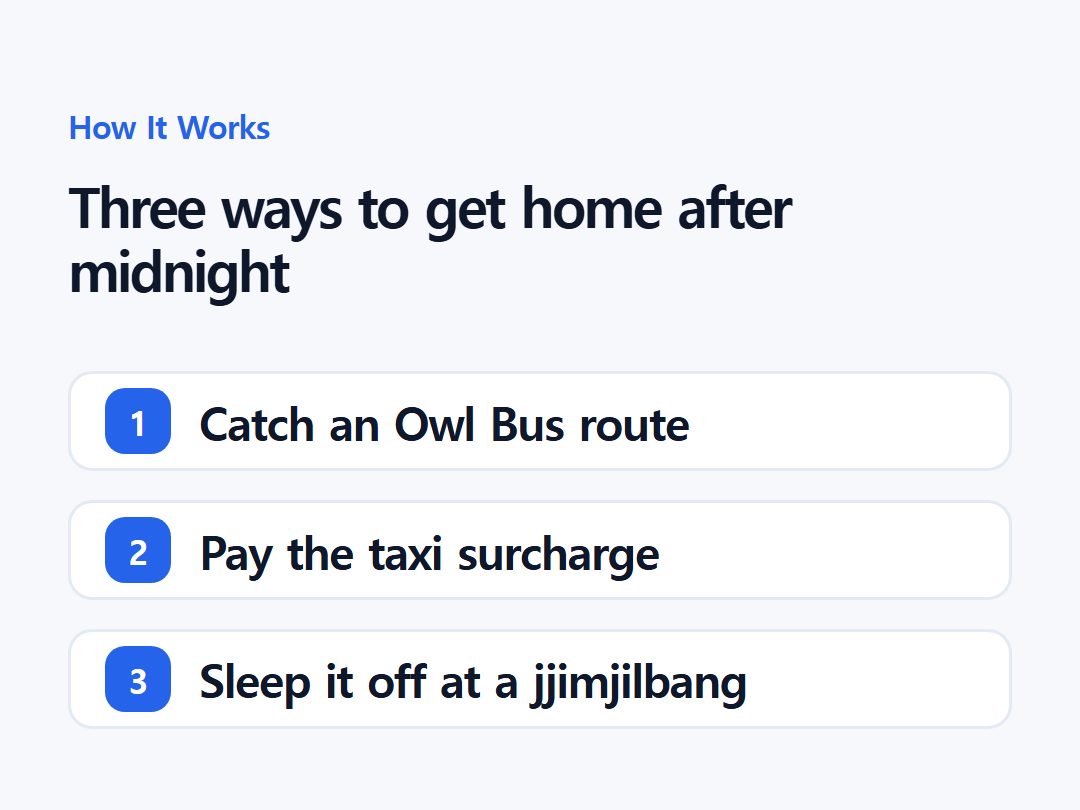
Missing the 막차 (makcha, "last train") is routine enough that an entire backup system exists to handle it: night buses, a taxi fare that changes by the hour, and 24-hour bathhouses built for exactly this moment. Visitors usually run into one piece of that system in a panic. Locals already know how all three pieces fit together.
Seoul's last train doesn't run on one citywide clock
There is no single "last train time" for the whole city. Each subway line — often each direction on that line — has its own last departure, and it depends on which station you're standing at.
As a rough pattern, trains bound for outer terminal stations clear around midnight to 1 a.m. on weekdays, roughly 30 minutes earlier on weekends and public holidays. On Line 5, the last train through central stops like Yeouido or Gwanghwamun passes around 11:50 p.m.; on Line 6, the window shifts anywhere from 11:30 p.m. to 12:30 a.m. depending on the branch.
Locals rarely memorize these times. They check a transit app — Kakao Subway or Naver Map are the standard choices — because the schedule can also shift for holidays or maintenance.
Why missing the train is expected, not a mistake
The backup system exists because Seoul's evening schedule doesn't end when the subway does. A standard company dinner, or 회식 (hoesik) — a semi-mandatory after-work meal that often continues into a second or third round at a different venue — routinely runs past 11 p.m. Nights out in Hongdae or Gangnam follow the same pattern.
Korean planning culture treats the last train less as a deadline to beat and more as one branch point in the evening, with known fallback options after it. This is the part international coverage usually skips: the night bus, the taxi surcharge, and the bathhouse aren't three unrelated facts about Korea. They're one coordinated system, each covering the gap the other two don't.
The three-way math Koreans run without thinking
Once the last train has left, the decision usually comes down to three questions, roughly in this order:
- Does a night bus route pass near both my start and end point?
- If not, is the taxi surcharge worth it for this distance?
- If neither works well, is it cheaper to wait it out until the first train?
Each answer points to a different, well-established piece of infrastructure, and all three are built around the same gap: roughly midnight to 5 a.m., when the subway is closed.
Nine routes designed from three billion phone records
The night bus network, branded the 올빼미버스 ("Owl Bus"), wasn't guesswork. When the Seoul Metropolitan Government launched it in 2013, planners analyzed roughly three billion anonymized late-night phone calls to map where people actually needed to travel between midnight and dawn.
The result was a radial network of "N"-prefixed routes converging on Jongno and Gwanghwamun, the areas the data showed as the busiest late-night hubs. The network has grown since — a route serving the southwest, N65, was added in 2016, and Seoul has continued expanding coverage in the years after.
Owl Buses run through most of the subway-closure window at 30–50 minute intervals, cost the same as a regular city bus, and include a speed limiter and a protective barrier for the driver — safety features built in because these routes only operate in the dark.
A taxi after 11 p.m. can cost 40% more
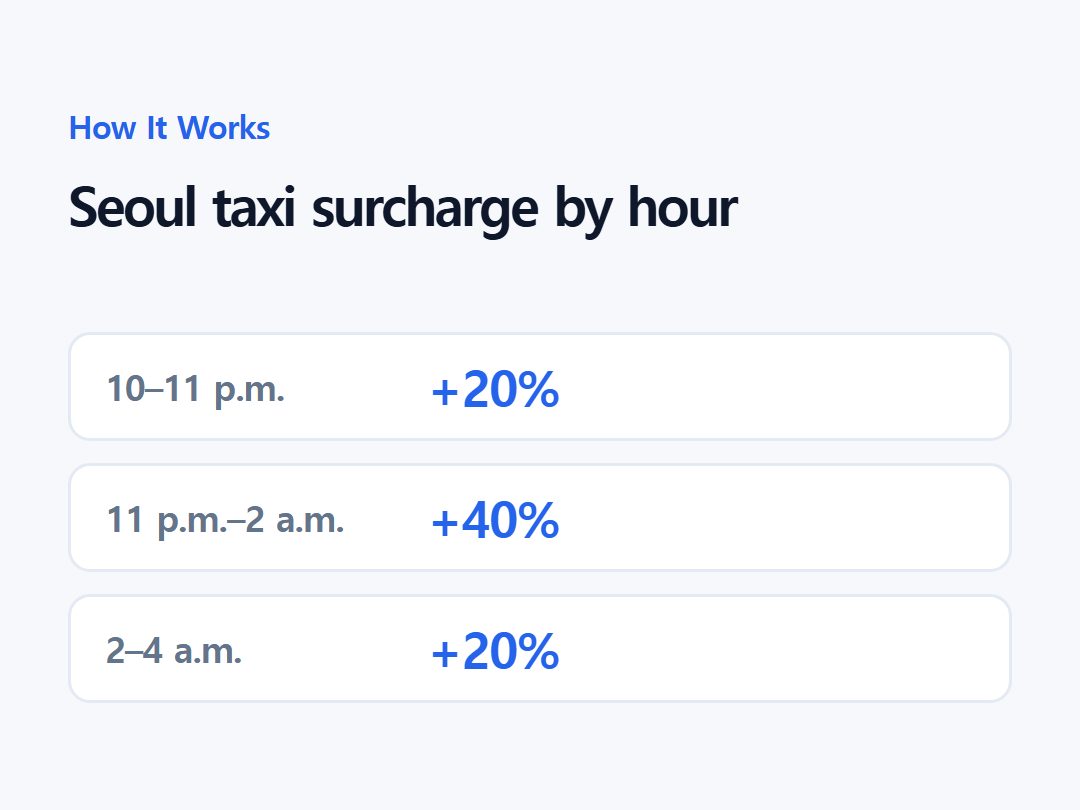
If no night bus route fits, the fallback is a taxi, priced on a sliding late-night surcharge (할증) rather than a flat late fee. For a standard sedan taxi in Seoul, the surcharge runs in three blocks:
- 10 p.m.–11 p.m.: +20%
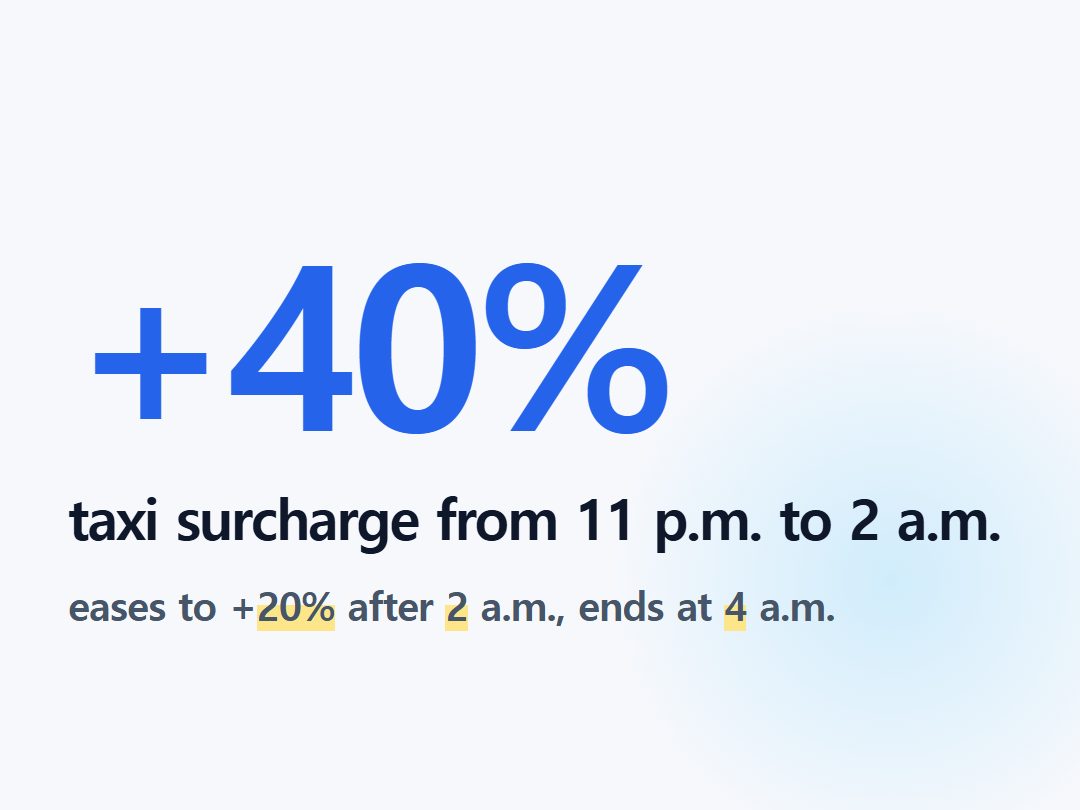
- 11 p.m.–2 a.m.: +40%, the peak window
- 2 a.m.–4 a.m.: +20%, dropping to the normal daytime rate at 4 a.m.
Deluxe and van taxis skip the peak bump and apply a flat 20% surcharge across the entire 10 p.m.–4 a.m. window instead, which can make them the cheaper option during the 11 p.m.–2 a.m. peak on longer rides.
The second surcharge that catches travelers off guard
A separate charge stacks on top of the late-night rate: crossing outside Seoul's city limits adds another 20%. During the peak window, that means a taxi to Incheon or a hotel in Gyeonggi Province can carry a combined surcharge of up to 60% over the metered fare — a number that surprises visitors booking airport transfers after a late flight.
Why the surcharge window starts two hours earlier than it used to
The current 10 p.m.–4 a.m. window is recent. Until late 2022, the late-night surcharge only applied from midnight to 4 a.m.; Seoul moved the start time two hours earlier specifically to fight a chronic shortage of late-night taxis.
The shortage traced back to drivers refusing short or low-fare rides in favor of waiting for a more lucrative late-night trip, a practice known as 승차거부 (seungcha-geobu, "ride refusal"). Widening the surcharge window and raising the peak rate to 40% was meant to make an ordinary late fare worth a driver's time again, instead of something worth turning away.
A bed, a sauna, and a wake-up call for under $15
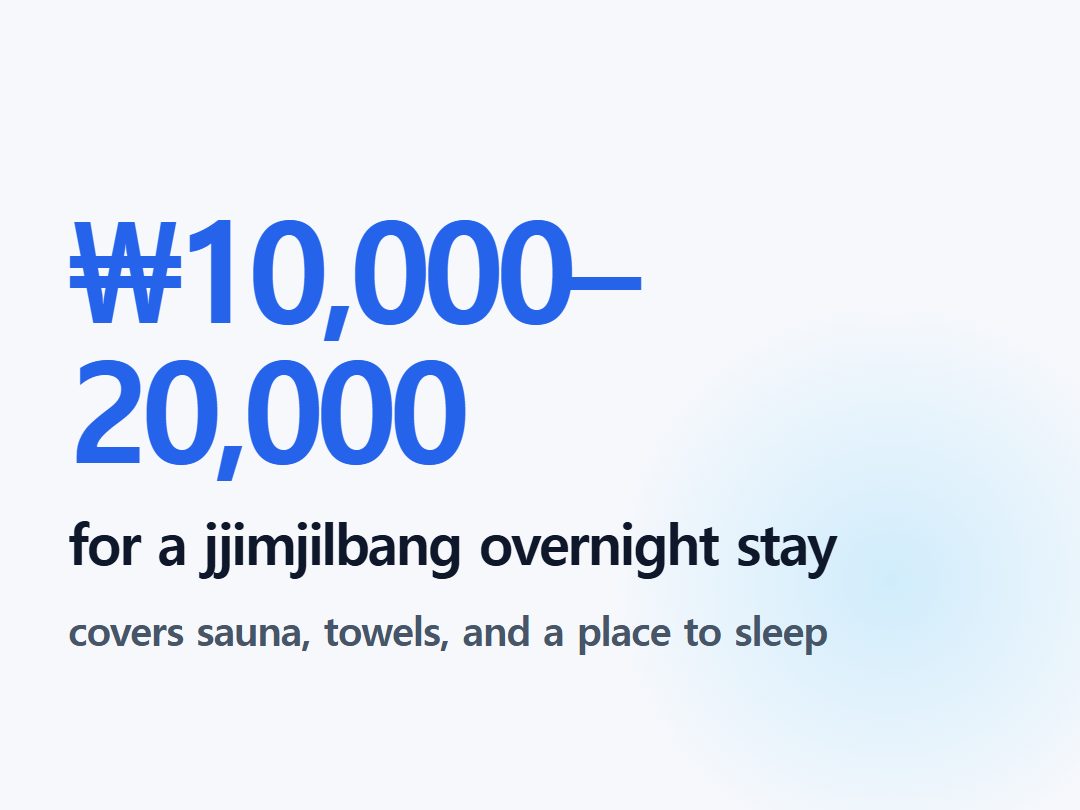
When neither bus nor taxi makes sense, the fallback with no real Western equivalent is the 찜질방 (jjimjilbang), a 24-hour bathhouse-and-sauna complex that also works as a legitimate overnight stay. Entry typically runs 10,000–20,000 won (roughly $7–15) and includes a uniform, two towels, a locker, and access to a heated communal floor for sleeping.
The bathing halls are gender-separated, but the sauna rooms, snack bars, and sleeping floor are shared common space where guests in matching uniforms nap, eat, and watch TV side by side. Many locals treat it as a normal budget option for a late night out, not a novelty — which is why it survives as real infrastructure rather than a tourist gimmick.
The bathhouse-turned-bedroom has a real-estate boom to thank
The jjimjilbang format Koreans use today didn't exist before the 1990s. Its ancestor is the mogyoktang, a public bathhouse dating back to the Joseon era, when most homes had no hot running water and a proper bath was a paid service.
The 24-hour version with a shared heated floor, restaurant, and overnight sleeping area emerged in the early 1990s, when a real-estate boom pushed ordinary hotel stays out of reach for many working travelers. The format spread fast once it appeared: the number of jjimjilbangs nationwide grew from roughly 550 in 1995 to about 1,600 by 2004.
Where the system still has gaps
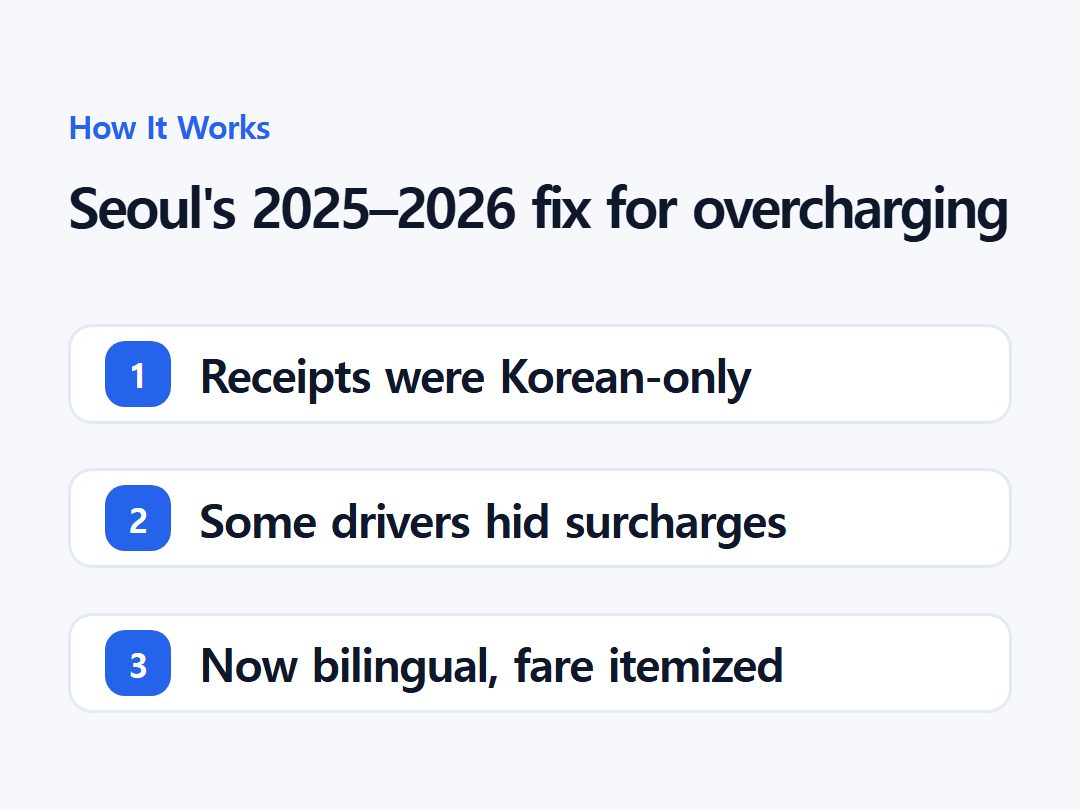
International visitors run into a version of this gap that most Koreans don't: overcharging. Paper taxi receipts were long printed in Korean only and didn't list whether a late-night or out-of-city surcharge had been applied, which let a small number of drivers misuse surcharge settings on foreign passengers who couldn't check the math.
Seoul answered in 2025–2026 by requiring taxis, through a partnership with T-money Mobility, to issue bilingual receipts showing the fare, boarding and alighting times, and exactly which surcharges applied. The fix targets a problem specific to visitors, since most Korean riders already know what a fair late-night fare looks like.
Coverage gaps remain too. Owl Bus routes are radial and hub-based, so residents living between routes rather than along them still face a long walk or a taxi regardless of the network's existence. Solo late-night travel, particularly for women, also remains a widely discussed safety concern despite the built-in features on Owl Buses.
Three ways to get home after the last train
| Option | Cost | Best For | When It Runs |
|---|---|---|---|
| Owl Bus (올빼미버스) | Same as a regular city bus fare | A route passes near both your start and end point | 30–50 min intervals, midnight–5 a.m. |
| Taxi | +20% to +60% surcharge over the metered fare | No nearby night bus route | Surcharge applies 10 p.m.–4 a.m. |
| Jjimjilbang | 10,000–20,000 won (~$7–15) | Waiting it out until the first train | Open 24 hours |
Frequently asked
What time does the last subway train run in Seoul?
There's no single citywide time — outer terminal stations typically close around midnight to 1 a.m. on weekdays and about 30 minutes earlier on weekends, but it varies by line and even by direction.
How much extra does a taxi cost after midnight in Seoul?
Standard taxis add a 40% surcharge from 11 p.m. to 2 a.m., dropping to 20% from 10-11 p.m. and 2-4 a.m.; crossing outside Seoul's city limits adds another 20% on top.
What is a jjimjilbang and can visitors sleep there overnight?
It's a 24-hour bathhouse-and-sauna complex where about $7-15 buys a uniform, two towels, a locker, and space on a heated communal floor to sleep — locals treat it as a normal late-night option, not a tourist gimmick.
Sources
Every factual claim above is traceable. We do not translate articles — we gather facts from multiple outlets and write them ourselves.
- Taxi — Seoul Metropolitan Government
- Seoul Expands Late Night Owl Bus Service Areas — Seoul Metropolitan Government
- Night Bus (called Owl Bus): Route Design Using Big Data — Seoul Solution (Seoul Metropolitan Government)
- Late Night Bus (Seoul) — NamuWiki
- Seoul Subway Line 5 — Wikipedia
- Seoul Subway Line 6 — Wikipedia
- 9 Best Korean Saunas in Seoul & Busan 2026: Prices, Rules & What to Know — Creatrip
- Jjimjilbang — Wikipedia
- Mixed responses from passengers, drivers to Seoul's late-night taxi surcharge — The Korea Times
- Seoul Cracks Down on Taxi Overcharging of Foreigners with English Receipts and Other Service Improvements — Seoul Metropolitan Government