Bubble is a subscription messaging app that lets K-pop fans "chat" with their favorite idols for a monthly fee. Each message arrives dressed up like a private conversation, with the idol's name, their profile photo, and a chat bubble that looks exactly like a text from a friend.
The short version
- Bubble sends one broadcast message to everyone, disguised as a private text.
- DearU keeps 40% of fees; idols get about $0.60 per $3.36 subscription.
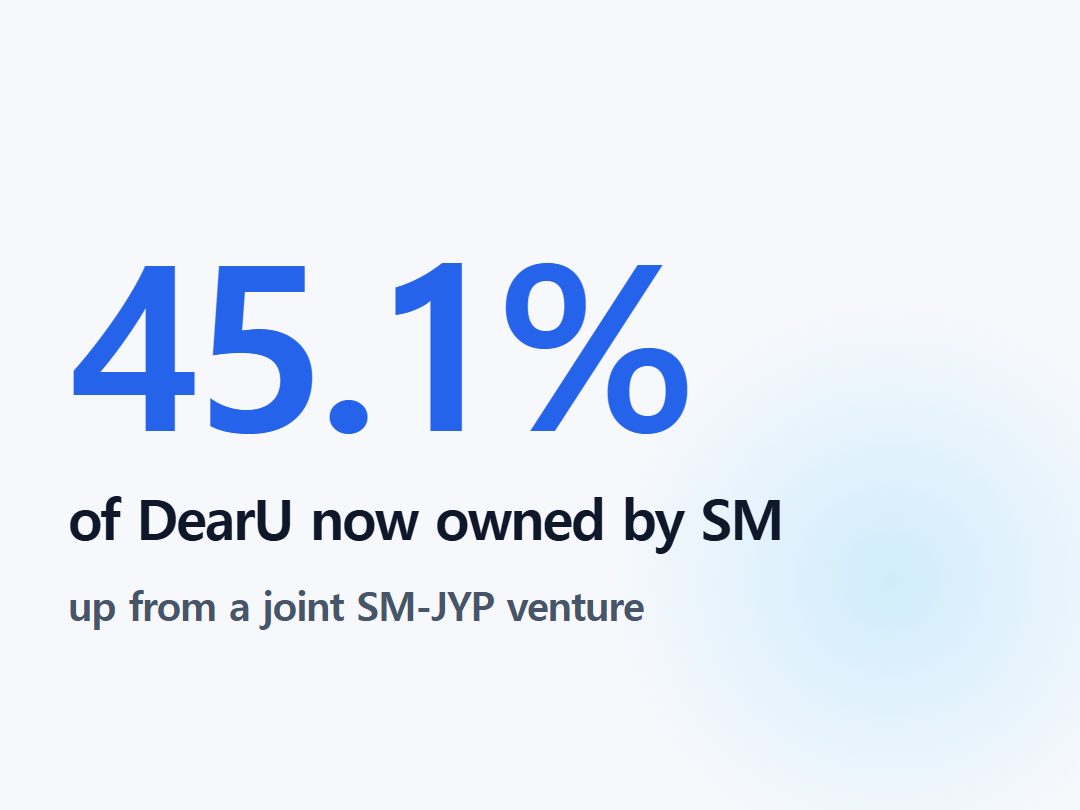
- SM now owns 45.1% of DearU, a company valued around $811 million.
What the screen doesn't show is that the same message just went out to everyone else who paid for that idol that month. Bubble, run by a Korean company called DearU, is built around making a one-to-many broadcast feel like a one-to-one text.
There is no direct Western equivalent. A paid Cameo video or a creator's Discord server does not disguise itself as a private text thread the way Bubble does, which is part of why the format confuses first-time international users.
One message, sent to everyone who paid
In Korea, a Bubble subscription costs about ₩4,500 a month, roughly $3.36, for messages from a single idol. Fans who follow every member of a five-person group pay for five separate subscriptions, one per person.
International users are billed in tiers, commonly around $3.99 for one month with small discounts for longer terms. By 2024, industry estimates put Bubble at roughly 2 million paying subscribers across some 600 idols and artists spanning dozens of agencies.
Why fans call it private when it technically isn't
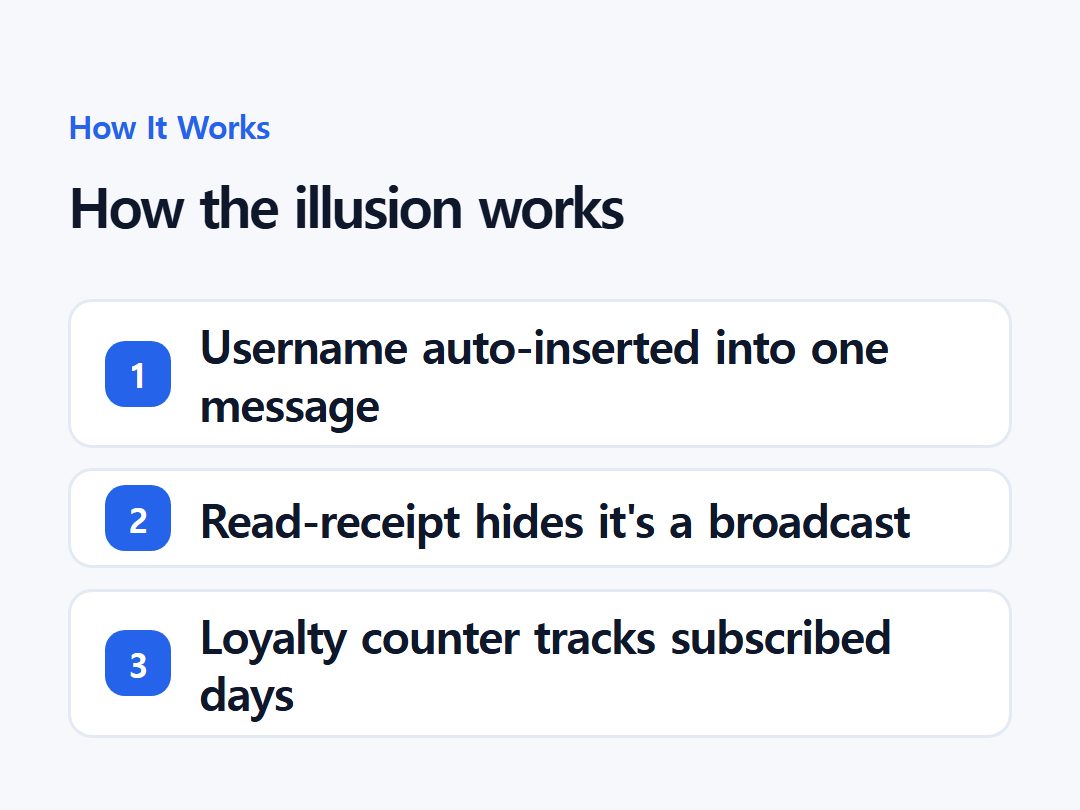
An idol does not write a separate note to each subscriber. They write one message, and the app automatically inserts each subscriber's username into it: "Good night, @username!" appears as "Good night, Sarah!" on one phone and "Good night, Alex!" on the next, according to a teardown of the app by the Nielsen Norman Group, a UX research firm.
On the idol's side, there is no string of individual conversations to answer. There is a single outbound message and, separately, a group feed where every subscriber's replies pile up, visible to the idol as a stream, not as private inboxes to respond to one by one.
This is the gap that matters to an outside reader: the product being sold is not really a conversation. It is a broadcast formatted to feel like one, and both the app's design and the industry's per-idol pricing depend on that feeling holding up.
The interface borrows Korea's most familiar chat app on purpose
Bubble's chat screen mirrors KakaoTalk, the messaging app most Koreans use daily, down to the color scheme and bubble shapes. A chat that looks like every other chat on a fan's phone is easier to read as real.
Several smaller design choices reinforce the same effect, per the Nielsen Norman Group's analysis:
- A small "1" marker sits next to each message and disappears once it registers as read, mimicking a normal read receipt
- A heart-shaped counter tracks how many consecutive days a fan has stayed subscribed to one idol, echoing how Korean couples track relationship anniversaries
- Cancelling a subscription triggers a broken-heart screen reading "one day we will meet again," designed to prompt a resubscription
Where a $3.36 subscription actually goes
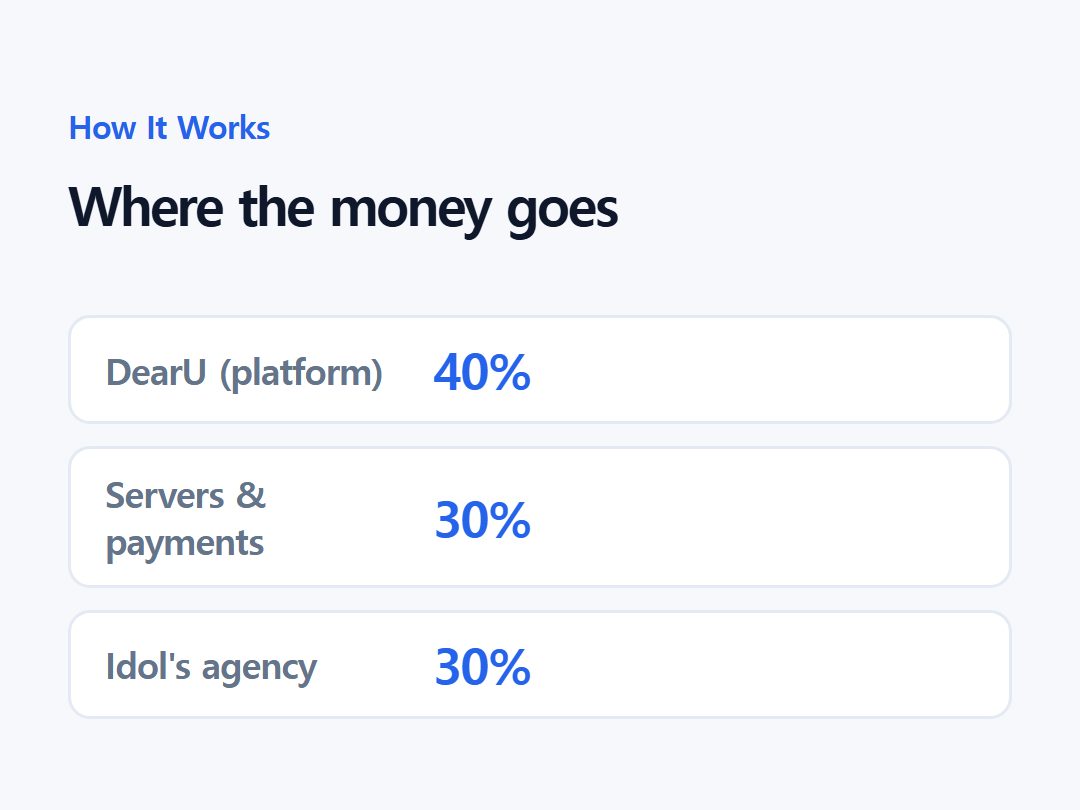
Bubble's revenue is split three ways, based on figures the app has disclosed and that Korean entertainment outlets have reported. DearU, which operates the platform, keeps 40%; another 30% covers servers and payment processing; the remaining 30% goes to the idol's agency, the management company that signs, trains, and takes a cut of a K-pop idol's earnings under a multi-year contract.
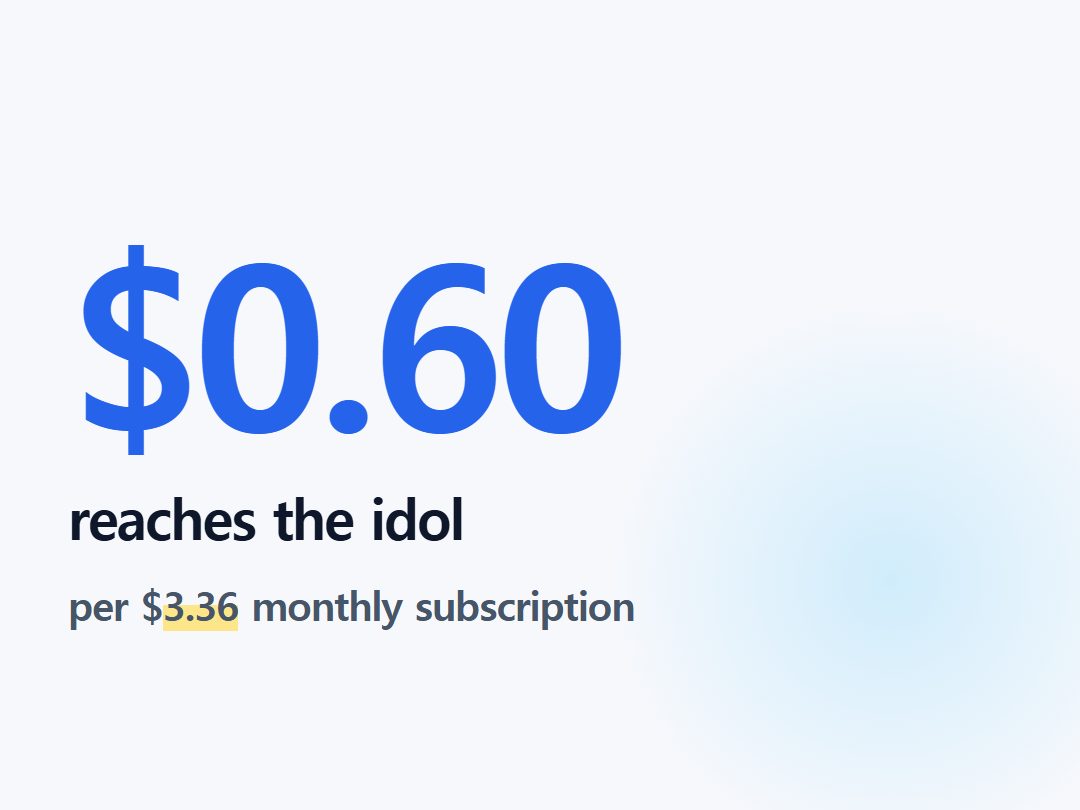
Idols typically receive about 60% of their agency's share, which works out to roughly ₩810, or $0.60, of every ₩4,500 monthly subscription.
| Recipient | Share | Per ₩4,500 subscription |
|---|---|---|
| DearU (platform) | 40% | ₩1,800 |
| Servers & payments | 30% | ₩1,350 |
| Agency | 30% | ₩1,350 |
| — of which, idol | ~60% of agency share | ~₩810 ($0.60) |
Scaled up, an idol with 10,000 monthly subscribers earns roughly ₩8 million, about $5,970, from Bubble in a single month, before whatever share their contract routes back to the agency for management or promotion costs.
Fans can reply, inside limits that loosen with loyalty
Subscribers are not locked out entirely. They can send a small number of replies to each idol message, commonly reported as up to three, with more unlocking after roughly a week. Reply limits and message length also expand the longer someone stays subscribed to one idol, tying the loyalty counter to actual functionality.
A 2024 update let idols flag one specific fan's message with a direct reply, without revealing that fan's username to anyone else in the chat. It is optional, used selectively, and does not change how the broadcast reaches everyone else.
Bubble began as one label's side project, not an industry standard
DearU traces back to July 2017, when SM Entertainment, one of Korea's oldest and largest K-pop agencies, founded the company under the name Everysing. In 2019 it merged with a messenger-software firm called Brinicle and launched Bubble in February 2020, limited at first to SM's own artists and offered as a feature inside Lysn, SM's existing fan-club app.
Early coverage was skeptical, questioning whether charging fans for a scripted, one-directional message exploited the parasocial bond between idol and fan rather than serving it. That criticism did not slow adoption.
The format worked immediately. Within about a year, Bubble had passed 1.2 million subscriptions and was generating an estimated ₩5.4 billion a month at the ₩4,500 rate, around $4 million at 2021 exchange rates, according to Korea Economic Daily's reporting. That was proof the format could scale before any other label joined.
A rival agency bought in to compete with the market leader
Bubble was not the only paid-messaging option. HYBE, the agency behind BTS, runs a separate platform called Weverse that dominated the space early on. In June 2021, JYP Entertainment, home to Stray Kids and TWICE, bought a 23.3% stake in DearU alongside SM's roughly 40% holding, explicitly to build a joint alternative large enough to compete.
A third competitor briefly existed. NCsoft, the gaming company, ran its own paid-messaging platform called Universe. After weak performance, DearU absorbed Universe's user base and intellectual property in early 2023, and Universe shut down that February, folding a rival straight into Bubble instead of leaving fans to switch apps themselves.
One label now controls the platform two labels built together
What started as neutral joint ground between SM and JYP has since tilted toward one owner. By 2025, SM had purchased additional DearU shares, including part of JYP's original stake, raising its holding to 45.1% and making DearU a consolidated subsidiary of SM rather than an independent joint venture, according to Music Business Worldwide and Korea Economic Daily.
That single purchase, worth about $92.6 million for an 11.4% stake, valued the entire company at roughly $811 million, a scale few fans messaging their favorite idol for $3.36 a month would likely guess.
What subscribers still can't see
Neither DearU nor individual agencies publish per-idol subscriber counts, so fans have no way to know how many other people are in "their" chat with a given member. No idol has publicly discussed the workload of writing a broadcast message on a near-daily basis as part of a talent contract.
No Korean regulator has weighed in on whether design choices like the anniversary counter and the guilt-driven cancellation screen cross a line into manipulation rather than ordinary marketing.
With SM now moving to expand Bubble into Japan, China, and the United States, it remains unclear whether pricing, agency revenue splits, or transparency about how the messages actually work will change for a larger international audience, or whether the same illusion simply gets exported as-is.
Where a ₩4,500 Subscription Actually Goes
| Recipient | Share | Per ₩4,500 Subscription |
|---|---|---|
| DearU (platform) | 40% | ₩1,800 |
| Servers & payments | 30% | ₩1,350 |
| Agency | 30% | ₩1,350 |
| — of which, idol | ~60% of agency share | ~₩810 ($0.60) |
Frequently asked
Is Bubble by DearU actually a private chat with the idol?
No. Idols write one message and the app inserts each subscriber's username, so it reads as personal but the same text goes out to everyone who paid for that idol that month.
How much does a Bubble subscription cost?
In Korea it's about ₩4,500 (roughly $3.36) a month for one idol, and fans following every member of a group pay separately for each one; international users are billed around $3.99.
How much money do idols actually make from Bubble?
Idols get about 60% of their agency's 30% share, roughly ₩810 ($0.60) per ₩4,500 subscription, which adds up to about $5,970 a month for an idol with 10,000 subscribers.
Sources
Every factual claim above is traceable. We do not translate articles — we gather facts from multiple outlets and write them ourselves.
- K-Pop Apps Create the Illusion of Private Messaging with Celebrities — Nielsen Norman Group
- Here's How Much K-Pop Idols Can Earn From The "Dear. U Bubble" Messaging Service — Koreaboo
- Idols Can Reply To Specific Fans Via Bubble, As The App Adds New Features — Koreaboo
- DearU: A K-pop fan engagement platform success story — Korea Economic Daily (KED Global)
- SM Entertainment And JYP Entertainment To Work Together On Global Mobile Platform — Soompi
- SM Entertainment buys additional 11.4% stake in Bubble superfan app operator DearU in $92m deal — Music Business Worldwide
- SM Entertainment acquires additional 11.4% stake in DearU for $9.2 mn — Korea Economic Daily (KED Global)