
A Korean drama on Netflix now typically runs eight to twelve episodes and wraps up within weeks. A Korean drama airing on terrestrial television at 8:30 p.m. on a weeknight can pass 100 episodes and still be running five months later.
The short version
- Korean daily dramas can run 100+ episodes, unlike 12-episode streaming exports.
- Ratings, not contracts, decide episode counts for daily and weekend dramas.
- MBC extended The Second Husband to 150 episodes after ratings spiked.
Both are accurately described as "a Korean drama." International audiences, who mostly encounter the genre through streaming, rarely see the second kind — even though by raw household viewership, it is often the more-watched one inside Korea.
English-language coverage of K-dramas has recently focused on the export side shrinking, from 16 episodes down toward 12 or fewer. That trend is real, but it describes only the half of the industry built for licensing abroad.
Streaming Exports One Format; Broadcast TV Runs Another
Recent coverage has tracked a real trend: dramas built for Netflix, Disney+, and prime-time broadcast have been shrinking, from a long-standing 16 episodes down to 12, 10, or even 8. Twelve episodes is now the industry default for that category, and 20-episode dramas were nearly extinct by 2025.
That story only covers half the industry. Korean broadcasters are still airing daily dramas (일일드라마), which run five nights a week and routinely pass 100 episodes, alongside weekend dramas (주말드라마) that run on Saturdays and Sundays. Both formats exist right now, on the same channels, in the same month as the 12-episode streaming hits.
A Weekday Slot That Leads Straight Into the 9 P.M. News
Daily dramas occupy a specific broadcast window, roughly 8:30 to 9:00 p.m. on weeknights, directly before the major networks' flagship news broadcasts. On KBS1 in particular, that slot has functioned for decades as a fixed lead-in audience: viewers who tune in early for the news and stay for whatever airs just before it.
Each episode runs about 30 minutes, roughly half the length of a streaming episode. A 100-episode daily drama and a 12-episode streaming drama can end up covering a similar number of broadcast hours — just spread across five months instead of five weeks.
Two Dramas, Two Businesses
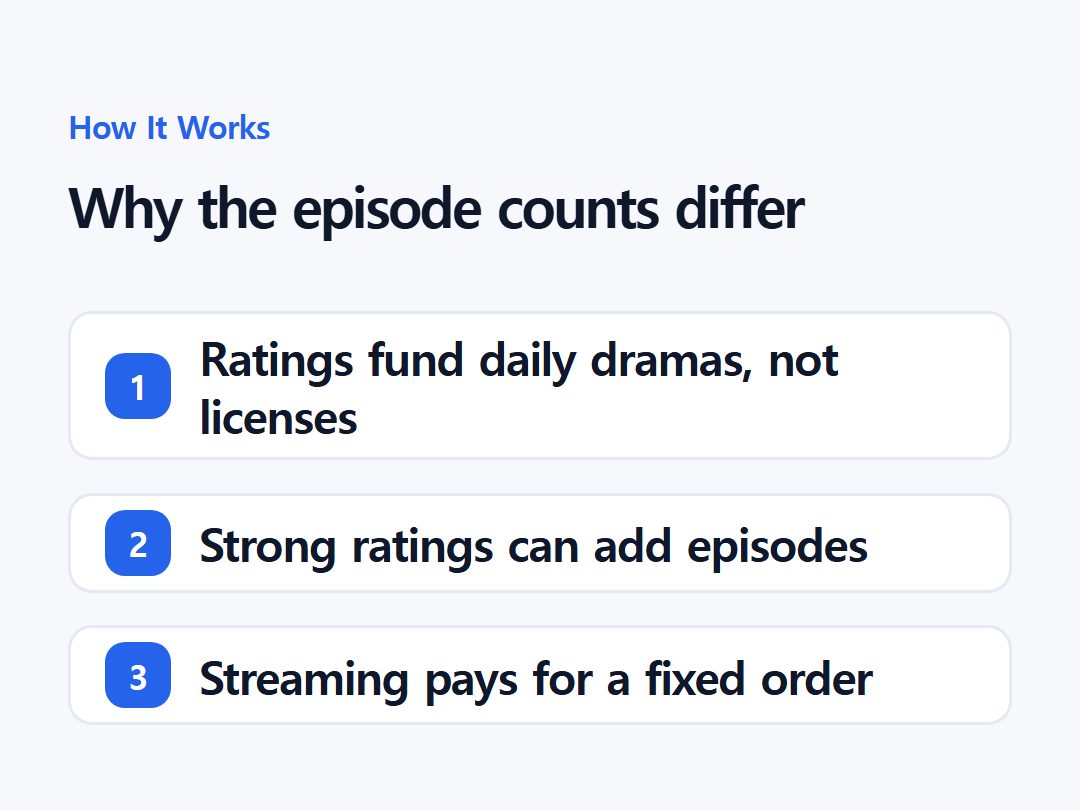
The two formats aren't different stages of the same production pipeline. They are funded differently, and that difference explains almost everything else about how long each one runs.
A streaming platform pays a production company a set fee for a finished, subtitled product of a defined length. A broadcaster pays for the daily drama slot by selling advertising against whatever household rating that slot pulls in — the drama itself is the delivery vehicle for the ad break, not a stand-alone product being sold once to a platform.
| Export / streaming drama | Daily or weekend drama | |
|---|---|---|
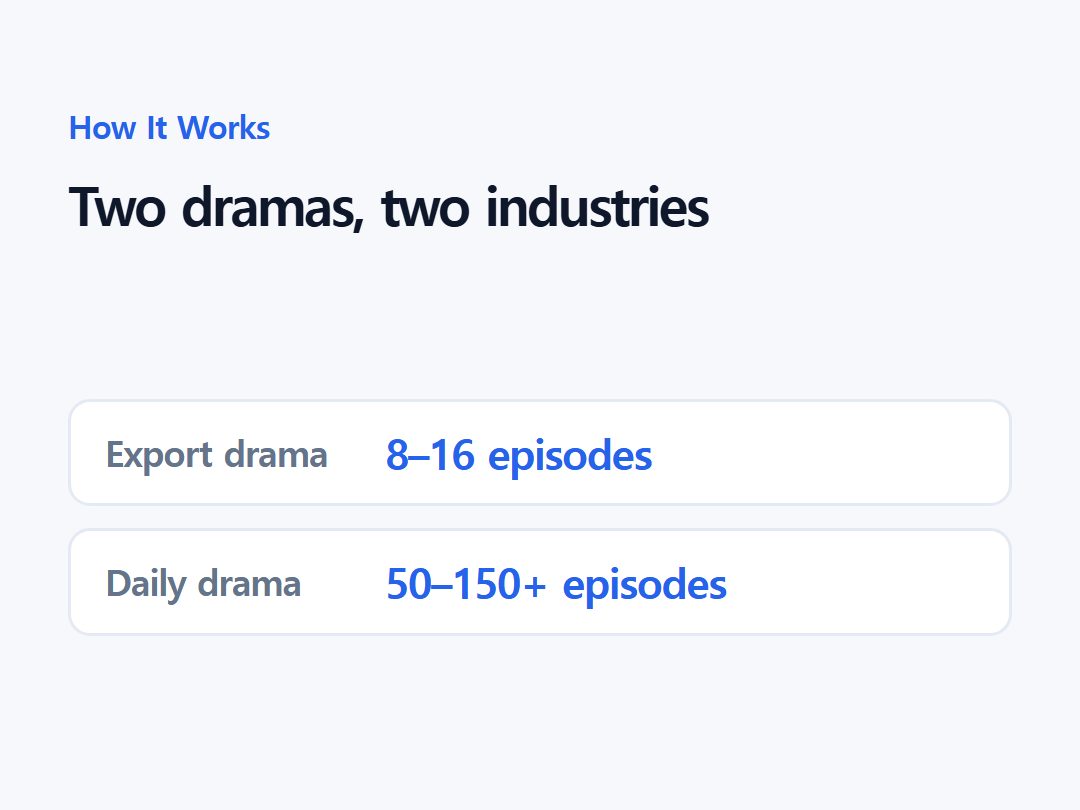
| Typical length | 8–16 episodes | 50–150+ episodes |
| Revenue source | Fixed streaming license or ad buy | Household ratings, sold as ad inventory |
| Episode order | Locked before filming starts | Can be extended mid-broadcast |
| Core audience | Global subscribers, younger domestic viewers | Domestic evening/family viewers |
Ratings, Not a Locked Episode Order, Decide How Long a Drama Runs
A streaming drama's episode count is written into the contract before a single scene is shot. A daily or weekend drama's count isn't fixed the same way — if household ratings hold up, broadcasters can add episodes while the show is still airing.
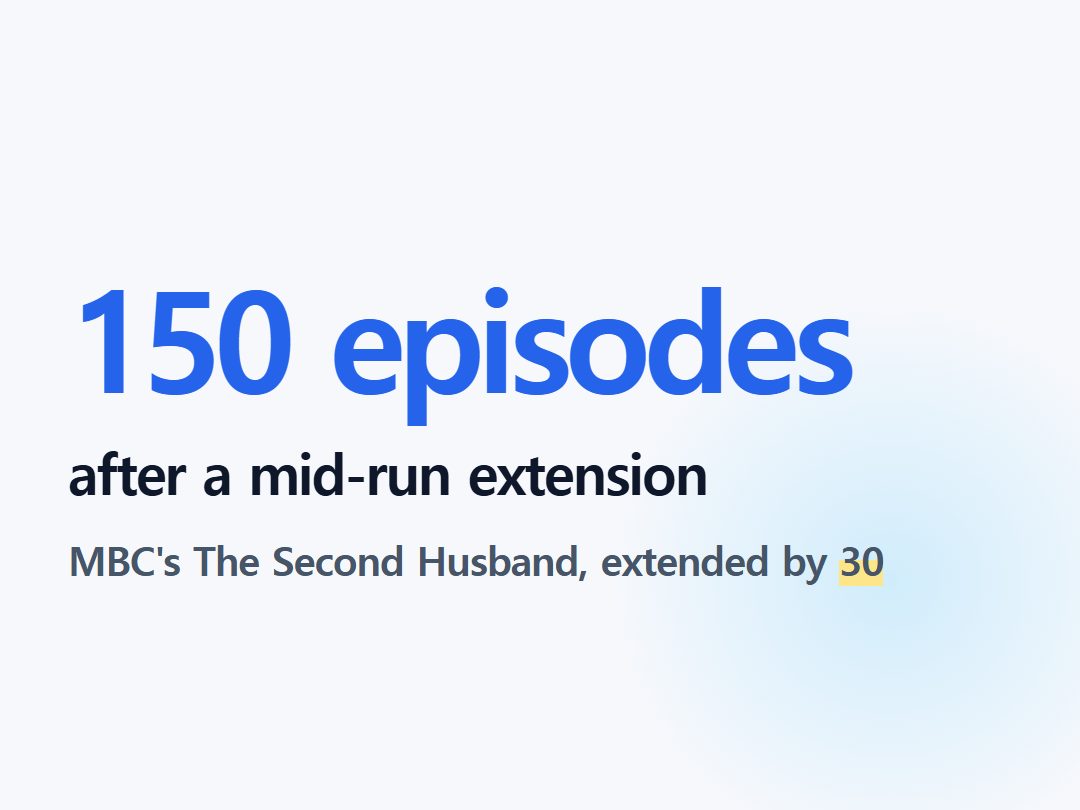
MBC's 2021–2022 daily drama The Second Husband is a documented case: the network extended it by 30 episodes, to a total of 150, after it broke into double-digit ratings partway through its run. The audience response itself became the reason the show kept going — something a fixed streaming order structurally cannot do.
One 2008 Melodrama Set the Template Still Used Today
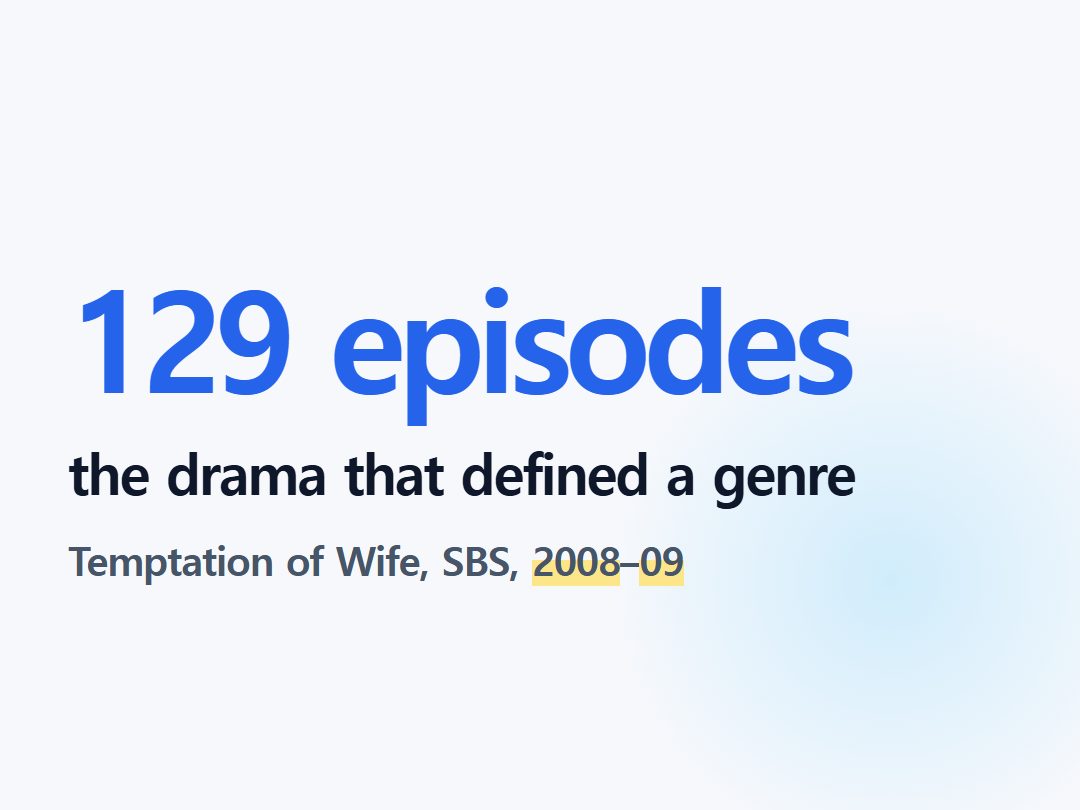
Temptation of Wife aired on SBS on weeknights from November 2008 to May 2009, ran 129 episodes, and averaged roughly 30% household viewership across that run. It's widely credited with cementing makjang (막장, literally "the end of the line") as a genre label for extended melodrama built on revenge, hidden identities, and family betrayal.
Academic analysis of Korean broadcasting groups Temptation of Wife with a handful of other late-2000s daily dramas as the genre's founding works, some of which drew audiences approaching 40% of everyone watching television at that hour. The plot devices those shows normalized — twin switches, sudden amnesia, staged deaths — still recur in daily dramas today.
The format predates 2008, too. Korean broadcast drama once ran even longer before settling near its current lengths: some 1990s series stretched past 80 episodes on general-audience schedules, and the 16-episode "export standard" now itself shrinking is, historically speaking, the newer invention.
Weekend Dramas Apply the Same Logic on a Slower Clock
Weekend dramas follow the same ratings-can-extend-the-run logic as daily dramas, just in roughly one-hour episodes on Saturdays and Sundays instead of 30-minute weeknight installments. One KBS2 weekend family drama from 2009 closed its finale at a 48.6% household rating — a figure no streaming-era Korean drama has approached domestically.
For comparison, a strong rating for a current network prime-time drama is around 6–8%, and even a global phenomenon like Crash Landing on You topped out near 22% on cable. Daily and weekend dramas remain, by raw household numbers, among the most-watched dramas made in Korea — they are simply not the ones licensed abroad.
Why the Long Format Rarely Gets Subtitled
A few practical factors keep daily and weekend dramas off international platforms almost entirely.
- Subtitling and licensing 100-plus episodes costs far more than a single 12-episode season
- The pacing and plots target older domestic viewers, not a global streaming algorithm
- Production still often runs close to broadcast rather than being finished in advance
Streaming has instead pushed the export-facing side of the industry toward pre-production — filming most or all episodes before broadcast begins — because it fits a global release calendar. Daily dramas, built around ratings-driven extensions decided after a show has already started airing, don't fit that model.
Casting also differs. Daily and weekend dramas lean on large, rotating ensembles of veteran domestic actors rather than the small, star-driven casts that streaming platforms market internationally, which further narrows their appeal to buyers shopping for a recognizable lead.
The Same Industry Is Shrinking at the Other End
The 16-episode format itself kept sliding through the 2020s. By 2025, 12 episodes had become the default for both broadcast and streaming projects aimed at export, with some titles cut to 10 or 8 — Netflix's The Trauma Code, for instance, was restructured from ten 60-minute episodes down to eight 45-minute ones.
Netflix's global, binge-friendly model is widely cited as the catalyst for that contraction, and the pressure has spread to Disney+ and domestic broadcasters producing for export. That shrinkage is happening only on the export-facing side — the daily and weekend drama slots have not followed it.
What Isn't Clear Yet
Whether the daily drama slot survives long-term is an open question. Terrestrial ratings have declined for years, and it isn't publicly documented how much longer broadcasters can sustain a format built for an audience that increasingly skips live television.
It's also unclear whether any streaming platform will eventually adapt the long format rather than avoid it. Shortened, subtitled cuts of long-running dramas have appeared occasionally, but no major platform has committed to airing the daily-drama model on its own terms.
For now, the two formats keep running side by side, aimed at almost entirely different audiences. A reader who has only watched Korean drama on a streaming app has seen one branch of the industry, not the whole tree.
Export/Streaming Drama vs. Daily/Weekend Drama
| Export / streaming drama | Daily or weekend drama | |
|---|---|---|
| Typical length | 8–16 episodes | 50–150+ episodes |
| Revenue source | Fixed streaming license or ad buy | Household ratings, sold as ad inventory |
| Episode order | Locked before filming starts | Can be extended mid-broadcast |
| Core audience | Global subscribers, younger domestic viewers | Domestic evening/family viewers |
Frequently asked
Why do some Korean dramas have 100 episodes?
Daily dramas air five nights a week and networks can extend them mid-broadcast if ratings hold up, unlike streaming dramas whose episode count is locked before filming starts.
What is a Korean daily drama (일일드라마)?
It's a roughly 30-minute weeknight broadcast slot airing right before the evening news, and it can run anywhere from 50 to 150+ episodes depending on ratings.
Why are Korean dramas getting shorter?
Netflix's binge-friendly model has pushed export-facing K-dramas from the old 16-episode standard down to around 12 or fewer, but that shrinkage only affects streaming exports, not domestic daily or weekend dramas.
Sources
Every factual claim above is traceable. We do not translate articles — we gather facts from multiple outlets and write them ourselves.
- Korean dramas shift to shorter seasons as 16-episode format fades — The Korea Times
- Temptation of Wife (South Korean TV series) — Wikipedia
- The 100-episode club: long K-dramas that are absolutely worth the watch — Tatler Asia
- Changes and continuities of Makjang drama in the 2000s and 2010s — Journal of Japanese and Korean Cinema (Taylor & Francis)
- MBC To Extend "The Second Husband" By 30 Episodes — Soompi
- Top 10 Highest-Rated Korean Dramas of All Time — KbizOom
- 일일 드라마 (Daily Drama) — Namuwiki