Since early 2026, three separate K-pop figures who once announced they were leaving the industry for good have quietly returned: former BIGBANG member T.O.P released a solo album, former TVXQ member Park Yoochun resumed his music career after settling years of lawsuits and tax debt, and two members of SS501 regrouped with Kim Hyun-joong under a new unit name.
None of them re-signed with the agency that dropped them. All of them took years to get here.
The short version
- South Korea has no law banning convicted celebrities from returning to TV.
- Terminated stars often launch their own label instead of signing elsewhere.
- Only 20-30% of cancelled Korean celebrities ever rebuild a career.
International coverage tends to treat each return as an isolated headline about forgiveness or nerve. Korean coverage treats it as a familiar mechanism, because the same steps — contract, silence, legal paperwork, overseas test run, quiet re-entry — show up almost every time.
Five idols, one recurring script
The pattern is not new, and it is not limited to 2026. Rapper B.I left the group iKON in 2019 after a drug-purchase investigation and returned as a soloist under his own label in 2021. Former FTISLAND guitarist Choi Jong-hoon, convicted in the 2019 Burning Sun case, tried a fan-platform return from Japan in 2024.
- T.O.P — marijuana conviction (2017), left BIGBANG (2023), solo album (2026)
- Park Yoochun — methamphetamine conviction (2019), agency-announced retirement (2019), full resumption (2026)
- B.I — drug investigation, contract terminated (2019), solo debut under new label (2021)
- Choi Jong-hoon — Burning Sun conviction, prison release (2021), fan-platform return attempt (2024)
Every one of these figures is a man; every case involves either a drug or violence conviction rather than a private-life controversy. That is itself informative — it shows what the industry considers survivable and what it does not.
An exclusive contract ends the moment a scandal breaks
K-pop idols work under what is called the agency system: a company signs a trainee to a multi-year exclusive contract, funds years of training, and in exchange controls scheduling, branding, and a share of earnings once the artist debuts. Leaving that contract, voluntarily or not, means losing the entire management structure — not just a job.
When a scandal breaks, the agency almost always terminates the contract within days. Park Yoochun’s agency, C-JeS Entertainment, cut ties with him in 2019 immediately after his drug charges were confirmed. T.O.P’s departure from BIGBANG followed the same logic once his contract with YG Entertainment lapsed.
That termination is the real starting gun for everything that follows. A star with no agency has no legal way to book broadcast work, negotiate endorsements, or even release music through Korea’s major distribution channels — they are, administratively, unemployed.
Korea has no law that keeps a convicted celebrity off television
This is the detail most international readers miss: South Korea has no statute barring a convicted celebrity from returning to entertainment. What looks like a formal ban is actually jasuk (자숙), a voluntary self-reflection hiatus that stars and agencies observe by custom, not by law.
Broadcasters decide, individually and inconsistently, whether to book someone. The Korea Herald has documented how wildly the unofficial hiatus length varies by case: rapper Psy returned after roughly six months following a marijuana fine, actor Ha Jung-woo after about two years following a propofol case, actor Ju Ji-hoon after three years following a drug charge, and T.O.P after five years.
Each network also runs its own unwritten rule. KBS and MBC historically leaned toward informal multi-year holds; MBC’s own three-year convention lost most of its force after a 2012 labor strike reshuffled the network’s practices.
None of this is written into broadcasting law — a lawmaker pushing for stricter rules put it bluntly in a domestic report, framing public anger as being less about the offense than about how quickly offenders return while still being paid large sums for it.
Why stars build their own label instead of signing with one
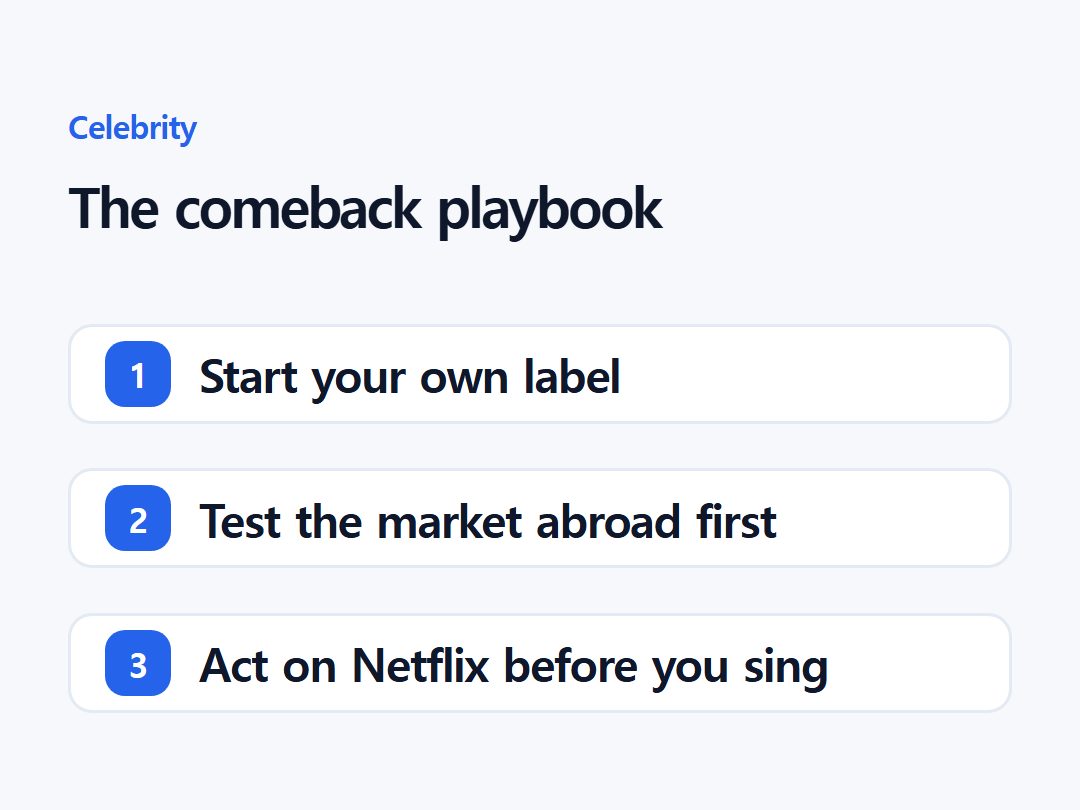
Once a name is attached to a drug or violence case, established agencies have little incentive to sign that person — the reputational risk transfers to them too. That is why several of these comebacks happen under a company the artist controls personally.
B.I did not sign with a rival idol agency. He became an executive at IOK Company in October 2020 and launched his own label, 131 Label, four months later, releasing his comeback single and album through it in 2021. T.O.P followed a similar path, releasing his 2026 solo album through his own company, Topspot Pictures, rather than returning to YG.
A self-owned label solves two problems at once: no outside agency has to accept the reputational exposure, and the artist keeps the revenue share a standard idol contract would otherwise split with a management company.
A Netflix credit doesn’t answer to a Korean broadcaster
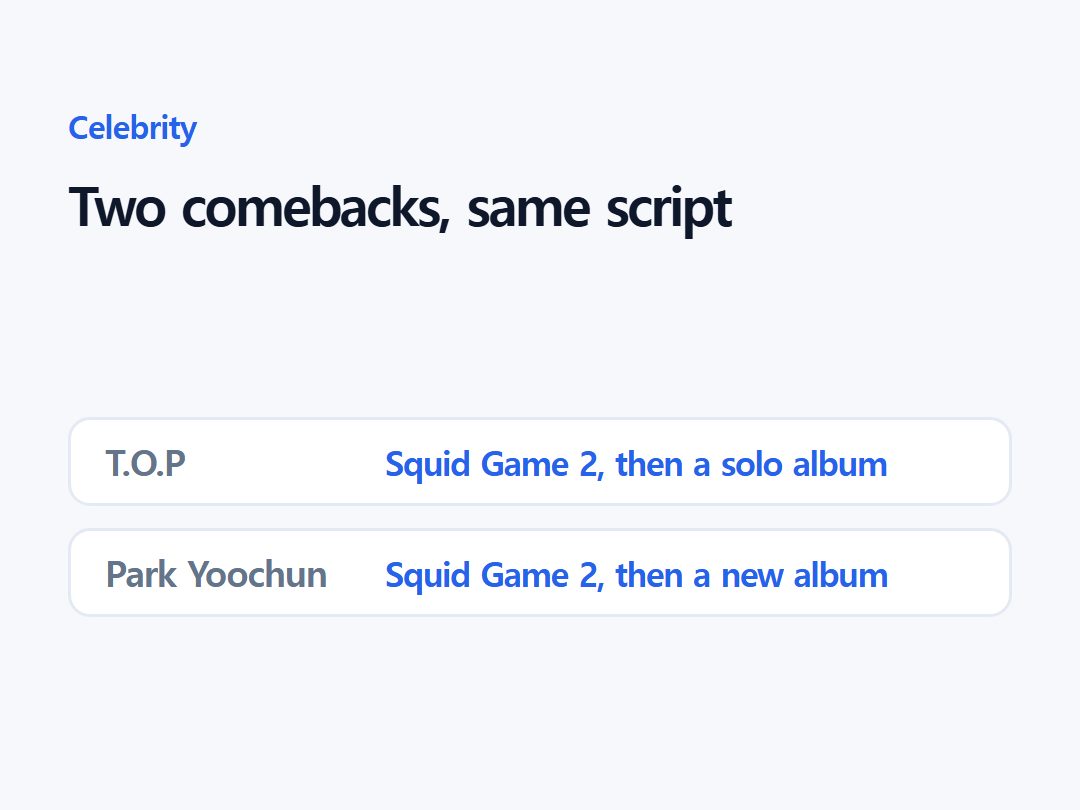
Both T.O.P and Park Yoochun made their first public reappearance not through a Korean network, but through the same Netflix production: Squid Game Season 2, released in December 2024. Their music comebacks followed only afterward, in 2026.
That sequencing is not incidental. A South Korean outlet covering Yoochun’s return described the broader pattern as public figures who had formally exited the industry shifting focus toward overseas markets and global platforms to bypass domestic restrictions — because a Netflix original isn’t programmed by KBS, MBC, or SBS, it isn’t subject to any of those networks’ internal holds or unwritten blacklists.
Japan and Thailand as the first stop home
Several of these figures tested the water abroad before facing a Korean audience directly. Park Yoochun rebuilt his career mainly through fan meetings, an independent film, and music releases in Thailand and Japan starting around 2020, years before his 2026 domestic resumption.
Choi Jong-hoon’s 2024 attempt to reconnect with fans ran through Fanicon, a Japanese fan-community platform, under the name Huniya — not a Korean broadcaster or label. Industry commentary has noted that Japan’s entertainment press and fan culture tend to respond less punitively to a rehabilitated figure than Korean domestic media do, making it a lower-risk venue to gauge demand before any Korean re-entry.
The same lawsuit that capped every idol contract at seven years
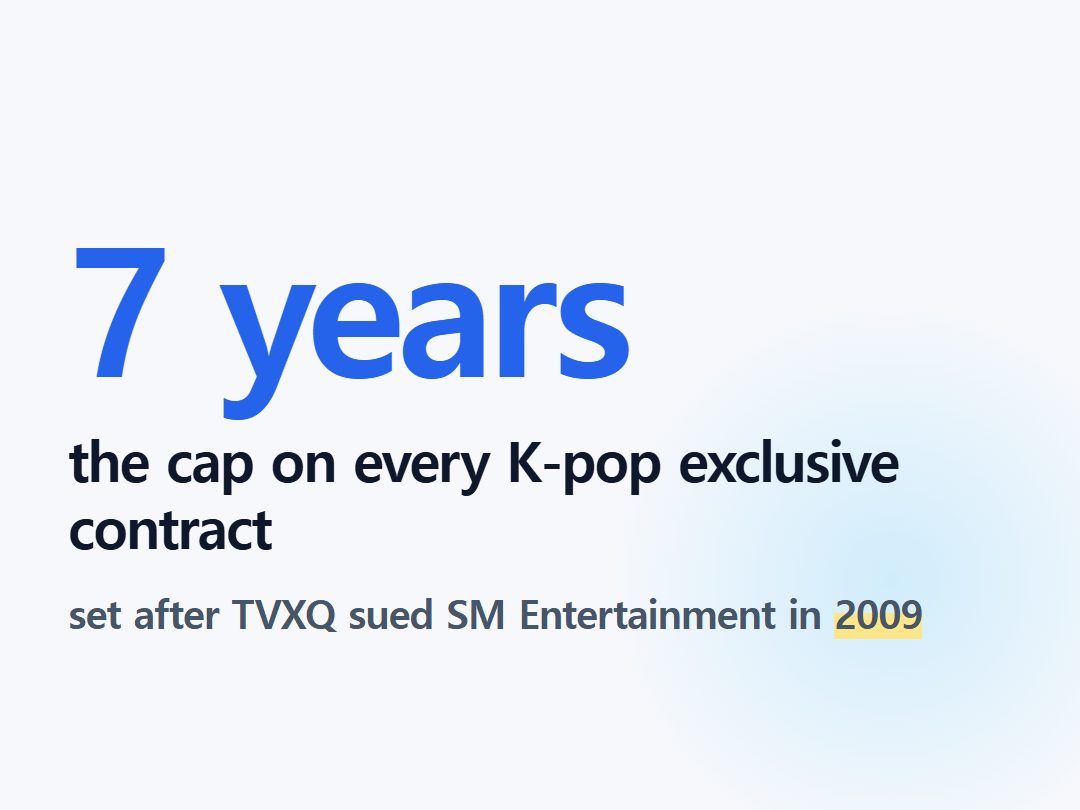
The contract system these stars are navigating has its own scandal origin. In 2009, three members of TVXQ — including Park Yoochun himself, more than a decade before his own comeback saga — sued SM Entertainment to void a 13-year exclusive contract they called excessive.
A Korean court agreed the term was too long. South Korea’s Fair Trade Commission responded by publishing the country’s first standard exclusive contract for entertainers that same year, recommending a maximum term of seven years — a cap that is now industry-standard for nearly every debuting idol group.
Yoochun’s presence on both sides of Korean entertainment-contract history, once as the plaintiff reshaping the system and now as a case study in how a terminated contract strands a star, is a coincidence worth noting rather than a pattern — but it underlines how central the exclusive contract is to every stage of an idol’s career, including its end.
Calling it an anniversary, not a comeback
Framing matters almost as much as logistics. When Kim Hyun-joong, who was found guilty of assaulting an ex-girlfriend in 2014, regrouped with two other SS501 members in 2025 as the unit FIVE O ONE, he was explicit about the label he wanted attached to it.
“It’s not exactly a comeback,” he said in a 2026 interview. “It’s our 20th debut anniversary. All five members didn’t reunite, but three of us formed a group.” Framing a return as a milestone celebration rather than a bid to resume a career gives press and fans a softer entry point than the word comeback would.
What hasn’t changed: Korean public opinion
None of these strategies has produced a warm domestic reception. Kim Hyun-joong’s 2025 reunion drew immediate pushback from fans who noted the original five-member lineup was being quietly reduced in spirit, if not in name.
Park Yoochun’s 2026 resumption was reported alongside explicitly cold domestic public sentiment, even after his legal issues were resolved. T.O.P’s return has been described in Korean entertainment coverage as met with a public mood that is not very good.
A 2025 industry analysis estimated that only around 20 to 30 percent of Korean celebrities who go through a public cancellation successfully rebuild a career, and that the ones who do typically combine a genuine break of six months to two years with a strong project and solid agency backing — not just time passing.
Lawmakers have also periodically pushed for a formal, legally binding broadcast ban tied to drug convictions specifically, arguing the current system lets stars simply outwait public anger; no such law has passed.
In July 2025, the Ministry of Culture, Sports and Tourism revised its standard entertainer broadcasting contract for the first time in 12 years, but the change added financial clawback terms for scandals rather than any blanket appearance ban — meaning the underlying gap these five comebacks all navigated remains open.
How long the unofficial jasuk hiatus lasted, by case
| Star | Offense trigger | Time until return |
|---|---|---|
| Psy | Marijuana fine | ~6 months |
| Ha Jung-woo | Propofol case | ~2 years |
| Ju Ji-hoon | Drug charge | 3 years |
| T.O.P | Marijuana conviction | 5 years |
Frequently asked
Is there a law banning convicted K-pop stars from TV?
No — South Korea has no statute barring a convicted celebrity from returning; the hiatus called jasuk is a voluntary industry custom, not a legal ban.
Why did T.O.P and Park Yoochun return through Netflix instead of Korean TV?
Squid Game Season 2 wasn't programmed by KBS, MBC, or SBS, so it wasn't subject to those networks' unwritten holds on scandal-hit stars.
What happens to a K-pop idol's contract after a scandal?
Agencies almost always terminate the exclusive contract within days, leaving the star without a legal way to book work until they sign elsewhere or start their own label.
Sources
Every factual claim above is traceable. We do not translate articles — we gather facts from multiple outlets and write them ourselves.
- Former iKON Member B.I to Release First Solo Full-Length Album — The Korea Times
- B.I (rapper) — Wikipedia
- 'Retirement reversal' Park Yoochun announces plan to fully pay off 400 million won in taxes after 10 years — Sports Khan
- Park Yoo Chun, Choi Jong Hoon, and T.O.P face backlash after backtracking on retirement — allkpop
- 'Cannabis smoking to Big Bang withdrawal to reversal of retirement' Top confirmed his solo comeback — STARNEWS
- Former BIGBANG member T.O.P to return as solo artist — The Korea Times
- Disgraced 'Burning Sun' Idol Choi Jong Hoon Suspected Of Attempting To Return To Entertainment Industry — Koreaboo
- K-pop fans uneasy about return of main culprits in 'Burning Sun' scandal — The Korea Herald
- SS501 tease return as a trio for their 20th anniversary, netizens frown upon Kim Hyun Joong's attempt to resume promotions in Korea — allkpop
- Kim Hyun Joong personally opens up about five-year legal battle with ex-girlfriend, says acquittal took a long time — allkpop
- Self-suspension, a peculiar 'punishment' for celebrities in Korea — The Korea Herald
- The truth about TVXQ: Korean Fair Trade Commission and the Contract — TVXQ! Express
- K-pop stars punished by unfair contracts — The Korea Times
- South Korea's cancel culture and how it impacts brands — Daxue Consulting