
Former U-KISS member Lee Jun-young has spent nearly a decade building an acting résumé that includes D.P., Weak Hero Class 2, and the 2026 JTBC series Reborn Rookie. In a May 2026 interview, he still described the bias he faced switching from music to acting as worse than he expected going in.
The short version
- Idols face bias before a performance is judged, not after it.
- Lee Jun-ho became the first idol-actor to win a Baeksang Best Actor award.
- The King's Warden sold 16.9 million tickets, Korea's second-biggest film ever.
His story is not unusual. It points to a pattern international fans rarely see explained: in Korea, a former idol trying to act is not just auditioning for a role. They are first auditioning to be taken seriously as something other than an idol.
That distinction sounds small from outside Korea, where singers moving into film and television is unremarkable. Inside the industry, it has shaped entire careers, review cycles, and even how award juries vote.
A label that follows them onto the set
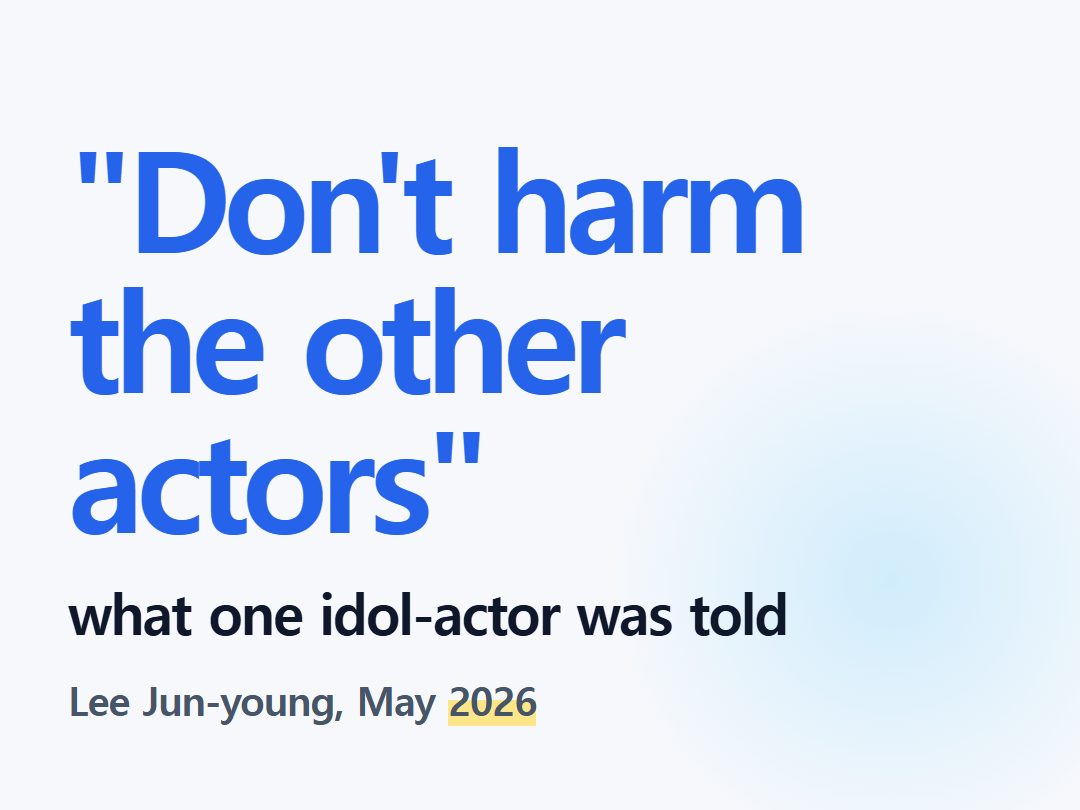
Lee Jun-young debuted as an idol in 2014 and moved into acting in 2017. Nearly a decade and multiple acclaimed dramas later, he told an interviewer that one remark has stayed with him: someone once told him, "don't cause harm to the other actors."
That comment did not target a specific performance. It targeted his category — idol first, actor maybe later, if he was lucky.
Why the skill question isn't actually the argument
International readers often assume the debate over idol-actors is about talent: can this singer deliver a convincing performance or not? That framing misses the actual mechanism.
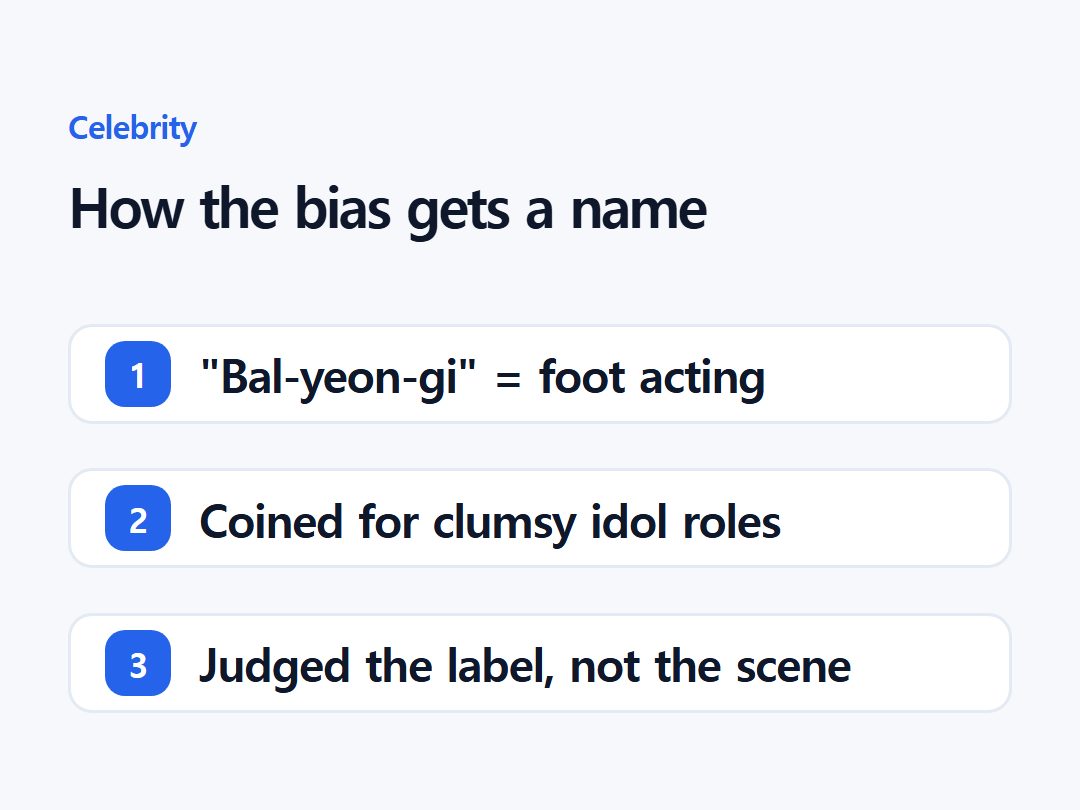
The bias is applied before a performance is judged, not after. A trained actor's bad scene is read as an off day. An idol's identical scene is read as confirmation that idols can't act — the label supplies the verdict in advance.
This is the double burden Korean fans take for granted and international fans usually don't: idol-actors are not just proving they can act. They are working to get the industry to evaluate them at all on the same terms as everyone else, regardless of how the role actually goes.
"Foot acting" became shorthand for an entire category
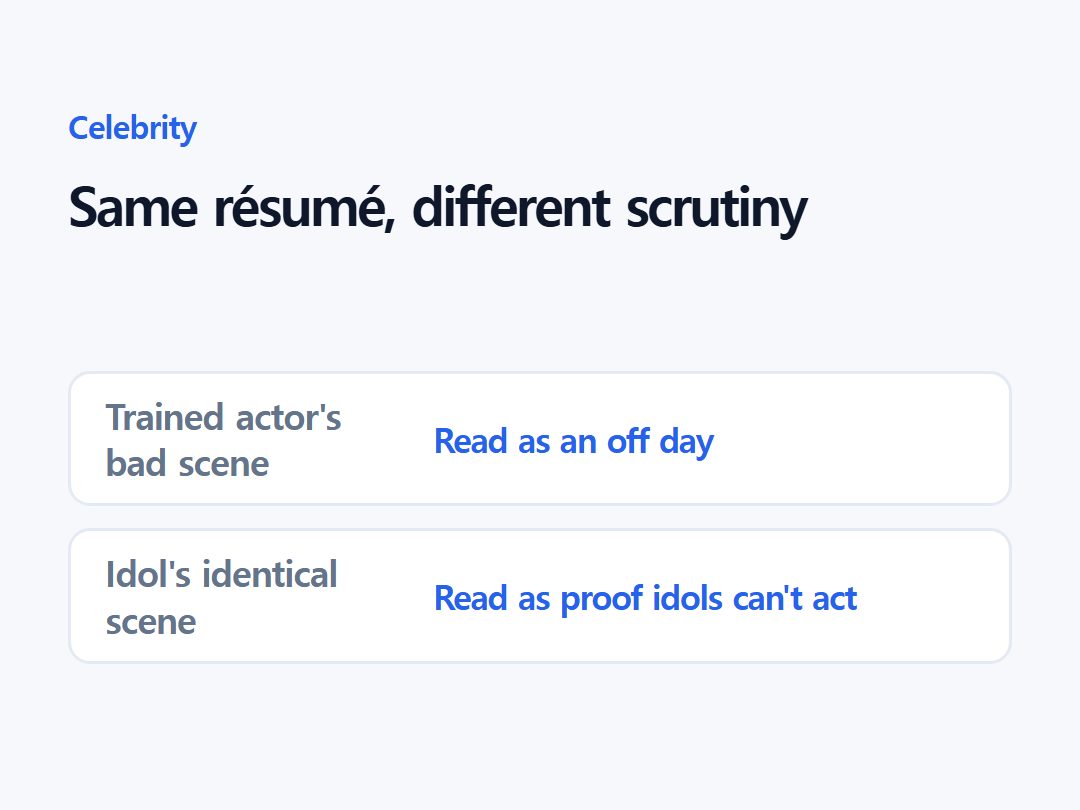
The bias has a name in Korean entertainment media: bal-yeon-gi, literally "foot acting" — a jab meaning performance so clumsy it looks like it was done with your feet. The term spread specifically to describe idols cast for their fanbase rather than their range.
Critics pointed to a consistent list of complaints: flat line delivery, stiff body language, and expressions that didn't shift with the scene. The term stuck because, for a period, it was often accurate — agencies were casting idols in dramas primarily to sell tickets, not to stretch their range.

Why agencies started training idols to act before they even debut
Understanding the fix requires understanding the system that created the problem. Korean idols come up through the agency system — companies that scout, house, and train trainees for years, sometimes starting in their young teens, before a group ever debuts.
For most of K-pop's history, that training covered singing, dancing, and media presence — not screen acting. Idols who wanted to act were essentially starting a second career from zero, mid-fame, in front of an audience already primed to doubt them.
That has changed. Agencies now build on-camera acting into trainee curricula well before debut, so idols who eventually move into drama or film are no longer complete beginners the day they show up on set.
The reviews aren't measuring the same thing
Even trained idol-actors describe a different standard of scrutiny than actors who came up through theater or acting academies. Online criticism of idol-actors still tends to focus on category first, performance second — a pattern several current idol-actors have pointed to in interviews about their own reception.
The frustration isn't that critics dislike bad acting. It's that the same scene gets read differently depending on which résumé the performer walked in with.
The co-star who says she had to unlearn her own bias
EXO's Doh Kyung-soo, who performs as D.O., debuted as an idol in 2012 and made his acting debut in the 2014 film Cart. His co-star in the SBS drama It's Okay, That's Love, veteran actress Yum Jung-ah, later said he "completely shattered" her own prejudice against idol-actors, citing his preparation and humility as a newcomer on set.
Doh has since gone on to reach "10-million actor" status in Korea — meaning a film he starred in sold over 10 million tickets — through the Along with the Gods franchise, and recently took a villain role in the Disney+ series The Manipulated.
Yoona's decade-long fight against a single image
Girls' Generation's Yoona faced a related but distinct version of the bias: typecasting. Rather than being doubted on ability outright, she was repeatedly cast to repeat the same "candy" idol image rather than take on range.
At a 2016 press conference for The K2, she addressed the idol-actress prejudice directly: "There was a period long ago when I felt burdened by it and struggled because of it, but I think I've become liberated from that to a certain extent." The drama became a turning point critics point to when her acting started being reviewed on its own terms.
From "Wink Boy" to the second-biggest film in Korean box office history
Park Ji-hoon debuted through the survival show Produce 101 Season 2 in 2017, where fans nicknamed him "Wink Boy" — a label built entirely around his idol persona, not his range as a performer.
In February 2026, he starred as the deposed teenage King Danjong in the historical film The King's Warden. By July, the film had sold 16.9 million tickets, making it the second-highest-grossing Korean film ever made, behind only The Admiral: Roaring Currents.
A box-office record does not erase a bias by itself. But it does something the bias depends on being able to avoid: it forces a mass audience, not just critics, to judge the performance on its own terms.
The first former idol to win Korea's top television acting prize
The clearest sign the bias can be overcome, rather than just endured, came in 2022. 2PM's Lee Jun-ho became the first idol-actor to win Best Actor – Television at the Baeksang Arts Awards, Korea's most prestigious entertainment ceremony, for playing King Jeongjo in The Red Sleeve.
He also became the first former idol to win the top acting prize at the Korea PD Awards and the Grand Prize (Daesang) for acting at the Asia Artist Awards that same year — three separate juries independently deciding an idol background was no longer disqualifying.
This tension predates the current generation
None of this is new. Idols have been pushing through the same skepticism for close to two decades, they've just rarely had a name for it internationally:
- Park Yu-chun (JYJ) won four acting awards within three years of his 2010 drama debut
- Bae Suzy (miss A) became one of the most credited idol-actresses after 2012's Architecture 101
- Choi Si-won (Super Junior) had acted before he ever debuted as an idol
Each case chipped away at the assumption a little more, which is why the bias today is weaker than it was a decade ago — but, as Lee Jun-young's 2026 interview shows, not gone.
What still hasn't been resolved
Formal recognition — a Baeksang win, a franchise lead, a co-star's public reversal — settles the question for one person's career. It does not settle it for the next trainee who debuts as an idol and later wants to act.
Each new idol-actor still appears to start close to zero on credibility, regardless of how many of their predecessors already proved the premise wrong. Whether that resets with every debut because Korean entertainment media treats each case individually, or because the audience does, is not something any single interview has answered.
Idol-actors who chipped away at the bias
| Idol-Actor | Group/Origin | Milestone |
|---|---|---|
| Park Yu-chun | JYJ | Won four acting awards within three years of his 2010 drama debut |
| Bae Suzy | miss A | Became one of the most credited idol-actresses after 2012's Architecture 101 |
| Choi Si-won | Super Junior | Had acted before he ever debuted as an idol |
| Doh Kyung-soo (D.O.) | EXO | Reached "10-million actor" status through the Along with the Gods franchise |
| Lee Jun-ho | 2PM | First idol-actor to win Best Actor – Television at the Baeksang Arts Awards (2022) |
| Park Ji-hoon | Produce 101 Season 2 | The King's Warden sold 16.9 million tickets, Korea's 2nd-highest-grossing film ever |
Frequently asked
What does 'bal-yeon-gi' mean in Korean entertainment?
It literally means 'foot acting' — Korean media slang for clumsy performances, originally aimed at idols cast for their fanbase rather than their acting range.
Which idol was the first to win a Baeksang Best Actor award?
2PM's Lee Jun-ho won Best Actor – Television at the 2022 Baeksang Arts Awards for playing King Jeongjo in The Red Sleeve, the first former idol to do so.
How many tickets did The King's Warden sell at the Korean box office?
Park Ji-hoon's The King's Warden had sold 16.9 million tickets by July 2026, making it the second-highest-grossing Korean film ever, behind The Admiral: Roaring Currents.
Sources
Every factual claim above is traceable. We do not translate articles — we gather facts from multiple outlets and write them ourselves.
- "Don't be a burden to other actors": Lee Jun Young opens up about painful biases after idol-to-actor transition — allkpop
- Lee Jun-young Says Bias Against Idol Actors Led to the Most Hurtful Remark of His Career — KDramaStars
- From "Don't Hurt Real Actors" to Critical Acclaim: Idol-Turned-Actors Overcome Prejudice — Kbizoom
- Why "Bad Acting" by Idols Is No Longer a K-Drama Problem — Kbizoom
- Girls' Generation's YoonA Shares How She's Dealt With Idol-Actress Prejudice — Soompi
- 2PM's Lee Junho becomes the first idol-actor to win Best Actor at the 58th Baeksang Arts Awards — allkpop
- Top 7 successful idol-turned-actors — The Korea Herald
- The King's Warden — Wikipedia