Some K-pop fans do not buy one copy of a new album. They buy ten, fifty, sometimes several hundred of the exact same release, then hand out or discard most of the physical package after keeping only what they wanted. Outside Korea this looks like brand loyalty taken to an extreme.
Inside the fandom, it is understood as a calculated response to how the album, the merchandise inside it, and the sales charts are all built to work together.
The short version
- Buying multiple albums buys fansign lottery entries, not just music.
- Randomized photocards work like gambling odds, not guaranteed collectibles.
- Every album sold counts equally toward Korea's official sales charts.
How many albums does a fansign really take?
Buying multiples of a single album is not a one-off trend tied to any particular comeback. It is a standing feature of how physical albums are sold in Korea.
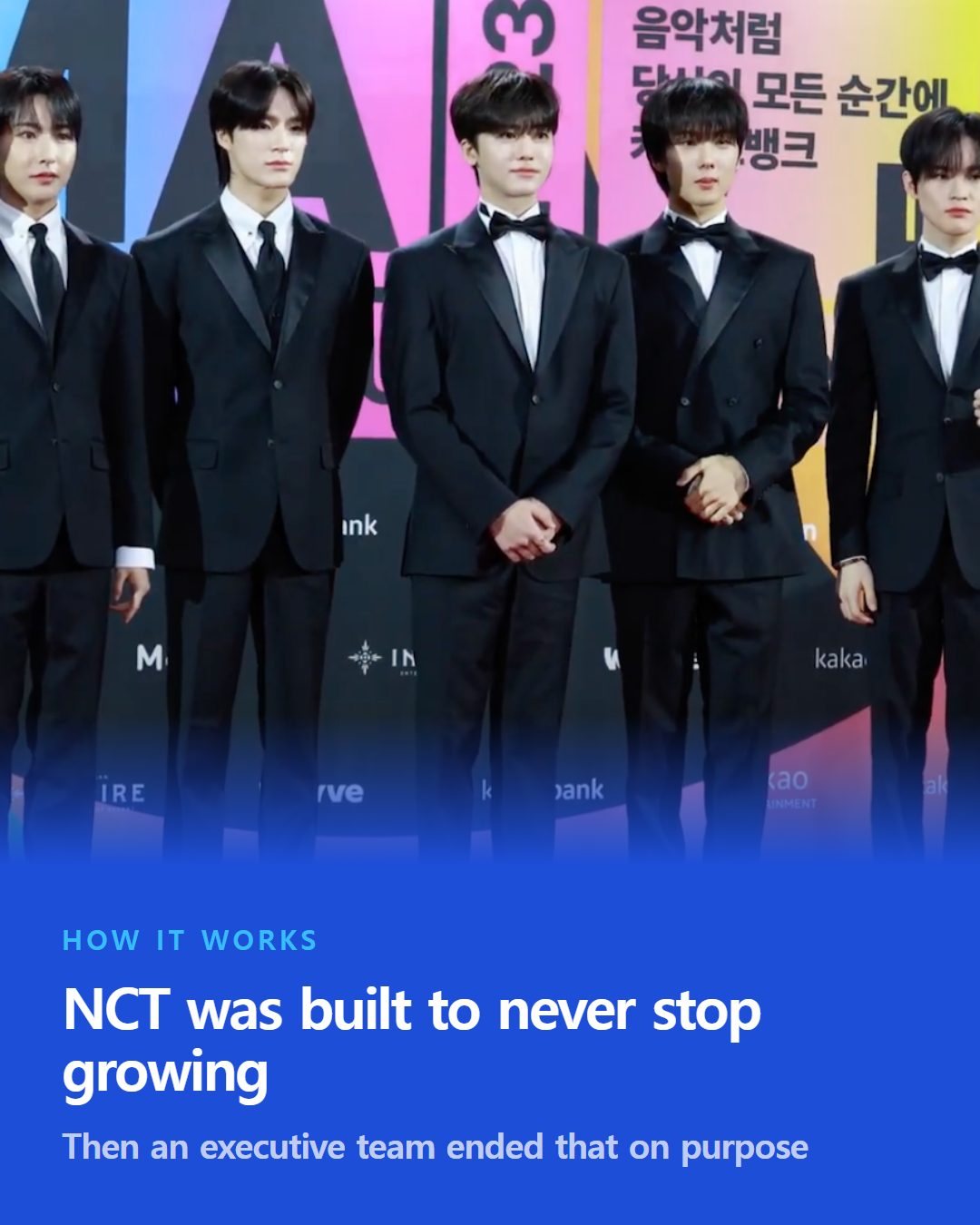
NCT, a group known for its large member roster and frequent sub-unit releases, has put out close to 50 different photocard designs across one album's various versions.
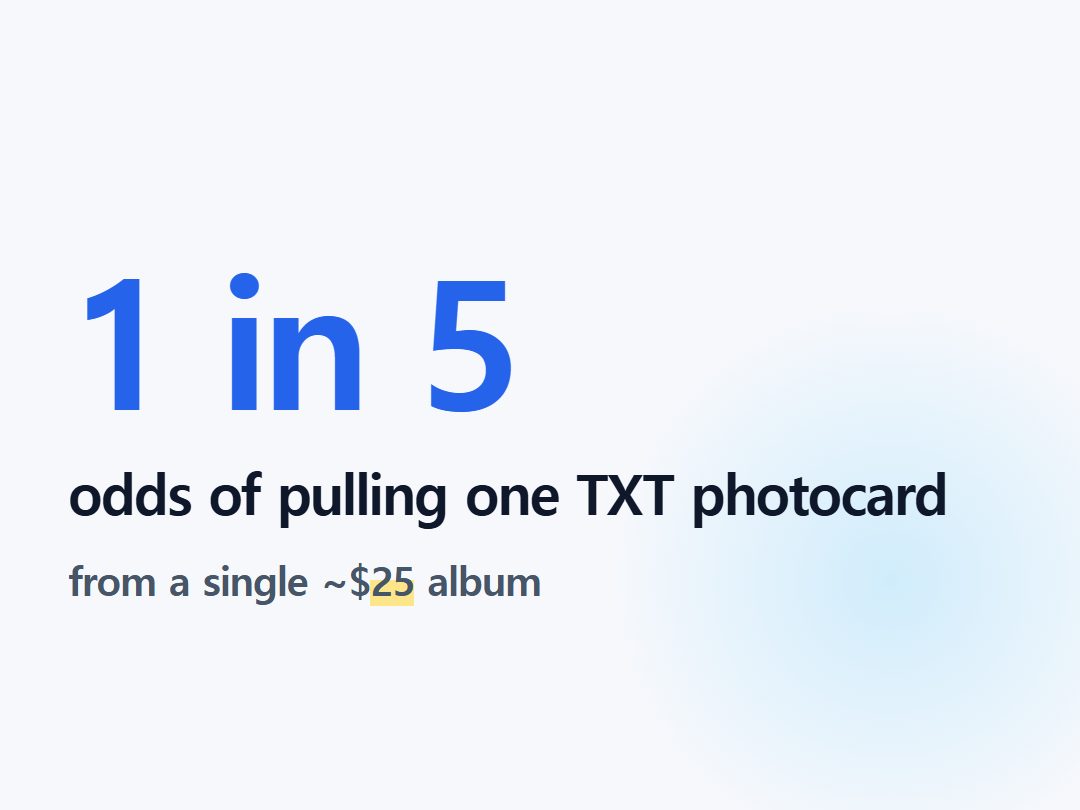
A single copy of TOMORROW X TOGETHER's Blue Hour carried roughly a 1-in-5 chance of including one specific member's photocard; that same card later resold for more than double the album's retail price on secondhand markets.
For fansign lottery events, fan guides commonly cite needing 15 to 40 album purchases for even a moderate shot at a slot, and some fans buy in the hundreds without winning. None of this is accidental.
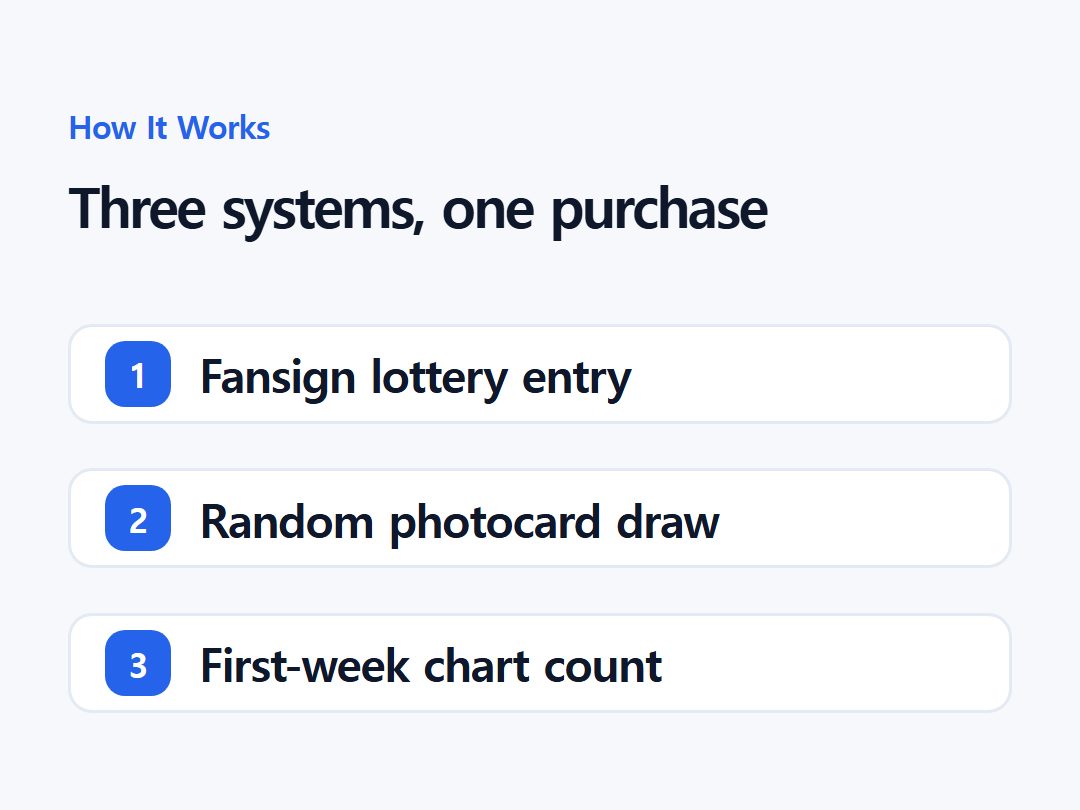
It reflects three systems, fan meet-and-greet access, randomized merchandise, and chart measurement, that are all keyed to the same purchase.
How one purchase pulls three levers at once
To an outside observer, repeat album buying looks like a taste preference: a fan simply loves the music enough to buy it many times. That is rarely the actual driver. Three structures, stacked on top of each other, do the work.
The fansign lottery
A fansign (fan signing event) is a meet-and-greet where a small number of winners get a brief, in-person moment with an idol, an autograph, a handshake, a few words. Access is not sold directly. Instead, retailers or agencies run a lottery tied to a purchase window: each album bought during that window equals one entry.
Buy one copy, get one entry; buy fifty, get fifty. Some events publish no minimum, but fandom-shared data from past events routinely lists benchmarks in the dozens of copies for a realistic chance, climbing higher for smaller sub-unit or solo events with fewer available slots.
Winners are picked at random, so there is never a guarantee, but the odds scale directly with spend, which is precisely the incentive the format is designed to create.
The photocard draw
Nearly every K-pop album now ships with a randomized photocard, a small collectible card of one member, inserted blind so the buyer cannot tell which member's card is inside until the album is opened.
Labels multiply the incentive by releasing an album in several physical versions, each with its own separate set of random photocards, and by producing several different card designs per member within a single version.
A seven-member group with four album versions and four cards per member per version can generate over a hundred unique photocards from a single comeback.
A fan who wants a specific member's card, rather than a random one, typically has to buy multiples to have a realistic shot, then trade off duplicates through peer-to-peer marketplaces to fill out the rest of a set.
Korean consumer researchers have compared the mechanic directly to gambling, since it uses variable, randomized rewards to sustain repeat purchases, a concern sharpened by the fact that a large share of the buyers are teenagers.
The chart connection
The purchases above also feed directly into how chart position is measured, which is the part international readers usually miss. South Korea uses two main physical-sales trackers.
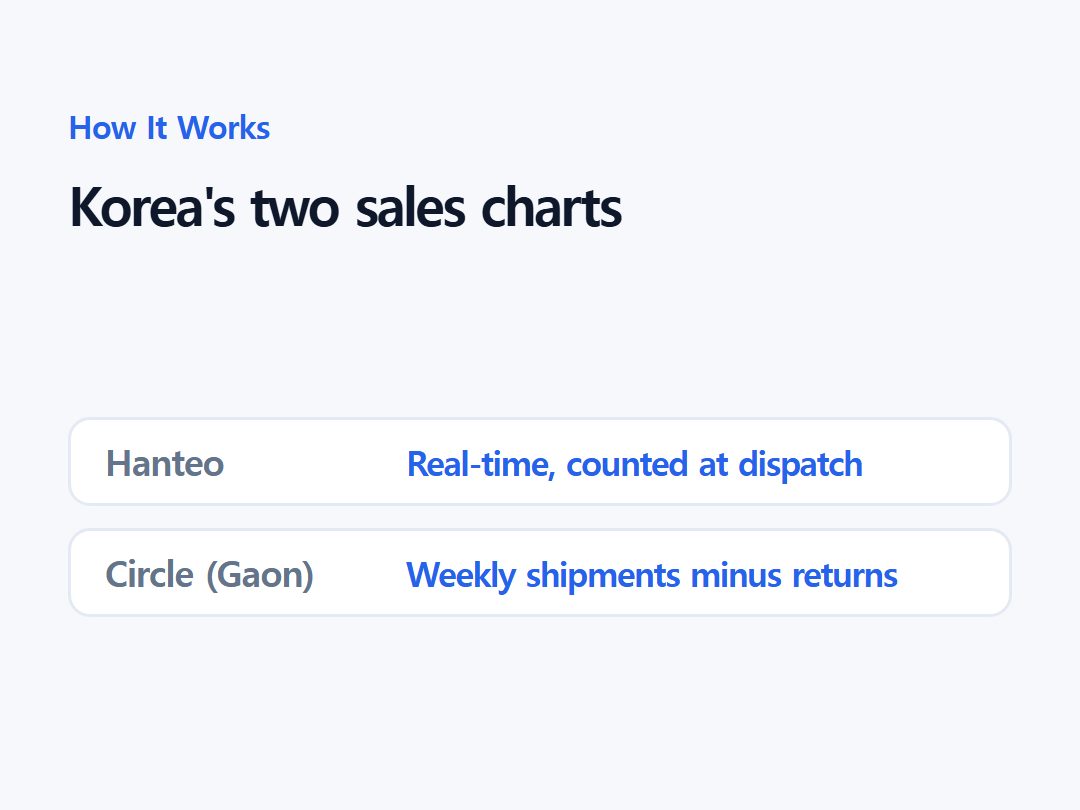
The Hanteo Chart, running since 1993 and now syncing in real time with roughly 1,500 record stores worldwide, logs a sale the moment a barcode is scanned at dispatch, not at the moment of payment or pre-order.
It is the source for chodong (초동, first-movement or first-week sales), the total that Korean media and agencies treat as a headline indicator of an act's commercial pull.
The Circle Chart (renamed from the Gaon Chart in 2022) instead compiles shipment volume minus returns, reported weekly, monthly, and yearly, drawing on data supplied directly by labels and distributors.
Neither chart distinguishes between an album bought to be listened to and an album bought purely to be opened for a photocard or entered into a fansign lottery: a unit sold is a unit counted.
That means the fansign lottery and the photocard draw are not side incentives bolted onto album sales, they are the mechanism that inflates the number the charts actually measure. Buying multiples is not really a purchase of music.
It is simultaneously a lottery ticket, a raffle entry into a collectible draw, and a vote on a national chart, wrapped inside one plastic case.
From chart tracking to the 2023 FTC probe
Hanteo's tracking dates to the early 1990s, when the domestic music industry needed a standardized way to count store sales as the idol system was taking shape.
The Gaon Chart followed in February 2010, created by the Korea Music Content Association with the Ministry of Culture, Sports and Tourism, giving the industry an official national ranking alongside Hanteo's real-time figures; it was rebranded as the Circle Chart in July 2022.
Fansign lotteries tied to purchase volume grew alongside these charts through the 2000s and 2010s as agencies looked for a way to convert single-copy buyers into repeat buyers without changing the music itself.
Randomized photocards became standard somewhat later, expanding rapidly through the 2010s as labels realized that collectible inserts, not just lottery access, could independently drive multiple purchases.
By the early 2020s the scale of the resulting practice, known in fan slang as album kkang (앨범깡, roughly "album crashing"), the ritual of buying and unboxing a stack of albums purely for the cards inside, had produced a visible backlash.
In 2021, photos of discarded album boxes, emptied of their photocards and left curbside in Seoul, circulated widely and drew criticism over the waste generated by a merchandising model that treats the CD and booklet as packaging rather than product.
Consumer complaints about the multiplying number of photocard variants, including NCT's roughly 50 designs for one release, prompted South Korea's Fair Trade Commission to open on-site investigations at SM, JYP, YG, and HYBE in mid-2023, examining whether the practice violated rules against improperly using subcontractors to inflate variant counts.
Why 2024's FTC fines changed so little
The Fair Trade Commission's process has produced two separate, and separately limited, results so far.
In a subcontracting-related case, HYBE, SM, YG, JYP, and Starship reached a consent resolution with the commission in 2024, agreeing to remedies such as HYBE setting aside roughly 200 million KRW (about $146,000) over three years for supplier support rather than accepting a direct fine.
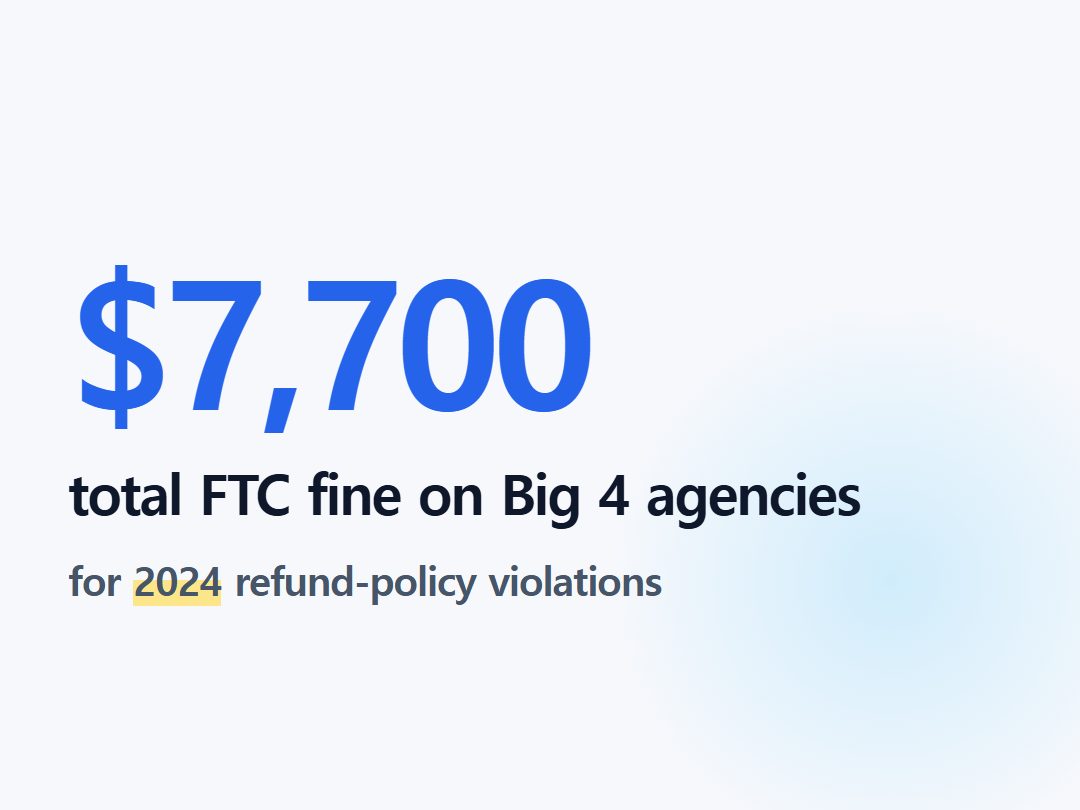
In a related but distinct case over merchandise refund policies, the commission fined the online stores of HYBE, SM, YG, and JYP a combined 10.5 million KRW (roughly $7,700) in August 2024 for setting refund and exchange conditions stricter than Korean e-commerce law allows.
Critics, including lawmakers who raised the figures during a National Assembly audit, have pointed out that such fines are negligible next to agency merchandise revenue, arguing they do little to change the underlying model.
No regulation to date directly limits how many randomized photocard variants a label can release, or requires agencies to disclose pull odds the way Korea already requires for mobile game loot boxes. Whether that comparison ever becomes a formal rule is the open question.
Until it does, the incentive structure described above, lottery access, collectible odds, and chart credit, all tied to the same purchase, remains the reason a fan buying "one more copy" is behaving exactly as the system around the album was built for them to behave.
Korea's two physical-sales charts
| Chart | Since | What it counts | When a sale is logged |
|---|---|---|---|
| Hanteo Chart | 1993 | Real-time sales across ~1,500 stores worldwide; source of chodong (first-week sales) | At the moment a barcode is scanned at dispatch |
| Circle Chart | Feb 2010 (renamed from Gaon Chart in July 2022) | Shipment volume minus returns, reported weekly, monthly, and yearly | From data supplied directly by labels and distributors |
Frequently asked
Why do K-pop fans buy so many copies of the same album?
Each copy is an entry into fansign lotteries, a chance at a specific member's randomized photocard, and a unit counted on Korea's sales charts, so one purchase serves three incentives at once.
What is a K-pop fansign lottery?
It's a meet-and-greet event where retailers or agencies give one lottery entry per album bought during a purchase window, so buying more copies raises but never guarantees the odds of winning a slot.
What is chodong in K-pop album sales?
Chodong (초동) is the Hanteo Chart's first-week sales figure, logged the instant an album's barcode is scanned at dispatch rather than at payment or pre-order.
Sources
Every factual claim above is traceable. We do not translate articles — we gather facts from multiple outlets and write them ourselves.
- K-Pop 101: How to Attend Fansigns — Soompi
- Circle Album Chart — Wikipedia
- About Hanteo Chart — Hanteo Chart
- Fair Trade Commission Investigates Major Entertainment Companies Over Random Photo Card Sales Scheme to Boost Album Revenue — allkpop
- Big 4 agencies (HYBE, YG, SM, JYP)'s online stores all fined by Fair Trade Commission for violating online consumer rights — allkpop
- FTC probes big K-pop agencies over 'photo card' selling — Korea JoongAng Daily
- K-pop agencies HYBE, SM Entertainment and more agree to subcontract reforms after FTC probe — K-Pop Source
- K-pop Deep-dive Dictionary: All About 'Goods' — album kkang — Hanteo News (Medium)
- Photocards, Lucky Draws, Pre-Order Benefits, Oh My! — The Kraze
- Fans once again trash boxes of albums on the side of the road after taking out the photocards — allkpop