Photos of K-pop fans sleeping on sidewalks for days before a show circulate every tour season. In July 2023, hundreds of fans lined Fifth Avenue outside Central Park days before BTS member Jung Kook's free solo debut performance, some arriving four days early with air mattresses and rotating food runs.
The short version
- VIP tickets buy soundcheck eligibility, not the front-row spot itself.
- Camping determines position only at overseas GA shows, not in Korea.
- Fan-made queue numbers aren't official — promoters can ignore them at check-in.
International readers usually read this as raw enthusiasm — the same instinct that makes people sleep outside a phone store overnight. That reading misses the mechanic. Camping is a response to how position in line gets allocated, and that allocation works completely differently depending on where the show is and what ticket a fan holds.
What campers are actually lining up for
At most K-pop shows, a fan's seat or standing block is already fixed by the ticket itself. Camping does not change that. What camping can change is a literal spot within a general admission (GA) floor — a standing area with no assigned positions — or a place in the queue for a separate, paid soundcheck session.
Soundcheck is the pre-show technical rehearsal where an artist runs through songs so engineers can test sound levels before doors open to the full audience. For fans, it is also the closest, most intimate look at the group they will get all night.
Inside the session fans are fighting to see
During soundcheck, performers typically appear in casual clothes rather than stage outfits, sometimes greeting the small VIP crowd directly before engineers run the group through several songs. It takes place roughly three to four hours before the main show, in a viewing area set close to the stage.
That combination — early, casual, close-up — is precisely what makes the credential worth fighting for. It is less a preview of the concert than a separate, smaller show most ticket holders never see at all.
Soundcheck is sold, not earned by waiting
Soundcheck access is not a reward for showing up early. It is a line item bundled into VIP ticket tiers, sold at checkout months before the show, alongside perks like early merchandise shopping and a numbered laminate.
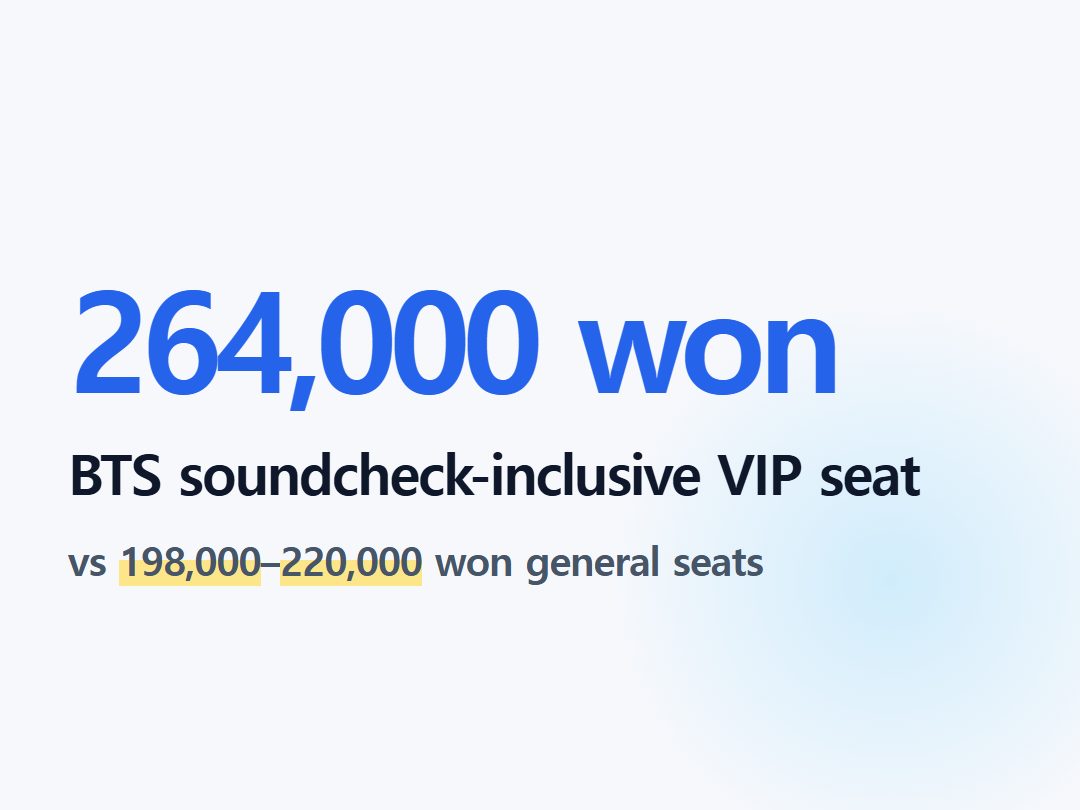
A South Korean consumer-affairs outlet reported BTS soundcheck-inclusive seats priced at 264,000 won against 198,000–220,000 won for general seats. SM Entertainment's RIIZE priced VIP-with-soundcheck at 198,000 won versus 165,000 won for standard seats — a premium fans pay regardless of how long they wait outside.
That same reporting traces the bundling practice to a BTS tour in March 2022, after which HYBE, SM, YG, and JYP — Korea's four major talent agencies — adopted similar packaging across their own tours. A consumer advocate quoted in the report called it forced bundling, since fans who only want a closer seat cannot buy that without also paying for soundcheck.
Korean industry reporting also points to fan club presale lotteries as a related pressure on prices, since agencies increasingly reserve the best-located tickets for paid fan club members before any public sale opens. Camping, VIP bundling, and fan club priority are three separate gates a fan may have to clear before reaching the front of a venue at all.

Camping still decides who stands closest
Buying the VIP ticket only gets a fan into the pool of people eligible for soundcheck. Where that fan physically stands once inside — against the front rail or twenty rows back — is usually still first-come, first-served among ticket holders. That is the layer where camping does something real.
This is why VIP ticket holders queue for hours before check-in even though their entry is already guaranteed. Fans have described arriving before noon for a soundcheck that does not start until 5 p.m., because the paid ticket buys eligibility, not proximity to the stage.
Domestic Korean concerts mostly skip the tents
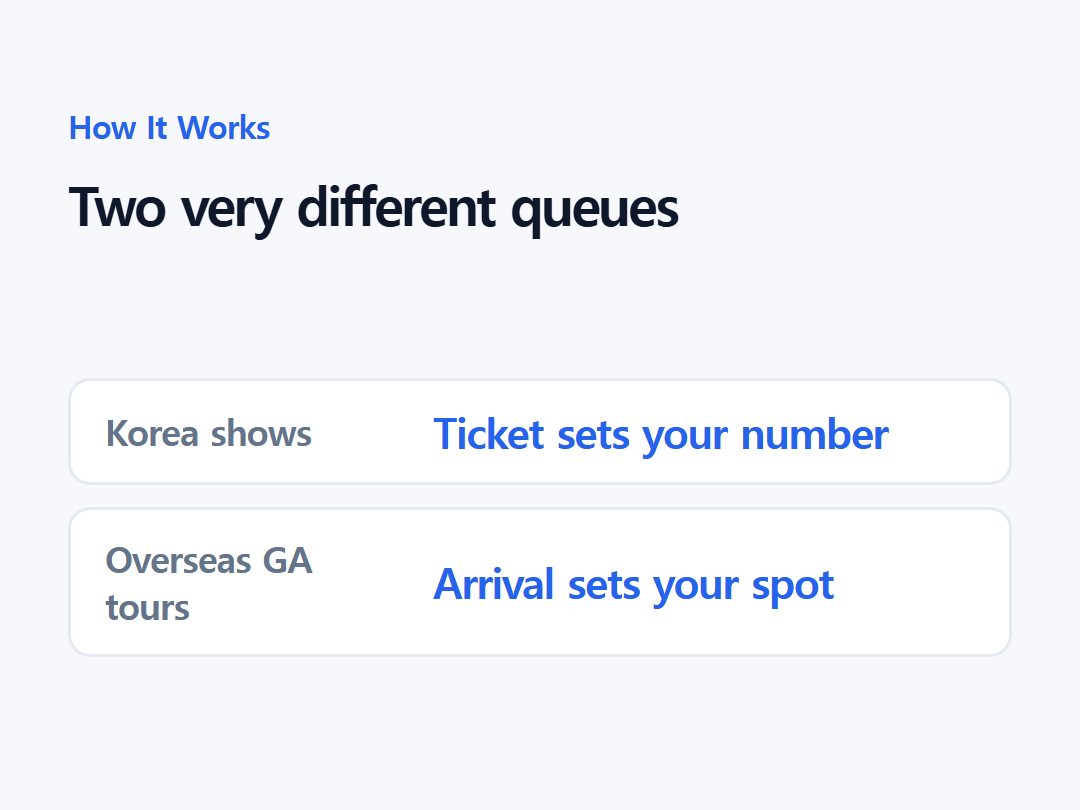
Inside Korea, this incentive to camp is largely engineered away. Standing tickets sold through platforms like Interpark carry a pre-assigned entry number generated at the moment of purchase, and official venue notices instruct standing ticket holders to arrive by a set time — commonly around 100 minutes before showtime — rather than to queue overnight.
Fans enter in strict number order regardless of when they physically show up within that window. A fast reflex during the ticket sale, not a tent on the sidewalk, is what buys a front-row spot at a domestic show.
| Domestic Korea shows | Overseas GA tours | |
|---|---|---|
| Standing position | Set by ticket purchase order | Set by physical arrival order |
| Camping useful? | Rarely — position is fixed | Often — position is earned in line |
| Soundcheck access | Purchased with VIP seat | Purchased with VIP seat |
Overseas tours run on a different rulebook
Once K-pop acts tour outside Korea, they frequently play Western-style GA venues that assign no standing numbers at all — the same floor format used for most pop and rock concerts. Without an official queue number, arrival order becomes the only currency, and fandoms have imported the camping norms of that older touring circuit rather than inventing something new.
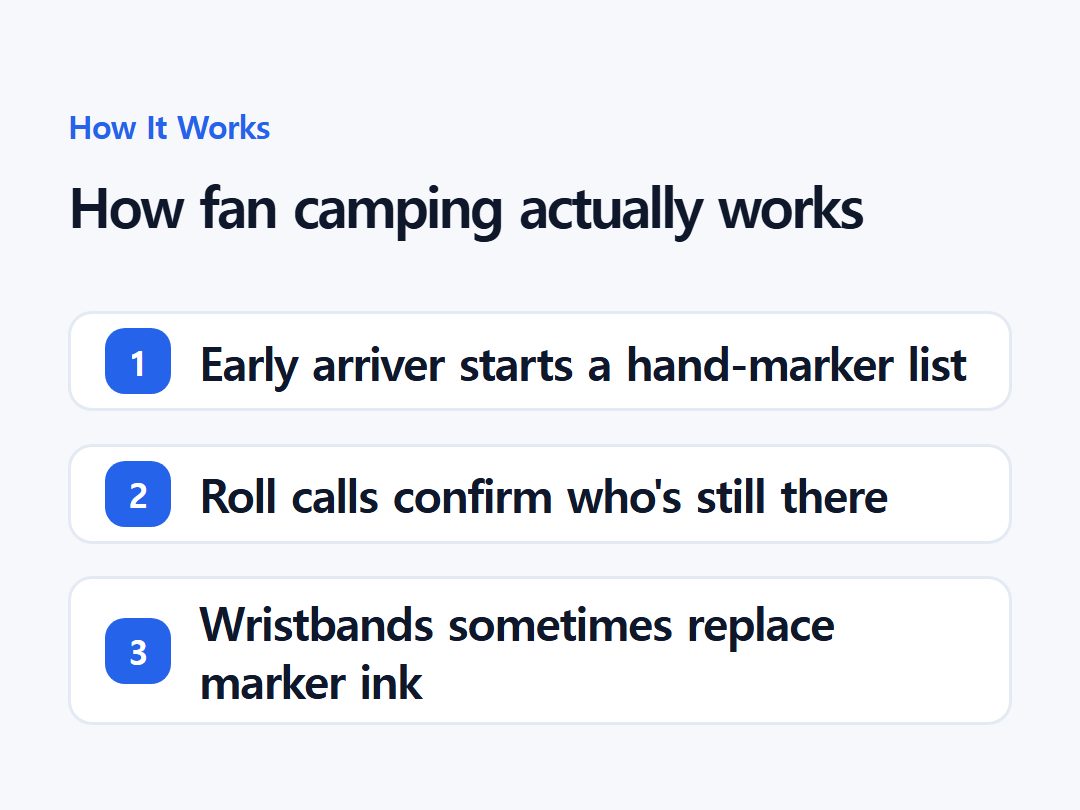
Fans have built their own workaround for the hours or days spent waiting, largely self-policed and run by whoever arrived first:
- An early arriver starts an informal list, often written in marker on each person's hand or wrist
- Periodic roll calls confirm who is still present, dropping anyone who skipped one
- Numbered wristbands sometimes replace marker ink to make the order harder to fake
None of this is run by the venue or the agency. It has no legal standing if a promoter chooses to ignore it on show day.
Promoters don't always honor the fan-made line
That gap between fan tradition and official policy is where most of the unresolved friction sits. Some tour stops have explicitly stated that unofficial fan-numbering systems will not be honored at check-in, meaning a camper who spent days holding a low number can still be reshuffled by venue staff.
Extreme weather adds another layer of risk with no clear owner. During the Central Park camp-out, torrential rain ultimately forced organizers to cancel Jung Kook's soundcheck and cut his set short — fans who had camped four days ended up seeing less than those who arrived that morning.
Does more camping guarantee a better spot?
Not automatically. A fan who camps four days but skips a single roll call can lose their number to someone who arrived hours later. And because fan-run lists carry no official weight, a promoter enforcing a strict check-in time can flatten days of waiting into whatever order people happen to be standing in that morning.
The safest predictor of a good spot remains the one Korean domestic shows rely on: a confirmed number tied to the ticket itself, not a number written on skin.
What is still unresolved
No agency has published a uniform standard for how camping-earned position interacts with paid VIP status, so the answer changes tour to tour and sometimes venue to venue on the same tour. Fans researching a show have to check that specific promoter's rules rather than assume past experience applies.
The bundling of soundcheck into VIP seats also remains a live consumer complaint in Korea, with critics arguing it functions as a forced upsell rather than an optional add-on. Whether regulators or agencies revisit that pricing structure is not yet settled.
Domestic Korea shows vs. overseas GA tours
| Domestic Korea shows | Overseas GA tours | |
|---|---|---|
| Standing position | Set by ticket purchase order | Set by physical arrival order |
| Camping useful? | Rarely — position is fixed | Often — position is earned in line |
| Soundcheck access | Purchased with VIP seat | Purchased with VIP seat |
Frequently asked
Why do K-pop fans camp outside concert venues?
At overseas general admission shows, physical arrival order — not the ticket — decides where a fan stands, so camping earns a better spot on the floor.
What is K-pop soundcheck and how do you get in?
Soundcheck is a pre-show rehearsal fans can watch up close, but access is sold as part of VIP ticket tiers months in advance, not earned by waiting in line.
Do you need to camp outside K-pop concerts in Korea?
No — domestic Korean shows assign a fixed entry number at the moment of ticket purchase, so fans arrive within a set window instead of camping overnight.
Sources
Every factual claim above is traceable. We do not translate articles — we gather facts from multiple outlets and write them ourselves.
- Jung Kook fans camp out at Central Park days before concert — CBS News New York
- 아이돌 콘서트 VIP석 앉으려면 '사운드 체크' 사실상 강제…"끼워팔기 아냐?" 팬들 뿔 — 소비자가 만드는 신문
- 사운드체크, 팬클럽추첨제… K-팝 공연 티켓값에 붙은 거품들 — 더스쿠프
- 예매시 주의사항 - 스탠딩 입장번호 안내 — Interpark Ticket
- Camping for Concerts - Necessities, Fan-made Numbering Systems, and More! — Fangirls World Tour
- Kpop Sound Check: How Does It Work and Is It Worth the Money? — Cute Frog Creations