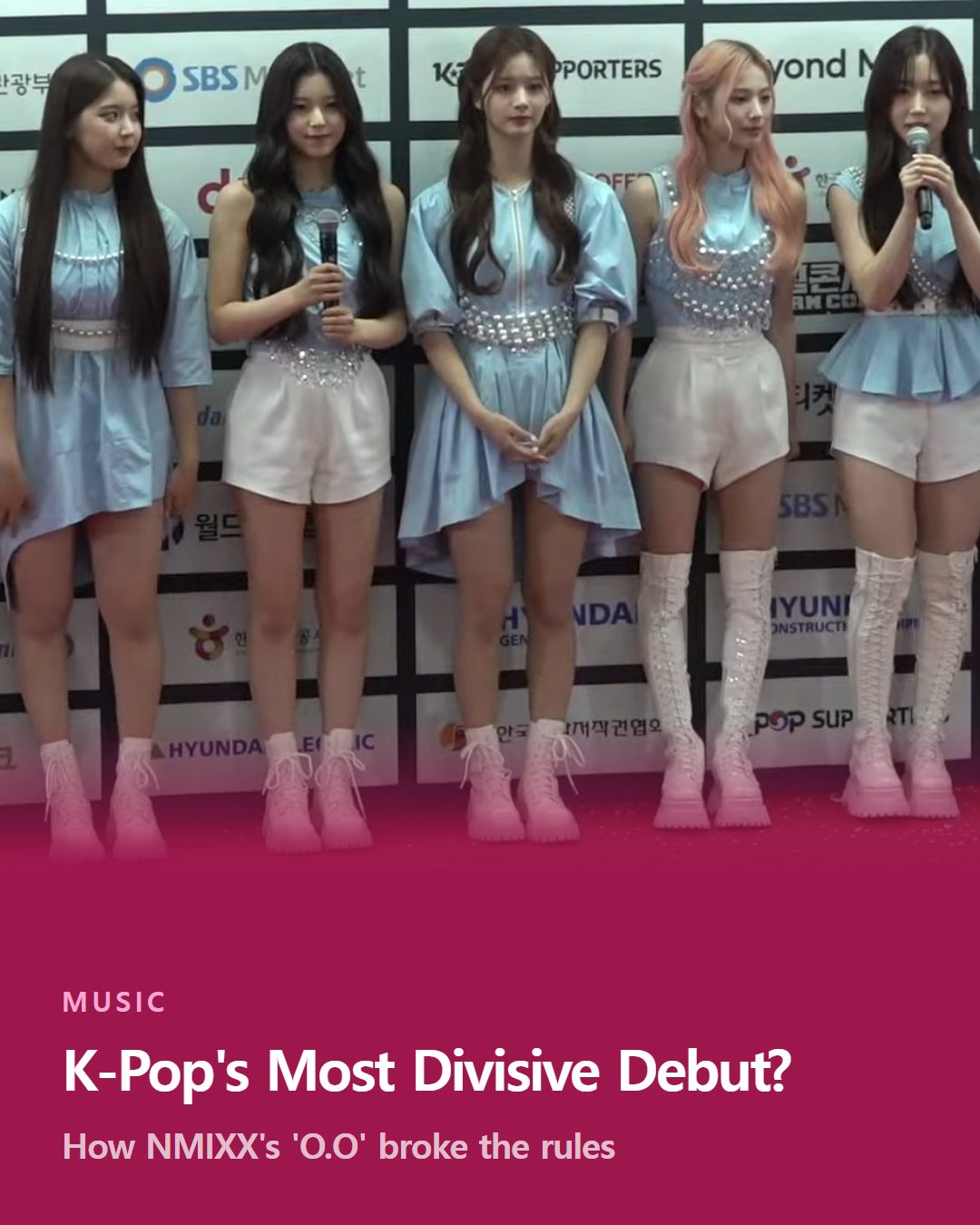
In mid-2026, a dance challenge called “GG EZ” spread across K-pop idol accounts. BTS's Jungkook, TXT's Yeonjun, ITZY's Yeji and members of MEOVV, Hearts2Heart and Kiss of Life all posted the choreography, and the song reached the top of Apple Music's R&B/Soul chart in Indonesia and Singapore.
The short version
- GG EZ's vocals and instrumental were AI-made; only lyrics and prompts were human.
- KOMCA admits no reliable AI-music detection exists, so enforcement relies on disclosure audits.
- Tidal, Deezer and Spotify each define and penalize AI tracks differently.
Only after it had already gone viral did fans learn who, or what, made it. The artist, M.Sasuke, confirmed the vocals and instrumental were built with AI software; only the lyrics, arrangement and prompts were human. Former Weeekly member Jiyoon publicly turned down the challenge once she found out, saying she liked the choreography but wouldn't perform to AI-made music.
GG EZ is the clearest confirmed case, but it isn't isolated. Over the past two years, K-pop fans have flagged song after song as possibly AI-written, and they tend to point to the same handful of clues each time.
A viral dance came first, the AI question came weeks later
The GG EZ choreography began with a Japanese dancer, then spread to K-pop artists, including ITZY's Yeji and TXT's Yeonjun, before any major idol picked it up. None of them, or their agencies, raised the AI question at that stage.
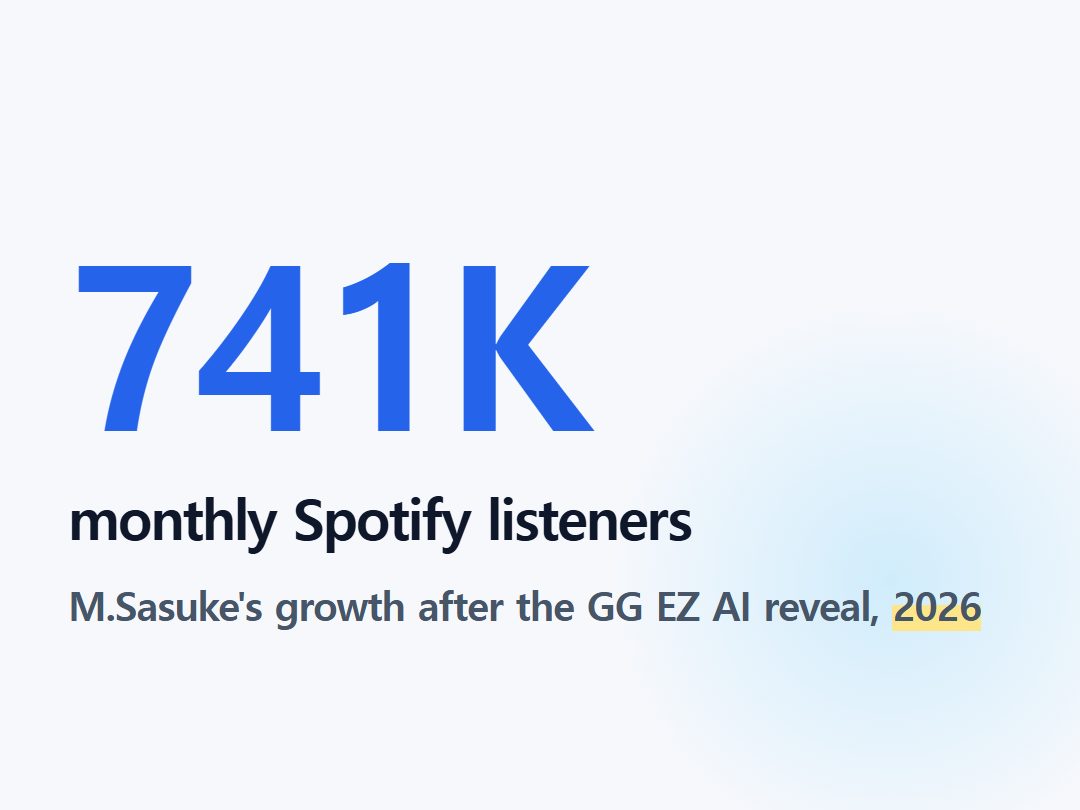
It wasn't until Jungkook's post, which drew 91.6 million views across his accounts, that the song became impossible to ignore, pushing M.Sasuke's Spotify monthly listeners past 741,000. The disclosure only caught up to the song's popularity after the peak, not before.
That lag is the pattern: fans discover a song is AI-made once it is already inside the K-pop ecosystem, worn into choreography and unintentionally endorsed by artists who had no way to check its origin before dancing to it.
One clarified quote still follows Seventeen two years later
The suspicion doesn't only attach to anonymous producers. In April 2024, Seventeen released the single “Maestro.” At the press conference, member and producer Woozi said he had experimented with AI tools while writing, describing it as practice, not as composing the final track with them.
A BBC article that July folded the comment into a claim that “Maestro” itself used AI-generated lyrics. Pledis Entertainment, Seventeen's agency (the company that manages the group's contracts, training and releases under Korea's agency system), publicly denied it and contacted the BBC to correct the piece.
Fans, known as CARATs, ran a hashtag campaign, “APOLOGIZE TO WOOZI.” BBC's later edit, replacing “AI-generated lyrics” with “AI-generated production,” didn't fully settle it. Two years on, the same quote still gets cited whenever a new Seventeen release draws AI speculation.
Why the suspicion attaches to some groups and not others
The common thread across both cases is that fans aren't reacting to hard proof so much as precedent. Once an agency shows it is willing to use AI anywhere in a release, fans extend that willingness to the parts they can't verify.
SM Entertainment gave fans exactly that precedent with aespa. The 2024 “Supernova” video used AI to hold members' faces still while only their mouths moved to the vocal track. By September 2025, SM went further: the video for “Rich Man (Yellow Claw Remix)” was generated entirely with Google DeepMind's Veo technology, with no members appearing on screen at all.
Neither case involved the song's composition. But once a label has shown, on video, that it treats AI as an acceptable production tool, fans stop assuming the audio is automatically exempt, even without direct evidence either way.
The three things fans actually point to
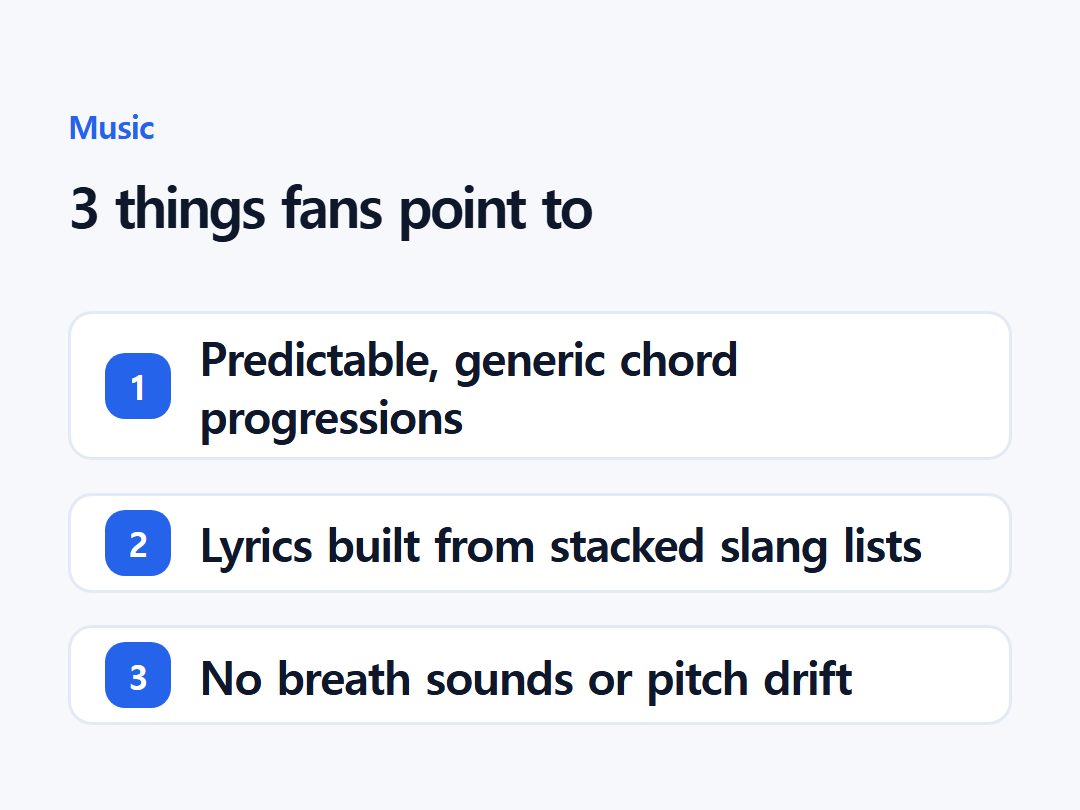
When fans do try to argue a specific track sounds AI-made, the reasoning tends to repeat:
- Chord progressions and hooks that follow the most statistically common pattern in a genre, criticized elsewhere as sounding “so predictable you could sing the next line before it arrives”
- Lyrics built from stacked slang or phrase lists rather than a narrative, as with GG EZ's verses, which are assembled almost entirely from gaming terms like “skill issue,” “low HP” and “rage quit”
- The absence of small human inconsistencies, such as breath sounds or natural pitch drift, that a single vocal take usually carries, replaced by a vocal that sounds evenly clean throughout
None of these prove anything on their own. A skilled human producer can write a predictable hook, and a good take can sound clean. But together, they're the vocabulary fans now reach for first.
Real artist pages, not-real songs
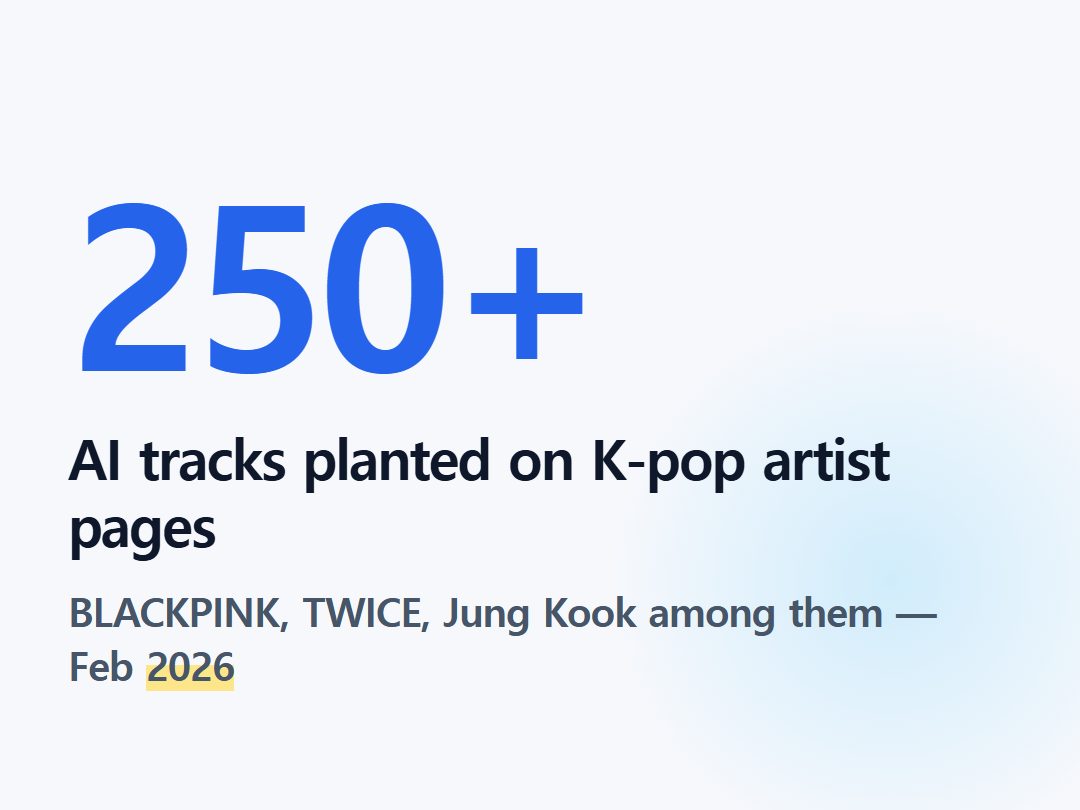
A separate problem has made the guessing game harder: songs the artist never claimed at all. A February 2026 investigation by journalist Jeff Benjamin found more than 250 AI-generated tracks uploaded across dozens of K-pop artist pages on streaming platforms, including BLACKPINK, Jung Kook, TWICE, P1Harmony, KATSEYE and XG.
None of those artists made the tracks. A producer had uploaded AI-generated songs and attached them to real artist profiles, so listeners browsing an official page could no longer assume every track on it was authentic.
That contamination feeds the broader suspicion: if AI-made songs can already sit unnoticed on a real artist's official page, fans reason, a genuinely new single is no longer automatically above question either.
A fully synthetic act followed the same playbook, and some fans didn't mind
In December 2025, a trio called GLXE debuted on TikTok with no photoshoot, no agency rollout, none of the usual K-pop pre-release marketing. Their voices and songs were made with Suno, the AI music platform now valued near $2.45 billion.
GLXE otherwise followed the format precisely: a fandom name, choreographed dance challenges, listening parties. Creator “Orion” has said roughly 90% of fan comments dismiss the AI origin outright; one fan wrote that the trio's voices “convey the most beautiful feelings.”
That split matters more than the group itself. It shows the suspicion isn't universal: a meaningful share of listeners have decided authorship doesn't change what a song makes them feel, which is precisely what worries the fans pushing back.
No one can reliably prove a song is, or isn't, AI-made
Fans keep arguing from circumstantial patterns because no better option exists. The Korea Music Copyright Association (KOMCA), which registers royalties for more than 55,000 members and whose decisions carry into 110 countries through its international body CISAC, has publicly acknowledged that reliable, universal AI-music detection does not currently exist.
In August 2026, KOMCA replaced its blanket ban on AI-assisted music with a disclosure-based registration system: creators declare a human contribution, and enforcement depends on audits of the documentation they kept, not on any technical test of the finished song.
That leaves the actual verification work to listeners, which is exactly the gap fan pattern-matching has been filling.
What the law now requires, and its grace period
South Korea's AI Basic Act took effect on January 22, 2026, requiring invisible watermarks on AI-generated text, sound and video, and visible labels on realistic deepfakes. Providers must notify users when generative AI is involved in an output.
The law carves out room for music specifically: labeling can be shown “in a manner not intended to hinder creative expression,” giving agencies latitude in how, and how visibly, they disclose AI's role. Companies that fail to comply face fines of up to roughly $20,400, but the government has set a grace period of at least a year before penalties are enforced.
In practice, the law meant to settle the question won't be fully tested until 2027 at the earliest.
Streaming platforms don't even agree on what counts as AI
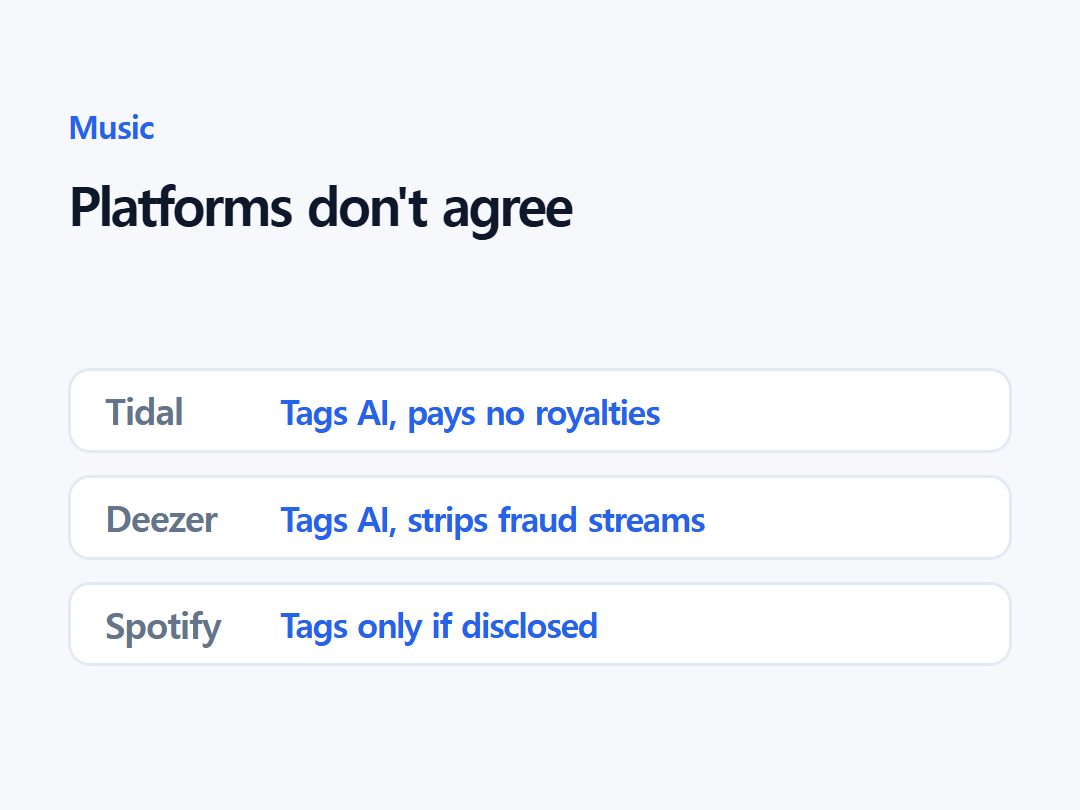
Where regulation moves slowly, platforms have moved unevenly on their own. Tidal now tags any track it judges 100% AI-generated and pays it no royalties, a policy that took effect July 15, 2026.
Deezer, which built its own detection system in 2025, was receiving close to 90,000 fully AI-generated tracks a day by that July, more than half of all new uploads, and strips royalties specifically from streams it flags as fraudulent.
Spotify has taken the lightest touch: it tags AI involvement only when an artist discloses it voluntarily, while removing more than 75 million “spammy” tracks industry-wide over the prior year.
| Platform | Policy on fully AI-generated tracks |
|---|---|
| Tidal | Tagged, streamable, no royalties (from July 2026) |
| Deezer | Tagged since June 2025; royalties stripped from flagged fraud |
| Spotify | Tagged only if the artist discloses; removes spam, not AI itself |
None of the three defines “AI-generated” the same way, so a track one platform treats as proven AI might not qualify under another's rules at all.
Even within Korea's own institutions, the position isn't settled. The K-Music Rights Organizations Mutual Growth Committee, a coalition KOMCA co-founded in February 2026, has called its own stance a “declaration of war” against generative AI, in tension with the disclosure pathway KOMCA opened the same year.
Until detection technology catches up to the music itself, the burden of figuring out what's AI-written and what isn't will keep falling on the people it does now: fans comparing a new release against the same handful of tells, one release at a time.
How streaming platforms handle fully AI-generated tracks
| Platform | Policy on fully AI-generated tracks |
|---|---|
| Tidal | Tagged, streamable, no royalties (from July 2026) |
| Deezer | Tagged since June 2025; royalties stripped from flagged fraud |
| Spotify | Tagged only if the artist discloses; removes spam, not AI itself |
Frequently asked
Is the K-pop song GG EZ made with AI?
Yes — artist M.Sasuke confirmed the vocals and instrumental were built with AI software, while only the lyrics, arrangement and prompts were human.
Did Seventeen use AI on the song Maestro?
Producer Woozi said he experimented with AI tools while writing as practice, not to compose the final track; Pledis Entertainment denied AI was used and had the BBC correct a report claiming otherwise.
How can fans tell if a K-pop song is AI-generated?
No reliable detection tool exists yet, so fans look for overly predictable chord progressions, lyrics stacked from slang instead of a narrative, and vocals missing natural breath sounds or pitch drift.
Sources
Every factual claim above is traceable. We do not translate articles — we gather facts from multiple outlets and write them ourselves.
- How AI-Generated Songs Like 'GG EZ' Are Taking Over K-Pop Dance Challenges — Forbes
- 4th-Gen Idol Sternly Refuses To Do Trending Dance Challenge Because Of The Singer — Koreaboo
- Seventeen's Woozi Denies Claim AI Wrote Songs — Billboard
- 'Stop spreading misinformation'—CARATs call out BBC for allegedly accusing SEVENTEEN of using AI for 'MAESTRO' lyrics — Sportskeeda
- 에스파도, 세벨틴도… 'AI 적극 활용 K팝 산업' 논란에 외신 주목 — Hankook Ilbo
- aespa drops “Rich Man (Yellow Claw Remix)” MV — allkpop
- AI-Generated Songs Planted on K-Pop Artist Pages — THE CROSSOVER
- K-pop has a generative AI problem — Dazed
- South Korea Ends AI Music Copyright Ban With Disclosure-First Registration Standard — Tech Times
- South Korea Passes 'World's First' Law to Label AI-Generated Content — eWeek
- TIDAL to automatically tag AI-generated music… and block it from earning royalties — Music Business Worldwide
- AI Music Tops 50% of Daily Uploads on Deezer — Deezer Newsroom