In October 2024, all six members of the K-pop group BOYNEXTDOOR walked through Incheon International Airport pulling out iPhones for selfies, a few with Apple AirPods Max slung around their necks. It should have been an unremarkable travel photo. Instead it became a minor national story, because the group had spent the previous year fronting Samsung Galaxy launch events.
The short version
- Samsung said BOYNEXTDOOR were never signed Galaxy ambassadors, so no contract broke.
- Korean law caps on-screen logos at one-quarter of the frame, 5% of runtime.
- Off camera, private endorsement contracts, not broadcasting law, decide what idols wear.
The backlash, and Samsung’s oddly specific response to it, is a compact case study in something international fans notice constantly but rarely see explained: why K-pop idols keep covering up brand logos that have nothing illegal, immoral, or even obviously competitive about them.
A phone swap that turned into a PR problem
The group had a real history with Samsung. BOYNEXTDOOR shot a Vogue Korea spread for the Galaxy Z Flip5’s Maison Margiela edition, appeared at the Galaxy S23 FE launch event in December 2023, and received a thank-you coffee truck from Samsung in April 2024.
Then, on October 11, 2024, departing for a concert in Madrid, members posed for airport photographers holding iPhone 16s in plain view. Korean social media reacted fast, with comments calling the timing “disrespectful” and “not a matter of loyalty, just basic manners.”
Samsung’s official response undercut the entire controversy: the company said BOYNEXTDOOR were “not Galaxy ambassadors” bound by a long-term contract, adding it was “not a situation that requires an official statement.” No deal existed to break.
Two different rules are doing the covering, not one
International viewers usually lump every instance of this together — a blurred snack wrapper on a variety show, a taped-over shoe logo, an idol angling a shopping bag away from a camera — as one habit with one cause.
It is actually two separate systems that happen to produce the same visual result. One is a broadcasting regulation that only governs what a produced television program is legally allowed to show. The other is private contract law, and it follows an idol everywhere a camera might be, whether or not anyone is filming a show.
The screen-quarter rule that decides what a camera can show
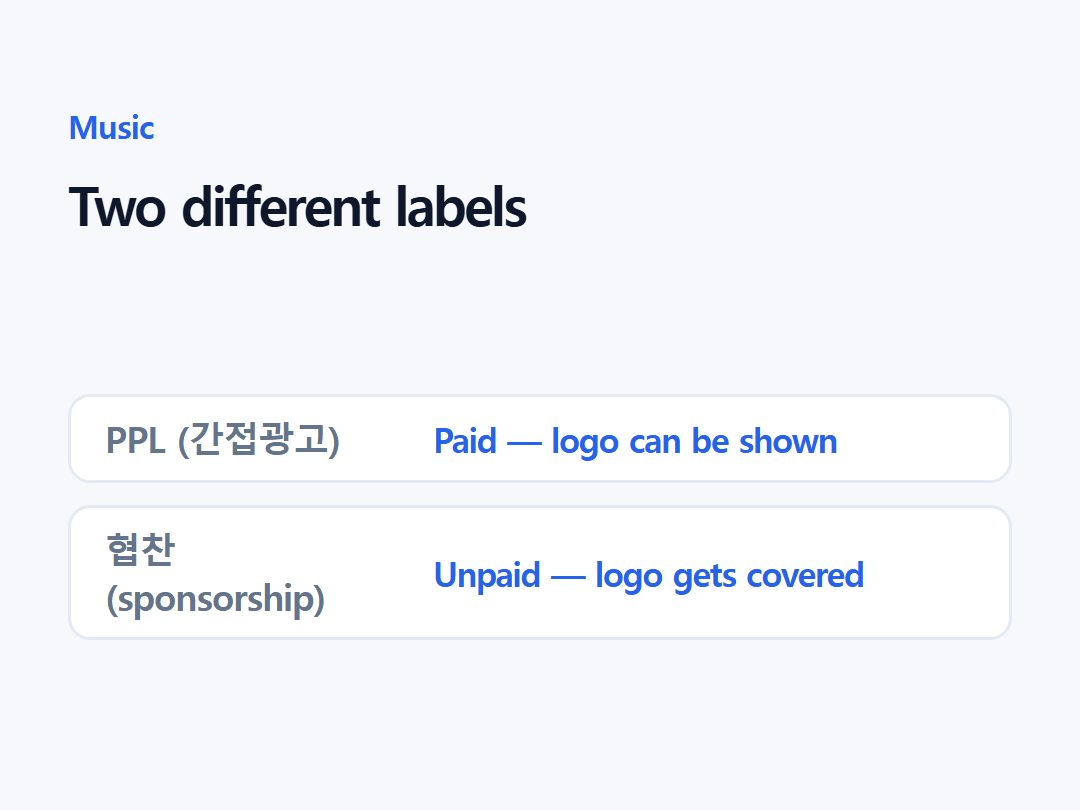
The broadcasting side traces to Article 73 of Korea’s Broadcasting Act, which defines 간접광고 (ganjeop gwango, “indirect advertising,” commonly called PPL) as advertising that exposes a product, trademark, or company logo inside a program in exchange for payment.
The law that legalized this, and the limits attached to it, are specific:
- A product or logo cannot occupy more than one-quarter of the screen
- Total exposure is capped at roughly 5 percent of a program’s runtime
- Hosts and cast cannot verbally recommend or urge viewers to buy the product
- Programs must display an on-screen notice disclosing that PPL is included
Indirect advertising is only permitted in entertainment and cultural programming — it is banned outright in news, current affairs, and children’s shows.
Sponsorship without the right to show it
A separate, older category explains most of the actual covering-up: 협찬 (hyeopchan, “sponsorship”). A company can supply a production with free clothing, snacks, or equipment in exchange for nothing more than a name credit listed at the end of the broadcast — not the right to display its logo on screen.
That is the gap production staff are managing when they physically tape over a ramen brand, a coffee cup, or a pair of sneakers before recording. The show has no paid right to expose that logo, so it gets covered rather than risk running afoul of the same disclosure rules that govern paid PPL.
Off camera, a different rule takes over: the contract
No broadcasting statute has any jurisdiction over an idol walking through an airport. What governs that moment instead is a private deal called 전속모델계약 (jeonsok model gyeyak, an exclusive spokesperson contract), signed either by an individual member or by the agency on a group’s behalf.
These contracts routinely include an exclusivity clause barring the model from being seen with a competitor’s product for the length of the deal, plus a separate “morals clause” obligating the celebrity not to damage the sponsor’s reputation — a provision South Korea’s Supreme Court upheld as enforceable in 2009.
Breach typically means repaying the endorsement fee or covering damages. How far the ban actually reaches — one product line, or an entire industry — depends entirely on how narrowly or broadly each side negotiated the wording.
One deal for the group, a separate one for each member
As groups mature, endorsement deals routinely fragment from a single group-wide sponsorship into individual luxury-house ambassadorships, each with its own exclusivity terms:
- Lisa of BLACKPINK has been a Celine ambassador since 2020
- Jennie of BLACKPINK is Chanel’s global ambassador
- V of BTS joined Celine and later added Cartier
- Jungkook of BTS became a Hublot ambassador in 2026
Each contract restricts a different product category, which means stylists and PR teams have to track exclusions per member, not per group — a member’s own deal might forbid a brand the person sitting next to her on a talk-show couch is free to wear.
Why the same slip keeps happening
BOYNEXTDOOR was not the first group to trip over this. Reported cases of the same pattern include:
- Several BLACKPINK members switching to iPhones after Samsung-linked promotions ended
- BTS’s V and Jungkook doing the same after their own Galaxy-adjacent activities wrapped
- Lovelyz’s Mijoo drawing similar criticism for an identical switch
By contrast, footballer Son Heung-min, a long-term Galaxy ambassador, has reportedly declined to use an iPhone even off-duty. The difference is contractual: Son signed a long-term ambassador deal, and Samsung’s own statement confirmed BOYNEXTDOOR never did — so there was nothing to legally enforce, only a reputational cost to absorb.
From a near-total ban to logos filling the screen
Before 2010, Korean broadcast law permitted only 협찬고지 — a listed sponsor credit at the end of a program — with no on-screen product exposure allowed at all, even as some producers already incompletely masked sponsor products to capture extra visibility anyway.
That changed in January 2010, when Korea’s broadcasting regulator revised the Broadcasting Act’s enforcement decree to formally legalize indirect advertising in entertainment programming.
The contradiction that followed almost immediately is instructive: weeks later, broadcasters banned a song by singer J.ae for mentioning “Chanel” and “McDonald’s” in its lyrics, and separately restricted a track by Epik High for referencing their own website — even as visual product placement was becoming routine on the very same channels.
A logo sitting quietly in a frame was treated far more leniently than a brand name spoken out loud.
What the rule doesn’t settle
No broadcasting statute obligates an idol to cover a logo at an airport or on a personal Instagram post. That decision sits entirely with an agency’s PR judgment and the specific wording of whichever endorsement contract is currently active, which is why practice varies from group to group and even member to member.
The concealment itself is often unconvincing. Korean bloggers have pointed out that a mosaicked or taped-over product is frequently still identifiable, meaning the cover-up can draw more curiosity toward a brand than it hides.
Contract scope stays genuinely disputed, too. Whether a competitor ban covers a single product line or an entire industry depends on wording that varies deal to deal, which is why entertainment lawyers disagree case by case on how far a given idol’s obligations actually extend.
Frequently asked
What’s the difference between PPL and 협찬 (sponsorship) on Korean TV?
PPL is a paid, disclosed placement where the law permits the brand’s logo to appear on screen; sponsorship is unpaid product support that earns only an end-credit mention, which is why those items get taped over or blurred instead.
Do idols get fined for wearing a rival brand in public?
Not by law. Broadcasting regulations only govern what a produced program may air, not what a celebrity wears on the street — off camera, a financial penalty can only come from a private endorsement contract’s exclusivity clause, and only if the idol personally signed one with a competing brand.
Why didn’t Samsung penalize BOYNEXTDOOR for using iPhones?
Because Samsung said the group had never been signed as official Galaxy ambassadors under a long-term contract — the earlier photo shoots and launch events were promotional appearances, not an exclusivity deal, so there was no contractual breach to enforce.
PPL vs. sponsorship: two different rules for showing a brand
| PPL (간접광고) | Sponsorship (협찬) | |
|---|---|---|
| Payment | Paid placement | Free products, no payment |
| Logo on screen | Allowed, capped at 1/4 of frame | Not allowed — gets covered |
| Runtime limit | ~5% of program runtime | No screen exposure permitted |
| Credit given | On-screen PPL disclosure required | End-credit sponsor listing only |
Frequently asked
What's the difference between PPL and 협찬 (sponsorship) on Korean TV?
PPL is a paid, disclosed placement where the law permits the brand's logo to appear on screen; sponsorship is unpaid product support that earns only an end-credit mention, which is why those items get taped over or blurred instead.
Do idols get fined for wearing a rival brand in public?
Not by law. Broadcasting regulations only govern what a produced program may air, not what a celebrity wears on the street — off camera, a penalty can only come from a private endorsement contract's exclusivity clause, and only if the idol personally signed one with a competing brand.
Why didn't Samsung penalize BOYNEXTDOOR for using iPhones?
Because Samsung said the group had never been signed as official Galaxy ambassadors under a long-term contract — the earlier photo shoots and launch events were promotional appearances, not an exclusivity deal, so there was no contractual breach to enforce.
Sources
Every factual claim above is traceable. We do not translate articles — we gather facts from multiple outlets and write them ourselves.
- “They were never ambassadors” Samsung responds to BOYNEXTDOOR using Apple products at the airport — allkpop
- All six BOYNEXTDOOR members boast their new iPhones & AirPods immediately after concluding their endorsement deal with Galaxy — allkpop
- Questions grow over effectiveness of Samsung's celebrity marketing for Galaxy — The Korea Times
- BOYNEXTDOOR Gets Flamed For Alleged Disrespect Towards Samsung — Koreaboo
- Korean Sociological Image #32: Censorship and Indirect Advertising — The Grand Narrative
- Morals Clause in an Endorsement Agreement with Korean Celebrity — Ask Korea Law
- A Closer Look at Blackpink's High-profile Brand Ambassadorships — WWD
- BTS brand collaborations in 2026 so far: which brands BTS members are working with — Tatler Asia