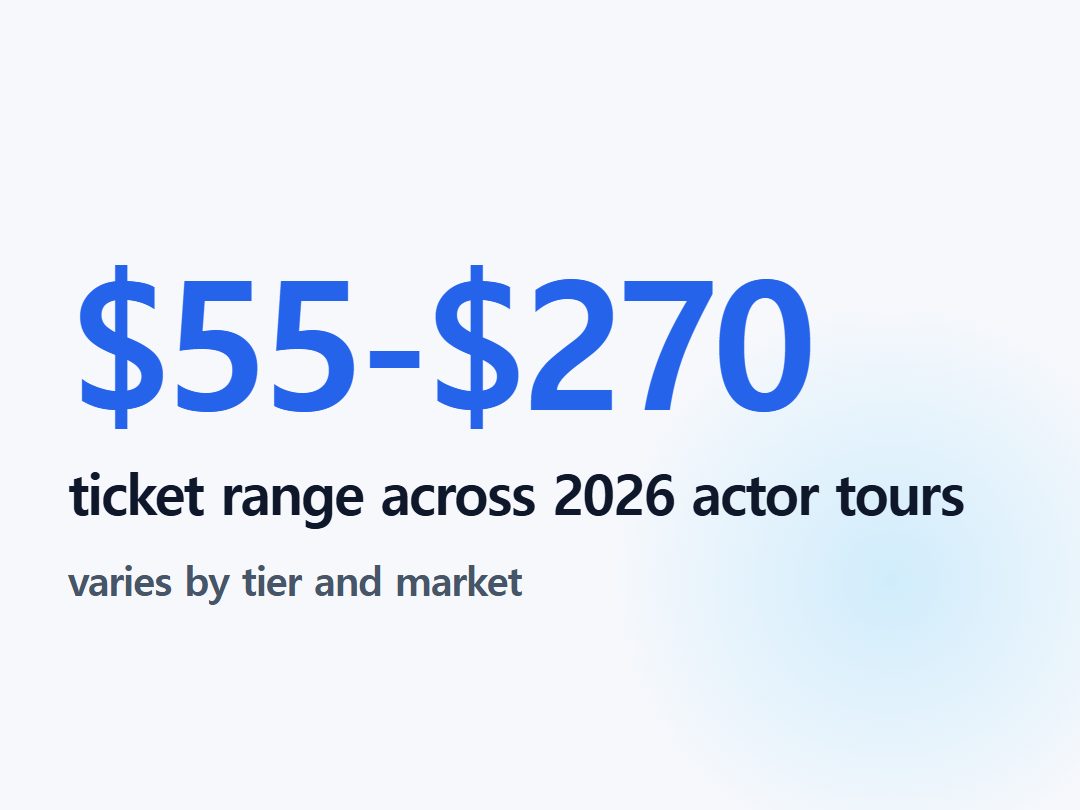
A Korean actor announces a "fan meeting." Tickets go on sale through an official platform, sell out within minutes, and cost anywhere from roughly $55 to $270 depending on the seat tier. This is not a red-carpet appearance or a press junket — it is a ticketed commercial event that an actor's management agency plans, prices, and profits from.
The short version
- Fan meetings are ticketed shows, not free fan service, priced $55 to $270.
- Agencies track fan-meeting revenue separately from acting fees as its own income line.
- The format traces back to Bae Yong-joon's 2009 Tokyo Dome fan events.
In 2026 alone, actors including Kim Mu-yeol, Byeon Woo-seok, Heo Nam-jun, Lee Je-hoon, and Kim Sun-ho have each held or announced solo fan meetings, several as multi-city Asia tours. To international readers, "fan meeting" can sound like an informal gathering.
In Korea, it names a structured business that predates K-pop's global concert boom and has become one of the more reliable ways an agency turns an actor's popularity into recurring income.
A fan meeting is not a fan-sign or a fan call
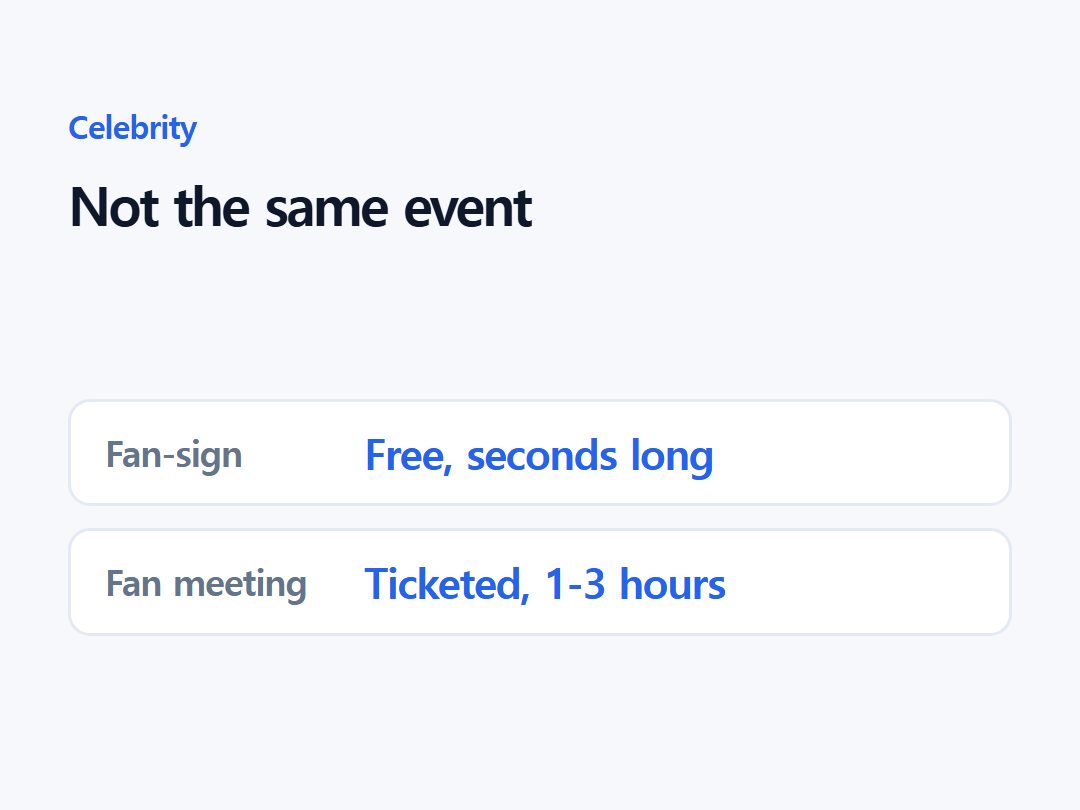
Korean fan culture separates celebrity encounters into distinct categories, each with its own cost and format. A fan-sign (횔사인회) is usually free or tied to buying an album, offering a brief autograph and a few seconds of conversation. A fan meeting is a standalone, ticketed production, typically one to three hours, built around scripted talk segments, games, and short performances.
- Fan-sign: free or product-linked, seconds of interaction
- Fan meeting: ticketed, one to three hours, structured program
- Concert: full musical performance, largest scale and price
International coverage often uses "fan meeting" loosely for any celebrity-fan encounter. In Korea the word specifically denotes a paid, agency-run show with its own ticketing page and seating chart.
Tickets are sold in tiers, and the tiers are the business
Actor fan meetings in 2026 show the pricing structure clearly. Byeon Woo-seok's Seoul stop at Jamsil Indoor Stadium priced membership presale seats at 99,000 won and general seats at 110,000 won, VAT included, as part of a tour also stopping in Bangkok, Yokohama, Taipei, Singapore, Manila, Jakarta, and Hong Kong.
In Jakarta, actor Kim Bum's fan meeting sold three tiers — Gold, Platinum, and Diamond — ranging from roughly 850,000 to 2,800,000 Indonesian rupiah. Park Bo-gum's "Be With You" Asia tour priced Singapore tickets from S$148 to S$268 before fees. Each tier bundles a different mix of proximity, photo access, or early entry, sold as separate products within one event.
Demand for these tiers is not guaranteed just because an actor is well known. Kim Sun-ho's agency, Fantagio, sold out his Seoul fan meeting the moment reservations opened on the NOL Ticket platform — his first fan meeting in Korea in roughly two years.
Heo Nam-jun's agency, H Solid, framed his August 2026 event at KBS Arena as his first-ever solo fan meeting, seven years into his career, showing that even the timing of a first ticketed event is a deliberate business decision rather than an automatic perk of fame.
Fan platforms now handle the whole transaction
Ticketing for these events rarely happens on a generic booking site. Much of it runs through dedicated fan platforms — apps like Weverse or agency-run membership portals — that combine ticket reservations, official merchandise purchases, and paid fan-club membership in a single account.
Membership on these platforms is often a prerequisite for early or discounted access to a fan meeting, which means the paid membership itself becomes part of the revenue chain before a single event ticket is sold.
Korean industry analysis of talent-agency revenue describes this bundled model — ticketing, merchandise (often labeled "MD"), and membership fees — as a core part of how agencies monetize a fanbase between an actor's acting projects.
Why a fan-service gesture became a stand-alone revenue line
The distinction international fans miss is this: a fan meeting is not a courtesy an agency offers alongside an actor's paid drama or film work. It is one of the agency's income sources, tracked separately from acting fees. Korean reporting on entertainment-management revenue structures lists event and merchandise income — often called 정산금, or settlement income — as its own category alongside advertising deals and appearance fees.
This matters because acting fees are project-based and depend on a production's budget, while a fan meeting is an event the agency initiates, prices, and controls directly. For an actor between drama roles, a solo tour across several countries can generate ticket revenue, merchandise sales, and licensing fees from local promoters, independent of whether a new project has even been cast.
How a Japanese housewife fandom built the template
The commercial fan meeting format traces back to the first wave of Hallyu, the Korean cultural wave that spread K-dramas and K-pop abroad. The 2003 Japanese broadcast of the drama "Winter Sonata" turned lead actor Bae Yong-joon into "Yonsama," a nickname pairing his given name with a Japanese honorific reserved for royalty.
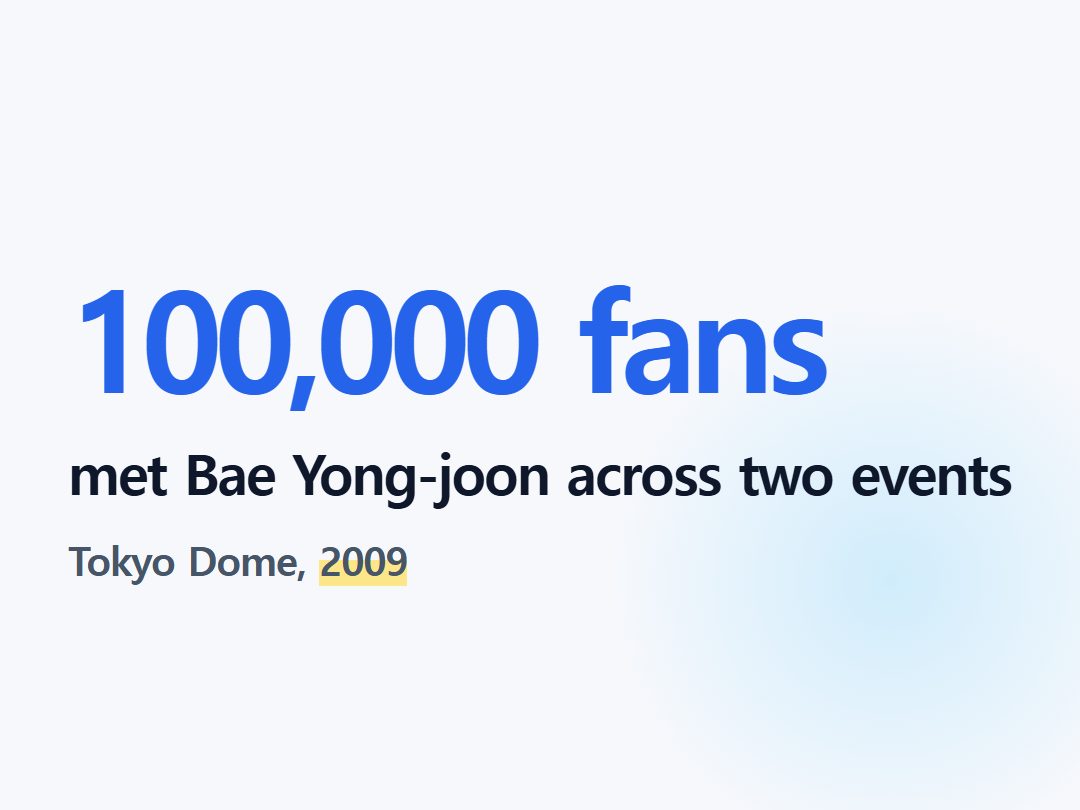
Airport arrivals drew thousands of fans, and by 2009 Bae's management reported he would meet an estimated 100,000 fans across two ticketed events at Tokyo Dome — one promoting an animated version of the drama, the other his book on Korean culture.
That scale showed Korean agencies a single actor's popularity could support a stadium-sized, revenue-generating event entirely separate from a drama's broadcast schedule.
From single events to licensed multi-country tours
What began as one-off gatherings tied to a hit drama is now a recurring, exportable product. In 2026, Byeon Woo-seok and Lee Je-hoon each ran fan meeting tours spanning six to eight cities across Asia, with local promoters in each market handling venue booking and ticket sales under license from the actor's Korean agency.
Lee Je-hoon's 20th-debut-anniversary tour had its Kuala Lumpur stop organized by a Chinese cultural-events company and its Ho Chi Minh City stop sold through a separate regional ticketing platform. This licensing model lets one agency multiply an actor's fan-meeting format across many markets without producing every show in-house.
What actually happens once the doors open
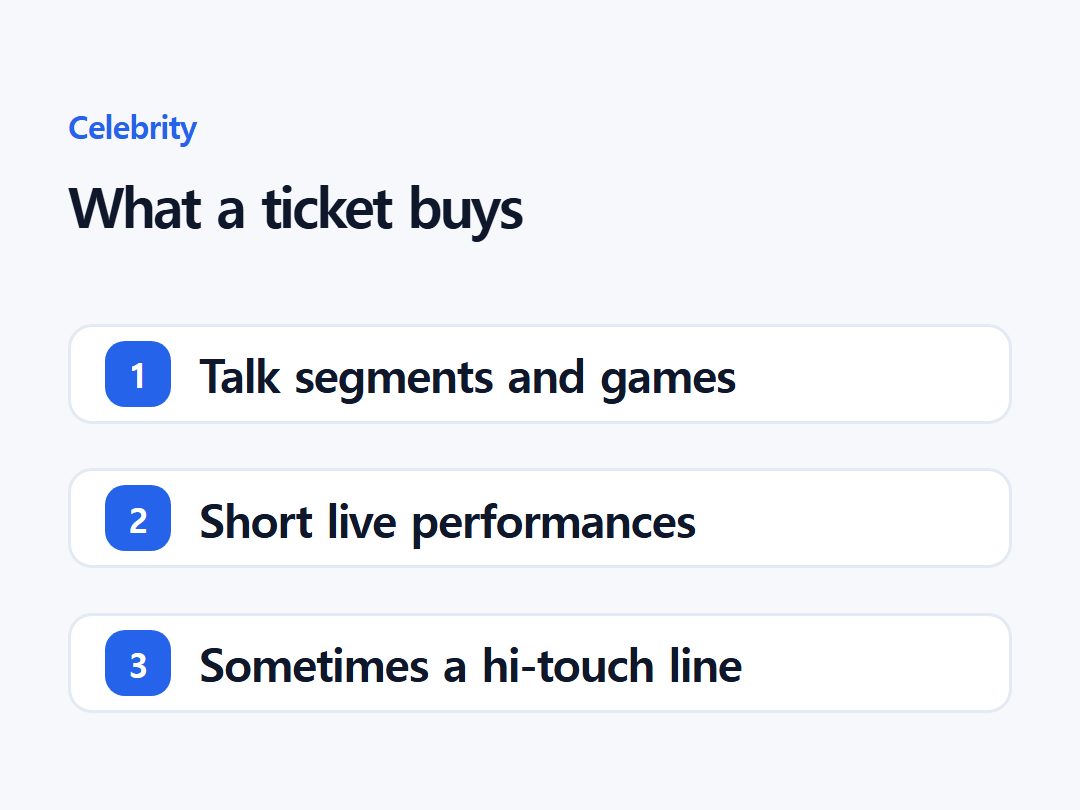
Despite the commercial framing, the program itself stays deliberately intimate in tone. A typical fan meeting runs through fixed segments: an opening talk hosted by an MC, or master of ceremonies, a Q&A drawn from pre-submitted fan questions, one or more short performances or games, and a closing message.
- Talk segments with a moderator asking fan-submitted questions
- Games or interactive audience segments
- Short performances, sometimes a song rather than a full set
- A closing message and, occasionally, a hi-touch line on the way out
Some agencies place small gifts, such as photo cards, bottled water, or snacks, on seats before fans arrive. The format has stayed fairly consistent even as ticket prices and tour scale have grown.
When ticket demand outpaces what a promoter can deliver
The commercial pressure behind fan meetings occasionally surfaces in public disputes. Actor Lee Soo-hyuk's agency, SARAM Entertainment, issued a statement after a fan event in China scheduled to run six and a half hours instead stretched to ten or twelve hours, which the agency attributed to overselling by the local organizer.
The episode points to a structural risk in the licensed-tour model above: once a Korean agency sells the rights to run an event to an overseas promoter, it has less direct control over how many tickets that promoter sells or how the schedule holds up on the ground.
What still has no clear answer
There is no public, standardized breakdown of how ticket revenue splits between an actor's Korean agency, the actor personally, and the local promoter running an overseas stop; that split is negotiated privately per tour. It is also unclear how consistently refund or rescheduling policies apply when an overseas leg is oversold, since each market's promoter sets its own terms.
What is documented is the trajectory: from a single Tokyo Dome date in 2009 to routine multi-country tours in 2026, with tiered pricing now standard. Whether that growth comes with matching consumer protections for the fans paying for it is a question the format has not yet answered.
Fan-sign vs. fan meeting vs. concert
| Format | Cost | Interaction length |
|---|---|---|
| Fan-sign | Free or product-linked | Seconds of interaction |
| Fan meeting | Ticketed | One to three hours, structured program |
| Concert | Largest scale and price | Full musical performance |
Frequently asked
What's the difference between a fan-sign and a fan meeting in Korea?
A fan-sign is usually free or tied to buying an album and lasts only seconds, while a fan meeting is a ticketed, one-to-three-hour show with talk segments, games, and performances.
How much do Korean actor fan meeting tickets cost?
Prices generally run roughly $55 to $270 depending on seat tier; Byeon Woo-seok's Seoul show, for example, priced presale seats at 99,000 won and general seats at 110,000 won.
Why do Korean actors hold paid fan meetings instead of free fan events?
A fan meeting is an agency-initiated, ticketed event tracked as its own income source separate from acting fees, letting agencies earn from tickets, merchandise, and membership between an actor's projects.
Sources
Every factual claim above is traceable. We do not translate articles — we gather facts from multiple outlets and write them ourselves.
- Bae to meet with 100,000 Japanese fans — The Korea Herald
- 'Winter Sonata,' the beginning of Hallyu — The Korea Herald
- 'Yonsama' fans trailblaze Hallyu in Japan — The Korea Herald
- Kim Mu Yeol's first-ever fan meeting sells out — allkpop
- Byeon Woo-seok announces 2026 Fan Meeting Tour, including Manila — GMA Entertainment
- 2026 ByeonWooSeok Asia Fanmeeting Tour notice — Weverse (official)
- Actor Heo Nam Jun announces first-ever solo fan meeting — allkpop
- Lee Je Hoon to mark 20th debut anniversary with Kuala Lumpur fan meeting — Malay Mail
- Park Bo-gum to meet fans in Singapore as part of 'Be With You' Asia tour — Malay Mail
- Kim Bum to hold fan meeting in Jakarta, ticket prices revealed — Databoks (Katadata)
- 'Seonho is sold out'... Sold out, sold out again — STARNEWS
- Lee Soo Hyuk's agency issues statement over alleged mistreatment during China fan meet — WION
- K-Pop 101: Difference Between Concert, Fanmeeting, Fansign And More — Kpopmap