
Many Korean film and drama actors work under a name that does not appear on their government ID. International fans often assume this is simple stylization, like a Western performer trading a plain surname for something catchier.
The short version
- Kim, Lee, and Park alone cover nearly half of South Korea's population.
- Duplicate names are a real career risk — three actors once shared one name.
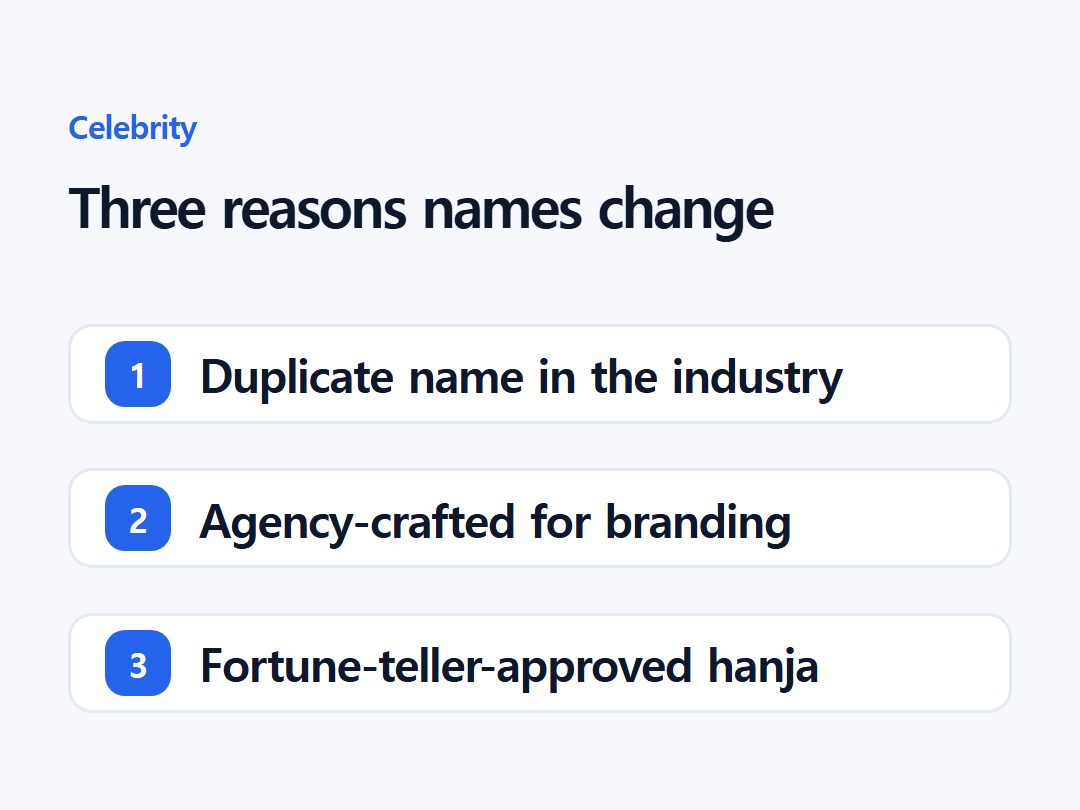
- Agencies pick stage names for branding, pronunciation, or luck, not just style.
The real reasons are more specific to Korea: a surname pool so small that duplicate names are a practical career risk, a talent-agency system that treats naming as part of branding, and a naming tradition that still consults fortune-tellers. A name change here is rarely just cosmetic.
The name on the poster rarely matches the one on the ID
The gap between screen name and legal name runs across generations of Korean film and TV. A talent agency (소속사, sosoksa) — the company that recruits, trains, and manages a performer for years, often starting in their teens — is frequently involved in choosing it.
- Hyun Bin, born Kim Tae-pyeong
- Gong Yoo, born Gong Ji-cheol
- D.O. of EXO, born Do Kyung-soo
- Ma Dong-seok, born Lee Dong-seok
None of these are vanity choices. Each traces back to one of a handful of practical problems that recur across film, television, and music alike, since actors and idols are managed through the same agency structure.
Kim, Lee and Park cover nearly half the country
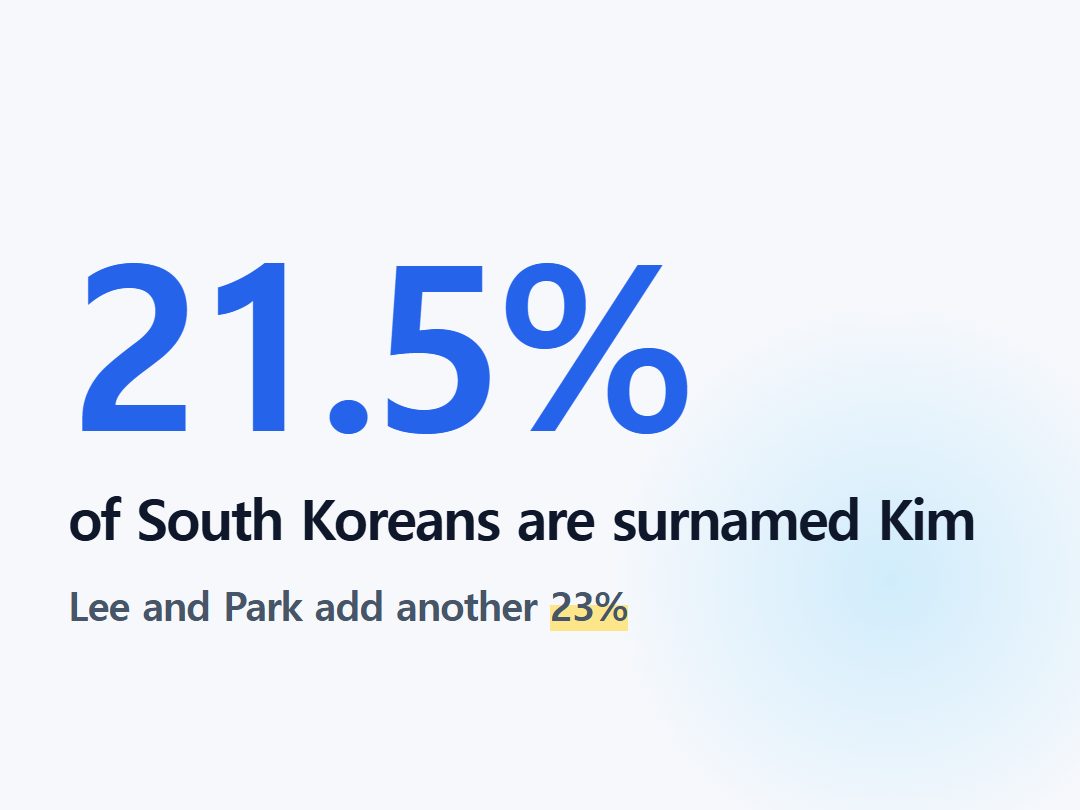
South Korea's surname pool is unusually small. In the 2015 census, the most recent full count by Statistics Korea, Kim accounted for 21.5% of the population, Lee for 14.7%, and Park for 8.4%. With Choi added, four surnames cover close to half of roughly 51 million people.
Koreans distinguish family lines through a bon-gwan, an ancestral clan tied to a founding region, so two people named Kim can trace to entirely unrelated families. A bon-gwan does not appear on a movie poster, though — only the printed name does.
Identical full names are common enough to be a career hazard. The largest single clan, Gimhae Kim, alone has close to four million members, all sharing a surname with hundreds of other public figures.
One actor gave up a name he had carried for 20 years
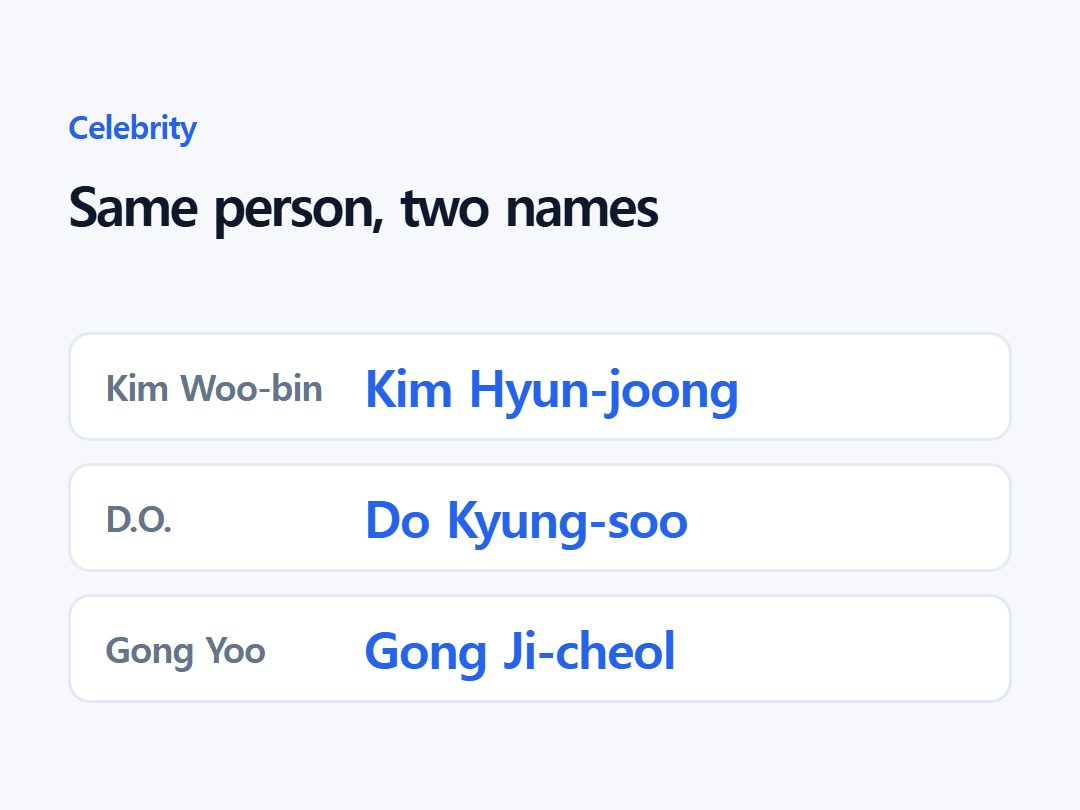
Kim Woo-bin debuted as a runway model in 2009 under his birth name, Kim Hyun-joong. A well-known actor and K-pop idol already used that exact name — the SS501 member who had played a lead role in Boys Over Flowers.
By late 2011 he switched to Kim Woo-bin, a name his agency's president suggested. He later called the change difficult: "People called me Kim Hyun-joong for over 20 years, and I could not stand being called another name."
He is not the only case. Actor Jin Yi-han was also born Kim Hyun-joong — a third working performer with the identical name, on top of the SS501 idol and Kim Woo-bin himself. Three careers, one legal name, is the surname math from the last section playing out in a single industry.
Agencies script how a name sounds before they script anything else
Once duplication is ruled out, agencies weigh how a name performs as a brand. Actor In Gyo-jin's first agency proposed the stage name Do Yi-sung for him; he used it until 2011, then reverted to his birth name on a later agency's advice.
Some agencies build a name around a concept instead. Rain, born Jung Ji-hoon, has said a producer told him his dancing carried a melancholic mood, so he adopted the Korean word for rain, "Bi," to match it. Singer IU built her stage name from the phrase "I and You," meant to signal that music connects performer and listener.
Actor Yoo Ah-in's first agency took a similar approach: his birth name, Uhm Hong-sik, was considered old-fashioned, so the company proposed the name he has performed under since.
A name that is easy to say is a name international fans can find
This is the part of the practice most invisible to international audiences: pronunciation is treated as a functional requirement, not an aesthetic preference. Actress and singer Suzy performs under an anglicized version of her birth name, Bae Su-ji, simplified for audiences who do not read Korean phonetics.
Short, low-syllable names also travel better across languages. Agencies have leaned into that as a deliberate strategy since idol acts began targeting audiences outside Korea in the 2010s, rather than treating it as a coincidence of style.
For international readers, this is the practical payoff: a name built to be typed and searched correctly the first time is a name that shows up in the results at all.
Fortune-tellers still sign off on plenty of these names
Saju is a traditional Korean fortune-telling system that reads a person's birth date and time against the five classical elements. Naming centers, or jangmyeongso, use it to choose the hanja — Chinese characters carrying specific meanings — inside a Korean name.
Lovelyz member Lee Mijoo legally changed her name to Lee Seung-ah after her mother consulted a fortune-teller who said a new name would bring better luck. She still performs as Mijoo, which is now her stage identity rather than her legal one.
Parents commonly commission the same kind of hanja consultation for newborns, so an adult entertainer visiting a naming center later in their career is extending a familiar custom rather than starting an unusual one.
Not every switch starts with the agency
Gong Yoo's name is not agency-manufactured branding but a blend of his parents' surnames — his father's Gong and his mother's Yoo — replacing his birth name, Ji-cheol.
Cases like this show the practice is not uniformly top-down. Personal, family, and superstition-driven changes sit alongside agency-engineered ones, and from the outside the two are not always easy to tell apart. Interviews and official bios are usually the only way to know which category a given name falls into.
Changing the legal name is a separate step, filed in court
Using a stage name for billing requires nothing more than the agency and outlets agreeing to use it — D.O. is still legally Do Kyung-soo on paper. Actually changing the name on the government record is different.
Under Korea's Act on the Registration of Family Relations, a person petitions their local family court and must report an approved change to the register within a set period. Courts generally expect evidence that the new name is already in real use — contracts, credits, or public records — not just a preference.
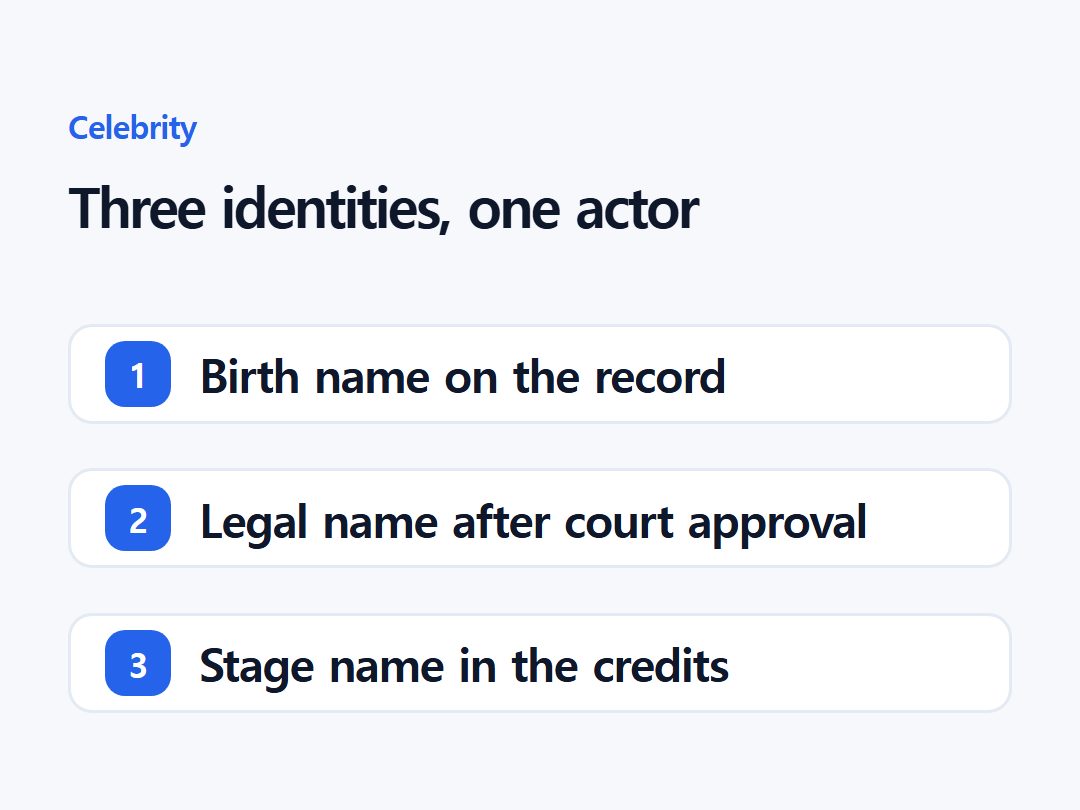
Because of that extra step, a working actor can carry three separate identities at once, and which one shows up depends entirely on the context: a tax document, a marriage record, or a film poster.
- Birth name — what is on the original record
- Legal name — what a court has since approved
- Stage name — what appears in the credits
A training system built in the 1990s made naming a company decision
The modern trainee system — years of company-funded vocal, dance, and language training before a performer earns anything — took shape at SM Entertainment in the mid-1990s under founder Lee Soo-man. The debuts of H.O.T in 1996 and S.E.S in 1997 validated the model, and rival agencies adopted the same structure within a few years.
Because agencies fund years of training up front, their contracts typically give them broad control over branding once a performer debuts, including the public name attached to that investment. Naming, under this model, is treated the same way a company would treat a product name — as an asset the company paid to develop, not a personal detail left entirely to the performer.
A newer generation of idols is choosing to keep its birth name
The practice is not fixed. As agencies debate names for debuting trainees, some now treat keeping a real name as a selling point rather than a liability, signaling authenticity to fans who grew up online. BLACKPINK's Jisoo, for instance, performs under her own given name rather than an invented one, a choice that would have been less common a decade earlier.
Old habits persist regardless. D.O. is still called Kyungsoo, his given name, by most fans no matter what his official credit says, and no agency can enforce what fans choose to call someone. Which of the three identities sticks — birth, legal, or stage — is still decided informally, one performer and one fandom at a time.
Why these actors changed their names
| Stage name | Birth name | Reason for change |
|---|---|---|
| Kim Woo-bin | Kim Hyun-joong | Shared his exact name with an SS501 idol and another actor |
| Gong Yoo | Gong Ji-cheol | Blend of his parents' surnames, Gong and Yoo |
| Rain | Jung Ji-hoon | Agency matched his name to the mood of his dancing |
| Yoo Ah-in | Uhm Hong-sik | First agency judged the birth name old-fashioned |
| Suzy | Bae Su-ji | Anglicized for audiences who don't read Korean phonetics |
Frequently asked
Why do Korean actors use stage names instead of their real names?
Korea's surname pool is small enough that duplicate names are common, and talent agencies often assign stage names for branding, easier pronunciation abroad, or luck from a fortune-teller.
What is D.O. from EXO's real name?
D.O.'s legal name is Do Kyung-soo — D.O. is only the stage name used for billing and credits.
Why did Kim Woo-bin change his name?
He was born Kim Hyun-joong, but a K-pop idol from SS501 and another actor already used that exact name, so his agency had him switch to Kim Woo-bin in 2011.
Sources
Every factual claim above is traceable. We do not translate articles — we gather facts from multiple outlets and write them ourselves.
- Kim Woo Bin talks about his real name 'Kim Hyun Joong' — Yahoo Style Singapore
- Kim, Lee, Park remain three most common surnames — The Korea Times
- Family Relations Register (South Korea) — Wikipedia
- Everything You Need to Know About Korean Entertainer Rain — Preview.ph
- Korean Actors And Actresses Who Changed Their Names — JazmineMedia
- In Gyo-jin — Wikipedia
- Jin Yi-han — Wikipedia
- Bae Suzy — Wikipedia
- D.O. (Do Kyungsoo, EXO) Profile — Kprofiles
- 12 Korean Celebrities Who Legally Changed Their Names for Better Fortune — MyKoreanName
- How Korean Parents Use Saju to Choose Names — MyKoreanName
- The Evolution of the K-Pop Trainee System — K-Pop Atlas
- IU — Kpop Wiki (Fandom)