
In 2021, a wave of anonymous posts accused South Korean celebrities of bullying classmates years, sometimes a decade, earlier. Almost every case followed the same first act: an accusation, a denial or apology, and an abrupt halt to whatever drama, group promotion, or film the person was working on.
The short version
- School bullying accusations rarely reach a court verdict or legal closure.
- Apologizing and reconciling privately leads to faster comebacks than suing accusers.
- Only 13.9% of Koreans support letting accused stars keep working immediately.
What international fans often miss is the second act. Actor Ji Soo, actor Kim Dong-hee, singer Soojin, and actress Kim Hieora have all resurfaced years after their own scandals — sometimes through a different country's market, sometimes only after a lawsuit ruling finally closed the file. The pattern repeats often enough to have its own shape.
A scandal with no court case to close
Most celebrity scandals eventually reach an ending: a verdict, a settlement, a statute of limitations. School bullying, called hakpok in Korean, rarely produces one, because the alleged acts happened when the accused was a minor, often more than a decade before the accusation surfaces online.
South Korea's school violence law lets a school discipline a student at the time of an incident, but it gives adults no criminal process to reopen a childhood dispute years later. Without a court able to rule guilty or not guilty, the case never technically closes. It just fades from headlines, until the star tries to work again.
Why agencies call it a "hiatus," not a firing
Korean entertainers work under exclusive, multi-year contracts with a management company. Under this agency system, the company also handles training, bookings, and public image — and an unproven allegation is not grounds to terminate that contract outright.
So agencies use a specific move instead: announce a pause in "all activities," pull the star from whatever they are filming or promoting, and wait. JYP Entertainment used exactly that language for Stray Kids member Hyunjin in February 2021 — a pause, not a release from the group.
Two lawsuits, one actor, five years
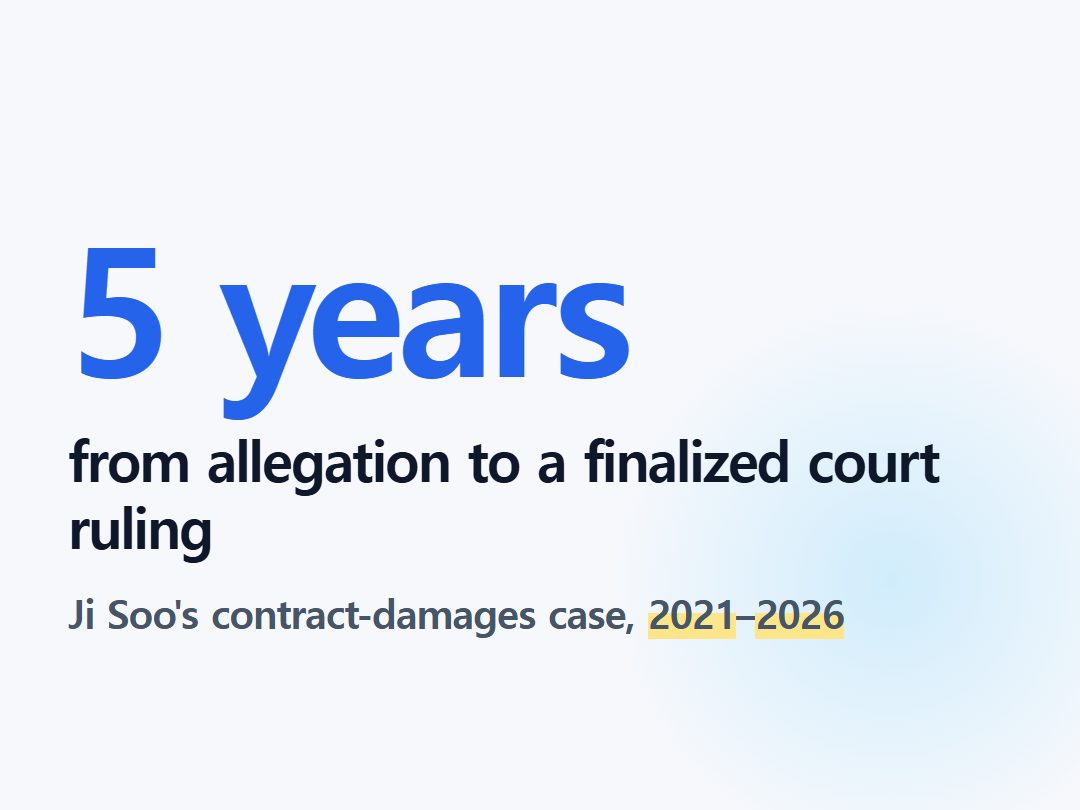
Actor Ji Soo's case shows why "years later" is often literal, not just a figure of speech. In February 2021, several episodes into the KBS drama River Where the Moon Rises, bullying allegations forced the production to recast his role and finish the series with a different actor.
That single decision spawned two separate legal tracks. Ji Soo sued the original accuser for defamation, and the complaint ended in acquittal. Separately, the drama's production company sued his agency, KeyEast, for the financial losses caused by his removal — a case that took until 2026 to finish.
A district court awarded roughly 1.42 billion won in 2024, an appeals court reduced that to 880 million won in early 2026, and KeyEast withdrew its final appeal that July.
Only after that second case was fully settled did Ji Soo publicly signal a return, first through a 2024 video and then through acting work based in the Philippines rather than Korea.
Admit and reconcile, or deny and litigate
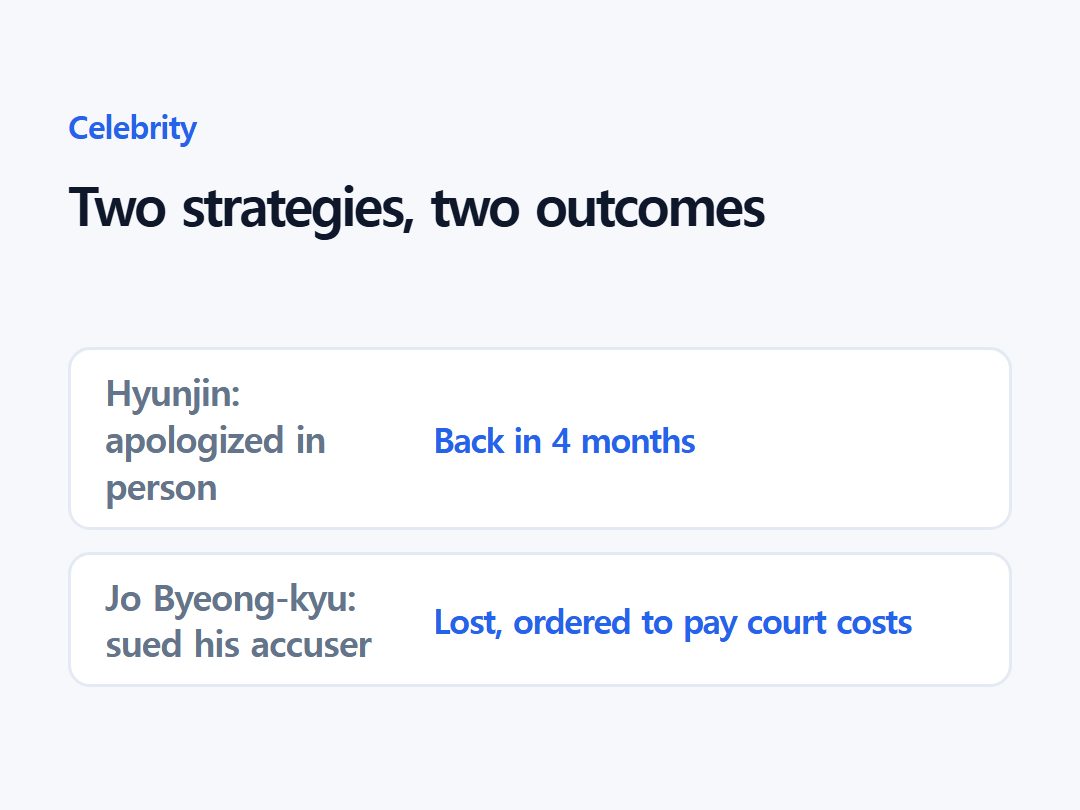
The cases that resolve fastest share one move: a private apology to the actual accuser, not just a public statement. Hyunjin met his accuser in person, and JYP's statement described the outcome plainly — misunderstandings were cleared up, and the two sides agreed to support each other going forward. He was back promoting new music within four months.
The opposite strategy has a worse record. Actor Jo Byeong-kyu sued his accuser for 4.64 billion won over a 2021 post accusing him of bullying while at school in New Zealand. In November 2025, a Seoul court dismissed the entire claim, ruling it could not conclude the post was false, and ordered him to cover the court costs.
Suing an accuser can look like clearing your name. When the suit fails, it instead reads as using legal costs to pressure someone with far less money to fight back — which is close to how the verdict was covered in Korean media.
The drama that made bullying impossible to ignore
The 2021 wave of accusations predates one specific show, but that show kept the issue alive afterward. Netflix's revenge drama The Glory, about a woman tracking down her school bullies as an adult, became a global hit in late 2022 and early 2023.
The irony caught up with one of its own cast members. In September 2023, actress Kim Hieora — who had played a bully in the drama — was accused of belonging to a real bullying group in middle school. She withdrew from a tvN series already in production and partially admitted to "collecting money for older peers," while denying the more serious claims against her.
Because she acknowledged some wrongdoing relatively quickly and reportedly made amends with her accusers by April 2024, her return through a film role arrived faster than cases built on flat denial.
A comeback often starts outside Korea
Several returning stars have chosen to rebuild somewhere with less institutional memory of the scandal. Kim Dong-hee, accused in 2021 of bullying a classmate with a disability, signed with a new Korean agency in January 2026 — but focused his actual comeback on Japan, opening an official Japanese fan club in June 2026 and filming there rather than for a Korean broadcaster.
Ji Soo followed similar geography, building his post-scandal work around the Philippines. A smaller, less saturated market lets a star rebuild a body of work before testing whether Korean audiences, and Korean casting directors, will accept them back.
What Korean audiences actually say about it
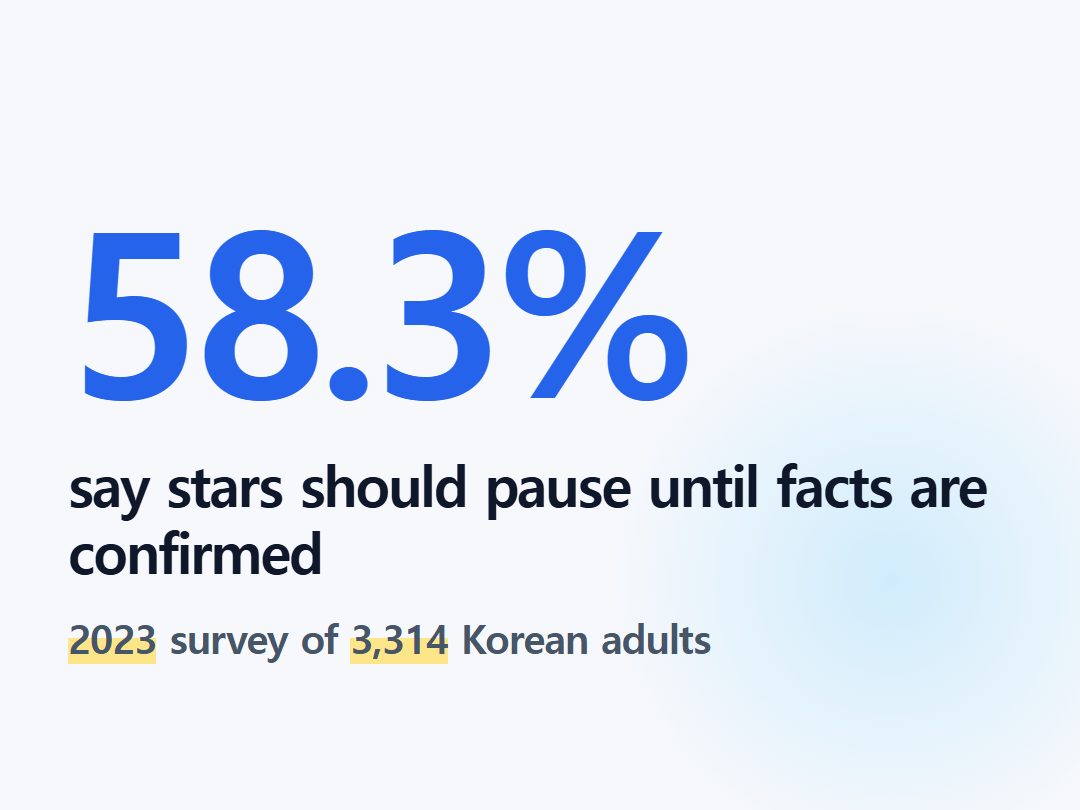
Public tolerance for these comebacks is measurably low. In a September 2023 survey of 3,314 Korean adults by Real Research Korea, only 13.9% said an accused star could keep working before the facts were confirmed.
- 58.3% said the star should pause all activity until the truth is established
- 24.3% said the star should stop activity immediately, regardless of what is later proven
- Just 3.3% said a bullying accusation should never be grounds to stop working
That leaves accused stars performing for an audience that has already decided, by a wide margin, that they should not be performing yet — which is part of why so many comebacks arrive through a foreign market, an independent film, or a low-visibility solo project instead of a mainstream Korean drama or group comeback.
Winning in court doesn't win back the audience
Actress Park Hye-soo shows that even a favorable legal outcome does not guarantee career recovery. She first appeared in public again at the 2022 Busan International Film Festival, for a panel on the independent film The Dream Songs, roughly a year and eight months after her scandal began.
Her fuller return followed in October 2023, when Korean police concluded that the rumors labeling her a bully were false and referred the people who had spread them to prosecutors — a rare full exoneration.
But a drama filmed years earlier and finally broadcast around the same time drew a rating of just 0.1%, and by March 2026 she had ended her contract with the agency she had been with for eleven years. Legal vindication cleared her record; it did not restore her career.
What is still unresolved
New cases keep entering the same cycle before older ones finish. In April 2024, actress Song Ha-yoon's agency confirmed she had been forcibly transferred out of her high school, one of the more severe school violence penalties, while actress Jeon Jong-seo's agency denied similar accusations the same month and threatened legal action against people spreading them.
Neither case has produced a finished lawsuit or a confirmed comeback timeline. Given how long the earlier cases took — Ji Soo's contract dispute alone ran five years — international fans should expect these newer allegations to stay open, and any eventual comeback to arrive quietly, for a while yet.
How five accused stars' strategies compared
| Star | Response Strategy | Outcome |
|---|---|---|
| Hyunjin (Stray Kids) | Private apology, reconciled with accuser | Resumed promotions within 4 months |
| Kim Hieora | Partial admission, made amends by April 2024 | Returned via film role |
| Ji Soo | Denied allegation, litigated for years | Comeback via Philippines after 5-year legal battle |
| Jo Byeong-kyu | Sued accuser for defamation | Lost case in Nov 2025, ordered to pay court costs |
| Park Hye-soo | Denied claim, fully exonerated by police in 2023 | Still ended 11-year agency contract by March 2026 |
Frequently asked
Why do accused K-pop idols and actors still get comebacks?
South Korea's school violence law gives no criminal process to reopen a childhood bullying dispute years later, so accusations rarely produce a verdict, settlement, or clear ending — the case just fades until the star tries to work again.
What happened with the Ji Soo bullying case?
Ji Soo sued his original accuser for defamation and the case ended in acquittal, while a separate lawsuit over his removal from a KBS drama took five years, ending when his agency KeyEast withdrew its final appeal in 2026 after an 880 million won judgment.
Why do accused Korean stars often relaunch their careers abroad?
Markets like Japan and the Philippines have less institutional memory of the scandal, letting a star rebuild a body of work before testing whether Korean audiences and casting directors will accept them back.
Sources
Every factual claim above is traceable. We do not translate articles — we gather facts from multiple outlets and write them ourselves.
- Why School Bullying Allegations Keep Striking South Korean Celebrities — TIME
- Can celebrities regain support after school bullying scandals? — The Korea Times
- Hyunjin of Stray Kids returns after bullying scandal — The Korea Times
- Ji Soo's Former Agency Ordered to Pay 880 Million Won for Drama Exit over School Violence Allegations — SBS News
- Ji Soo ordered to pay 880 million KRW in damages over 'River Where the Moon Rises' exit — allkpop
- South Korean actor Jo Byeong Kyu loses $2.8 million lawsuit over school violence allegations — WION
- 'The Glory' actress Kim Hieora faces bullying allegations — The Korea Times
- 'The Glory' Actress To Return Almost 2 Years After Her School Bullying Scandal — Koreaboo
- 'School Bullying Controversy → Activities in Japan' Kim Dong-hee Returns to Filming — StarNews
- Kim Dong Hee's Current Situation After School Violence Scandal: Signals Comeback With New Agency — KbizoOm
- Dear M star Park Hye-soo makes 1st public appearance post bullying scandal at BIFF 2022 — Sportskeeda
- Actress Park Hye Soo parts ways with her long-time agency after 11 years — allkpop
- Ex-girl group member disgraced by bullying rumors eyes comeback — The Korea Herald
- "학폭 논란 스타, 사실 밝혀지기 전까진 활동 보류해야" — Sports Khan