
A character in a Korean drama opens a robot vacuum's packaging on screen. Another orders a specific brand of instant coffee by name, in dialogue, mid-scene. A watch, a car, or an airline logo lingers in frame just a beat too long. International viewers usually clock this as clumsy advertising and move on.
What they are actually watching is the financing model that keeps most Korean dramas in production at all: broadcasters and studios do not cover the full cost of making a drama, and product placement — known in Korea as PPL — is not a bonus on top of that funding. It is one of the main pillars holding the budget up.
The short version
- Korean broadcasters cover only about half of a drama's production cost.
- Product placement supplies 20-40% of a Korean drama's total financing.
- Netflix's long PPL-free reputation broke in 2025 with foreign-brand deals.
Why is product placement in Korean dramas so common?
To understand why PPL is everywhere in Korean dramas, you have to understand how little of the budget a broadcaster actually puts up.
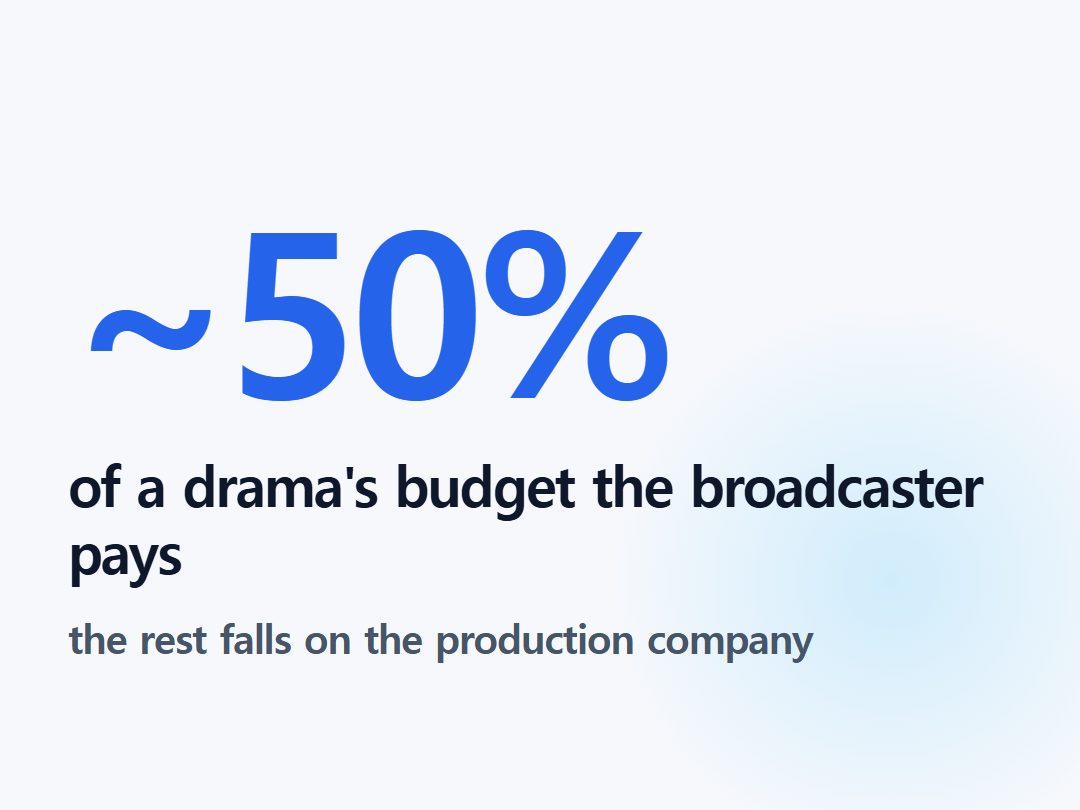
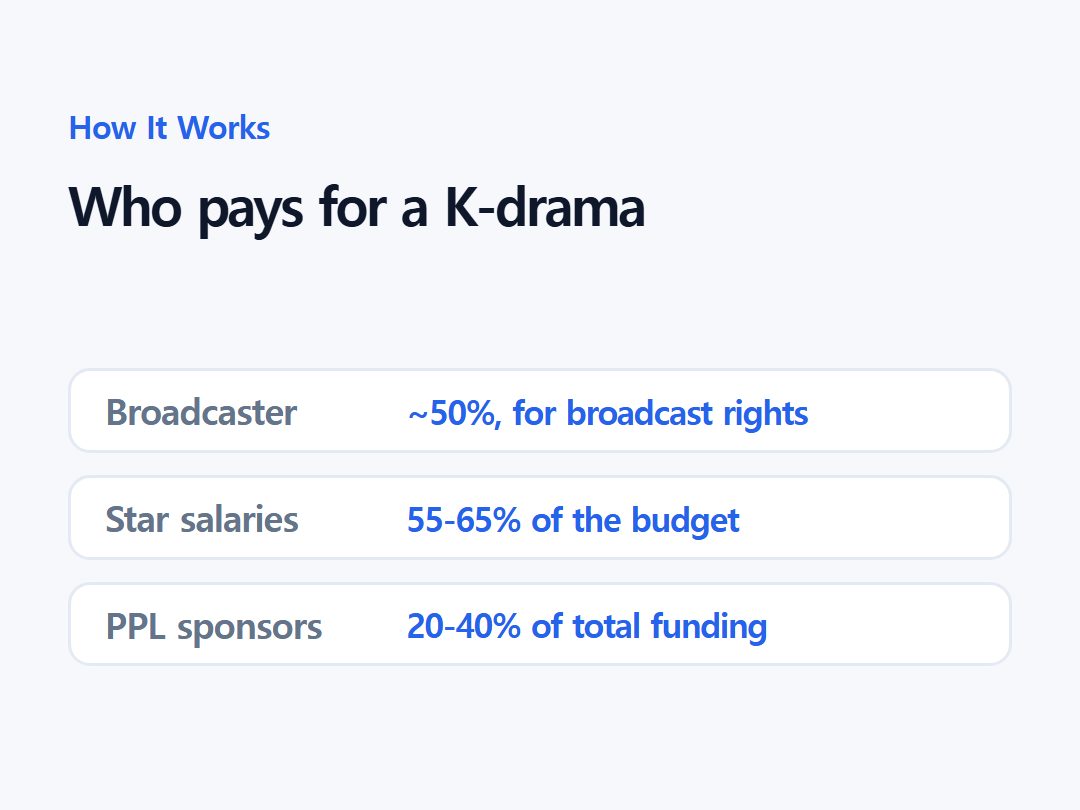
Korean terrestrial networks (지상파, jisang-pa — the free-to-air channels KBS, MBC and SBS) and major cable channels typically fund only around half of a drama's production cost in exchange for broadcast rights, according to reporting compiled by Facts and Details on the Korean drama industry.
When a project has A-list stars attached, the broadcaster may cover more — but the remaining cost still has to come from somewhere, and it is the production company, not the network, that is on the hook for the shortfall.
That shortfall has grown sharply.
A 2024 industry analysis from the Korea Communications Agency (KCA), a government-affiliated media research body, put the average per-episode production cost at roughly 3.1 billion won (about US$2.2 million), while broadcasters' advertising revenue has failed to keep pace — the report bluntly concludes that Korea's domestic broadcasting market has "lost its self-sufficiency for drama production." Separate industry data cited by trade outlet ContentAsia, drawn from the Korean Drama Production Association, puts per-episode costs at KRW 1-3 billion (roughly US$717,500-2.2 million) as of 2025, up from an average closer to KRW 300 million-1 billion just a couple of years earlier, according to figures from the Korea Creative Content Agency (KOCCA). Costs have roughly doubled to quintupled over a single decade.
A large share of that money goes to actors.
Star fees now eat up an estimated 55-65% of a Korean drama's budget, compared with 20-30% in Japan and roughly 10% in the United States, per Facts and Details' industry breakdown — and the KCA report notes that top-tier leads can now command 200-300 million won per episode on their own.
Since most Korean dramas (an estimated 80%, per industry figures) are made not by the broadcasters themselves but by independent production companies working under license — a system sometimes called 외주제작, oeju jejak, or "outsourced production" — it is these smaller companies that absorb the gap between what the network pays and what the show actually costs, a structure similar to what the U.S. industry calls deficit financing.
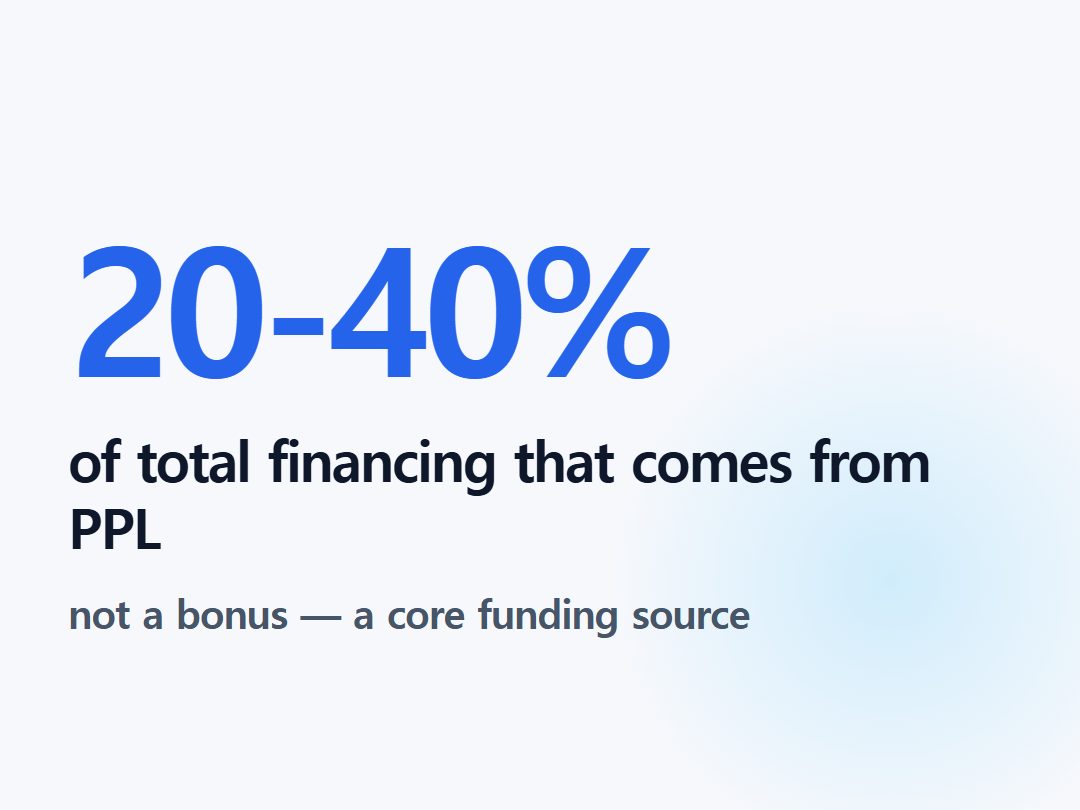
This is where PPL stops being incidental. Industry estimates compiled by content-industry outlet KcontentHub put product-placement revenue at 20-40% of a Korean drama's total financing — not a marginal add-on, but often the single largest non-broadcaster funding source available to a production company.
A single branded placement can be worth anywhere from a few thousand dollars for a background prop to $500,000-$1 million for making a brand the lead character's actual workplace or storyline device, according to figures reported by Facts and Details.
For a production company staring at a budget gap in the hundreds of millions of won, signing enough sponsors to cover a third or more of the show is often the difference between the drama getting made and it not happening.
This explains a pattern that puzzles international viewers: why the placement is sometimes so blunt it breaks the scene.
Korean broadcasting regulations only allow indirect advertising in entertainment programming (not news or children's content), and cap how much of a screen a product can occupy and how long it can appear per broadcast.
Sponsors paying real money for limited, regulated screen time have an incentive to make sure their product is unmistakable within that window — which is why a coffee brand gets a close-up rather than a passing glance in the background.
How Korea legalized product placement in 2010
Indirect advertising in Korean broadcasting used to occupy a legal gray zone.
Regulators technically prohibited it, yet as early as 2006 authorities began quietly encouraging placement of Korean products specifically, hoping to ride the export momentum of the early Korean Wave — carmaker Kia's arrangement to supply vehicles for the 2009 spy drama "IRIS" was an early example of this soft encouragement, as documented by Korea-focused blog The Grand Narrative at the time.
Broadcasters were, somewhat contradictorily, blurring competitor logos on screen while cutting brand deals of their own.
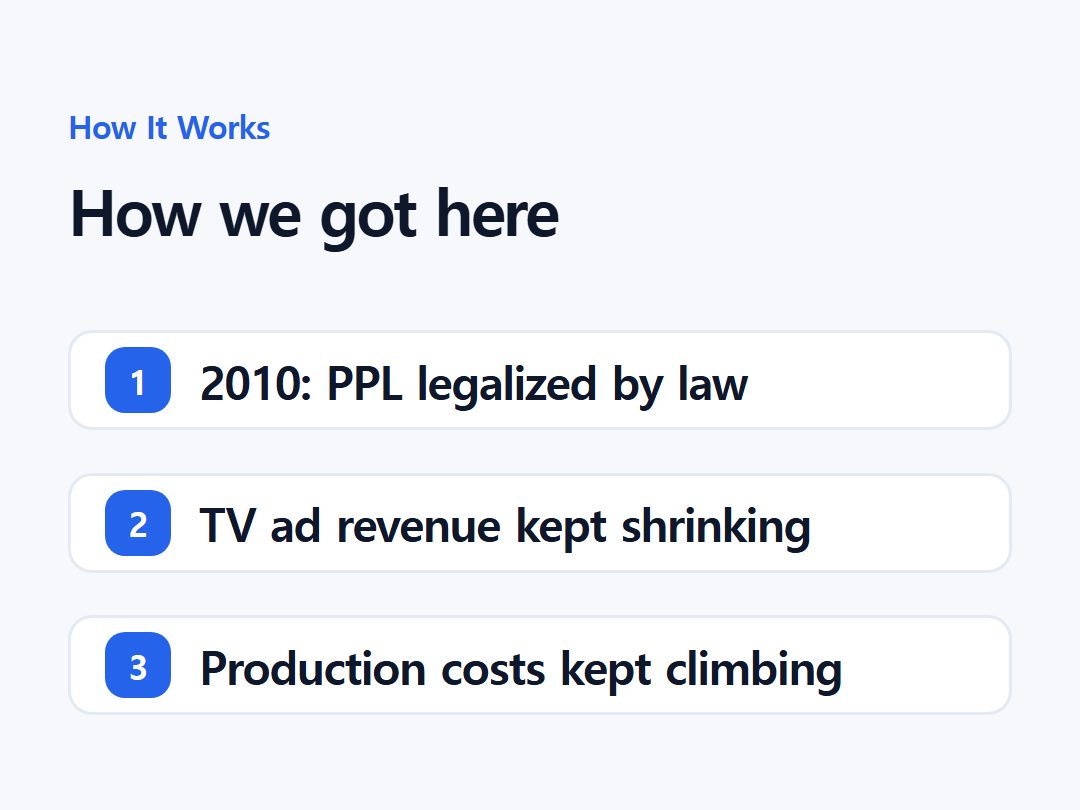
That contradiction was resolved in January 2010, when Korea's broadcasting regulator approved a revision to the Broadcasting Act's enforcement ordinance that formally legalized PPL for terrestrial and cable television. The timing was not a coincidence.
Terrestrial TV's share of Korea's total advertising market had fallen from 40.5% in 2001 to 24.6% in 2008, according to a Korea Creative Content Agency (KOCCA) research report on the policy shift, as viewers migrated toward cable, digital platforms and ad-skipping habits.
Legalizing PPL gave broadcasters and producers a second, growing revenue stream just as their first one — traditional commercial breaks — was shrinking.
Since then, two things have moved in opposite directions and squeezed the industry harder each year. Production costs have kept climbing, driven mainly by star salaries and by production companies competing for scripts and directors with track records overseas.
Meanwhile, broadcasters have been pulling back rather than scaling up: KCA data shows terrestrial networks aired 91 dramas a year in 2012 versus just 32 in 2023, and total annual drama broadcasts across all channels fell from more than 120 to 78 over the same period.
SBS eliminated its Monday-Tuesday drama slot in 2019, and by 2023 the major terrestrial networks and cable channel tvN had all dropped Wednesday-Thursday drama programming in favor of variety shows — fewer, more expensive slots chasing the same shrinking advertising pool.
With less broadcaster money available per show, sponsorship revenue has had to fill an ever-larger share of each remaining production's budget.
Is Netflix's PPL-free reputation over?
The frontier now is streaming. Netflix built its Korean-content reputation partly on being a "PPL-free" viewing experience, since it does not depend on domestic TV advertising revenue the way terrestrial broadcasters do. That reputation has started to erode.
The Korea Times reported in November 2025 that Netflix's "Genie, Make a Wish," from star screenwriter Kim Eun-sook, carried placement deals from ten different brands, half of them foreign — including China's robot-vacuum maker Narwal and UK luxury label Jimmy Choo — breaking what the outlet called Netflix's nine-year "PPL safety zone." The same reporting noted that the share of foreign brands appearing in Korean drama PPL has grown roughly fivefold over the past five years, with companies like Indonesian candy brand Kopiko running what's described as a "reverse-export" strategy: appearing repeatedly in hit dramas in markets where the product isn't even sold yet, using the drama itself as the international launch campaign.
That shift raises the open question for the years ahead: if even streaming platforms start leaning on sponsorship to offset licensing and talent costs, does PPL keep expanding regardless of which platform a drama lands on, or does viewer irritation with obvious "active PPL" — placement written directly into dialogue and plot, rather than left in the background — eventually force platforms to draw a harder line?
Domestic drama output is also shrinking, from 141 titles in 2022 to 107 in 2024 according to the Korean Drama Production Association, while global streamers have reportedly cut their Korean drama commissioning by roughly 43% over two years.
With fewer shows being greenlit and each one costing more to make, the pressure on the remaining productions to secure sponsorship — and to make that sponsorship as visible as contracts allow — is unlikely to ease.
Korean stars claim far more of the budget
| Country | Star Fees Share of Budget |
|---|---|
| South Korea | 55-65% |
| Japan | 20-30% |
| United States | ~10% |
Frequently asked
Why is there so much product placement in Korean dramas?
Broadcasters typically cover only about half of a drama's production cost, and PPL revenue — often 20-40% of total financing — fills the gap production companies would otherwise have to absorb themselves.
When did product placement become legal on Korean TV?
Korea's broadcasting regulator formally legalized indirect advertising for terrestrial and cable TV in January 2010, after years of it existing in a legal gray zone.
Does Netflix use product placement in Korean dramas?
Netflix built its reputation on being 'PPL-free,' but that broke by November 2025, when Kim Eun-sook's 'Genie, Make a Wish' carried placement deals from ten brands, half of them foreign.
Sources
Every factual claim above is traceable. We do not translate articles — we gather facts from multiple outlets and write them ourselves.
- BUSINESS OF KOREAN DRAMAS: PRODUCTION COSTS, INCOME, PRODUCT PLACEMENTS — Facts and Details
- Why Is There So Much PPL in Korean Dramas? Production, Business, and the Global Fan Perspective — KcontentHub
- 미디어 이슈&트렌드 Vol.63 - 제작비 폭등에 따른 국내 드라마 시장의 변화와 개선방안 — Korea Communications Agency (KCA)
- Plot twists: Korean studios are cutting back at home, but powering ahead abroad — ContentAsia
- Why are so many actors eating Kopiko in K-dramas? Inside Netflix's 'Genie, Make a Wish' and the global PPL boom — The Korea Times
- Korean Sociological Image #32: Censorship and Indirect Advertising — The Grand Narrative
- 드라마 간접광고(PPL)와 스토리텔링 — Korea Creative Content Agency (KOCCA)