
Turn on Korean television on almost any weeknight and there is a live music chart show on air. Mnet's M Countdown airs Thursdays, KBS's Music Bank airs Fridays, MBC's Show! Music Core airs Saturdays, and SBS's Inkigayo closes the week on Sundays. MBC M holds Wednesday with Show Champion, and SBS Life holds Tuesday with The Show.
The short version
- Each show scores differently — Wednesday rewards voting, Thursday rewards global fans.
- Show Champion's low transparency and 35% digital score make Wednesday wins easier.
- Two shows went dark in 2025; five others kept their weekly slot.
To an outside viewer, that spread looks like networks simply avoiding a scheduling collision. To a K-pop agency planning a comeback, it is closer to choosing which of six different competitions to enter, because each show counts an artist's success by a different formula, on a different day.
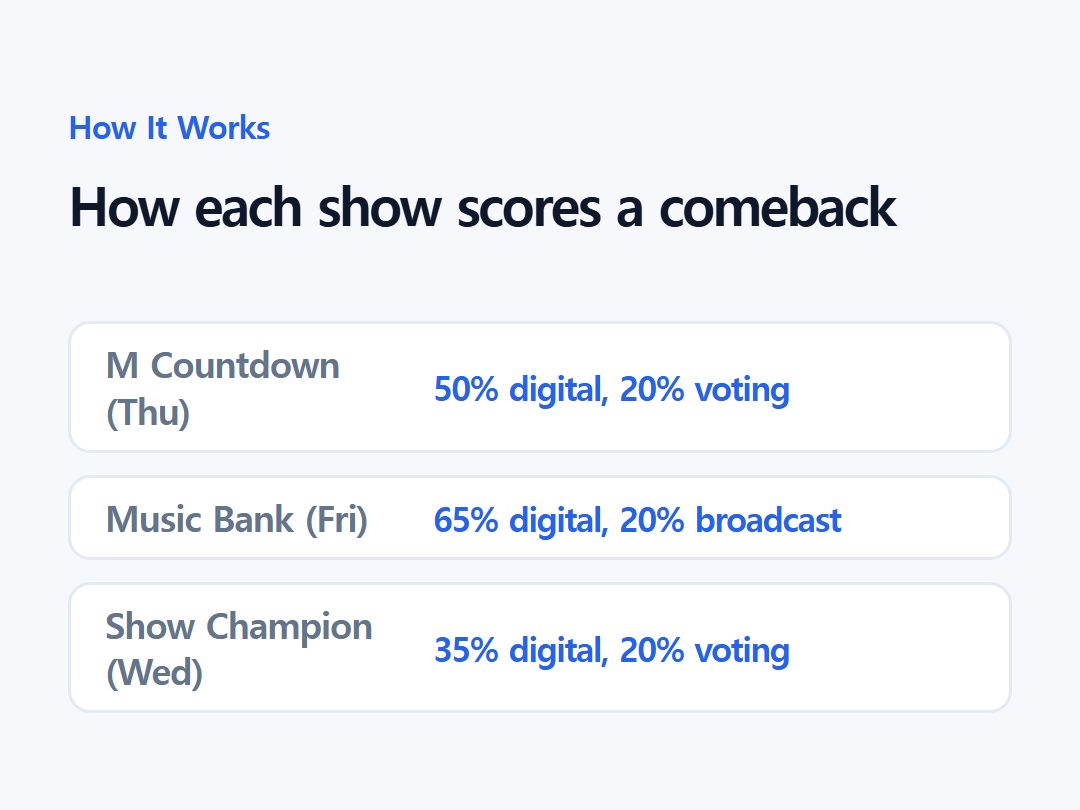
Six weekday slots, six different scoring formulas
Every show's chart victory means something different because every show measures different things. Digital streaming and sales make up at least a third of each score, but what fills the rest of the formula changes network to network.
| Show (network) | Airs | Digital | Broadcast | Voting |
|---|---|---|---|---|
| M Countdown (Mnet) | Thursday | 50% | 10% | 20% |
| Music Bank (KBS) | Friday | 65% | 20% | 10% |
| Show! Music Core (MBC) | Saturday | 50% | 10% | 20% |
| Inkigayo (SBS) | Sunday | 50% | 10% | 10% |
| Show Champion (MBC M) | Wednesday | 35% | 20% | 20% |
The remaining points in every formula go to physical album sales and official music-video views, split in different proportions each time. Show! Music Core, for instance, adds a five-member viewer committee vote on top of its regular pre-vote and live vote, a layer none of the other four shows use. No two shows reward the same behavior in the same amounts.

Why the same comeback can look stronger on one day than another
Because each show's tracking window falls on a different stretch of the week, the same seven days of streaming and sales can look different depending on which broadcast is reading them. Fan-run scoring guides that track M Countdown's published criteria describe its digital score as drawn from the Monday-to-Sunday period ahead of its Thursday broadcast.
A group whose title track drops on a Friday — the day most releases land worldwide — walks into Wednesday's Show Champion with only a handful of days of sales behind it, but into the following Friday's Music Bank with a full week. The calendar itself decides how much evidence a show has to work with.
Some shows also limit how long a song stays eligible at all. Show! Music Core's own criteria, compiled from its broadcast rules, allow only songs released within the past two months to compete, which means a comeback's window to win narrows on a fixed clock regardless of how the song performs afterward.
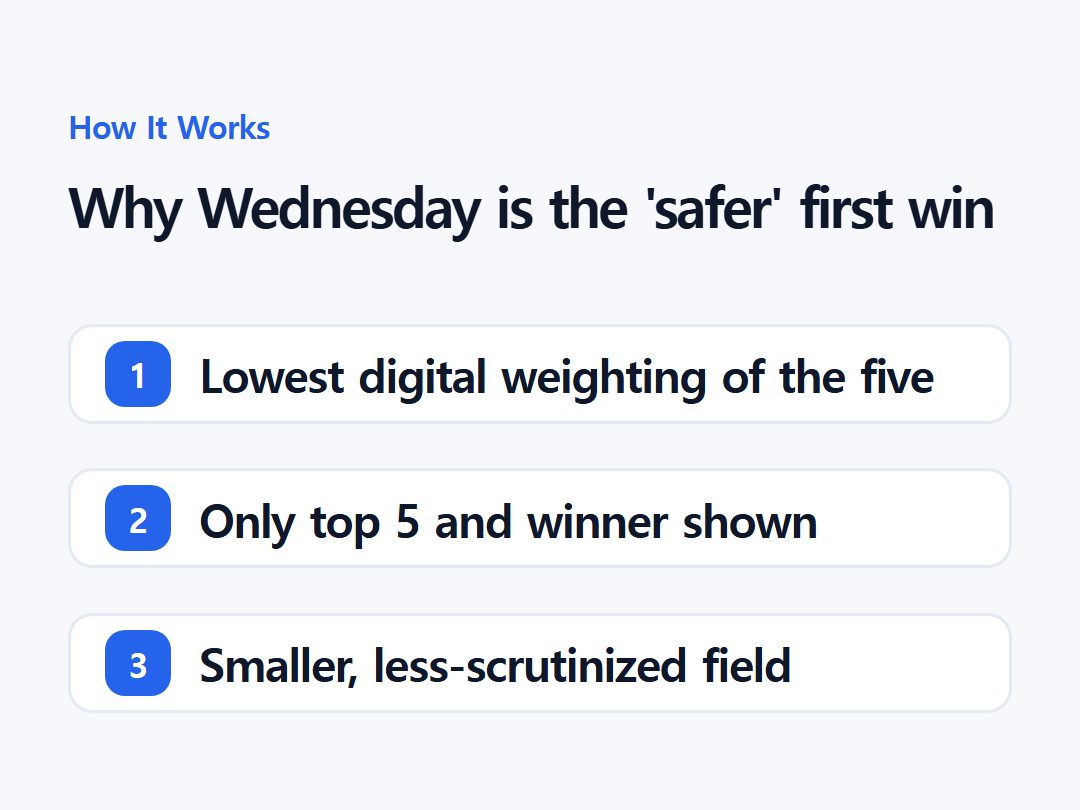
Wednesday is where companies send a group for a safer first win
Show Champion airs on MBC M, a cable channel, rather than one of the three terrestrial broadcasters that carry the other four shows. Its digital weighting, 35%, is the lowest of the five publicly scored shows, and it makes up the difference with broadcast points and voting — categories a coordinated fandom can move more easily than raw sales.
It is also the only one of the five that does not publish full rankings; viewers only ever see the top five acts and the winner. Less transparency and a lighter competitive field make a Wednesday win easier to plan for, which is one reason agencies with newer or mid-sized acts often send a debut or comeback's very first stage there rather than to Friday's Music Bank or Sunday's Inkigayo.
Thursday carries more weight because it rewards a global fandom
M Countdown builds in something the terrestrial shows do not: a dedicated online voting window open to fans anywhere, worth 20% of the total score once pre-voting and live voting are combined. A group with modest domestic sales but a large international fanbase can still compete on Thursday in a way it cannot on Friday's more sales-heavy Music Bank.
That is why a Thursday win reads differently to fans and press. Rookie girl group Kep1er's "WA DA DA" won on M Countdown just ten days after their 2022 debut, an outcome commentators flagged as unusual precisely because M Countdown wins are supposed to demand sustained international mobilization, not one strong week.
That same global-voting mechanism is also why groups with a large following outside Korea sometimes see their best single-show result land on a Thursday even when their domestic sales trail the week's other contenders. The vote is open to anyone with an internet connection, not just Korean listeners.
Music Bank spent a decade drifting before settling on Friday
No one designed this weekly spread on a whiteboard; each show claimed its day independently, often after years of trial and error. KBS's Music Bank, which replaced the long-running Gayo Top 10 in June 1998, spent nearly ten years moving around the calendar.
It opened on Tuesday evenings, shifted to Thursday in 2000, to Friday in 2003, and to Sunday afternoons in 2005. Falling ratings during the Sunday run pushed it back to Friday evenings in September 2007, where it has stayed since. Music Bank's own predecessor, Gayo Top 10, had aired on that same Friday evening slot from 1981 until 1998, so the current schedule is in some sense a return to where KBS started.
Inkigayo canceled its own chart twice before Sunday became permanent
SBS's Inkigayo has an even more disrupted history. It began as SBS Popular Song in 1991, was cancelled in 1993, and was revived under its current name in 1998.
The chart itself was dropped entirely twice: replaced by a non-ranked "Take 7" format in 2003, and abolished again in 2012 before being reinstated in 2013. The show has aired live on Sunday afternoons since switching from a recorded broadcast in 2007.
Between the two of them, Music Bank and Inkigayo account for more than three decades of trial and error over which day, format, and chart system actually kept viewers watching.
The two newer shows filled the days everyone else had left alone
Show! Music Core has held Saturday without interruption since it launched in October 2005, replacing an earlier MBC program. Show Champion, MBC M's cable-only entry, has held Wednesday since its debut in February 2012 — a day none of the terrestrial shows were using.
Both arrived after Music Bank and Inkigayo had already claimed the weekend's biggest audiences, which is part of why their formulas lean harder on broadcast and voting points than on raw digital sales. Leaning on fan-movable categories is one of the few ways a newer show can still compete for attention.
What "does the day matter" misses if you stop at scheduling
The bigger open question is not which day is best, but how many days will still have a show on them at all. Arirang's Simply K-Pop, long known for giving smaller-agency and rookie acts a stage that Music Bank and Inkigayo often would not, ended permanently in July 2025 after thirteen years on air.
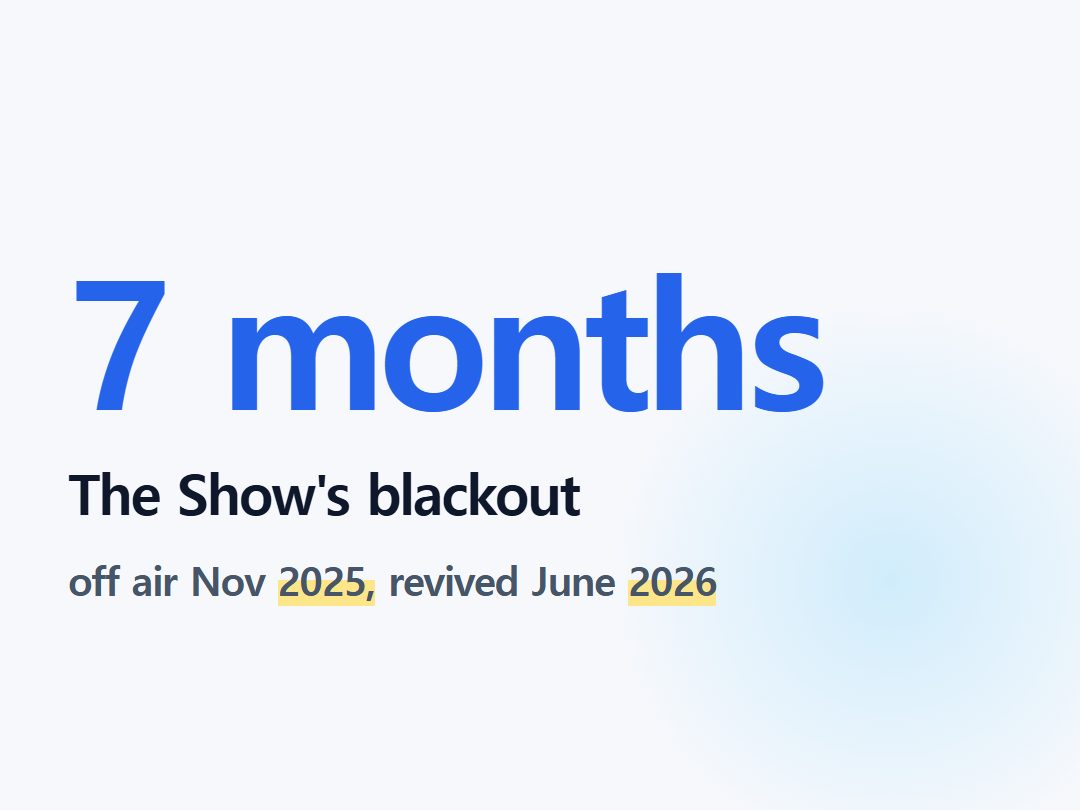
SBS's Tuesday program, The Show, went dark that November when its production company, SBS Medianet, exited entertainment production entirely — only to return seven months later, on June 2, 2026, under a new owner, the entertainment-tech startup BIGC, with a free global simulcast on TikTok.
The new version also brought in different hosts and a global voting segment, but the schedule itself did not change — The Show still occupies the same Tuesday slot it held for fourteen years before the pause. What changed was who owns the show, not which day it airs.
- Simply K-Pop: ended July 2025, no revival announced
- The Show: ended November 2025, relaunched June 2026 under new ownership
- Five other weekly shows: schedule unchanged as of September 2026
Fewer total shows means fewer weekly stages to divide among a growing number of debuting and comebacking acts, which raises the stakes attached to whichever day a group does get. For a smaller agency, simply landing a stage at all is now closer to the real contest than picking the theoretically ideal one.
Chart show scoring formulas by network
| Show (network) | Airs | Digital | Broadcast | Voting |
|---|---|---|---|---|
| M Countdown (Mnet) | Thursday | 50% | 10% | 20% |
| Music Bank (KBS) | Friday | 65% | 20% | 10% |
| Show! Music Core (MBC) | Saturday | 50% | 10% | 20% |
| Inkigayo (SBS) | Sunday | 50% | 10% | 10% |
| Show Champion (MBC M) | Wednesday | 35% | 20% | 20% |
Frequently asked
Which K-pop music show is easiest to win?
Show Champion on Wednesday is often seen as the easier first win because its digital weighting is only 35%, the lowest of the five publicly scored shows, and it only shows the top five acts rather than full rankings.
What day does Inkigayo air?
Inkigayo airs live on Sunday afternoons, a slot it has held since switching from a recorded broadcast in 2007, after a history of cancellations and format changes.
Did The Show get cancelled?
The Show went dark in November 2025 when its production company SBS Medianet exited entertainment production, then returned on June 2, 2026 under new owner BIGC while keeping its original Tuesday slot.
Sources
Every factual claim above is traceable. We do not translate articles — we gather facts from multiple outlets and write them ourselves.
- K-Pop Music Show Guide 2026 — KoreaRoute
- Guide to Korean Music Show Wins: How the Scores are Calculated — Creatrip
- Guide To K-Pop Music Show Wins: What You Need To Know — Soompi
- Show! Champion Guide: How the Scoring and Voting System Works — Shapes
- [MUSIC SHOW INFO] MNET'S M Countdown — US BTS ARMY
- Music Bank — Wikipedia
- Inkigayo — Wikipedia
- Show Champion — Wikipedia
- Show! Music Core — Wikipedia
- 'Simply K-pop' announces final broadcast after 13 years — allkpop
- 'The Show' officially ends after 14 years of K-pop music broadcasting — allkpop
- The Show K-pop Returns June 2026: SBS LIFE, BIGC, New Format Explained — Namanecard
- SF9, ALPHA DRIVE ONE comeback stages on The Show — Sports Khan