
Every so often, a Korean celebrity's mandatory military enlistment becomes a small controversy — not because he refuses to serve, but because he is assigned to serve as a social service worker (사회복무요원) instead of an active-duty soldier. International fans often read this as a loophole or a quiet favor. It is neither.
It is a separate, legally defined category of service that a government medical exam assigns to a man, whether he wants it or not.
The short version
- A mandatory medical exam, not favoritism, decides social service duty status.
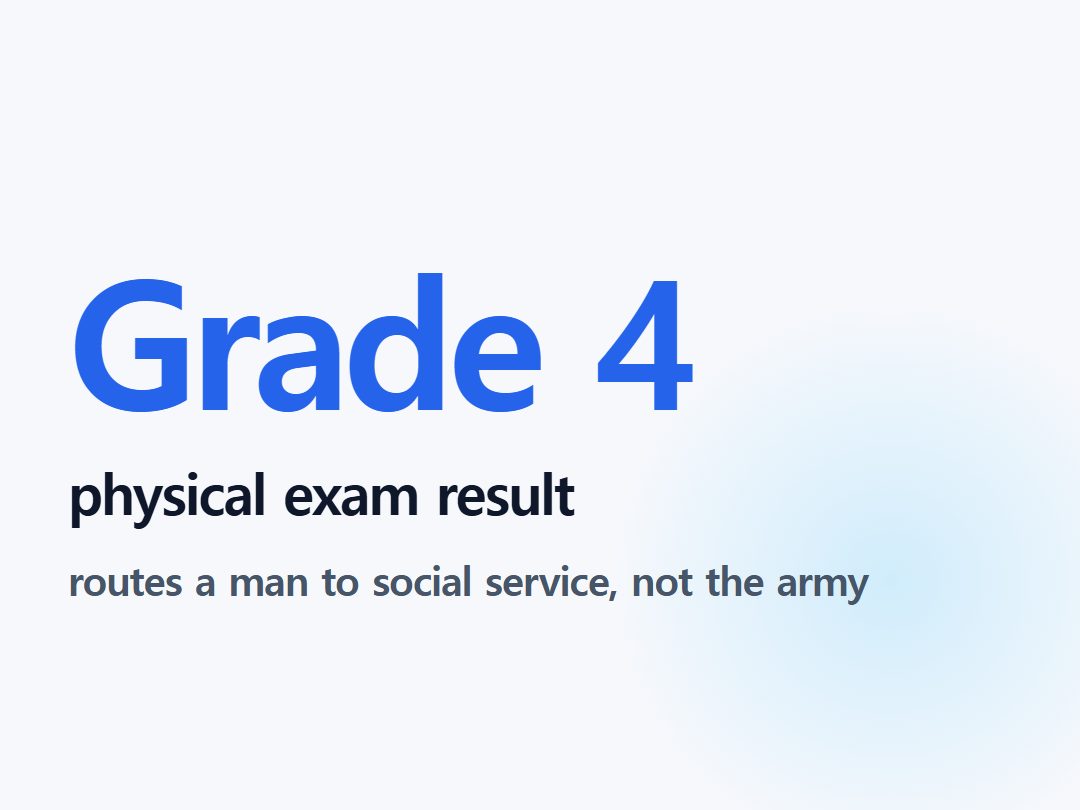
- Grade 4 means fit to work but not fit for combat training.
- Some stars fought to leave social service and join active duty instead.
Military service splits into several different tracks
South Korea requires nearly all able-bodied men to complete national service, typically for 18 to 21 months depending on the branch.
But "military service" in Korean law is not one track — it is several, and which track a man is placed on is decided by a mandatory physical and psychological exam administered by the Military Manpower Administration (MMA), a government agency under the Ministry of National Defense that manages the entire draft process.
Men who pass this exam at the top grades are sent to active duty in the army, navy, air force, or marines.
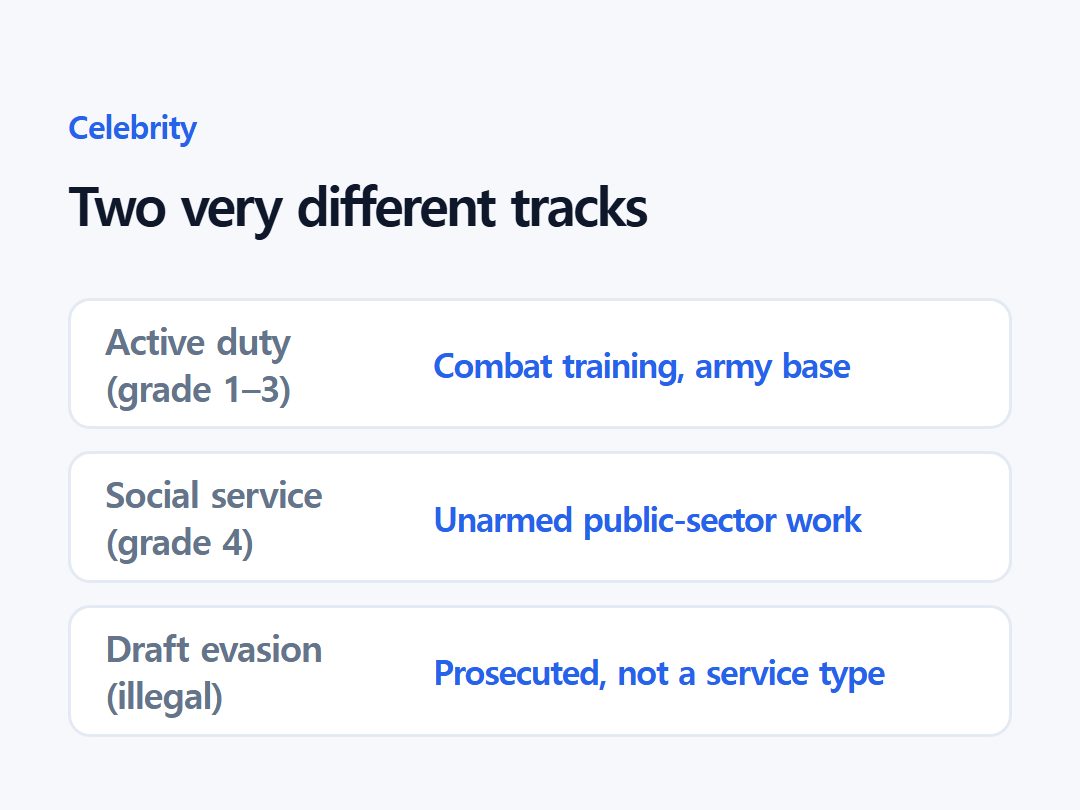
Men who are found fit enough to work but not fit enough for combat training are instead assigned to social service duty: unarmed, non-residential public service posted to city halls, public hospitals, welfare centers, libraries, and similar institutions, generally for 21 months.
Several well-known entertainers — most recently BTS's Suga — have completed their national service this way, and each time, the assignment has drawn public questions rather than simple acceptance.
How does Korea decide who gets social service?
The confusion starts with a fact international readers usually don't know: the grade that decides a man's service type is set by a doctor's exam, not by request, wealth, or fame.
At age 19, every Korean man takes the 병역판정검사 (byeongyeok panjeong geomsa), a day-long physical and mental evaluation that sorts him into a numbered grade. Under South Korea's Military Service Act, grades 1 through 3 are cleared for active duty.
Grade 4 is reserved for men found to have a genuine physical or mental limitation — serious enough to disqualify them from combat training, but not serious enough for a full exemption — and it is grade 4 that routes a man into supplementary service (보충역), of which social service duty is the largest category. Grade 5 leads to a reserve-forces classification, and grade 6 is a full exemption.
This is the core distinction international coverage often flattens: social service duty is not an exemption, and it is not a privilege. It is still compulsory national service, under military law, for the same length of time as many active-duty postings. What differs is the physical demand and the type of work, not the obligation itself.
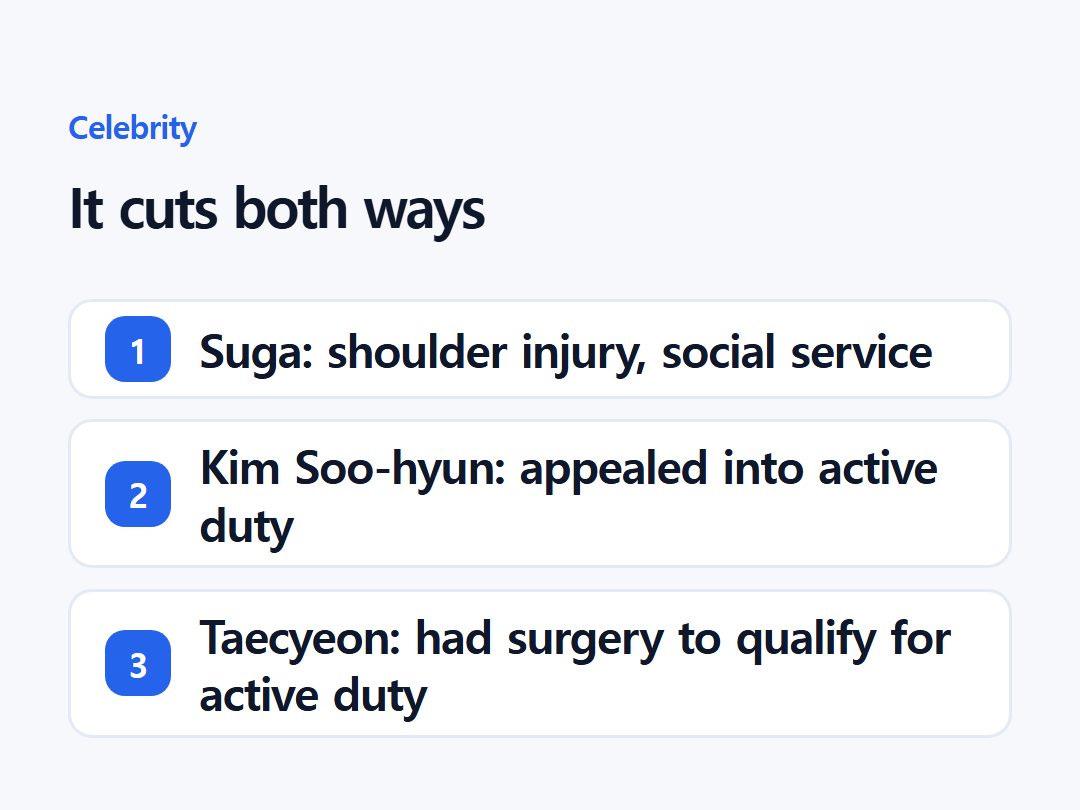
Suga's case illustrates how this plays out. He enlisted on September 22, 2023, and was assigned to social service duty rather than an army base; local Korean outlets linked the decision to a labral tear in his left shoulder that required surgery in 2020.
Big Hit Music never confirmed the specific medical reason, citing artists' right to privacy over personal health records, but did not dispute that the assignment followed the standard MMA exam.
Suga completed his service and was formally discharged on June 21, 2025, becoming the last of BTS's seven members to finish national service.
He was not the first idol to face this scrutiny. Kim Jong Kook, a fitness-focused variety star on shows like Running Man, was assigned to public service duty around his 2006 enlistment because of a chronic spinal condition, later requiring lumbar disc surgery.
Because his physique made the assignment look implausible to the public, he faced years of comments questioning whether he had "dodged" the army — enough that he eventually posted an X-ray of his spine on social media in 2016 to address it directly.
The system also runs in the opposite direction, which underscores that the outcome is medical, not preferential.
Actor Kim Soo-hyun was initially graded a 4 because of childhood heart surgery and placed on the social-service track, but after his condition improved he formally requested a re-examination, was reclassified to grade 1, and served as an active-duty infantryman from 2017 to 2019.
Ok Taec-yeon of 2PM went further still: he gave up the U.S. green card that would have let him skip Korean service entirely, was initially found fit only for social service duty because of a herniated disc, and underwent two rounds of back surgery specifically so a later re-exam would clear him for active duty, which he then completed in 2017–2019.
In both cases, a celebrity actively fought to leave the social-service category, which would make little sense if the category were the easier or more desirable outcome.
It is also worth separating this legal category from genuine draft evasion, because Korean audiences do not conflate the two even when international coverage sometimes does.
Rapper MC Mong was prosecuted in 2010–2012 after prosecutors alleged he had healthy teeth extracted to manipulate his grade; he was ultimately acquitted of that specific charge but convicted on a separate count of using false pretenses to repeatedly delay his enlistment, receiving a suspended sentence.
Singer Yoo Seung-jun (Steve Yoo) took a more drastic route: he acquired U.S. citizenship in 2002, just before his enlistment date, and has been barred from re-entering Korea ever since — a ban Korean courts have called procedurally flawed but that the Justice Ministry has continued to enforce and, as of 2026, is moving to write explicitly into immigration law.
Both cases involve men who tried to escape the system entirely. Neither has anything to do with a documented grade-4 classification.
How celebrity fraud scandals fueled public suspicion
The social service framework has existed in something like its current form since 1995, when it was created as 공익근무요원 ("public-interest service personnel"), replacing an earlier, less formalized system that had been criticized for enabling exactly the kind of favoritism it was meant to prevent.
In 2013, an amendment to the Military Service Act renamed it 사회복무요원 ("social service personnel") and more precisely defined the categories of public-interest work — welfare, health and medical support, education, environment, and safety — that assigned personnel could be posted to.
The renaming did not settle public suspicion, and that suspicion has a specific history.
Korea's entertainment industry has a real track record of military service fraud, not just perceived unfairness: beyond MC Mong's case, the 2000s saw a string of prosecutions involving public figures accused of bribing doctors or falsifying medical records to obtain lower grades.
That history is precisely why a legitimate grade-4 classification for a famous, visibly healthy-looking entertainer still triggers public doubt — Korean audiences have concrete precedent for celebrities gaming the system, even though a documented shoulder tear or a decades-old spinal condition is a different matter entirely, decided by MMA physicians rather than the entertainer or their agency.

A pending lawsuit and a shrinking draft pool
Two threads remain unresolved.
First, Yoo Seung-jun's third lawsuit over his entry ban is still active, with a ruling from the Seoul High Court scheduled for September 4, 2026; the outcome, combined with the Justice Ministry's parallel push to formally codify entry bans for citizenship-based draft evasion, will settle a two-decade legal standoff between Korean courts and the government over how far the state can go to punish evasion after the fact.
Second, South Korea's shrinking birthrate is steadily reducing the pool of draft-age men, and defense officials have said this is pushing the MMA to scrutinize grade-4 and grade-5 classifications more closely across the board — not celebrities specifically, but the system they are assigned through.
If standards tighten, future cases involving public figures are likely to draw even more attention, simply because there will be fewer of them and each one will be checked more carefully.
Which K-pop idols were assigned social service?
| Person | Reason for grade 4 | Final outcome |
|---|---|---|
| Suga (BTS) | Shoulder labral tear (surgery in 2020) | Completed social service duty; discharged June 21, 2025 |
| Kim Jong Kook | Chronic spinal condition | Completed social service duty around his 2006 enlistment |
| Kim Soo-hyun | Childhood heart surgery | Re-examined, reclassified to grade 1, served active duty 2017–2019 |
| Ok Taec-yeon | Herniated disc | Had back surgery, reclassified, served active duty 2017–2019 |
Frequently asked
Is social service duty the same as skipping the military in Korea?
No — it is still compulsory national service under military law, lasting about 21 months. What differs is the physical demand and type of work, not the obligation itself.
Why was BTS's Suga assigned to social service instead of active duty?
Local Korean outlets linked the assignment to a labral tear in his left shoulder that required surgery in 2020, following the standard MMA medical exam. He was discharged on June 21, 2025.
Who decides whether a Korean celebrity does active duty or social service?
The Military Manpower Administration assigns a numbered grade based on a mandatory physical and psychological exam every man takes at age 19 — grades 1–3 go to active duty, and grade 4 routes a man into social service duty.
Sources
Every factual claim above is traceable. We do not translate articles — we gather facts from multiple outlets and write them ourselves.
- Social service personnel — Wikipedia
- Supplementary service in South Korea — Wikipedia
- BTS' Suga to fulfil military service as social service agent, not on active duty — Gulf News
- BTS member Suga begins alternative military service in South Korea — The Hill / AP
- Suga completes military service: army rejoices, BTS now officially seven again — Malay Mail
- Kim Jong Kook Has Had Enough Of People Judging Him For Not Serving In The Military — Soompi
- Kim Soo Hyun Shares How His Improving Cardiac Condition Affects His Enlistment Plans — Soompi
- 2PM's Ok Taecyeon — The Idol Who Voluntarily Gave Up His USA Green Card To Enlist In Korea's Military — Koreaboo
- MC Mong denies draft dodging — The Korea Times
- Korea to Codify Entry Ban on Draft Dodgers Like Steve Yoo — Seoul Economic Daily
- 3rd appeals trial begins for former K-pop star Steve Yoo over visa denial — The Korea Times