
In February 2022, three singers who had spent seven years as members of the girl group GFriend released their first song as a new act called VIVIZ, signed to a different company. In December 2021, two former members of the group IZ*ONE, Ahn Yujin and Jang Wonyoung, debuted again as part of a six-member group called IVE.
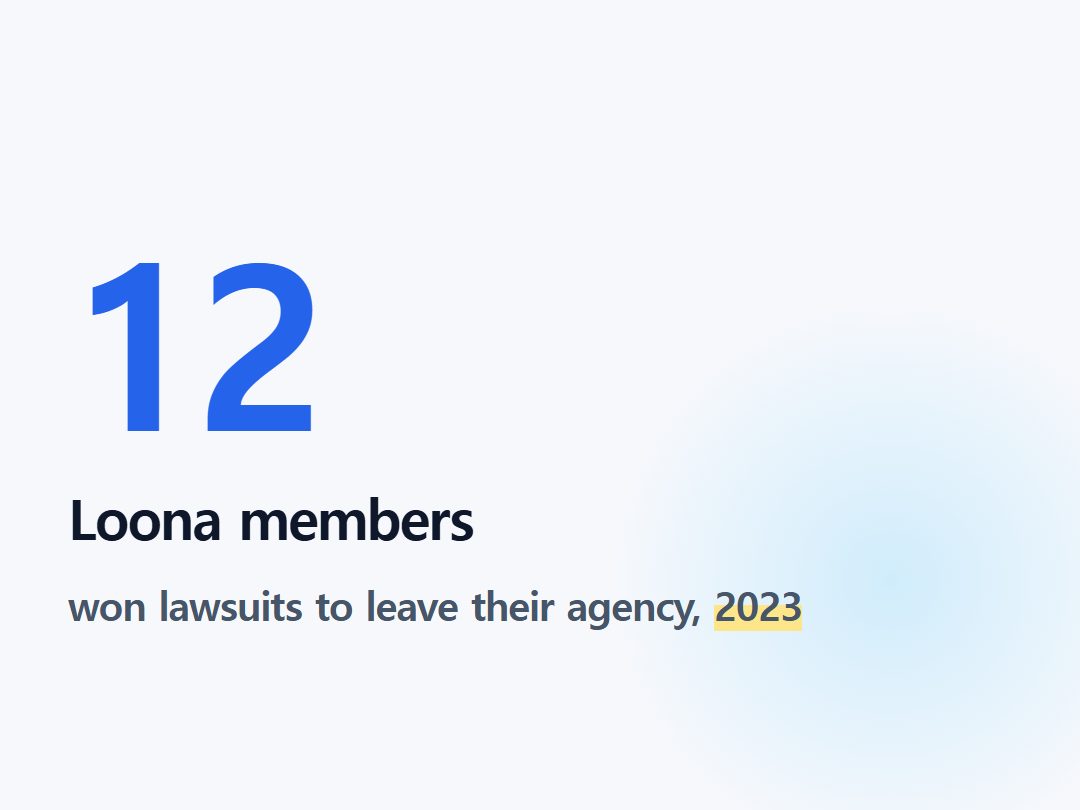
And across 2023 and 2024, all twelve members of the group Loona left their original agency by court order and re-emerged split between two new groups, ARTMS and Loossemble. None of these were treated in Korean coverage as comebacks from failure. They were simply what happens when a contract runs its course.
The short version
- Idols leave groups because agency contracts expire, not because they failed.
- Fair Trade Commission capped exclusive contracts at seven years back in 2009.
- Re-debuting under a new name is a routine, accepted career step in Korea.
This pattern — an idol leaving one group and, months or years later, debuting again in another — is common enough in K-pop to have its own casual shorthand, jaedebwi, or "re-debut." For readers outside Korea, used to bands that either stay intact for decades or split acrimoniously, it can look like a step down, or a sign a career stalled.
For Korean fans, who have watched this cycle repeat across different companies and different idols for close to two decades, it is usually neither.

Why doesn't leaving a group mean failure?
The confusion starts with a structural fact that Western pop rarely has an equivalent for: in the Korean idol system, a performer's contract is with an agency, not with the group.
Companies known as agencies (in Korean, sosoksa) recruit teenagers as trainees, sometimes years before debut, and cover the cost of vocal, dance and language training, styling and living expenses.
Trainees can spend anywhere from months to a decade in this unpaid or minimally paid holding pattern, auditioning internally against label-mates for an eventual debut slot that is never guaranteed.
In exchange for that investment, the trainee who does debut signs an exclusive contract binding them to the company for a set period. A "group" — its name, concept and members — is essentially a product the agency builds using trainees under contract to it.
The person and the group are not permanently fused; the person's actual, ongoing legal obligation is to the company, not to the four or five people they happen to be performing alongside.
That distinction matters because it means a contract can end — through expiry, non-renewal, an agency's business decision, or a legal dispute — without the idol having done anything wrong.
Korea's Fair Trade Commission has capped the standard length of these exclusive contracts at seven years since 2009, so idol groups routinely reach a contractual checkpoint around their seventh anniversary, nicknamed the "seven-year itch" in fandom, at which members and agency either renew or part ways.
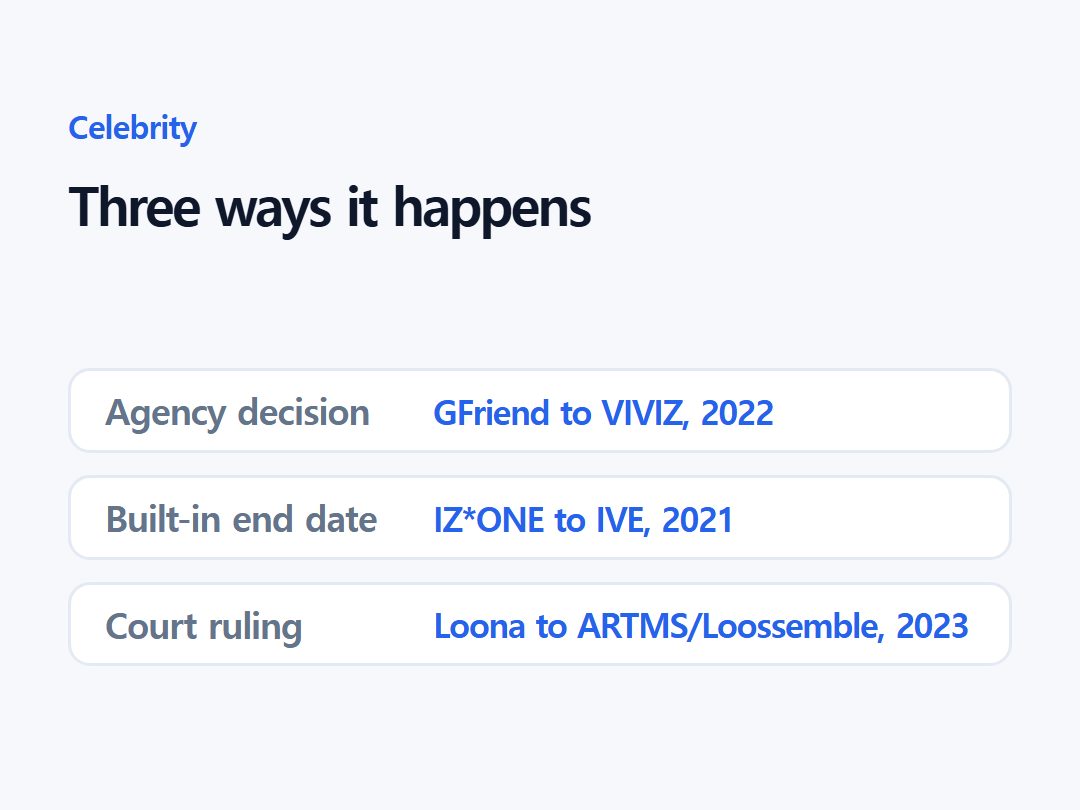
The three examples above show the range of ways that split can happen, none of which imply failure.
GFriend was still an actively charting group when its agency, Source Music, announced its disbandment in May 2021, even though members reportedly had time left on their contracts; SinB, Eunha and Umji simply signed with a new label, Big Planet Made, and returned eight months later as VIVIZ.
IZ*ONE was what the industry calls a project group — a group whose end date is fixed before it even debuts, usually because it's assembled from contestants on a competition show and its members remain under their original, separate agencies the whole time.
IZ*ONE's contract was always going to end in April 2021; when it did, Yujin and Wonyoung simply resumed activity at their home agency, Starship Entertainment, which built IVE around them.
Loona's case was more contentious: members sued their agency, BlockBerry Creative, arguing it had transferred part of their contracts to a Japanese company without consent, and South Korean courts ruled in the members' favor between January and June 2023, freeing all twelve to sign elsewhere.
In each case, Korean entertainment coverage described the outcome in neutral, procedural language — contract terminated, group disbanded, new label confirmed — rather than the language of comeback narratives common in Western pop media, where a former member's new project is often framed as redemption or reinvention after decline.
That framing gap is the real thing international readers are missing: a re-debut is not evidence that the first group failed. It is closer to an employee's contract lapsing and them taking a new job — unremarkable in itself, and telling you nothing about how well they performed at the last one.
Where did K-pop's seven-year contract rule start?
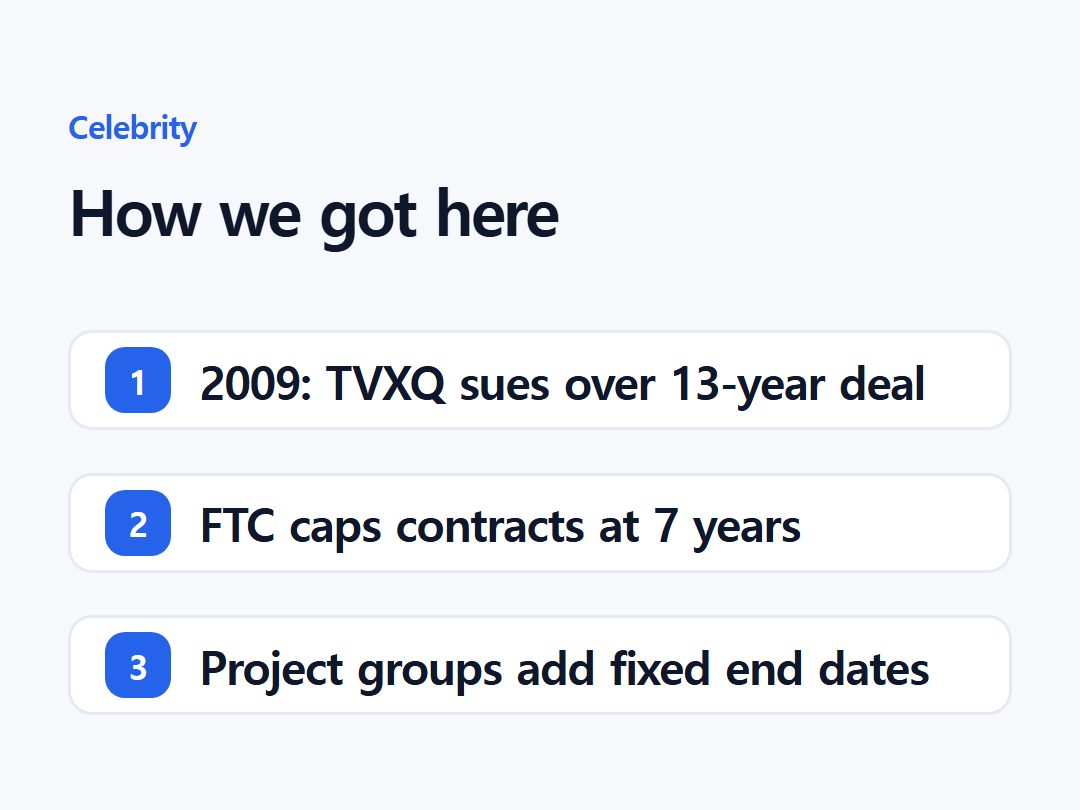
The seven-year rule that shapes this cycle has a specific origin. In July 2009, three members of the group TVXQ — Kim Jaejoong, Park Yoochun and Kim Junsu — sued their agency, SM Entertainment, to void a contract that bound them for thirteen years.
A Seoul court granted a partial injunction that October, and the three went on to form a new group, JYJ, under a different company the following year, while SM continued TVXQ with its two remaining members.
The lawsuit was eventually settled in 2012 with no final verdict, but its public fallout pushed Korea's Fair Trade Commission to introduce a standardized contract template later in 2009 that capped exclusive terms at seven years, with further protections added in a 2017 revision.
That template turned what had been ad hoc, company-by-company negotiations into a predictable cycle that every idol group now operates inside.
The idea of an idol re-debuting under a new name is older than that cycle, though. HyunA debuted with Wonder Girls in February 2007, left the group months later after her family raised concerns about her health, joined Cube Entertainment, and debuted again with 4Minute in June 2009 — a full decade before re-debuts became a routine talking point in English-language K-pop coverage.
What changed the scale of the phenomenon was the rise of the project group format from around 2016 onward.
Survival shows such as Produce 101 assembled temporary groups — I.O.I, Wanna One, X1, IZ*ONE — from trainees who remained contracted to their original, separate companies throughout, with a promotional period and an end date fixed before the group ever performed.
This built scheduled re-debut directly into the format: fans knew from day one that when the clock ran out, members would return to their original agencies and very possibly debut again elsewhere, as Yujin and Wonyoung did with IVE.
Loona's 2023 court rulings added a further precedent, establishing that idols could legally compel an early exit if an agency violated the terms of their contract, not just wait out a full term.
More groups near renewal as rules tighten in 2026
Two things keep this cycle moving. First, more groups that debuted in the late 2010s are approaching or have already passed their own seven-year mark, meaning more renewal-or-depart decisions, and potentially more re-debuts, are effectively already scheduled.
Second, regulators keep revising the underlying contract templates: South Korea's Ministry of Culture, Sports and Tourism issued an updated standard contract for trainees effective January 1, 2026, adding clearer payment deadlines after contract termination, expanded protections for minors, mandatory access to mental health support, and stricter financial-transparency requirements for agencies.
None of this guarantees a re-debut will succeed — Loossemble, the group HyunJin, Yeojin, Vivi, Go Won and Hyeju formed after leaving Loona, itself parted ways with its label in November 2024, just over a year after debuting.
What the pattern does establish is that leaving a group and starting again elsewhere is a recognized, functioning exit ramp in the Korean idol system, not a last resort.
How three idol groups split and re-debuted
| Original group | New group(s) | Reason for split | Re-debut date |
|---|---|---|---|
| GFriend | VIVIZ | Agency (Source Music) disbanded the group | February 2022 |
| IZ*ONE | IVE | Project group's fixed end date (April 2021) | December 2021 |
| Loona | ARTMS and Loossemble | Court ruled in members' favor in contract dispute | 2023–2024 |
Frequently asked
Why do K-pop idols leave their group?
Their exclusive contract is with the agency, not the group, so it can end through expiry, non-renewal, an agency's business decision, or a legal dispute without the idol having done anything wrong.
What does jaedebwi (re-debut) mean in K-pop?
It's the casual fan shorthand for an idol debuting again in a new group after leaving a previous one, a common cycle in Korea that isn't treated as a comeback from failure.
Why do K-pop contracts last seven years?
After TVXQ members sued their agency in 2009 over a 13-year contract, Korea's Fair Trade Commission introduced a standardized contract template that capped exclusive terms at seven years.
Sources
Every factual claim above is traceable. We do not translate articles — we gather facts from multiple outlets and write them ourselves.
- JYJ and S.M. Entertainment end three-year legal spat — The Korea Herald
- The 7-year jinx: K-pop bands with contracts expiring soon — The Korea Herald
- Disbandment not the end: GFriend members to redebut as Viviz — The Korea Herald
- New Girl Group VIVIZ With Former GFRIEND Members SinB, Eunha, And Umji To Debut In February — Soompi
- Watch: Starship's New Girl Group IVE Makes Highly-Anticipated Debut With Enchanting "ELEVEN" MV — Soompi
- Court severs Loona's contracts with agency BlockBerry Creative — Korea JoongAng Daily
- Loossemble End Contract With CTDENM Label A Year After K-Pop Re-Debut — Forbes
- Korea to revise standard trainee contracts to strengthen rights protections — allkpop
- Hyuna — Wikipedia