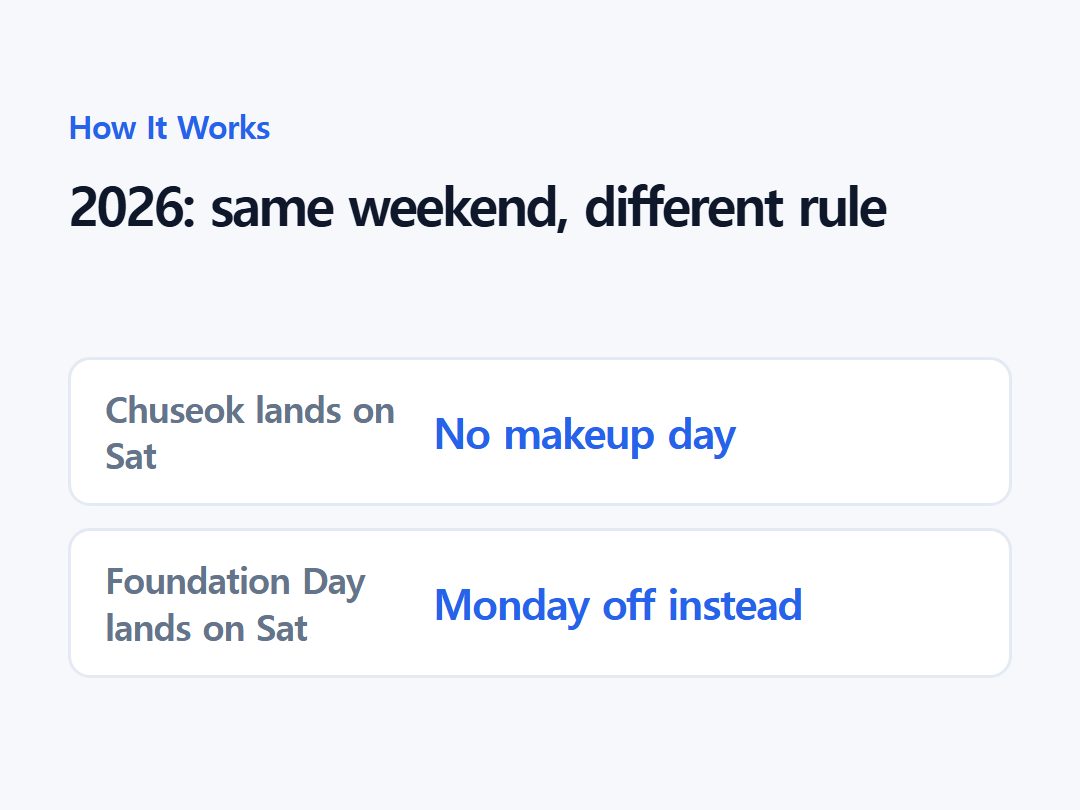
Check Korea's 2026 holiday calendar and something looks like a mistake. Chuseok, the autumn harvest holiday, runs Thursday through Saturday, September 24–26 — and the Saturday buys no extra day off. Twelve days later, National Foundation Day falls on Saturday, October 3, and it does: Monday, October 5 becomes a paid holiday instead.
The short version
- Chuseok's Saturday-ending run gets no substitute day; National Foundation Day's Saturday does.
- About 3 million small-workplace employees have no legal claim to it.
- The rule has been rewritten at least four times since 2013.
Both are weekend overlaps on the same calendar, six days apart, handled by two different rules. The mechanism is called daecheegonghyuil (대체공휴일) — the substitute holiday system — and it does not treat every holiday the same way.
For a visitor planning travel around Korean holidays, or a foreign employer trying to work out which Mondays their Korean staff actually have off, that inconsistency is not a rounding error. It is written into the law on purpose, and it has been rewritten at least four times since 2013.
Three tiers, and most confusion lives in tier two
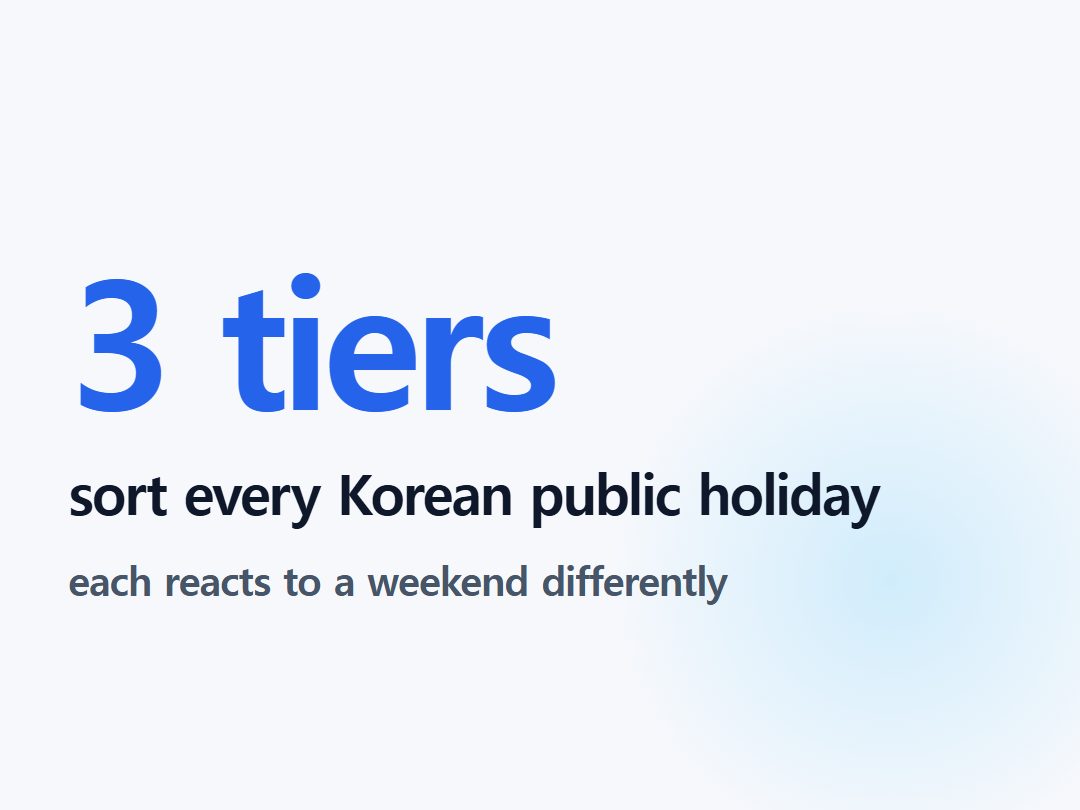
The system runs on a presidential decree, the Regulation on Public Holidays of Public Offices, not one blanket law. It sorts Korea's holidays into three tiers, and each tier reacts to a weekend differently.
| Tier | Holidays | Weekend trigger |
|---|---|---|
| 1 | 4 national days, Children's Day, Buddha's Birthday, Christmas | Saturday or Sunday |
| 2 | Seollal, Chuseok | Sunday only |
| 3 | New Year's Day, Memorial Day | Never |
The 4 national days are Independence Movement Day, Liberation Day, National Foundation Day, and Hangeul Day — the only holidays Korean law formally classifies as gukyongil (국경일), a narrower legal category than an ordinary public holiday.
Why a Saturday Chuseok gets nothing, but a Saturday National Foundation Day does
Seollal and Chuseok sit in tier two: a substitute day only appears if the holiday run collides with a Sunday, not a Saturday. In 2026, Chuseok's three legal holiday days land Thursday to Saturday, so a Sunday never enters the collision — no substitute is issued, even though the run ends on a weekend day.
National Foundation Day is tier one, so a Saturday landing is enough on its own. Because October 3, 2026 falls on Saturday, the next available weekday, October 5, becomes the substitute — producing a three-day break where Chuseok's calendar produced none.
Two different reasons landed the same two holidays outside the system
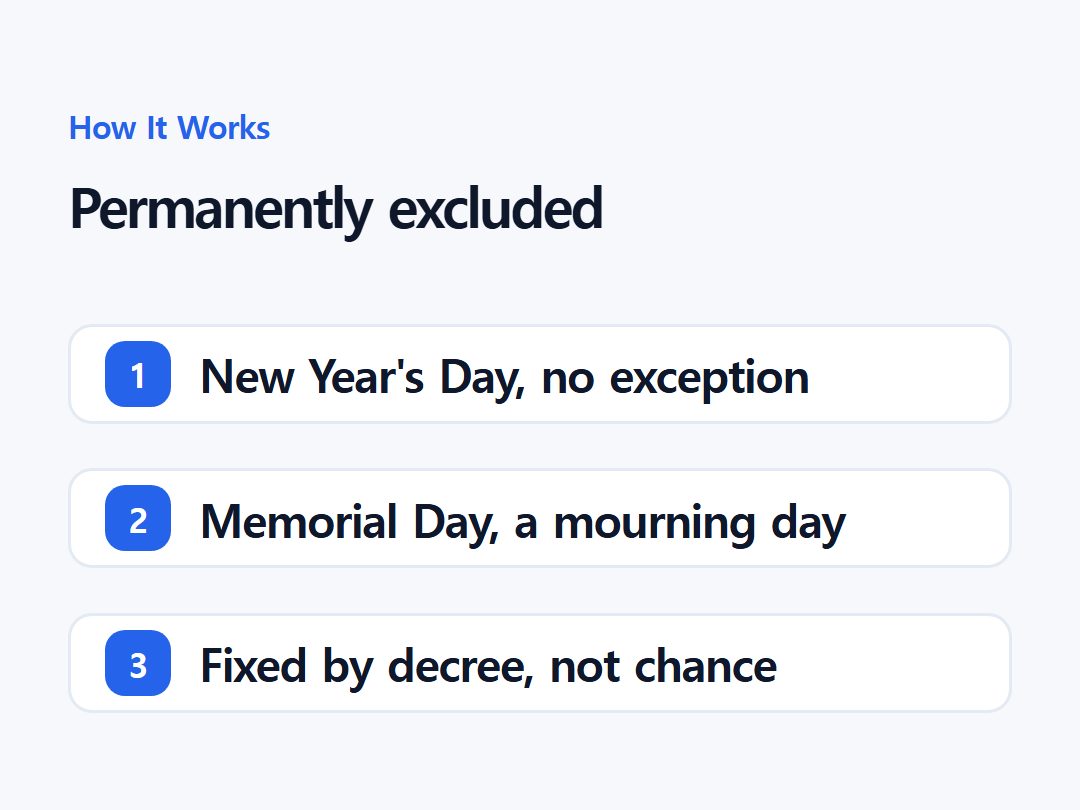
New Year's Day and Memorial Day never get a substitute, regardless of the weekday they fall on — but they were excluded for different reasons. New Year's Day was simply never classified as a gukyongil, so it fell outside the category the substitute system was originally built to protect.
Memorial Day, observed June 6 for South Korea's war dead, is legally a day of national mourning rather than a national day. Officials and commentators have argued that shifting a memorial observance onto whichever weekday happens to be free defeats the point of marking a fixed date.
In 2026, Memorial Day falls on a Saturday — under tier-one rules that would trigger a Monday substitute, but because it sits in tier three, the day off is simply lost, and the calendar shows nothing in its place.
A 1959 law that lasted only a few years
The idea is not new. Korea first introduced a substitute holiday rule in 1959, then abolished it not long after — it stayed dormant for over five decades. The revival became a campaign issue because Korea's biggest holidays, Seollal and Chuseok, are multi-day family gatherings built around travel; losing a day of that window to a weekend felt different from losing an ordinary single-day holiday.
- 2013 — revived as a campaign pledge of President Park Geun-hye, but limited to Seollal, Chuseok, and Children's Day
- 2013 rule — a substitute only applied if one of those three landed on a Sunday
- September 10, 2014 — the first substitute holiday under the revived system, the day after that year's Chuseok
The 2021 rewrite added four national days — and drew a business line
The National Assembly passed a broader bill on June 29, 2021, explicitly framed as pandemic-recovery support for workers' rest and wellbeing. It added the four gukyongil — Independence Movement Day, Liberation Day, National Foundation Day, Hangeul Day — to the substitute system for the first time.
Buddha's Birthday and Christmas were deliberately left out. The Ministry of Personnel Management said at the time it was excluding them "in consideration of extra burdens on the management of small and medium-sized businesses," after the Korea Federation of Small and Medium Business warned the change would "disrupt corporate production due to lack of working hours and lead to rapid increase in labor costs."
Buddha's Birthday and Christmas crossed that line in 2023
Two years later, the government reversed that part of the compromise. A Cabinet meeting chaired by President Yoon Suk Yeol finalized substitute-holiday status for Buddha's Birthday and Christmas in May 2023.
Personnel Management Minister Kim Seung-ho framed the change as a way to "ensure the right to sufficient rest for workers, prop up consumption and improve the domestic economy." New Year's Day and Memorial Day were on the same shortlist the ministry said it would review — neither has been added since.
Not every employee actually gets the makeup day
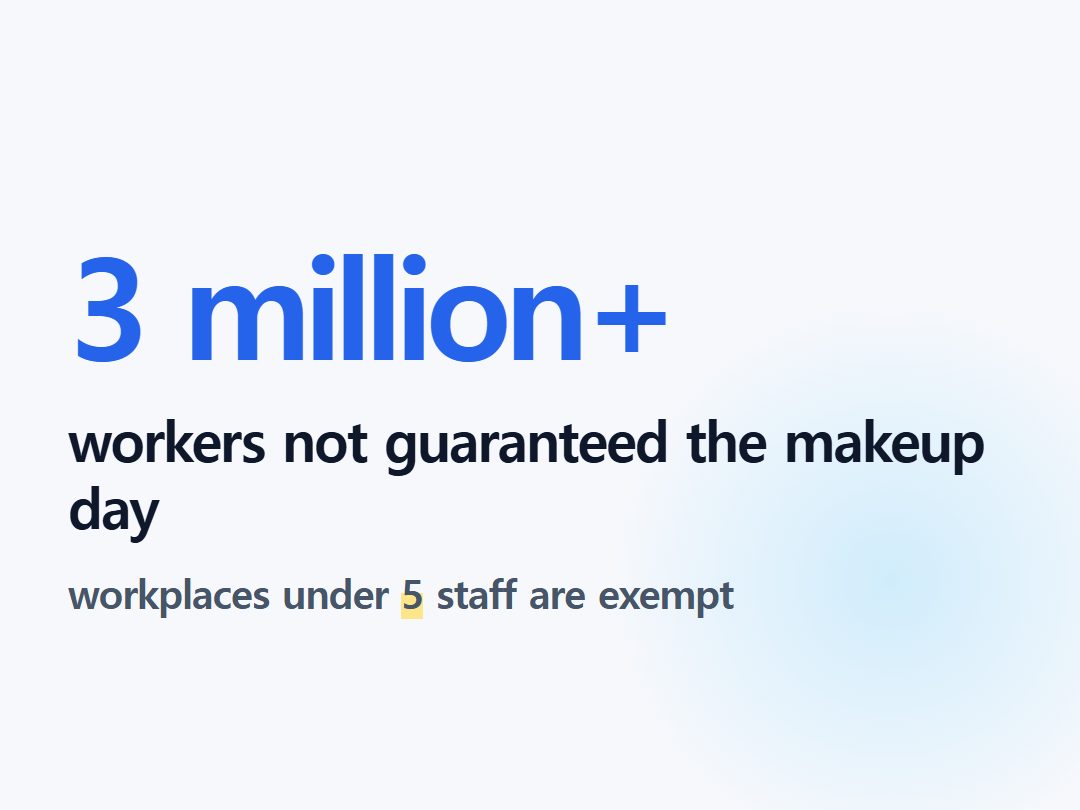
Even a holiday that qualifies for a substitute doesn't guarantee every worker a paid day off. Article 55 of the Labor Standards Act exempts workplaces with fewer than five regular employees from the requirement to treat public and substitute holidays as paid leave.
The gap is not small. Roughly 2.98 million insured workers — and likely over 3 million once uninsured small businesses are counted — work at companies below that threshold, which make up 67.7% of all Korean workplaces.
The Korea Labor Institute has flagged the size-based cutoff as a possible equality problem, since two employees doing identical work can lose or keep a paid holiday depending only on their employer's headcount.
Buddha's Birthday in 2026 is a direct example. It falls on a Sunday, triggers a tier-one substitute, and gives most of the country Monday, May 25 off — but reporting on that same substitute holiday singled it out as the case that leaves an estimated 3 million small-workplace employees with no legal claim to the extra day at all.
How Korea's fix compares with Japan's
Placed next to its neighbors, Korea's system sits in the middle of a regional spread rather than at either extreme.
- Japan, Hong Kong, and Singapore grant a substitute only when a holiday lands on a Sunday — a Saturday holiday simply disappears, with no makeup at all
- Vietnam and Thailand cover both Saturday and Sunday overlaps, closer to Korea's tier-one rule
- Korea splits the difference by holiday type: tier one matches Vietnam and Thailand, tier two matches Japan
Japan also took a different structural route for four of its holidays, permanently rescheduling them to a fixed Monday under its 1998–2001 Happy Monday System, rather than patching collisions after the fact.
That trade swaps Korea's unpredictable substitute weekday — which can land on a Monday, Tuesday, or later depending on how a multi-day holiday like Chuseok falls — for a guaranteed three-day weekend on a fixed schedule.
What's still unresolved
In its 2023 planning report, the Ministry of Personnel Management said it would consider extending substitute-holiday status to New Year's Day and Memorial Day, alongside the Buddha's Birthday and Christmas changes it did make that year. No further expansion has followed.
The small-workplace exemption remains the more consequential open question: as long as Article 55's five-employee line stands, a holiday's tier only decides who gets an extra day off on paper — not who actually gets to take it.
How Korea's substitute holiday law expanded, 1959–2023
| Year | What changed |
|---|---|
| 1959 | Substitute holiday rule introduced, then abolished within a few years |
| 2013 | Revived as a campaign pledge — limited to Seollal, Chuseok, and Children's Day, triggered only by a Sunday |
| September 10, 2014 | First substitute holiday granted under the revived system |
| June 29, 2021 | National Assembly added the 4 national days (gukyongil) to the system |
| May 2023 | Buddha's Birthday and Christmas added |
Frequently asked
Why didn't Chuseok get a substitute holiday in 2026?
Chuseok is a tier-two holiday, so a substitute day only appears if the holiday run collides with a Sunday — in 2026 it runs Thursday to Saturday, so no Sunday is involved.
Does every company have to give the substitute holiday as paid leave?
No — Article 55 of the Labor Standards Act exempts workplaces with fewer than five employees, a group that makes up 67.7% of all Korean workplaces.
Why don't New Year's Day and Memorial Day get substitute holidays?
New Year's Day was never classified as a gukyongil, and Memorial Day is legally a day of mourning rather than a national day, so both sit outside the substitute system no matter what weekday they fall on.
Sources
Every factual claim above is traceable. We do not translate articles — we gather facts from multiple outlets and write them ourselves.
- Korean Public Holidays 2026–2027: Dates and Substitute Days — Korea Toolbox
- [Newsmaker] Buddha's Birthday, Christmas to be excluded from alternative holidays — The Korea Herald
- Buddha's Birthday, Christmas to be given alternative holidays — The Korea Herald
- 3 Million Korean Workers Excluded from Buddha's Birthday Substitute Holiday — Seoul Economic Daily
- 관공서의 공휴일에 관한 규정 — Korea Ministry of Government Legislation, National Law Information Center
- 2026년 개천절 날짜 - 10월 3일 국경일·대체공휴일 안내 — dallyeok.com
- 2026 추석 연휴 며칠? 9월 24~27일 4일·대체공휴일 없는 이유 — Wikidocs Blog
- Happy Monday System — Wikipedia