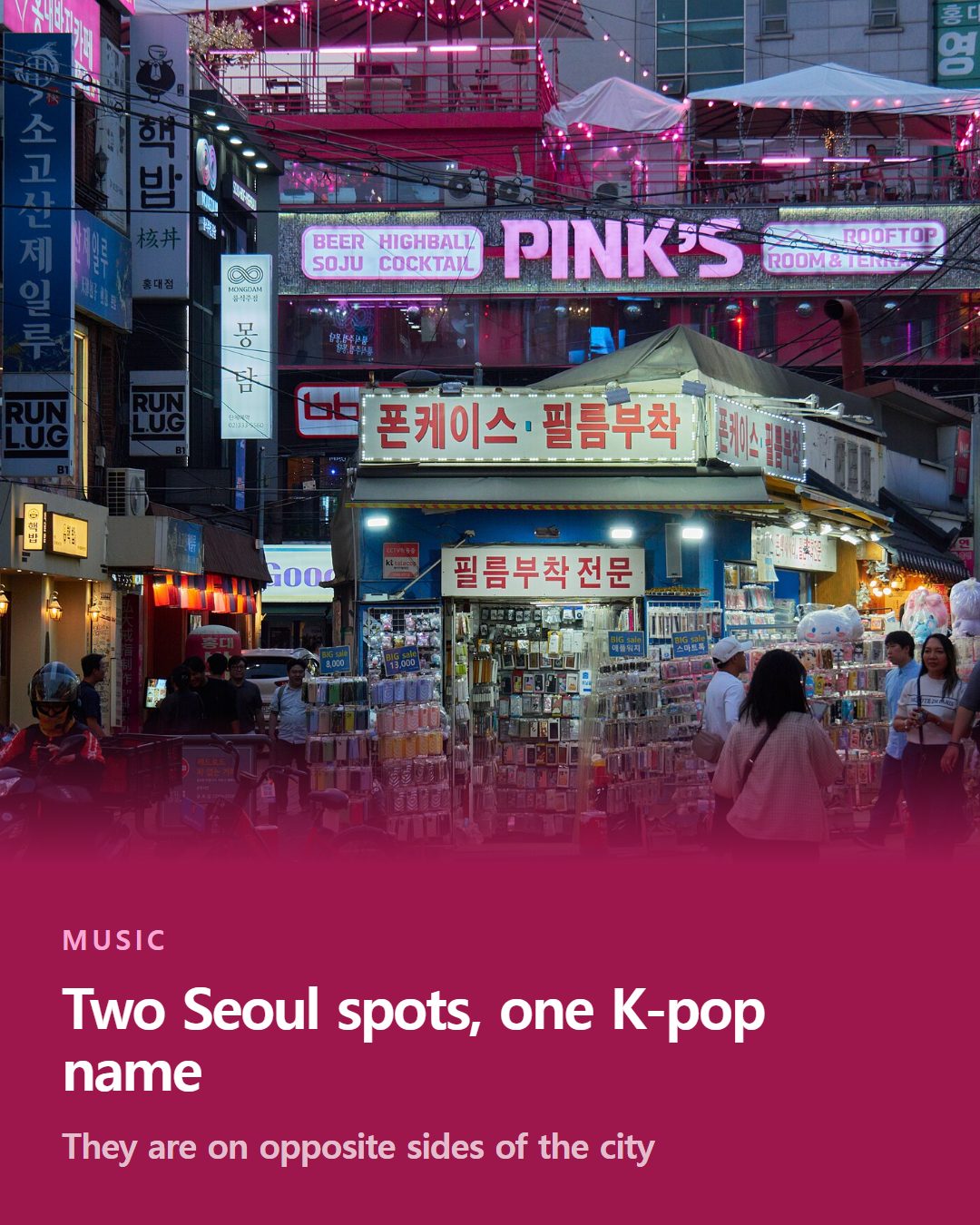
International fans who watch year-end K-pop coverage eventually notice the pattern: MAMA in November or December, the Melon Music Awards a few weeks later, the Golden Disc Awards in January, the Seoul Music Awards somewhere in between. The same groups often show up at all of them, sometimes winning at one and losing at another in the same season.
The short version
- Four major K-pop award shows are each owned by a different media company.
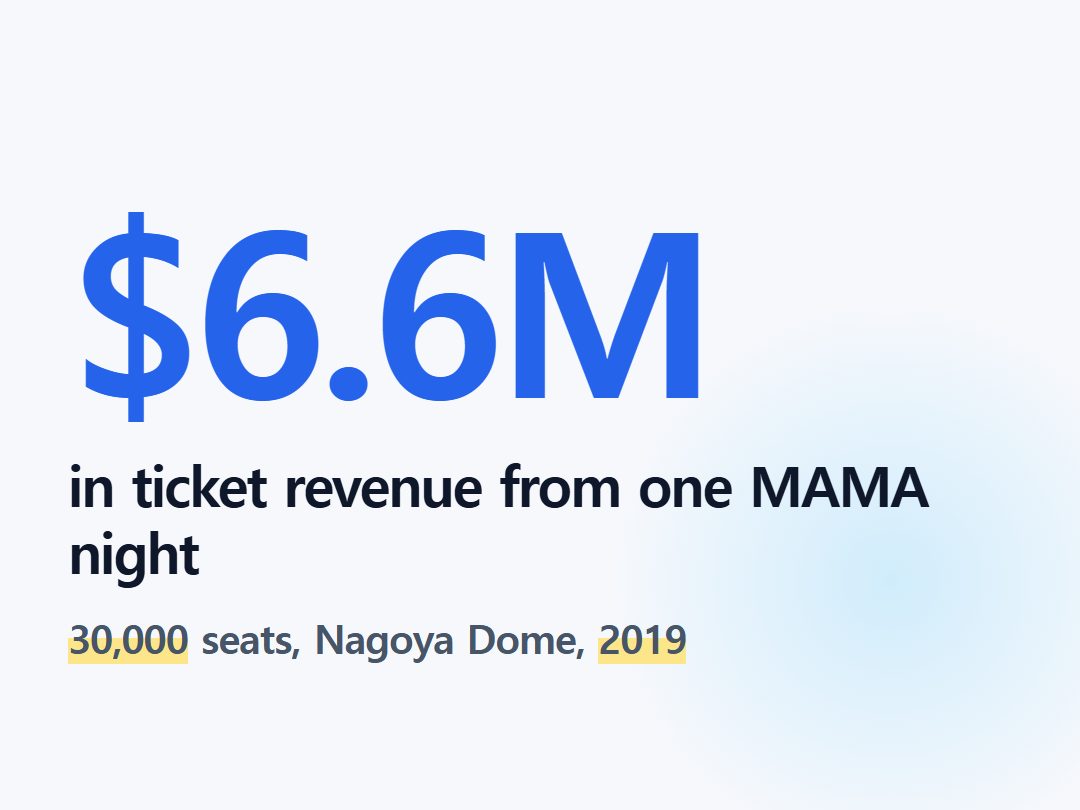
- MAMA's 2019 Nagoya Dome show alone earned CJ ENM about $6.6 million.
- KMCA canceled its own show, saying awards were traded for performances.
The natural assumption is that these shows are competing for the same title — that one of them is the "real" ranking and the rest are also-rans. That assumption is wrong. Each show is a separate business owned by a different company, and each one profits from running its own ceremony regardless of what any other show decides.
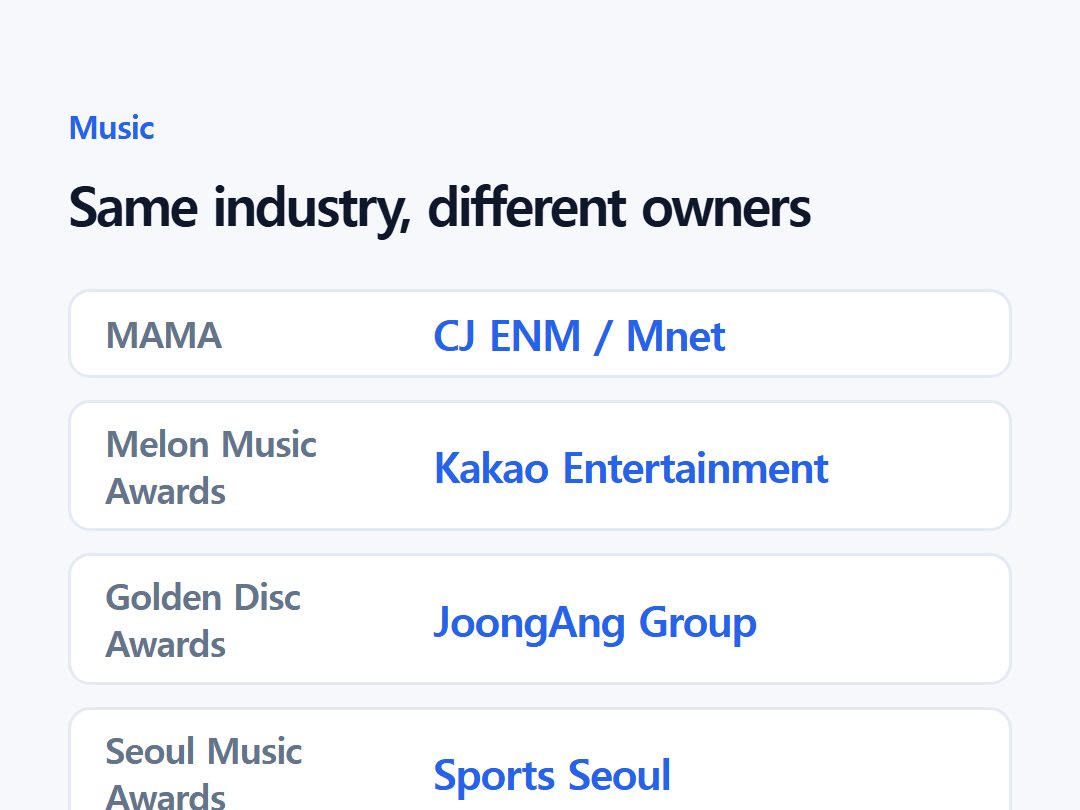
MAMA, Melon, Golden Disc: three different companies' shows
MAMA is produced by CJ ENM through its cable channel Mnet. The Melon Music Awards belongs to Kakao Entertainment, built around its Melon streaming service. The Golden Disc Awards is presented by JoongAng Group and airs on its broadcaster, JTBC. The Seoul Music Awards comes from the newspaper Sports Seoul.
| Show | Owner | First held |
|---|---|---|
| MAMA Awards | CJ ENM (Mnet) | 1999 |
| Golden Disc Awards | JoongAng Group (JTBC) | 1986 |
| Melon Music Awards | Kakao Entertainment | 2009 |
| Seoul Music Awards | Sports Seoul | 1990 |
None of these four companies answers to the others. There is no governing body that sits above them and declares an overall winner of the year, the way, say, a national film board might oversee a country's film awards.
Every show is owned by the network that airs it
This is the piece Korean fans take for granted and international fans usually miss: a Korean award show is not a neutral judging body that a broadcaster simply covers. The broadcaster is the organizer. MAMA exists because it is valuable programming for Mnet — it fills a night of television, drives app downloads, and generates ad sales, all owned end-to-end by CJ ENM.
The same logic applies to the others. Melon runs the MMA to keep artists, labels, and fans engaged with its streaming app during a season when a competing platform could otherwise pull them away. JTBC keeps the Golden Disc Awards because JoongAng Group bought the rights to host it in 2022, after longtime organizer Ilgan Sports was sold off to a different conglomerate.
In other words, a K-pop award show is closer to a branded television special that a media company owns outright than to an independent academy vote. Winning MAMA does not make an act better than whoever won the Golden Disc — it means CJ ENM's data and CJ ENM's judges liked that act's year.
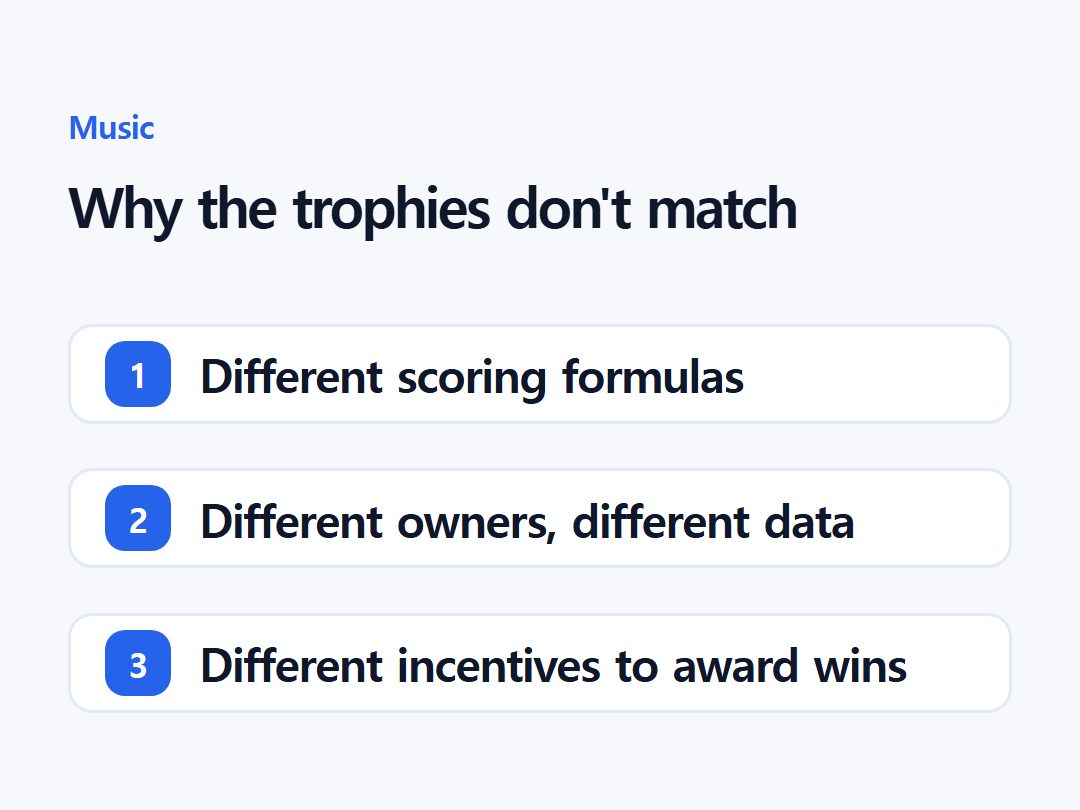
The math behind each trophy is different
Because each show is run by a different company, each one also uses different data to decide winners — usually data the parent company already owns.
- MAMA's Artist of the Year mixes a judging panel (40%), streaming (30%), and album sales (30%).
- The Melon Music Awards leans on Melon's in-house chart data and, from 2026, a new joint "Global-K Chart" built with Tencent Music and Line Music.
- The Golden Disc Awards has historically weighted physical and digital sales data most heavily, only adding a broader Artist of the Year category more recently.
A group can therefore top the sales-driven Golden Disc while losing the streaming-and-vote-driven MAMA in the same season, without either result being "wrong." They are not measuring the same thing.

Selling out a dome in Japan is part of the business model
The clearest evidence that these are businesses first is where they are held. MAMA has staged ceremonies in Hong Kong, Japan, and elsewhere outside Korea for over a decade, and the reason is straightforward: overseas fans will pay for tickets that Korean broadcast law and market size cannot replicate at home.
When MAMA was held at Nagoya Dome in 2019, all roughly 30,000 seats sold out at about 238,670 won (roughly $220) each, with an additional red-carpet ticket around 54,630 won (about $50). That single night is estimated to have brought in over 7.1 billion won — roughly $6.6 million — to CJ ENM. The Golden Disc Awards has run the same playbook, holding ceremonies in Osaka in 2012 and Kuala Lumpur in 2013.
The voting app earns money before a single vote counts
Fan voting adds a second revenue layer. Mnet's own voting app, Mnet Plus, lets users earn extra voting credits by checking in daily, watching short video clips, and — for some voting periods — watching advertisements in exchange for points that can be spent on votes.
None of this is unique to MAMA; most of the major shows run comparable apps or point systems. The effect is the same across the industry: a vote is rarely just a vote. It is also an ad impression, an app session, or a data point the platform can reuse elsewhere, such as CJ ENM using MAMA's regional voting patterns to help choose host cities for its KCON fan conventions.
Two of the biggest shows started as newspaper promotions
The multiplicity is not a streaming-era invention. The Golden Disc Awards began in 1986 as the Korea Visual and Records Grand Prize Award, organized by the sports daily Ilgan Sports — a newspaper, not a broadcaster — as a way to promote its own coverage of the music industry. It was renamed the Golden Disk Awards in 2001 and restyled to Golden Disc in 2015.
The Seoul Music Awards followed the same pattern in 1990, launched by the rival newspaper Sports Seoul. Korea's award-show landscape was, from the start, a way for media companies — first print, later cable and streaming — to compete with each other for cultural relevance, not a single institution that later fractured.
A city government pulled its name off one show in 2016
The Seoul Music Awards briefly carried the Seoul Metropolitan Government's name as a co-sponsor. That ended in 2016, after backlash over an unpaid "volunteer" staffing call for the ceremony drew public complaints to City Hall. Officials withdrew sponsorship and barred further use of the city's logo within days, though Sports Seoul kept the show running under new commercial sponsors.
The episode is a small but telling example of how fragile these partnerships are: a show's backers can change, but the underlying business — a media company staging an annual ceremony around its own content — continues regardless.
In 2024, the industry's own trade group canceled its own show
The clearest sign that the system has strained even insiders came from the Korea Music Content Association (KMCA), the trade body representing major labels including HYBE, JYP Entertainment, and SM Entertainment, which also runs its own ceremony, the Circle Chart Music Awards.
In March 2024, KMCA indefinitely postponed that show and said publicly that Korean award ceremonies had "lost their way, giving awards in exchange for performances" — meaning artists were made to feel that skipping a ceremony's stage lineup would cost them a trophy.
KMCA counted roughly 20 K-pop award ceremonies held annually in Korea, with more than five new ones launched in the previous five years alone, and blamed the growth on ticket and appearance revenue rather than artistic merit.
The postponed show still hasn't returned
As of 2026, the Circle Chart Music Awards remains suspended, with no confirmed date, even as KMCA had once planned to host it in Busan through 2026. The other shows — MAMA, Melon, Golden Disc, Seoul Music Awards — have continued on their usual calendars without pause.
That split outcome is itself the unresolved part of the story. A single trade association can withdraw its own ceremony as a protest, but it has no authority to change how CJ ENM, Kakao, or JoongAng Group run theirs, because none of those companies were ever operating a shared system to begin with.
For international fans trying to figure out which trophy "counts," the honest answer is that each one counts only on its own owner's terms.
Who owns Korea's major K-pop award shows
| Show | Owner | First held |
|---|---|---|
| MAMA Awards | CJ ENM (Mnet) | 1999 |
| Golden Disc Awards | JoongAng Group (JTBC) | 1986 |
| Melon Music Awards | Kakao Entertainment | 2009 |
| Seoul Music Awards | Sports Seoul | 1990 |
Frequently asked
Why are there so many K-pop award shows?
Each show — MAMA, Melon Music Awards, Golden Disc, Seoul Music Awards — is owned outright by a different media company, so there is no single body that decides one overall winner.
Which K-pop award show is the most legitimate?
None ranks above the others; MAMA weighs judging panels and streaming, Melon uses its own chart data, and Golden Disc has historically leaned on sales, so they measure different things.
What happened to the Circle Chart Music Awards?
The industry trade group KMCA indefinitely postponed the show in March 2024, saying ceremonies had "lost their way, giving awards in exchange for performances," and as of 2026 it still hasn't returned.
Sources
Every factual claim above is traceable. We do not translate articles — we gather facts from multiple outlets and write them ourselves.
- From MAMA to MMA: Sorting through the alphabet soup of K-pop awards ceremonies — Korea JoongAng Daily
- MAMA Awards — Wikipedia
- Golden Disc Awards — Wikipedia
- Melon Music Awards 2026 Announces Dates And Details — Soompi
- Kakao Entertainment to Introduce Melon K-pop Categories at Tencent... — Asia Economy (Asiae)
- The Korea Music Contents Association takes a stand against proliferation of K-pop awards, postpones Circle Chart Awards — allkpop
- K-Pop Award Shows Prioritize Profit-Making Over Fairness, KMCA Warns Changes Coming — Koreaboo
- Guide to 2025/26 Year-End K-pop Events — Trazy Blog
- Seoul Music Awards — NamuWiki
- Mnet Plus - Entertainment App — MWM App Directory