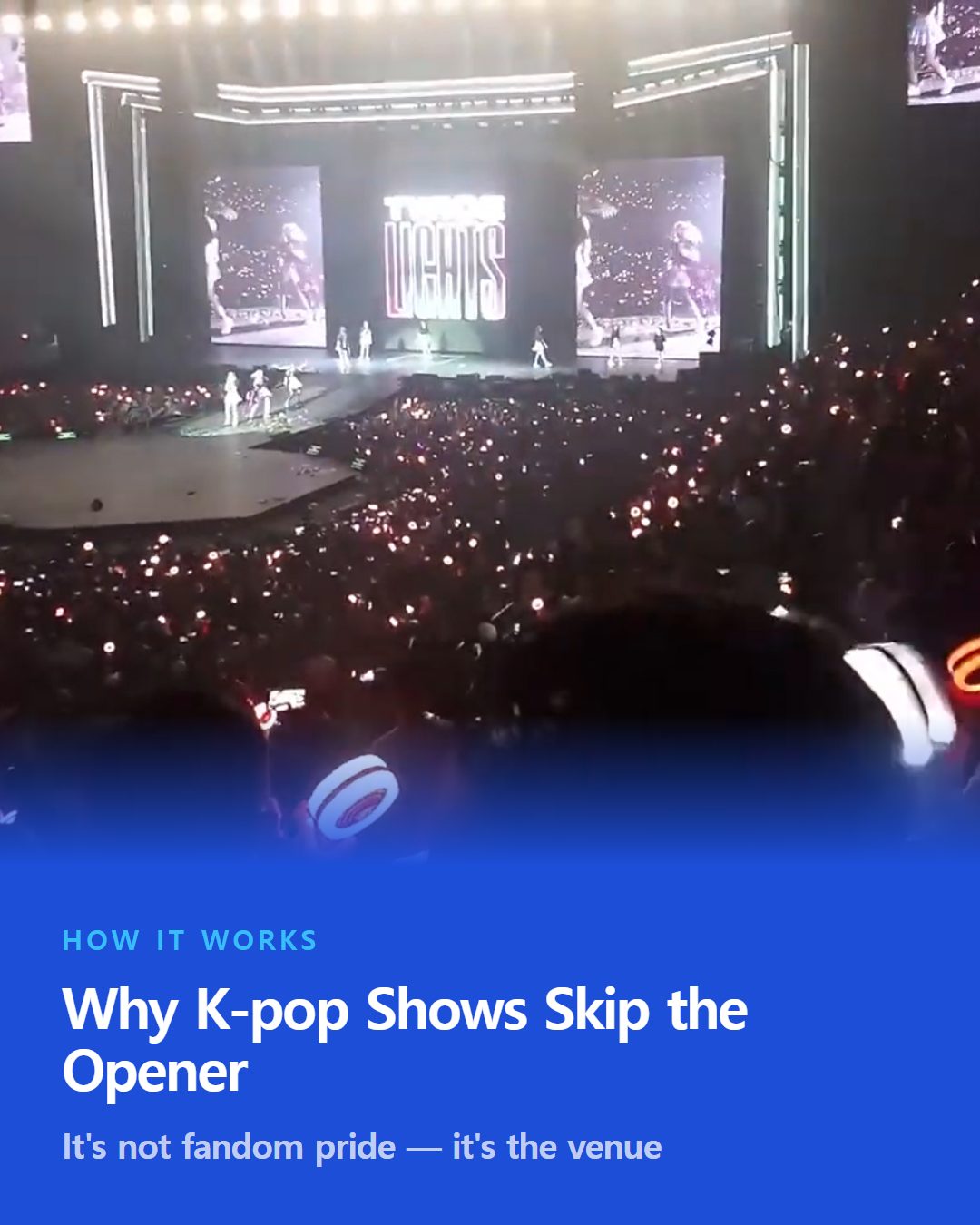
A K-pop arena show starts on the dot. There is no warm-up band, no thirty-minute buffer, no unfamiliar act taking the stage before the headliner appears. For fans used to Western touring, where a mid-tier act or a labelmate usually opens, this can look like an oversight.
The short version
- Korea has too few large venues to spare room for an opening act.
- Numbered tickets remove the early crowd an opener would normally entertain.
- Seoul Arena opens in 2027, but the no-opener ticket format likely stays.
It isn't. The absence of opening acts in Korean K-pop concerts follows directly from how few concert venues Korea has, how those venues get rented out, and how tickets are sold to fill them. Each of those three constraints closes off the same option on its own.
One act owns the full two hours
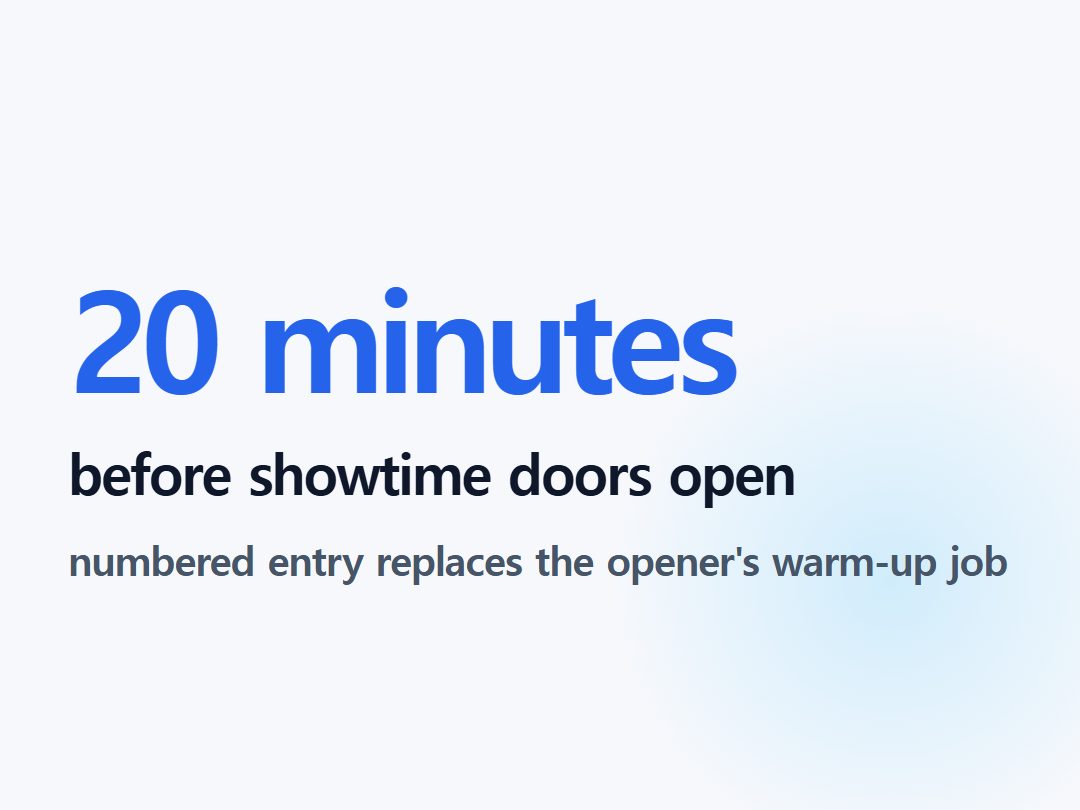
Doors open at the listed time and the show starts then — no cushion for a warm-up act. Fans who arrive late are held in the lobby until the first break between songs, then let in, and shows typically run about two and a half hours before the crowd is let out.
In place of an opener, shows run on "ments" — short breaks where members talk directly to the crowd between songs, sometimes called "encore" segments near the end. Unit stages, where two or three members perform while the rest of the group rests offstage, serve the same purpose.
Both do the pacing work an opening act would otherwise do, just inside the same headliner's set instead of before it.
Seoul doesn't have a room to spare
The deeper constraint is supply. Even Seoul's largest indoor venues are limited: Gocheok Sky Dome and KSPO Dome hold roughly 16,000 and 15,000 seats. Seoul World Cup Stadium is the only venue in the city that can hold more than 50,000, and it largely sits idle over turf-maintenance concerns.
Jamsil Baseball Stadium, one of the few genuinely large options, has been effectively off-limits and isn't expected back until around 2031 because of renovation work that overlaps with the baseball season. Sports events get first claim on what remains, and performance rentals fill whatever dates are left over.
That scarcity has already pushed shows out of the capital altogether. Some international acts have had to book exhibition halls in Goyang and Incheon instead of a purpose-built arena, simply because nothing large enough was free in Seoul. With that little room to spare, there is no spare capacity left over for a second act's production.
A booking is one act's day, repeated
Because rooms are scarce, agencies don't rent a venue for one night and move on — they book a run of dates back to back, and each date is still built around a single act. Lim Young-woong held six shows at KSPO Dome over nine days; NCT 127 booked six shows in the same venue over two weeks; Kim Dong-ryul ran six dates there as well.
Every date in that run is a self-contained rental: load-in, soundcheck, the show, and teardown, cleared in time for the next act — sometimes an entirely different artist — to move in the following morning. There is no slack in that schedule for a second production's gear, crew, and soundcheck to also fit.
Doors open by number, not by who waited longest
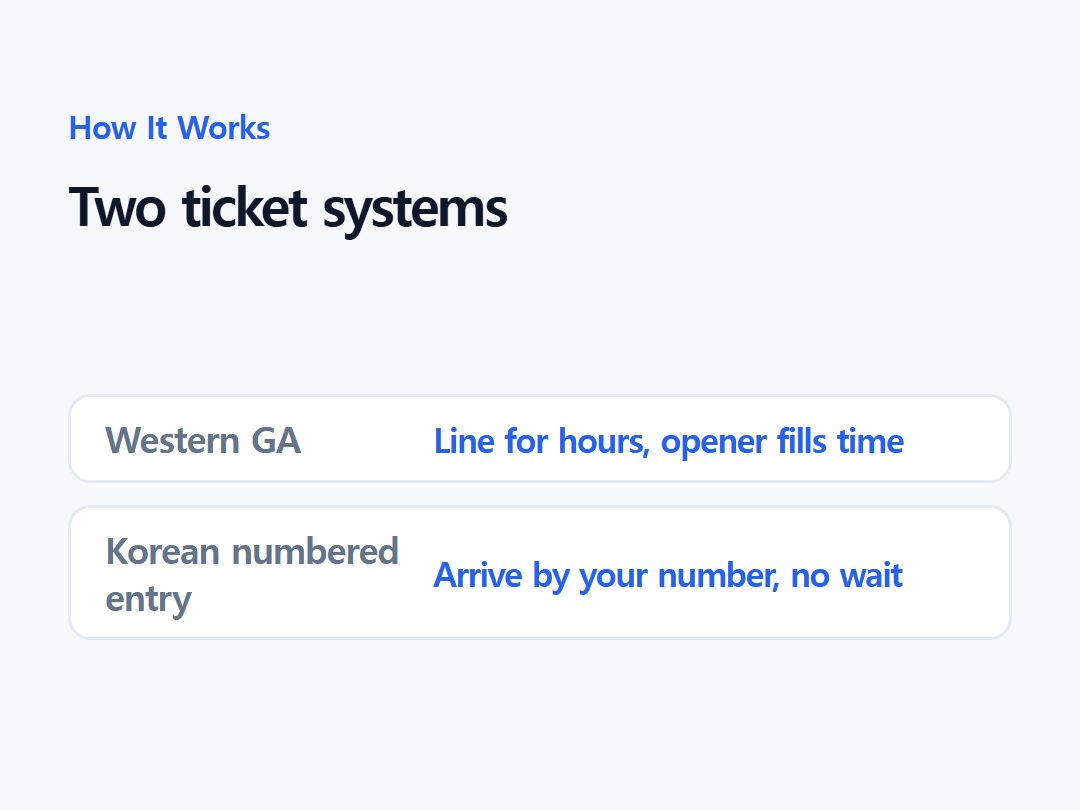
At a US or UK arena show, general-admission fans queue outside for hours to claim a spot near the stage, and an opening act gives that early crowd something to watch while the room fills. Korean standing tickets, usually sold as a numbered "standing zone" rather than an open pit, don't create that problem in the first place.
Tickets carry an entry number, and venues call groups of numbers in waves starting only about twenty minutes before showtime. Arriving early doesn't move you up — your number was fixed the moment you bought the ticket — so there is no long, restless line for an opener to entertain.
That single design choice removes the practical reason Western shows book an opener in the first place: giving an early-arriving crowd something to watch. In Korea, there simply isn't an early crowd standing around with nothing to do.
| Western general-admission show | Korean numbered-entry show |
|---|---|
| Fans queue for hours; position depends on arrival time | Position is fixed by ticket number, called in waves |
| An opening act fills the wait while the room fills | Doors open roughly twenty minutes before the show starts |
A ticket this hard to win buys one fandom's night
Getting the ticket at all is its own contest. Fan-club presales, identity verification, and a general sale that can sell out in seconds mean a ticket represents a real fight, not an impulse buy — a process separate from, and layered on top of, the venue and entry constraints above.
That is part of why the rare exception draws backlash. When JYP Entertainment added its then-rookie group VCHA as an opener for TWICE's 2024 shows in Mexico, São Paulo, and Las Vegas, some TWICE fans objected — not to VCHA specifically, but to spending part of a hard-won ticket on a set they had not paid to see.
Others defended the pairing as ordinary touring practice, arguing many fans simply had no prior experience with openers to compare it to.
Multi-act shows exist — they're just not headliner-plus-opener
Korea does put several acts on one stage. Award shows, year-end galas, and agency showcases regularly feature multiple groups performing back to back on equal footing, and joint "family concerts" pairing labelmates are a long-running tradition.
What's absent is the specific pairing of an established headliner with a lesser-known act warming up the crowd before the "real" show begins.
The distinction matters commercially. A multi-act bill is sold as several headliners sharing a night, priced accordingly. A traditional opener is sold as one headliner's ticket plus an unpaid-for extra — a structure Korean concert pricing was never built around.
The exceptions almost always happen overseas
When a K-pop tour does use a traditional opener, it tends to happen outside Korea, on stages already run by Western-style venue rental and general-admission queuing.
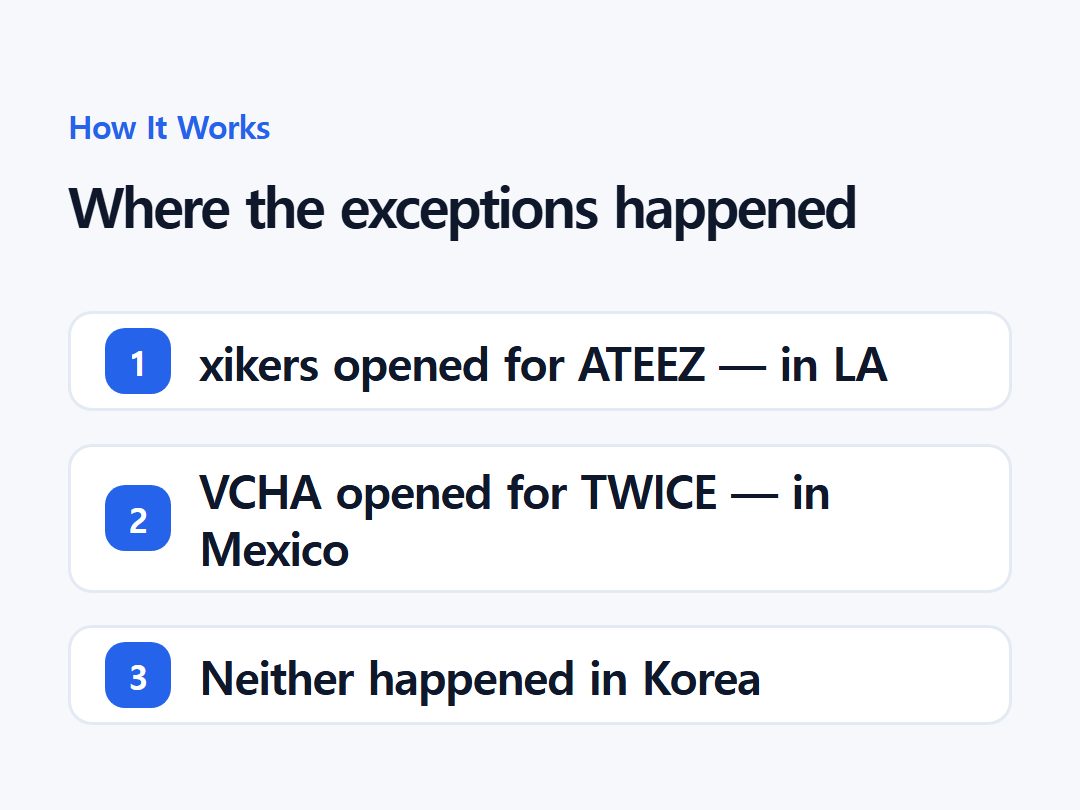
- VCHA opened several TWICE tour stops in Mexico, Brazil, and Las Vegas
- xikers opened ATEEZ's Los Angeles and Arlington shows in 2025
- Neither pairing has been repeated at a venue inside Korea
Overseas legs are usually run by local promoters under local venue contracts, general-admission queuing included, so adding a support act fits how the room already operates. A Seoul date, booked under a domestic rental with a numbered-entry ticket, doesn't offer the same opening — so the format simply doesn't travel home with the tour.
Seoul is finally building a room made for this
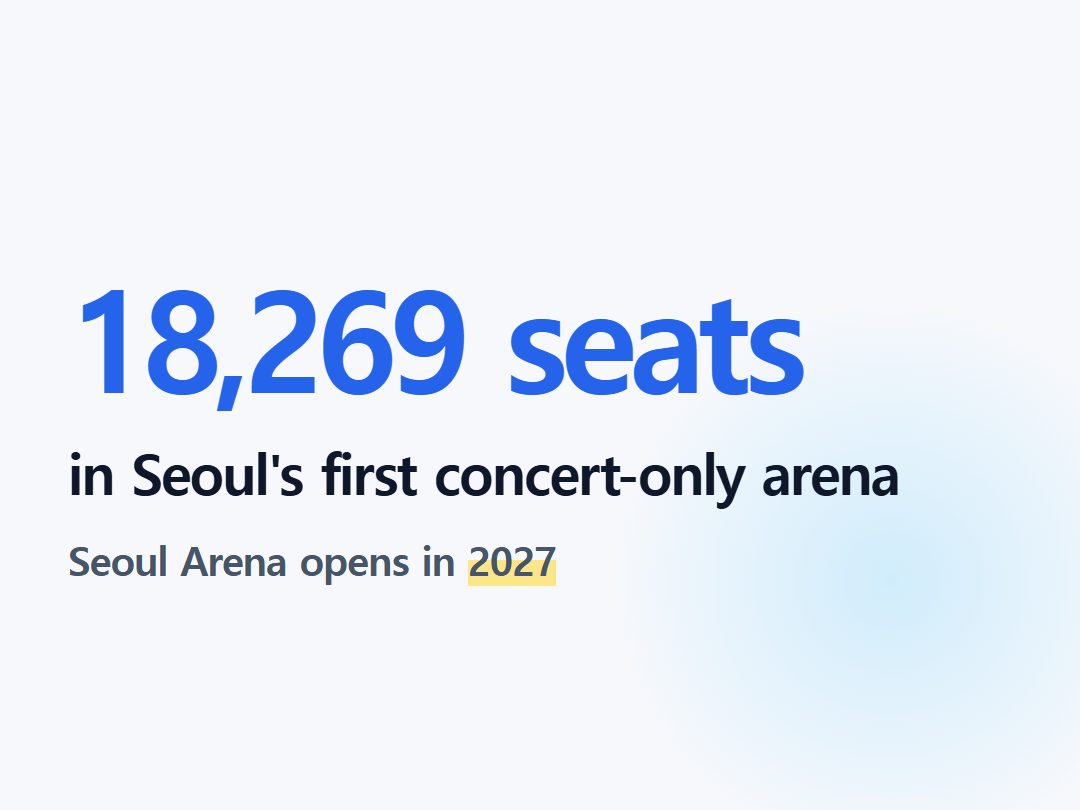
Seoul Arena, the city's first venue built specifically for concerts rather than sports, is due to open in the first half of 2027 in Dobong-gu, with 18,269 seats in its main hall and room for up to 28,000 including standing space, plus a separate 2,010-seat mid-sized hall.
Kakao will operate the venue for thirty years under an agreement with the Seoul Metropolitan Government, which supplied the site. It is the first Seoul venue conceived around concerts from the start, rather than adapted from a stadium, gymnasium, or exhibition hall.
What a bigger venue still won't fix
More seats solve the capacity problem, not the format. Even once Seoul Arena opens, shows will likely keep the numbered, near-showtime entry system that removed the crowd-filling need for an opener in the first place.
Korean music critics have separately called for a dedicated venue in the 50,000-seat range, arguing the industry has outgrown its current rooms. Others caution that any new hall needs to stay busy with non-concert events year-round to justify itself.
Whether a larger venue eventually changes how shows are booked, or simply lets more fans into the same one-act format, is still unresolved.
Western general-admission shows vs. Korean numbered-entry shows
| Western general-admission show | Korean numbered-entry show |
|---|---|
| Fans queue for hours; position depends on arrival time | Position is fixed by ticket number, called in waves |
| An opening act fills the wait while the room fills | Doors open roughly twenty minutes before the show starts |
Frequently asked
Why don't K-pop concerts have opening acts?
Korea has very few large venues, so agencies book back-to-back single-act dates, and numbered-ticket entry removes the early, restless crowd an opener would normally entertain.
When does Seoul Arena open?
Seoul Arena, the city's first venue built specifically for concerts, is due to open in the first half of 2027 in Dobong-gu, with 18,269 main-hall seats.
Has any K-pop group ever had an opening act?
VCHA opened for TWICE on 2024 tour stops in Mexico, Brazil, and Las Vegas, and xikers opened for ATEEZ in Los Angeles and Arlington in 2025 — both overseas exceptions never repeated inside Korea.
Sources
Every factual claim above is traceable. We do not translate articles — we gather facts from multiple outlets and write them ourselves.
- Concert Venues Waging Rental Wars As They Are Unable To Keep Up With The K-Pop Demand — Koreaboo
- Global stars set for concerts in Korea amid venue shortage — The Korea Times
- 18,000-seat K-pop concert venue Seoul Arena to open in 2027 — The Korea Times
- K-Pop Concert Etiquette in Korea: Foreigner Survival Guide — KoreaRoute
- TWICE Announce Special Guests For Their Upcoming Concerts, Sparking A Heated Debate — Koreaboo
- K-Pop Group xikers to Open for ATEEZ at Los Angeles Concert — TenAsia