Walk into a K-pop pop-up store or scroll a fan account before a comeback, and the same group's new album might be listed six or eight different ways: a photobook edition, a compact digipack, a jewel case, several "member" covers, and a handful of versions sold only through specific retailers.
The songs inside are usually identical. What differs is the packaging, and above all, the photocards packed inside — and that difference is not accidental. It is the mechanism that keeps K-pop's physical-album economy running.
The short version
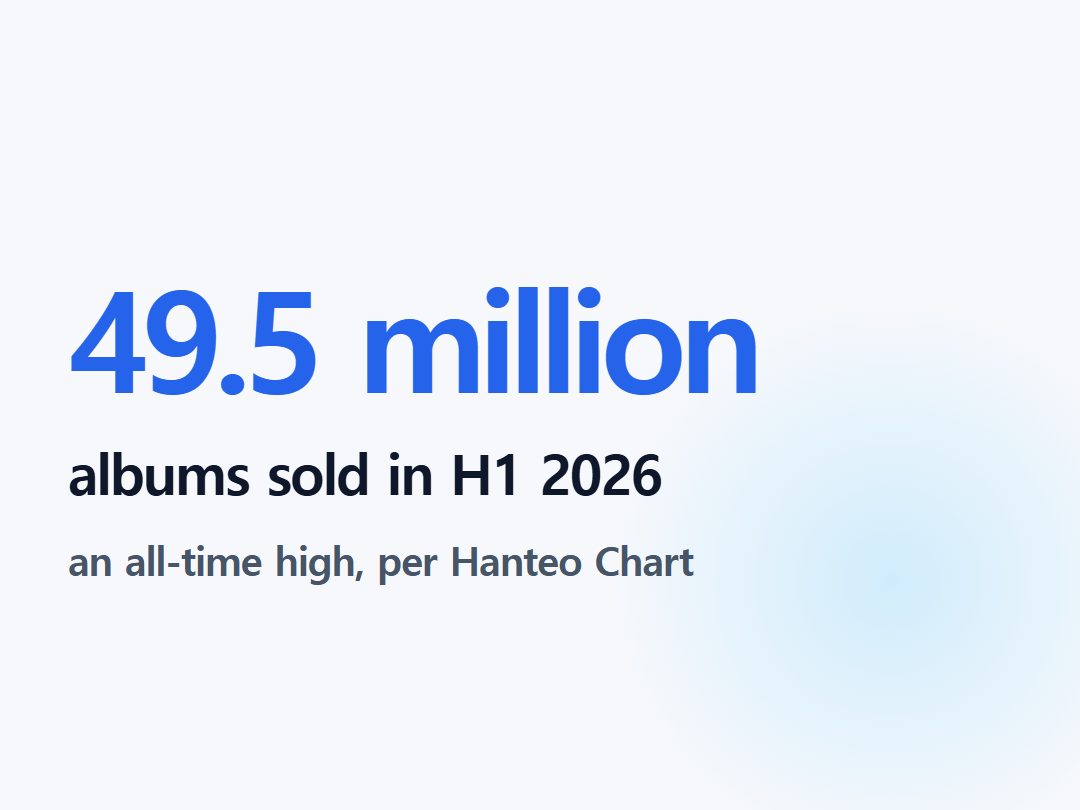
- K-pop album sales hit a record 49.5 million copies in early 2026.
- Random photocards push fans to buy multiple copies of one album.
- First-week 'chodong' sales, not streams, decide K-pop chart rankings.
Album sales hit a record 49.5 million copies
This isn't a single news event; it's a system international listeners keep running into without an explanation.
In the first half of 2026, K-pop album sales hit a record 49.5 million copies, according to Hanteo Chart, the industry's primary real-time sales tracker — up 23.4 percent from the same period the previous year and past the prior record of 46.2 million set in the first half of 2023.
Hanteo credited part of the surge to BTS's comeback album "Arirang," which sold roughly 4.16 million copies in its first week alone, plus fourteen separate releases that each cleared one million first-week copies.
None of that is possible without the multi-version model: fans are not buying one copy of an album, they are often buying several, and the industry has built its release strategy around exactly that behavior.
Why do fans buy the same album twice?
To an outside observer, buying five copies of the same CD looks irrational. Inside the K-pop system, it is a rational response to how the industry counts success.
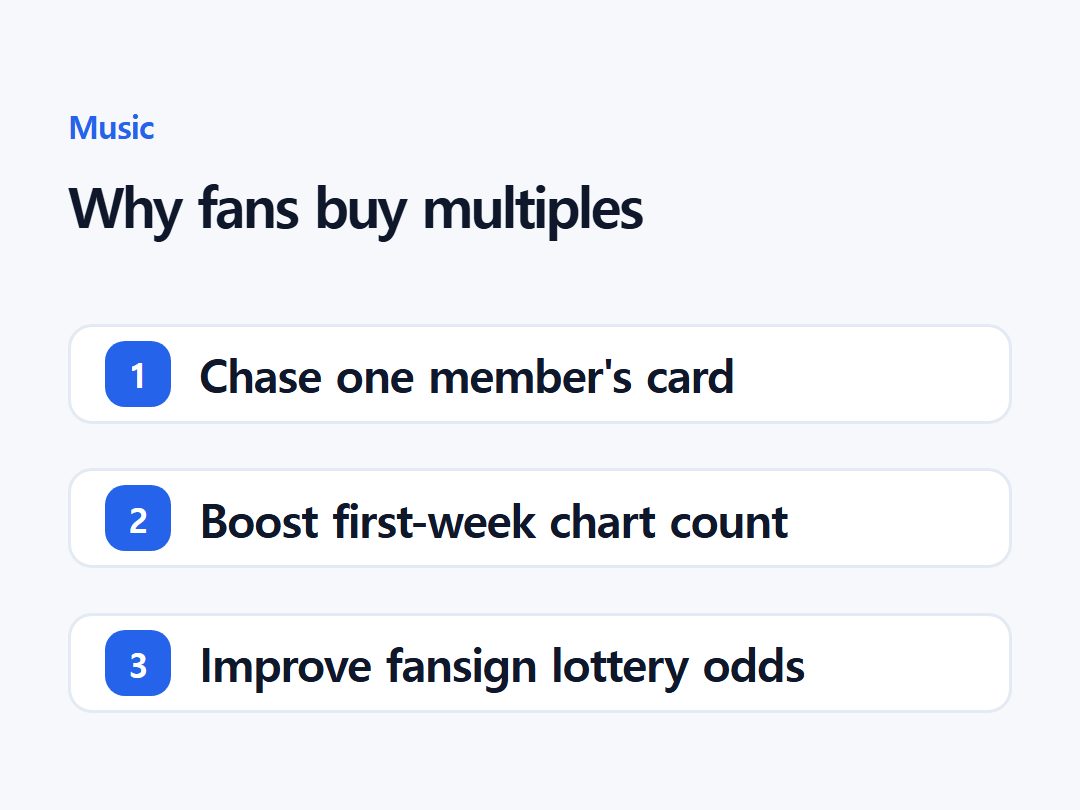
Korean charts — principally Hanteo and Circle Chart (the rebranded successor to Gaon Chart) — rank albums heavily by physical sales, and one number matters more than almost any other: chodong (초동), the album's first-week sales count.
Chodong numbers decide chart placement, feed into year-end and award-show rankings, and function as a public scoreboard of a group's popularity that fans, agencies, and rival fandoms all watch closely.
Because the metric is units sold, not units listened to, the fastest way to move it is to sell more physical copies to the same buyers — not just to reach new ones.
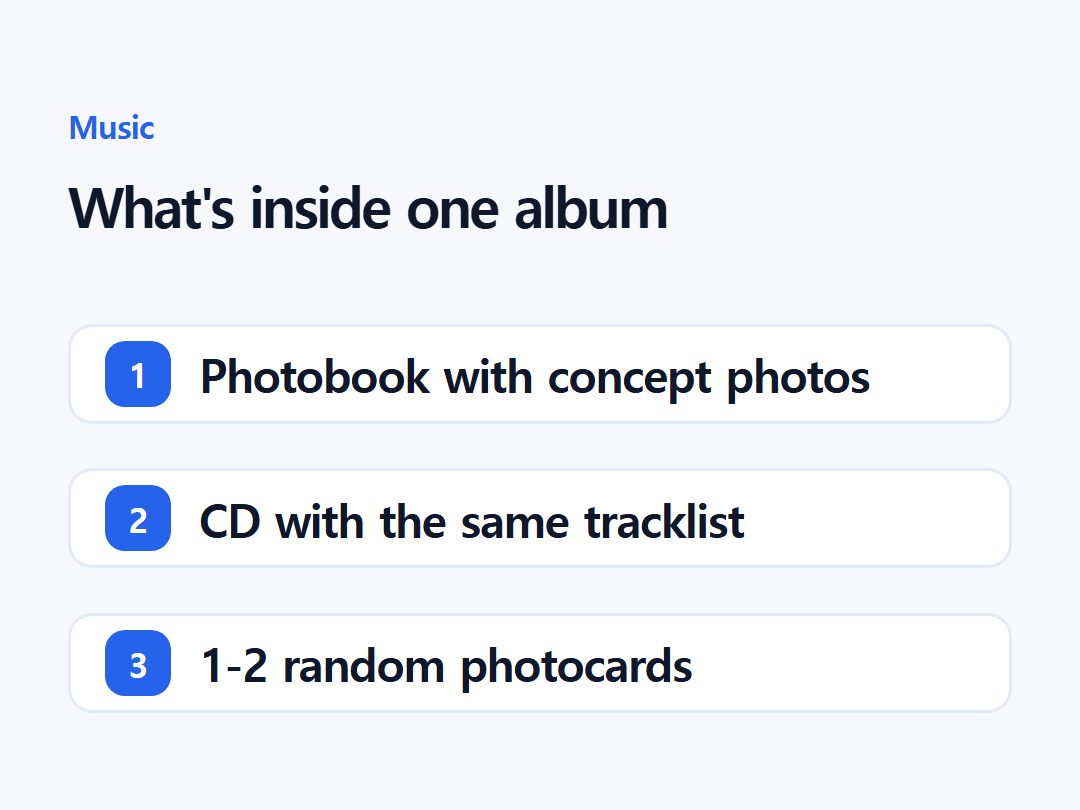
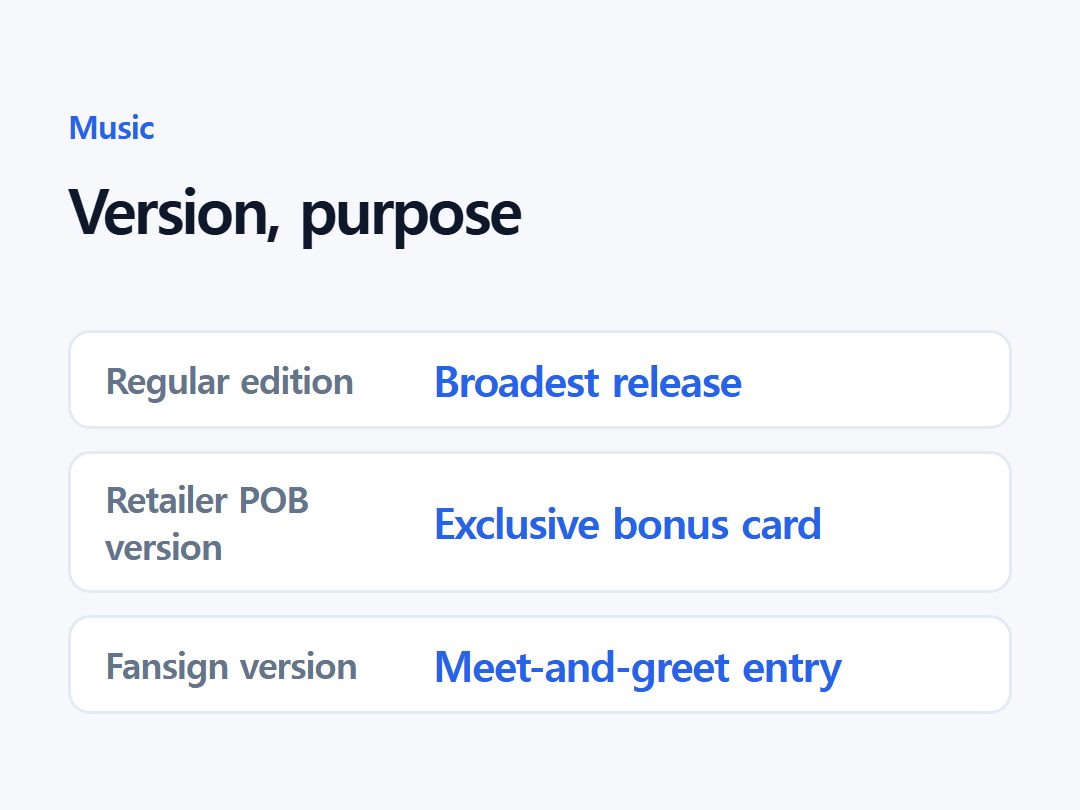
Multiple album versions are the tool that makes repeat buying attractive rather than redundant. A typical version includes a photobook of concept photography unique to that edition, the CD itself, and one or two photocards — small, collectible photographs of individual members — inserted at random.
Because the card is random and the versions differ, a fan chasing a specific member's card from a specific concept has no way to buy it directly; they have to buy multiple copies and hope.
Multiply that by several album versions, several members, and sometimes dozens of possible card designs, and a single comeback can generate well over a hundred unique photocards. No one pulls them all from random purchases alone, which is precisely why fans keep buying.
Layered on top of the version system are pre-order benefits, or POBs — retailer-exclusive bonus photocards offered by platforms like Weverse Shop, Ktown4u, and Aladin.
Because each retailer's POB is different, a completist fan who wants every possible card has to place separate pre-orders across multiple stores, each purchase counted toward the same chodong total.
Some album versions go further still, functioning as entry tickets to a fansign — a lottery-based meet-and-greet event where winners are drawn from among purchasers of a qualifying album, sometimes requiring dozens of copies bought under one name to improve the odds.
None of this requires false advertising or hidden fees; it is openly marketed. But it does mean that "album sales" in K-pop measure something closer to fan spending capacity and depth of engagement than they measure how many individual people bought the record once.
The result is a genuine parallel economy.
Photocards are traded, sold, and graded on secondary markets the way sports cards are, with rare fansign or lucky-draw cards from top-tier members reportedly commanding hundreds of dollars, while duplicate album copies — stripped of their cards — are frequently resold, given away, or discarded.
Understanding this is the difference between reading a chart-topping first-week number as "this album is popular" and reading it correctly: it reflects a purchasing structure specifically engineered to multiply per-fan spending, on top of underlying popularity.
This also explains why physical-sales figures often outpace what streaming or digital-download numbers alone would predict for the same act.
A group with a smaller but highly organized fanbase can post a chodong total that rivals a group with far larger casual listenership, simply because more of that fanbase is buying multiples.
Award shows in Korea, many of which weight album sales heavily in their scoring, inherit this same distortion — another reason agencies keep investing in version design rather than treating it as an afterthought.
How one 2010 album started the photocard rush
The photocard mechanic has a traceable origin point.
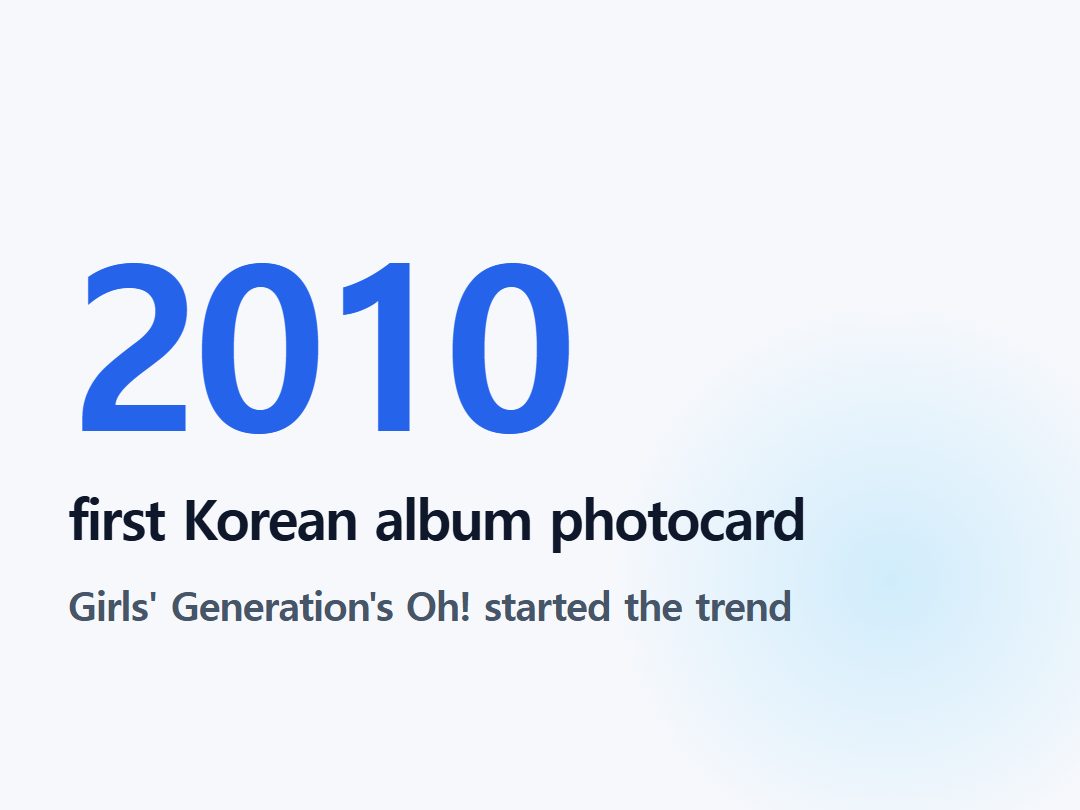
TVXQ's 2007 Japanese EP "Summer" is often cited as an early instance of the format, but the practice took hold domestically with Girls' Generation's 2010 album "Oh!", widely credited as the first Korean release to include a randomized photocard — one card drawn from a set of ten, covering the group's nine members plus a group card.
SM Entertainment reissued the set twice more with new photo selections, foreshadowing the "re-press" and multi-version habits that later became standard across the industry.
"Oh!" was also a commercial landmark in its own right: combined with its repackage, it was the best-selling release of 2010 on the Gaon Album Chart, and Girls' Generation became the first female act to win the ceremony's Album Daesang (grand prize).
What began as a single bonus insert scaled up over the following decade. Agencies including SM, JYP, YG, and HYBE built photocard variety and retailer-exclusive POB deals into album planning from the earliest production stages, treating card design as its own marketing discipline.
Chart infrastructure evolved alongside the practice: Gaon Chart, South Korea's official music chart operated by the Korea Music Content Association, rebranded as Circle Chart in 2022 and began publishing more granular weekly physical-sales data, formalizing the chodong-driven reporting that fandoms already tracked obsessively.
By the early 2020s, industry-wide album sales were setting new records nearly every year, with more than 100 million K-pop CDs sold in a single year for the first time in 2023 — a scale the original single-photocard insert of 2010 never anticipated.
Can K-pop's plastic album waste be fixed?
The model is now facing organized pushback.
Reporting from South Korean and international outlets has documented piles of stripped-down albums — photocards removed, everything else discarded — left on Seoul streets after release days, and activist group Kpop4Planet has run campaigns delivering thousands of unwanted albums back to HYBE, SM, and JYP to press the point.
A 2026 investigation from The Korea Times tied the top four agencies to roughly 6,667 tons of disposable plastic waste since 2021, driven substantially by CD packaging that is difficult to recycle.
Some companies have responded with biodegradable plastic, soy-based inks, or digital "smart album" formats that carry a code instead of a physical disc, but critics argue these changes leave the underlying incentive — buy more copies to raise your odds — untouched, and have called the shift greenwashing rather than reform.
Whether chart operators, agencies, or regulators eventually adjust how physical sales are weighted against streaming and digital formats remains unresolved, as does whether fan-led waste campaigns will meaningfully change purchasing habits during comeback season.
For now, the version count on any new K-pop release is less a packaging choice than a readable signal of how the chart system, the photocard market, and fan spending are designed to work together.
How the photocard system scaled up
| Year | Milestone |
|---|---|
| 2007 | TVXQ's Japanese EP "Summer" is often cited as an early photocard instance |
| 2010 | Girls' Generation's "Oh!" becomes the first Korean release with a randomized photocard, drawn from a set of ten |
| 2022 | Gaon Chart rebrands as Circle Chart and starts publishing more granular weekly physical-sales data |
| 2023 | More than 100 million K-pop CDs are sold in a single year for the first time |
| 2026 | A Korea Times investigation ties the top four agencies to roughly 6,667 tons of plastic waste since 2021 |
Frequently asked
Why do K-pop albums come in so many versions?
Each version packs in random photocards and retailer-exclusive bonuses, so fans buy multiple copies hoping to land a specific member's card. That repeat buying is exactly what drives first-week sales rankings.
What is chodong in K-pop?
Chodong (초동) is an album's first-week sales count, the main number Korean charts like Hanteo and Circle Chart use to rank popularity and feed into award-show scoring.
Why do people throw away K-pop albums after buying them?
Many fans only want the randomized photocard inside, so once they pull it they discard the CD and packaging, generating thousands of tons of plastic waste that groups like Kpop4Planet have protested.
Sources
Every factual claim above is traceable. We do not translate articles — we gather facts from multiple outlets and write them ourselves.
- K-pop album sales hit record 49.5 million in first half of 2026, Hanteo says — Korea JoongAng Daily
- Circle Album Chart — Wikipedia
- K-pop greenwashing betrayal: 6,667 tons of plastic waste driven by merchandising — The Korea Times
- K-pop fans take aim at CD, merchandise waste — The Jakarta Post
- The First K-Pop Group Ever To Have Official Photocards — Koreaboo
- Fans once again trash boxes of albums on the side of the road after taking out the photocards — allkpop
- Kpop4planet — Wikipedia