
In August 2026, actor Ha Young's agency, Bistus Entertainment, issued a written apology on her behalf — not for anything she had done, but for her great-grandfather. Days earlier, she had spoken warmly on a KBS talk show about her family's medical background.
Online users traced her lineage and found that her great-grandfather, Ahn Sang-ho, appeared on a 1916 roster of the Daejeong Friendship Association, a pro-Japanese group active during Korea's colonial period (1910–1945).
Her agency first called the claim groundless, then reversed itself once the record was verified, and apologised for the earlier denial as well as the ancestral history itself.
The short version
- Korean agencies, not celebrities, usually issue the first public apology statement.
- Handwritten letters are reserved for the most serious offenses, agencies say.
- Jasuk hiatus length varies wildly — T.O.P took five years, B.I. took none.
This is not an isolated case. In March 2024, aespa's Karina posted a handwritten letter on Instagram after fans reacted with anger to news that she was dating actor Lee Jae-wook.
In November 2023, RIIZE's Seunghan wrote another handwritten apology — his second — for a leaked video, and was criticised as much for his handwriting as for the offense itself.
In 2021, actor Kim Seon-ho apologised through his agency, Salt Entertainment, after allegations about how he had treated a former girlfriend, in a statement that led multiple brands to drop him before he had responded publicly at all.
Different offenses, same format: a statement or a handwritten letter, released through a talent agency, sometimes followed by a period out of the public eye. For readers outside Korea, the pattern raises an obvious question — why does an idol have to apologise on paper for dating someone, or for a relative's century-old conduct?
Why do agencies apologize on the idol's behalf?
The format is not incidental — it is the product of a specific industry structure that has no close equivalent in Western entertainment.
Nearly every Korean idol, actor, and on-air personality works under an agency system: a management company that scouts, trains, houses, and markets the performer, and that also controls, or heavily influences, their public communications.
When a controversy breaks, it is almost never the celebrity who speaks first — it is the agency, in a formal statement to entertainment press.
According to Korea JoongAng Daily's reporting on the practice, PR staff at agencies review any handwritten letter before it is posted, checking that the lines don't slope, that the handwriting looks neat, and sometimes advising the star not to write one at all if the offense is judged too minor to warrant that level of contrition.
A handwritten letter, as one agency source put it, signals that the words came from the artist personally rather than from a publicist — which is precisely why agencies treat the decision to allow one as a calculated escalation, not a spontaneous gesture.
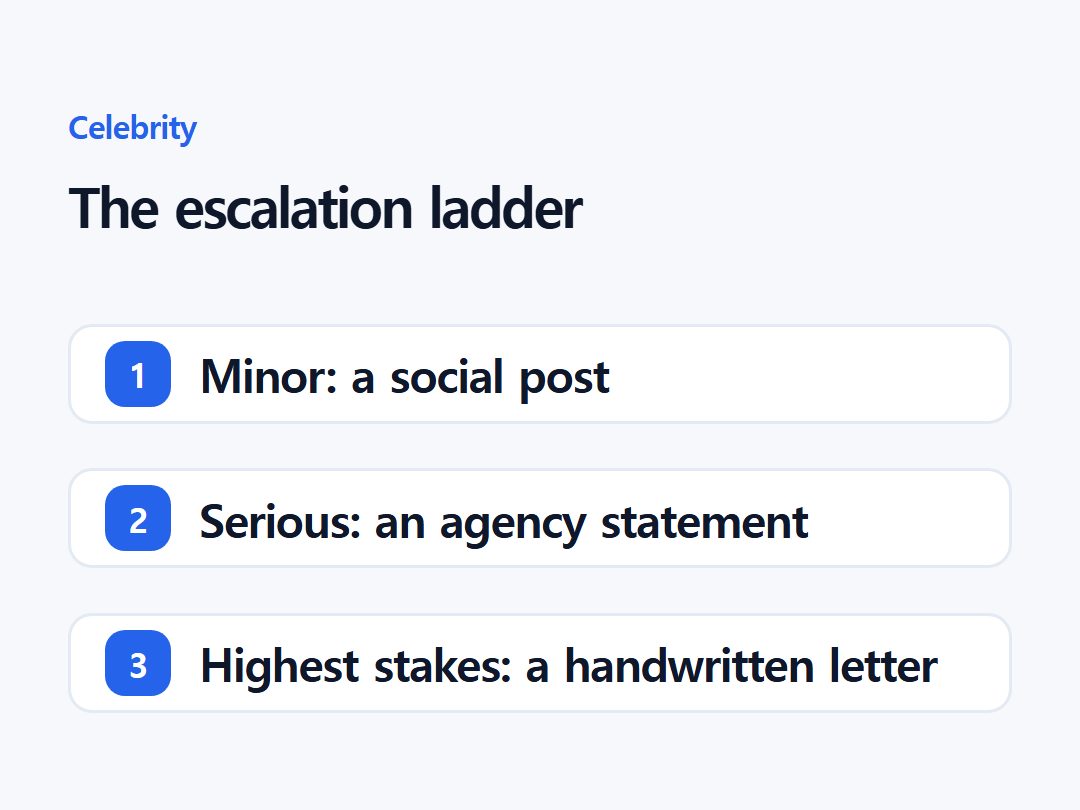
That escalation follows a rough hierarchy. A minor lapse — a tasteless joke, an awkward livestream moment — is handled with a short social media post or is ignored entirely.
When NCT 127 members sang along to their own song “Earthquake” moments after an actual earthquake alert interrupted a livestream, they still posted brief apologies to Instagram Stories, even though most viewers considered the backlash overblown.
A more serious matter, one involving personal conduct, a broadcast deemed offensive, or a legal question, is handled with a formal agency statement.
The most serious cases — ones agencies judge to require visible personal remorse — get the handwritten letter, still the highest-stakes format in Korean celebrity communication precisely because it cannot be blamed on a publicist.
Two structural features explain why this matters so much more in Korea than in the West.
The first is the intensity of the parasocial relationship between idols and fans.
Korean entertainment companies actively cultivate a sense of closeness — fan meetings, live-streamed practice sessions, direct messaging apps — that makes fans feel entitled to weigh in on an idol's personal choices, including who they date, in a way Western pop fandom generally does not.
Karina's apology drew a genuinely split reaction: alongside supportive comments, one of the most upvoted replies read that no idol should have to apologise for dating in 2024, showing that even within Korea the expectation is now contested.
But the apology was still written, because the agency judged that the backlash was large enough to require it.
The second is what happens after the apology: a period called 자숙 (jasuk), or self-imposed reflection — a voluntary, unpaid hiatus in which the celebrity withdraws from television, endorsements, and public appearances.
There is no fixed length or legal requirement; jasuk is closer to a ritual than a punishment, but skipping it altogether is read as a lack of remorse.
Big Bang's T.O.P stayed out of the public eye for roughly five years after a 2017 suspended sentence tied to marijuana use, according to the Korea Herald, while rapper B.I., convicted in a separate drug case in 2021, took no real hiatus and kept releasing music — an inconsistency that critics say makes jasuk look less like accountability and more like a negotiable waiting period before a comeback.
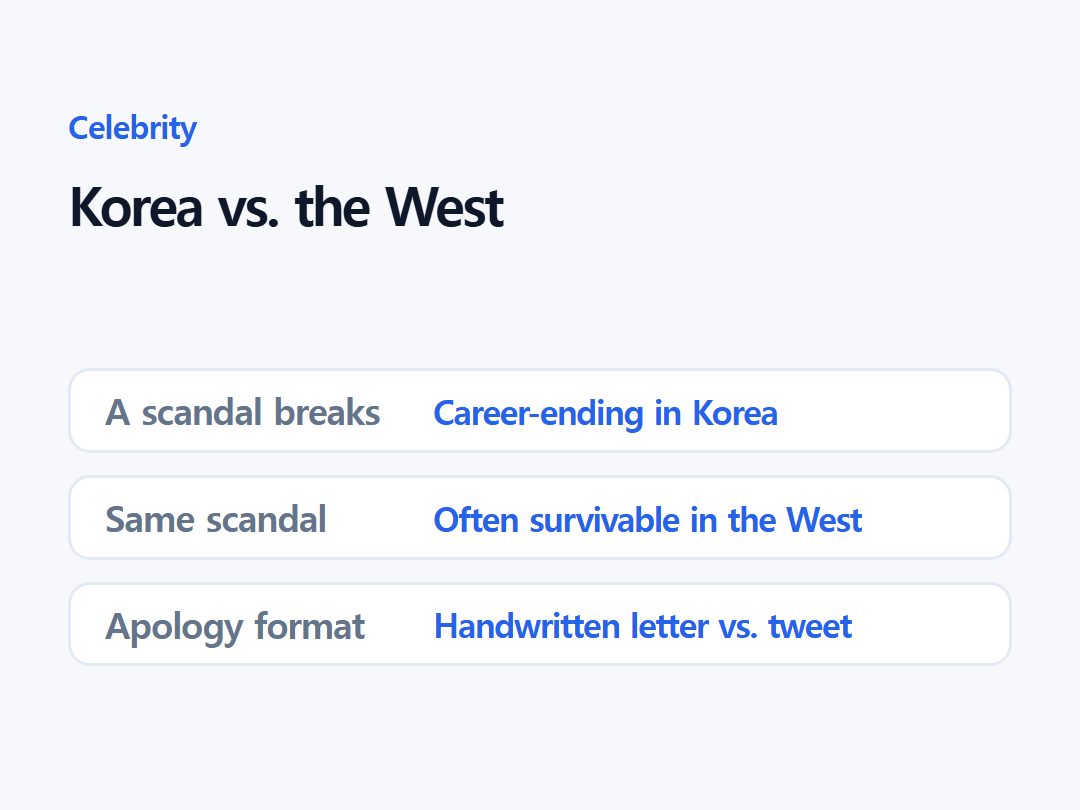
Underneath both mechanisms is a harder truth: in the Korean entertainment market, a damaged reputation is close to a career-ending event, not a speed bump.
Advertisers and broadcasters drop a star at the first sign of sustained online criticism, often before any formal finding of wrongdoing, because the risk of association outweighs the cost of losing the talent.
In the United States or the UK, a celebrity scandal can be survived, sometimes even turned into a comeback narrative; in Korea, the assumption runs the other way, and the public apology is the opening move in trying to prevent that outcome, not a formality after the fact.

How the handwritten apology became a PR tool
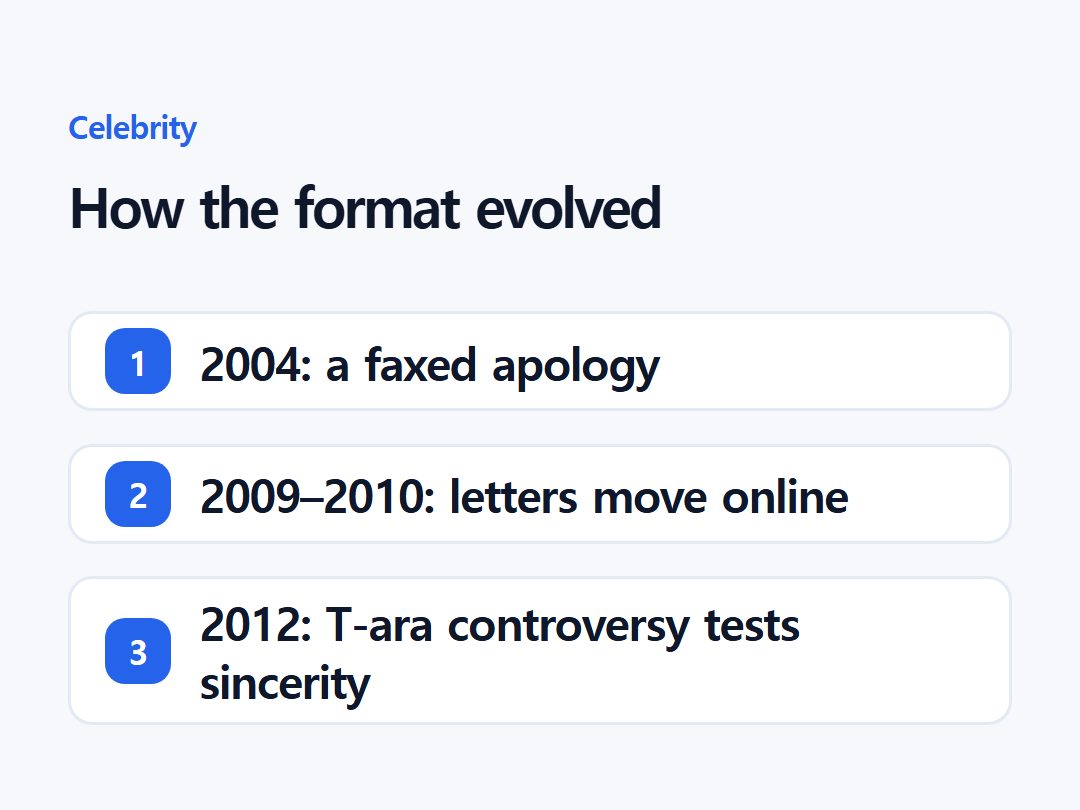
The handwritten apology as a media format is younger than it looks. Korea JoongAng Daily traces an early version to 2004, when actor Song Seung-heon sent a faxed apology during a controversy — a format tied to the fax machine, not yet the personal note it would become.
The practice shifted onto the internet between 2009 and 2010, as celebrities including actor Lee Byung-hun and singer Baek Z-young posted handwritten statements to blogs and early social platforms, taking advantage of direct-to-fan channels that bypassed print media entirely.
2012 was the turning point that made the format controversial in its own right. Girl group T-ara's members were accused of bullying labelmate Hwayoung after a series of dismissive tweets about her following an injury during a Japan concert.
A month into the backlash, the group posted a joint handwritten letter, calling their behaviour immature and expressing sadness that they could no longer perform with Hwayoung — without directly addressing the bullying allegation itself.
The letter satisfied almost no one: critics questioned whether the handwriting was genuinely each member's own, and the episode is widely cited as the moment handwritten apologies started being read as PR instruments rather than sincere gestures, even as agencies kept using them.
Hwayoung reopened the case publicly in 2024, more than a decade later, disputing the company's account — evidence of how long these episodes stay live in Korean public memory compared with equivalent Western scandals.
By the 2020s the format had become standard enough to cover not just scandals but life announcements — marriages, military enlistments, group departures — with idols like TVXQ's Max Changmin and EXO's Chen using handwritten letters to announce their weddings.
The apology letter and the announcement letter now share the same visual grammar: a photographed page of handwriting, posted without agency branding, designed to look unmediated even when it has been reviewed line by line before publication.
Whether Korea's unwritten apology rules are shifting
Three things remain unresolved.
First, whether the generational pushback visible in reactions to Karina's apology — fans openly asking why dating requires contrition at all — will change what agencies choose to escalate to a handwritten letter, or whether it remains a minority view drowned out by louder criticism online.
Second, whether jasuk continues to function as real accountability or hardens further into a predictable, strategically timed absence, given the visible gap between cases like T.O.P's five-year withdrawal and B.I.'s effectively unbroken career.
Third, cases like Ha Young's show the apology net widening beyond a celebrity's own conduct to family history and inherited association — a category Western celebrity culture has no direct equivalent for, and one likely to keep testing how far Korean audiences think personal responsibility should extend.
Korea's escalation ladder for celebrity apologies
| Severity | Format | Example |
|---|---|---|
| Minor lapse | Short social media post, or no apology at all | NCT 127's brief Instagram Stories apology after the "Earthquake" livestream moment |
| Serious personal or legal matter | Formal agency statement | Kim Seon-ho's 2021 statement through Salt Entertainment |
| Most serious, requires visible remorse | Handwritten letter | Seunghan's second handwritten apology in November 2023 for a leaked video |
Frequently asked
Why do K-pop idols write handwritten apology letters?
Agencies treat a handwritten letter as the highest-stakes apology format because it signals the words came from the artist personally rather than a publicist, so it's reserved for the most serious controversies.
What is jasuk in Korean entertainment?
Jasuk is a voluntary, unpaid hiatus a celebrity takes after a scandal to show remorse. It has no fixed length or legal requirement, but skipping it is read as a lack of remorse.
Why did actor Ha Young apologize for her great-grandfather?
Her great-grandfather, Ahn Sang-ho, was found listed on a 1916 roster of the Daejeong Friendship Association, a pro-Japanese group active during Korea's colonial period, and her agency apologized once the record was verified.
Sources
Every factual claim above is traceable. We do not translate articles — we gather facts from multiple outlets and write them ourselves.
- Korea's 'Notes app apology': Why celebrities address their most delicate moments by hand — Korea JoongAng Daily
- Aespa's Karina apologizes to K-pop fans after relationship reveal sparks backlash — CNN
- RIIZE's Seunghan writes another handwritten apology for his latest controversy — allkpop
- Self-suspension, a peculiar 'punishment' for celebrities in Korea — The Korea Herald
- T-ara Finally Speaks Up About Controversy and Issues Apology in Handwritten Letter — Soompi
- 5 ridiculous K-pop apologies, from NCT 127's Earthquake joke to Winwin and BTS' Jungkook hanging out with female friends — South China Morning Post
- Actor Ha Young apologizes over great-grandfather's pro-Japanese activities — The Korea Times
- South Korean actor Kim Seon-ho admits forced ex-girlfriend into having an abortion — Malay Mail