
International viewers who discover Korean variety television usually meet it in fragments: a clip of a game on Running Man, a Netflix trailer for Physical: 100, a cooking-competition thumbnail for Culinary Class Wars.
What is often missing is the map connecting them — the sense that these are not random one-off hits but examples of a handful of distinct formats that Korean broadcasters and streamers have been refining for two decades.
Korean fans call the whole category yeneung (예능), a broad term covering everything from panel comedy to dating shows to survival competitions. This piece is a beginner's map to that category: the three main genres, where each one came from, and which shows are the standard entry points.
The short version
- Korean variety shows split into three genres: game, observation, and survival competition.
- Physical: 100 was Korea's first unscripted show to top Netflix's global chart.
- Netflix carries survival hits; game and observation shows live on Korea-focused platforms.
Netflix hits arrived before any explanation did
There is no single event driving this piece — it is a guide, not breaking news. But the reason a genre map is useful now is that Korean variety content has become one of the country's most visible cultural exports outside K-pop and K-drama.
Netflix has spent the past several years building an unscripted slate around Korean formats, and shows like Physical: 100 and Culinary Class Wars have topped the platform's non-English global charts, introducing large numbers of first-time viewers to Korean variety without any context for what they are watching or how it fits into a longer tradition.

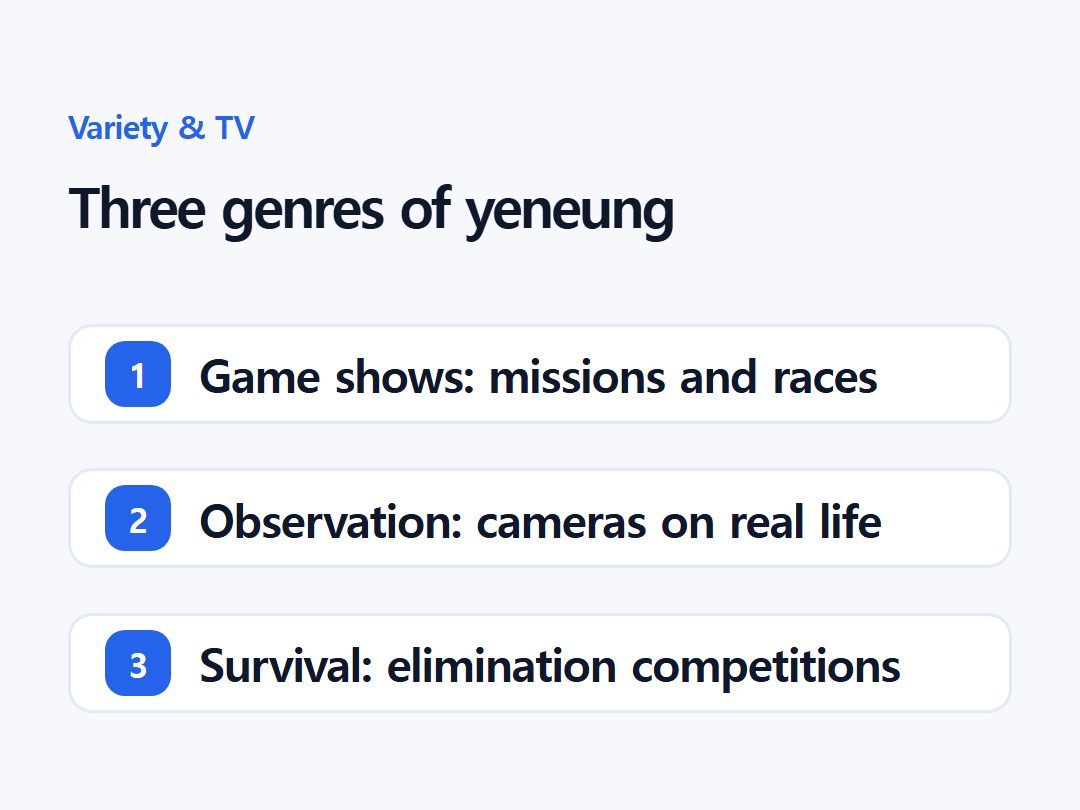
What are the three types of Korean variety shows?
Korean variety shows are not one thing. International coverage tends to lump them together, but domestic audiences and critics generally recognize three broad, overlapping genres, and knowing the difference changes what a viewer should expect from a given show.
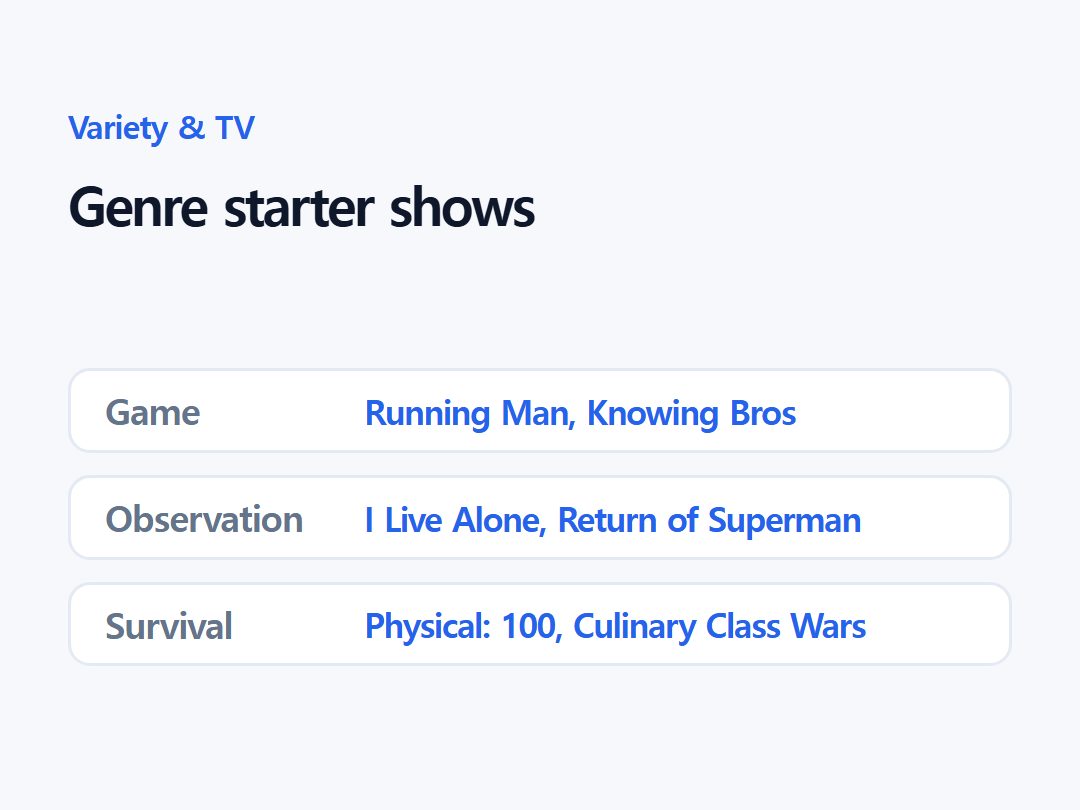
The first and oldest is mission-based game variety: a fixed cast (sometimes with celebrity guests) completes structured games, physical challenges, or quizzes, usually for a trivial prize or the avoidance of a silly punishment. Running Man, which airs on the network SBS, is the standard example — cast members race through city locations ripping name tags off each other's backs to eliminate opponents. Knowing Bros uses a classroom conceit instead of a city chase: the regular cast plays exaggerated "students," and each episode's guest — often a K-pop idol or actor — appears as a "transfer student" who answers questions and plays games with them.
This genre is the easiest entry point for new viewers because it needs the least cultural background: the appeal is slapstick, competitive banter, and watching celebrities lose their composure.
The second genre is observation variety (관찰 예능, gwanchal yeneung), sometimes called reality-variety.
Instead of staged games, a camera crew documents a celebrity's actual daily life — living alone, raising children, going to work — and the footage is typically edited down and replayed in a studio, where a host panel reacts to it live. I Live Alone, on MBC, follows single celebrities through their everyday routines and has run since 2013. The Return of Superman, on KBS2, follows celebrity fathers left alone to care for their children for 48 hours without their wives' help; it premiered as a holiday special in September 2013, the same year as its MBC counterpart Dad!
Where Are We Going?, which sent celebrity fathers and their kids on rural camping trips. Omniscient Interfering View, running on MBC since 2018, adds a twist: celebrities are observed through their own managers' footage and commentary, turning the assistant's daily grind into part of the entertainment.
This genre asks for more patience than a game show — it is slower, more intimate, and often closer to a soft documentary than to slapstick comedy.
The third genre is survival and reality competition, the format that has traveled furthest internationally, largely through Netflix.
Contestants — sometimes celebrities, sometimes ordinary people recruited for a specific skill — compete under elimination rules until a single winner remains. Physical: 100, which launched in January 2023, put 100 contestants (Olympians, professional fighters, bodybuilders, ex-soldiers) through physical challenges for a cash prize, becoming the first Korean unscripted show to top Netflix's global non-English chart; its success led to spinoffs including Physical: Asia and Physical 100: USA. Culinary Class Wars, launched in September 2024, pits 100 chefs — 20 established "white spoon" names against 80 lesser-known "black spoon" cooks — against each other in a cooking tournament, and became the first Korean unscripted series to hold Netflix's Global Top 10 Non-English TV list for three consecutive weeks. Single's Inferno, a dating-survival hybrid where singles must "match" with another contestant to escape a spartan island for a luxury hotel, was the first Korean unscripted series to reach Netflix's global top 10 for non-English TV.
These genres blend at the edges — Running Man has aired observation-style segments, and observation shows sometimes fold in light competition — but the three-way split (game, observation, survival) is the fastest way for a new viewer to predict what kind of show they are pressing play on.
How two decades of hits shaped each genre
The modern template for game-based Korean variety was set by Infinite Challenge, which aired on MBC from 2005 to 2018.
Hosted by Yoo Jae-suk with a rotating cast, it sent its members through absurd, loosely themed "challenges" — a rock concert, a wrestling special, cross-country races — and at its 2008 peak drew close to 30 percent of Korean television viewers.
It ended in 2018 after 563 episodes, following the departure of its longtime producer, Kim Tae-ho. Running Man, which began on SBS in July 2010 as an "urban action variety" built around city-wide missions, eventually settled into the studio-and-field game format it is known for today.
It overtook Infinite Challenge as Korea's longest-running variety show in July 2021 and, as of mid-2023, had also surpassed it in total broadcast days — a milestone Yoo Jae-suk, who hosted both shows, noted came with a caveat: Infinite Challenge had actually run for more calendar years, but lost more weeks to production breaks and a broadcasting strike.
Observation variety emerged as a distinct genre around 2013, when Dad! Where Are We Going? and The Return of Superman both premiered within months of each other, each turning celebrity fatherhood into unscripted, lightly narrated footage rather than a studio game.
The format proved durable and exportable — China's Dad Is Back was produced in direct collaboration with The Return of Superman's Korean production team — and it laid the groundwork for later observation shows built around single life, workplaces, and friendships rather than parenting specifically.
The survival-competition genre is the newest of the three to reach a mass international audience, and its growth is closely tied to Netflix's investment in Korean unscripted programming over the past several years, expanding its slate of Korean reality titles significantly between 2022 and 2024.
Physical: 100 and Culinary Class Wars did not invent the elimination-competition format, but their production scale and global marketing turned them into the genre's international calling cards in a way earlier Korean competition shows never achieved.

Where should a beginner start watching?
Where a genre goes next is still unsettled. Netflix has continued exporting the survival-competition format directly — Physical: 100's Asia and USA spinoffs, and an Italian adaptation, test whether the format travels without needing a Korean cast at all.
Culinary Class Wars returned for a second season, betting that the same competitive structure works with an entirely new pool of chefs.
Whether observation variety, which relies heavily on cultural familiarity with its cast, can find a similarly large international audience without a competition hook remains an open question.
For a first-time viewer trying to decide where to start, the practical dividing line is availability: Netflix carries the newer survival-competition hits with full subtitle support, while long-running game and observation shows such as Running Man, Knowing Bros, and I Live Alone are more reliably found on Korea-focused platforms like Viki, OnDemandKorea, or KOCOWA, which specialize in variety programming that Netflix has not licensed.
A quick reference table for the three genres
| Genre | Flagship Show | Network | Started |
|---|---|---|---|
| Mission-based game variety | Running Man | SBS | 2010 |
| Observation variety | I Live Alone / The Return of Superman | MBC / KBS2 | 2013 |
| Survival & reality competition | Physical: 100 | Netflix | 2023 |
Frequently asked
What is the difference between Running Man and I Live Alone?
Running Man is mission-based game variety with staged challenges, while I Live Alone is observation variety that documents a celebrity's real daily life with a studio panel reacting to the footage.
What does 'yeneung' mean in Korean?
Yeneung (예능) is the Korean umbrella term for variety television, covering game shows, observation reality, and survival competitions.
Where can I watch Korean variety shows outside Netflix?
Long-running game and observation shows like Running Man, Knowing Bros, and I Live Alone are more reliably found on Korea-focused platforms such as Viki, OnDemandKorea, or KOCOWA.
Sources
Every factual claim above is traceable. We do not translate articles — we gather facts from multiple outlets and write them ourselves.
- Infinite Challenge — Wikipedia
- "Running Man" Cast Celebrates The Program Becoming Longest-Running Korean Variety Show — Soompi
- SBS's 'Running Man' is about to break the record for the longest-running Korean TV variety program in history — allkpop
- The Return of Superman (South Korean TV program) — Wikipedia
- Dad! Where Are We Going? — Wikipedia
- Omniscient Interfering View — Wikipedia
- I Live Alone (TV program) — Wikipedia
- Single's Inferno — Wikipedia
- Netflix's latest runaway hit is a Korean reality cooking show — The Seattle Times
- Netflix Korea Unveils 'Physical: Asia' October Premiere, 'Culinary Class Wars S2' December Release & New Unscripted Shows — Deadline
- Netflix's 'Physical: 100' Becomes Global Hit, Second Season Confirmed — Variety
- Korean cooking show 'Culinary Class Wars' takes Netflix by storm — The Korea Times