On almost any night in 2026, a Korean broadcaster or streaming platform is airing a show where strangers try to fall in love on camera. I Am Solo, Transit Love, and Single’s Inferno now run across three different platforms in overlapping seasons.
The short version
- Single's Inferno drew 37.3 million hours watched in a single week.
- Non-celebrity casts make dating shows far cheaper than celebrity variety shows.
- Skipping vetting on non-celebrities has caused arrests and cast scandals.
Newer entries keep arriving every few months. This is not one lucky hit — it is a genre that has quietly become one of the most reliable formats on Korean television.
Three platforms, one Wednesday-night habit
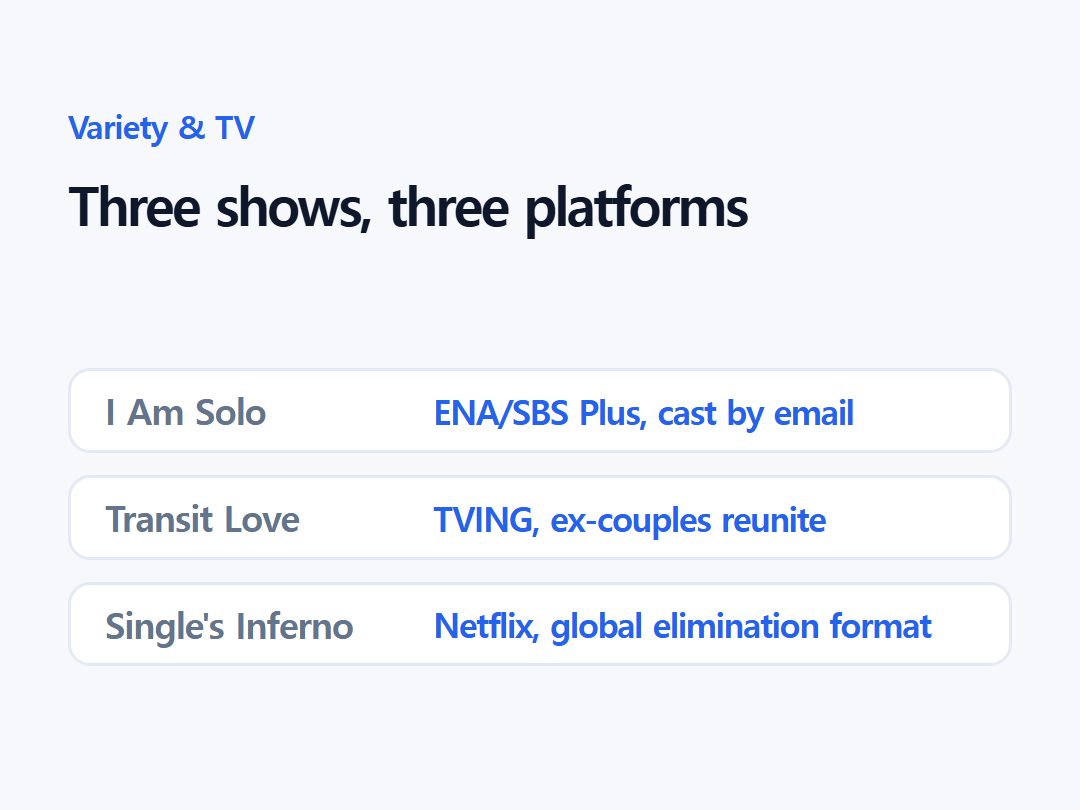
I Am Solo, syndicated by cable channels ENA and SBS Plus since 2021, sends six men and six women to a fictional setting called “Solo World” each season. A September 2023 broadcast drew a combined nationwide rating of 6.541%, a series best at the time, and the show remains one of Korean non-drama TV’s most consistent ratings performers.
Transit Love — its Korean title, Hwaseung Yeonae, literally means “transfer romance” — streams on the subscription platform TVING and reunites four broken-up couples to see whether they reconcile or move on. Producers said casting its fourth season alone took nearly five months, starting from about 100 applicants.
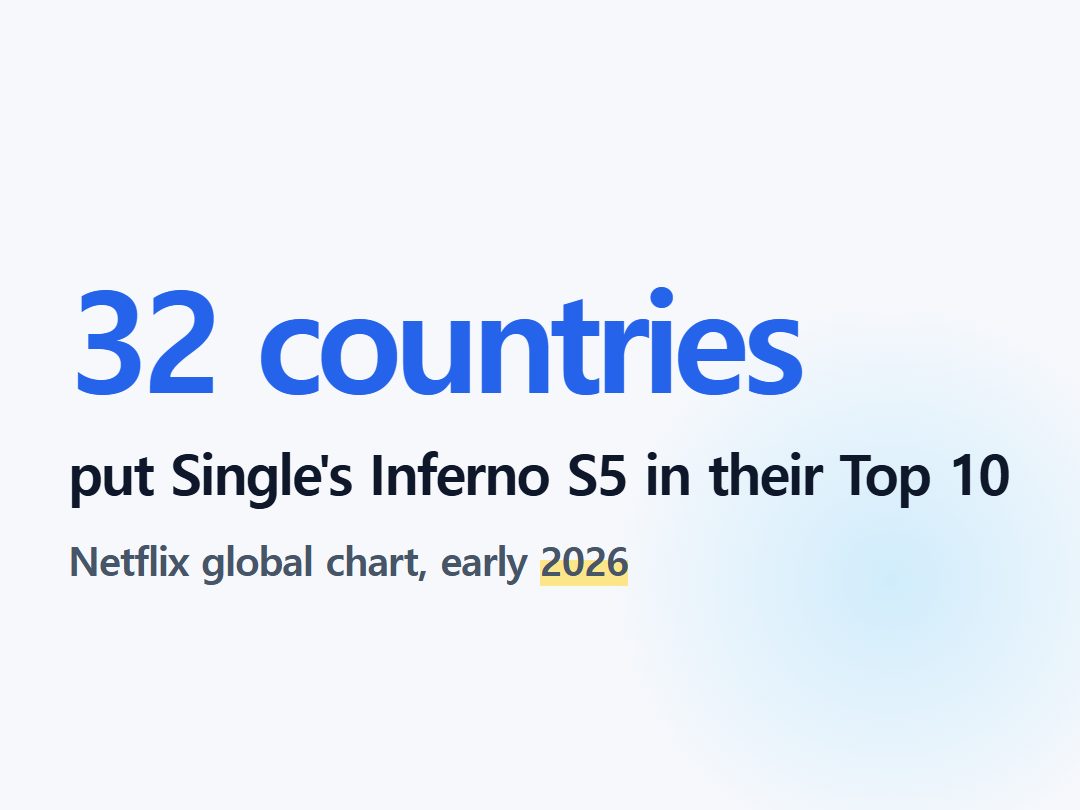
Single’s Inferno, Netflix’s own entry, has traveled furthest internationally. Its fifth season reached No. 2 on Netflix’s Global Top 10 Non-English TV chart in early 2026 and landed in the Top 10 in 32 countries, from Brazil to Japan to the UK.
| Show | Platform | Central hook |
|---|---|---|
| I Am Solo | ENA / SBS Plus | No scouted cast, applications by email |
| Transit Love | TVING | Ex-partners meet again, cameras hidden |
| Single’s Inferno | Netflix | Island elimination format, global cast reach |
Why producers don’t need a single star
Korean variety shows built around celebrities are expensive. Industry figures cited by cast member Kim Gu-ra put a typical variety episode’s budget around 160 million won (about $123,000), and a single top-tier actor’s appearance fee can run past 100 million won for one episode — enough to swallow most of that budget alone.
Dating shows sidestep that cost almost entirely. A producer told the Korea Herald that non-celebrity cast members’ appearance fees are “significantly less than what celebrities command, making the productions highly cost-efficient.”
Industry analysts have gone further, describing the format as “value-for-money content.” Casting and location costs stay low, yet a hit can still dominate the ratings chart.
The pitch is that the viewer is the star, not the cast
This is the part international audiences most often miss: the appeal isn’t the cast’s fame — it’s the absence of it. A dating show doesn’t need a K-pop idol or an established actor to draw attention, because the entire premise depends on contestants feeling like someone the viewer might actually know.
Producers describe this openly. Viewers “can easily empathize” with dating-show contestants, one told the Korea Herald, “as they see their own experiences... reflected in the honest and unfiltered appearances.” A K-pop group’s comeback or a drama’s love triangle asks viewers to watch someone else’s story; a dating-survival show asks them to imagine their own.
That single mechanic — low cost paired with high viewer self-insertion — is why the genre has scaled the way it has. A network doesn’t need a bankable star to generate a hit; it needs a premise ordinary enough that millions of viewers can picture themselves inside it.
A 2011 show called The Mate set the template — and exposed its risk
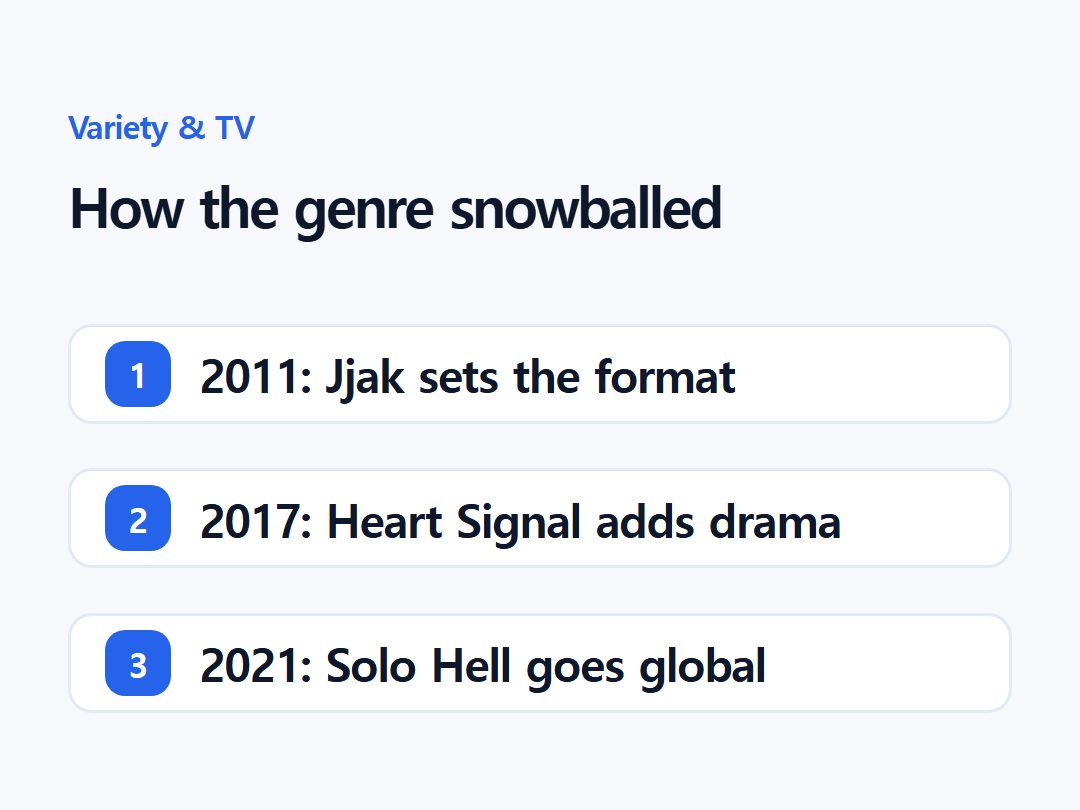
The format’s roots go back further than most viewers realize. SBS’s Jjak (“The Mate”), which premiered in 2011, gathered about ten men and women at a Jeju Island guesthouse nicknamed “Lovetown,” identified them by number instead of name, and ran them through physical challenges to win a date.
The show was cancelled in 2014 after a 29-year-old contestant died by suicide, with past participants later describing bullying and humiliation during filming. It was an early, painful signal of a tension the genre has never fully resolved: putting ordinary people, not trained performers, under sustained emotional pressure for entertainment.
Heart Signal added drama; Single’s Inferno turned it into an export
Channel A’s Heart Signal, launched in 2017, is widely credited with reigniting the genre after Jjak’s collapse. It filmed eight people living together for a month while a celebrity panel guessed who secretly liked whom.
Critics called it a “more dramatized” format, closer to watching a melodrama unfold in real time than a standard dating show. It has since run five seasons.
Netflix’s Single’s Inferno, which debuted in December 2021, became the first Korean unscripted series to reach Netflix’s global Top 10 for non-English TV. By its fourth season in January 2025, it had logged 4.8 million views and 23.1 million hours watched in a single week.
Season 5 broke that record again, at one point drawing 37.3 million hours watched in a single week. It ranked No. 1 in South Korea, Hong Kong, and Singapore.
The format keeps stretching to stay novel
With dozens of dating shows now competing for the same premise, producers have pushed the concept into new territory to stand out. Recent entrants include:
- My Sibling’s Romance (JTBC) — siblings help each other date
- Chain Reaction (Coupang Play) — paired contestants are physically chained together
- Possessed Love (SBS) — a hidden-camera dating experiment now on its second season
Korea also aired its first dating show built around bisexual contestants in mid-2026, and a separate program has begun testing AI-generated companions as romantic partners for human cast members — both signs that the format’s core mechanic is being applied to premises well beyond its original single-and-searching template.
Ordinary casting comes with an ordinary-person risk
Recruiting non-celebrities cheaply also means skipping the background vetting that agencies typically do for their own talent. The industry now has a name for what happens when that gap surfaces: “non-celebrity risk.”
In June 2025, a Season 25 participant on I Am Solo was arrested on quasi-rape charges tied to an incident in Seoul’s Mapo district; his footage was pulled from the show and its spinoff. An earlier cast member from Season 10 was fined 7 million won for assault.
On the Wavve series ToGetHer, a contestant’s scenes were removed entirely after allegations that she had worked in adult content and prostitution.
Media professor Lee Moon-haeng has argued that broadcasters need stricter background checks and legal accountability clauses before casting, saying the cost savings no longer justify the reputational damage when a scandal breaks mid-broadcast.
Producers and critics disagree about how far is too far
The clearest sign the genre may be reaching a limit arrived in August 2026, when SBS premiered Love Against Time, a dating show. Its contestants have terminal diagnoses or histories of life-threatening illness, and they exchange units of their remaining time to build relationships.
Reaction split immediately. Supporters called it a rare dating opportunity for people who struggle to date conventionally, while critics said the premise “risks turning their vulnerable circumstances into a form of entertainment.”
Pop culture critic Jung Duk-hyun has framed the broader problem as one of purpose, not shock value. “The genre has reached a kind of creative ceiling,” he said.
He warned that provocation without meaning won’t hold an audience: “If these shows remain at the level of simple provocation, they’re no longer sustainable.” Whether the next wave of concepts serves that purpose, or simply escalates it, remains open.
How the genre evolved
| Year | Show | Milestone |
|---|---|---|
| 2011 | Jjak (The Mate) | Set the format's template; cancelled in 2014 after a contestant's suicide |
| 2017 | Heart Signal | Reignited the genre with a more dramatized format; ran five seasons |
| 2021 | Single's Inferno | First Korean unscripted series to reach Netflix's global Top 10 |
| 2025 | Single's Inferno S4 | 23.1 million hours watched in a single week |
| 2026 | Single's Inferno S5 / Love Against Time | 37.3 million hours watched; genre tests limits with terminal-illness cast |
Frequently asked
Why are Korean dating shows so cheap to produce?
Non-celebrity cast members' appearance fees are far lower than a top-tier actor's, whose single-episode fee can run past 100 million won.
What happened to Jjak, the original Korean dating show?
Jjak was cancelled in 2014 after a 29-year-old contestant died by suicide, following reports of bullying and humiliation during filming.
How well is Single's Inferno doing internationally?
Season 5 reached No. 2 on Netflix's Global Top 10 Non-English TV chart, landed in the Top 10 in 32 countries, and drew 37.3 million hours watched in one week.
Sources
Every factual claim above is traceable. We do not translate articles — we gather facts from multiple outlets and write them ourselves.
- 'Single's Inferno 5' ranks No.2 on Netflix Global Non-English TV Chart, proving a record breaking season — allkpop
- Single's Inferno season 5 sets a new Netflix viewership record — Primetimer
- Dating Show "I Am Solo" Soars To Its Highest Ratings Yet Of 100+ Episode Run — Soompi
- Bed Blind Dates and Cohabitation: Dating Shows Grow Bolder Amid IP Race — Seoul Economic Daily
- 'Non-celebrity risk' shakes Korean dating reality TV — The Korea Herald
- 'Heart Signal,' the show that started Korean dating TV rush, is back again — The Korea Herald
- Korea's dating show for the terminally ill sparks debate ahead of premiere — The Korea Herald
- Dating-themed reality shows evolve, show different paths to love — The Korea Times
- Korea's SBS Cancels Dating Show After Contestant Suicide — Yahoo/AFP
- Transit Love Series (EXchange) — NamuWiki