International fans who watch Korean variety shows have all seen the moment: a host tells a guest, usually a woman, "show us some aegyo," the guest freezes, the studio audience screams before anything even happens, and a clip of pouted lips and a squeaky voice ends up on social media captioned simply "cute." That caption is the problem. Aegyo (애교) gets translated as "cuteness" or "acting cute" because English has no closer word, but the translation drops the two things that actually matter: aegyo is something you perform, not something you are, and it comes with rules, a script, and a running argument in Korea about who is allowed to demand it.
The short version
- Aegyo is a performed Korean style, not an English-style innate trait.
- Weekly Idol turned aegyo into a graded songbook idols must know.
- Critics call it 'forced aegyo,' a gendered pressure watchdogs want reduced.
What does aegyo actually mean in Korean?
Aegyo is written with the hanja (Chinese-derived characters used in Korean) 愛嬌, combining "love" and "charming." The same two characters exist in Japanese, read aikyō, where they keep an older, broader meaning close to natural amiability.
Korean usage narrowed and sharpened that meaning: aegyo became something a person switches on, not a trait they simply have. The grammar gives this away. Koreans do not say someone "has" aegyo the way an English speaker says someone "has" charisma.
They say a person 부린다 (puts on) or 떤다 (lays on) aegyo — the same verbs used for putting on an act. The Korean dictionary itself defines it as "an attitude of appearing cute to others," which is a definition about technique, not personality.
That distinction is why a flat English gloss like "cute" or "cutesy" fails. Cuteness in English is usually read as a quality a person or thing possesses. Aegyo is closer to a register of speech and gesture that a Korean speaker can turn on for a specific audience and purpose, then turn off. Understanding that gap is the point of this piece.
Is aegyo cute performance or forced behavior?
Aegyo is built from identifiable, repeatable components, which is part of why Korean media can standardize and even grade it.
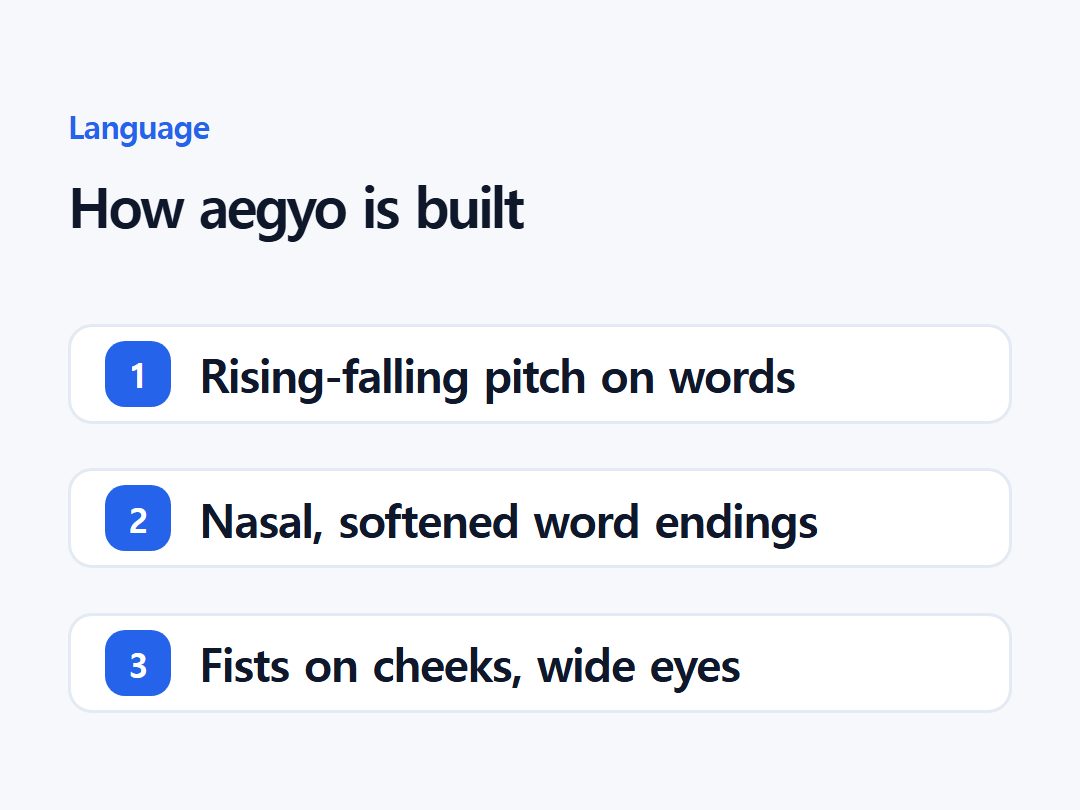
Linguists who study the style point to a small set of recurring resources: a rising-then-falling pitch on the final syllable of a sentence, often written with a tilde (~) to mark it in text; nasal vowels and an added ㅇ sound at the end of casual verb endings, so that 밥 먹어요 ("I'm eating") becomes the softer-sounding 밥 먹어용; and "infantile" consonant shifts, where a normal past-tense ending like 했어 becomes 했쪄.
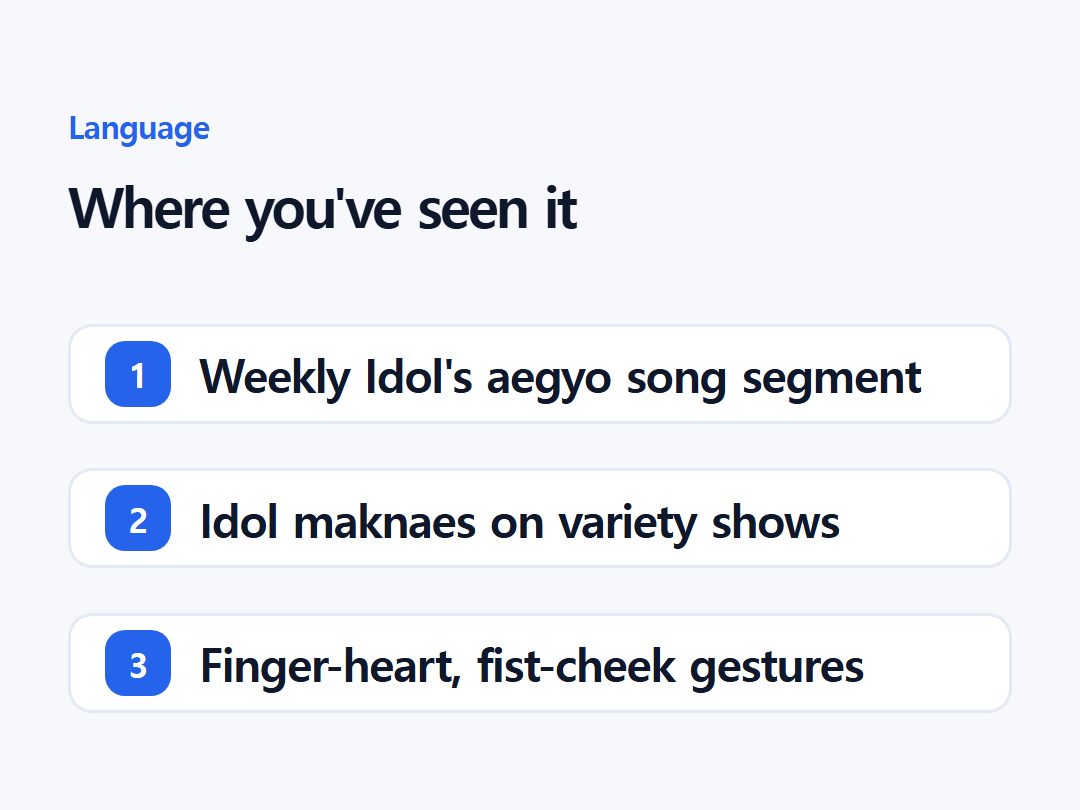
Physically, aegyo pairs this speech with widened eyes, cheek-puffing, and the well-known gesture of pressing both fists to the cheeks while saying 뿌잉뿌잉 — an onomatopoeia for cuteness that functions like a live sound effect.
The address term 오빠 (oppa, what a woman calls an older brother, older male friend, or boyfriend) is considered the single most aegyo-loaded word in the language, because stretching and pitching it turns a simple form of address into something closer to a plea.
Because these are learnable techniques rather than a fixed trait, Korean entertainment treats aegyo as a skill to be tested on camera, and has built an entire televised economy around watching people attempt it.
The long-running music variety show Weekly Idol (주간 아이돌, 2011–2025) turned this into a recurring segment built around an actual songbook: idol guests are challenged to perform short "aegyo songs" — titles include the Ottoke Song, the Yam Yam Song, and Naekkohae — that were written and composed for the show by Hyojung of the group OH MY GIRL.
These are not improvised; guests are expected to know a fixed, shared repertoire, the way a stand-up comedian is expected to know a set list.
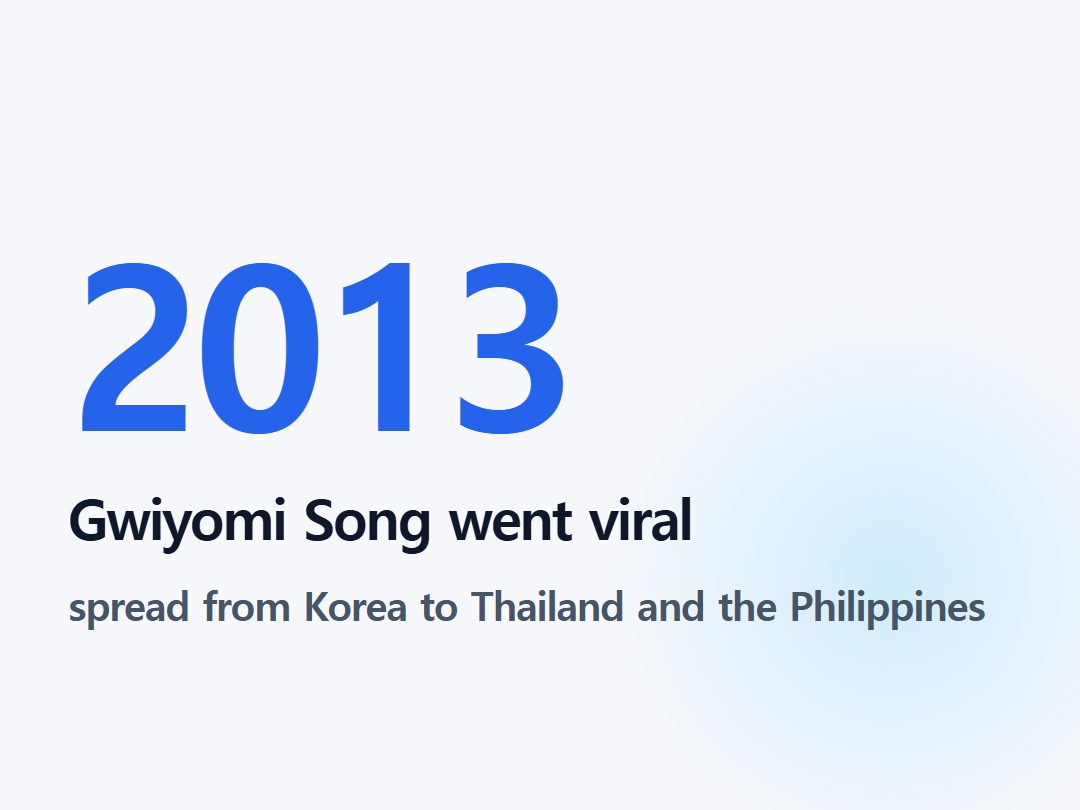
A related segment format, the "aegyo battle," grew out of a 2012 web meme when BTOB member Jung Il-hoon performed a hand gesture called the "Gwiyomi Player" on his group's reality show.
When singer Hari built a 2013 novelty single called "The Gwiyomi Song" around counting gestures matched to numbers, the combination went viral across Korea and then across Southeast Asia — Philippine noontime television and Thai teen audiences both picked it up — turning a private in-joke into an industry-wide, internationally exported ritual that nearly every debuting idol was expected to perform for a period.
Inside idol groups specifically, aegyo duty is often distributed by role rather than left to chance.
The maknae (막내, the youngest member of a group) is typically expected to carry the heaviest aegyo load, on the assumption that youth licenses the performance, while some groups designate an informal "aegyo prince" or "aegyo princess" to handle these bits during variety show appearances.
Doing it well is treated as a marketable skill: Korean press has credited aegyo moments with launching individual careers, pointing to actress Hyeri's early variety-show aegyo appearances as a factor in her casting for the drama Reply 1988, and to TWICE member Sana's "shy shy shy" line from the song "Cheer Up" becoming a signature moment that raised her media profile independent of the group.
With roughly five dozen new idol groups debuting in a typical year in South Korea, agencies treat the ability to perform aegyo convincingly as a competitive asset alongside singing and dancing.
The same performance carries real social risk, which is what separates it from ordinary cuteness.
A widely cited 2009 moment from a Girls' Generation variety appearance illustrates the stakes: when a panel asked each member in turn to perform aegyo, member Sooyoung said "I really can't do aegyo, I don't have aegyo," attempted a version anyway, and was judged by hosts and online audiences to have failed — not because the gestures were wrong, but because visible effort and discomfort undercut a performance that is supposed to look spontaneous while everyone in the room knows it isn't.
That paradox, effortless-looking effort, is exactly what makes aegyo a skill rather than a mood.
There is also an unresolved gender argument underneath the entertainment.
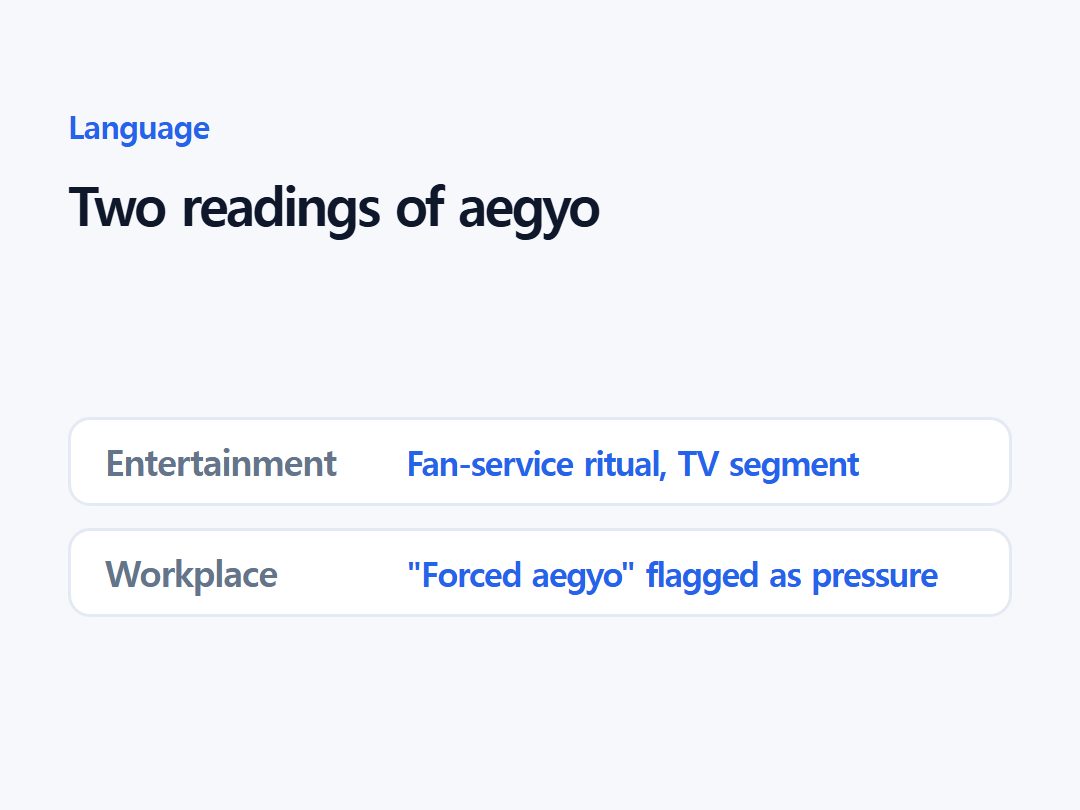
Because aegyo is disproportionately demanded of young women, and because critics describe it as a kind of adult infantilization, Korean media watchdogs have pushed back on how variety shows use it. A 2020 broadcast-monitoring report by the Seoul YWCA, examining gender stereotypes in popular Korean variety programming, flagged instances where female cast members were pressed into aegyo-style routines in ways that framed adult women as fragile or childlike for comic effect, and called for the practice to be phased out of entertainment formats going forward.
The term 애교 강요 ("forced aegyo") has entered Korean workplace-harassment vocabulary to describe situations, outside of entertainment, where women are pressured to perform this register for male superiors or clients.
So the same word covers a fan-service ritual millions of people enjoy watching and a documented form of gendered pressure that Korean advocacy groups are actively trying to name and reduce — both readings are current and neither cancels the other out.
From a 1920s novel to a beauty-industry term
The word aegyo is not new. It appears in a Korean novel from 1923, where it described a quality a person gently possessed — closer to the older, broader sense still current in Japanese.
What changed over the following decades was Korean broadcast media's habit of extracting that quality and turning it into a repeatable, on-demand act: a segment format, then a songbook, then a graded skill with a right and wrong way to do it.
The 2012–2013 Gwiyomi Song wave marked the moment aegyo shifted from something performed occasionally on variety shows into something with its own viral choreography that ordinary fans, not just idols, were expected to be able to reproduce. Weekly Idol's standardized aegyo-song catalog, maintained across more than a decade of the show's run, then formalized the ritual further, giving every new idol generation a shared, testable repertoire rather than an improvised one.
Aegyo also spread beyond behavior into the beauty industry: 애교살 (aegyo-sal, literally "aegyo flesh") is the cosmetics-industry term for the small pouch of fat beneath the eye that makes a smile look younger, and Korean beauty counters sell products specifically to draw one on — evidence of how thoroughly the concept of performed cuteness has been absorbed into everyday self-presentation, not just idol culture.
No regulation yet, but attitudes are shifting
Two threads remain open.
One is generational: younger Korean cast members and fans increasingly treat exaggerated aegyo segments as a genre to be sent up rather than performed straight, and it is an open question whether formats like the Weekly Idol aegyo song survive a wider generational shift the same way they have for over a decade.
The other is the gender debate itself — advocacy groups continue to monitor variety programming for forced-aegyo content, but no broadcast regulator has issued binding rules specifically on the practice, so whether Korean TV formats change is currently a matter of production choices and public pressure rather than policy.
Both are worth watching for anyone tracking how Korean entertainment negotiates its own most recognizable, least translatable performance style.
Five techniques, from pitch shifts to cheek gestures
| Type | Technique | Example |
|---|---|---|
| Speech | Rising-then-falling pitch on the final syllable | Marked with a tilde (~) in text |
| Speech | Nasal vowels / added ㅇ sound | 밥 먹어요 → 밥 먹어용 |
| Speech | "Infantile" consonant shift | 했어 → 했쪄 |
| Gesture | Fists pressed to both cheeks | 뿌잉뿌잉 |
| Address term | Stretched, pitched delivery | 오빠 (oppa) |
Frequently asked
What does aegyo mean in Korean?
Aegyo (애교) is a performed style of cute speech and gestures, using techniques like pitch changes and baby-talk endings, rather than a fixed personality trait, which is why English words like 'cute' don't fully translate it.
What is 'forced aegyo' (애교 강요)?
It describes situations outside entertainment where women are pressured to perform aegyo-style cuteness for male superiors or clients, a practice Korean advocacy groups like the Seoul YWCA have criticized in variety programming.
What is the Gwiyomi Song?
It's a 2013 novelty single by singer Hari built around counting gestures, which went viral across Korea and Southeast Asia after growing out of a 2012 hand-gesture meme started by BTOB's Jung Il-hoon.
Sources
Every factual claim above is traceable. We do not translate articles — we gather facts from multiple outlets and write them ourselves.
- Aegyo — Wikipedia
- Aegyo Doesn't Mean Cute: 애교, and Why Korea Argues About How It's Done — 82 Crafted
- What do you know about 'aegyo'? — The Korea Herald
- The Gwiyomi Song — Wikipedia
- The Gwiyomi Song — Know Your Meme
- 2020년 한국 예능, 여전히 '남자는 울지 않고 여자는 애교 강요' — Media Today (미디어오늘)