Ask a Korean speaker to translate 후배 (hoobae) into English, and most will say "junior," then hesitate. Every Korean-English dictionary offers the same short list of options — junior, protégé, underclassman — and none of them is exactly wrong. What they leave out is that hoobae was never a job description.
It is one half of a paired relationship, matched with 선배 (sunbae, "senior"), that comes with rules an English speaker has never had to learn, because English has never needed them.
The short version
- Hoobae means junior, but English skips the obligations built into the word.
- Entry order sets sunbae/hoobae rank, not age — even one day counts.
- Oxford added sunbae in 2026; hoobae still has no English dictionary entry.
"Junior" is the dictionary's whole answer, and it isn't enough
A junior colleague in English is simply someone with less experience or a lower rank. A hoobae is that too, but the word also assigns a set of duties the moment it's spoken: how you address the person, how you're expected to behave around them, what you owe them, and what they owe you.
Swap "hoobae" for "junior" in a sentence and the rank survives, but the obligations disappear. That is the actual gap, not a matter of Korean having a fancier word for the same idea.
Whoever arrived first outranks whoever is older
The detail that trips up most outsiders is that sunbae/hoobae status is set by order of entry into a shared school, company, team, or industry — not by birth year. A 25-year-old who joined a company two years before a 30-year-old new hire is that colleague's sunbae, without exception.
K-pop makes this concrete. BTS, who debuted in 2013, are sunbae to Stray Kids, who debuted in 2018 on the same label, regardless of any age gap between individual members. Debut date decides who bows to whom, not birthday.
The hierarchy runs on debts owed in both directions
What makes hoobae resist translation is that it names one end of a two-way arrangement, not just a rank. Korean workplace convention expects a sunbae to actively look after the people who came after them.
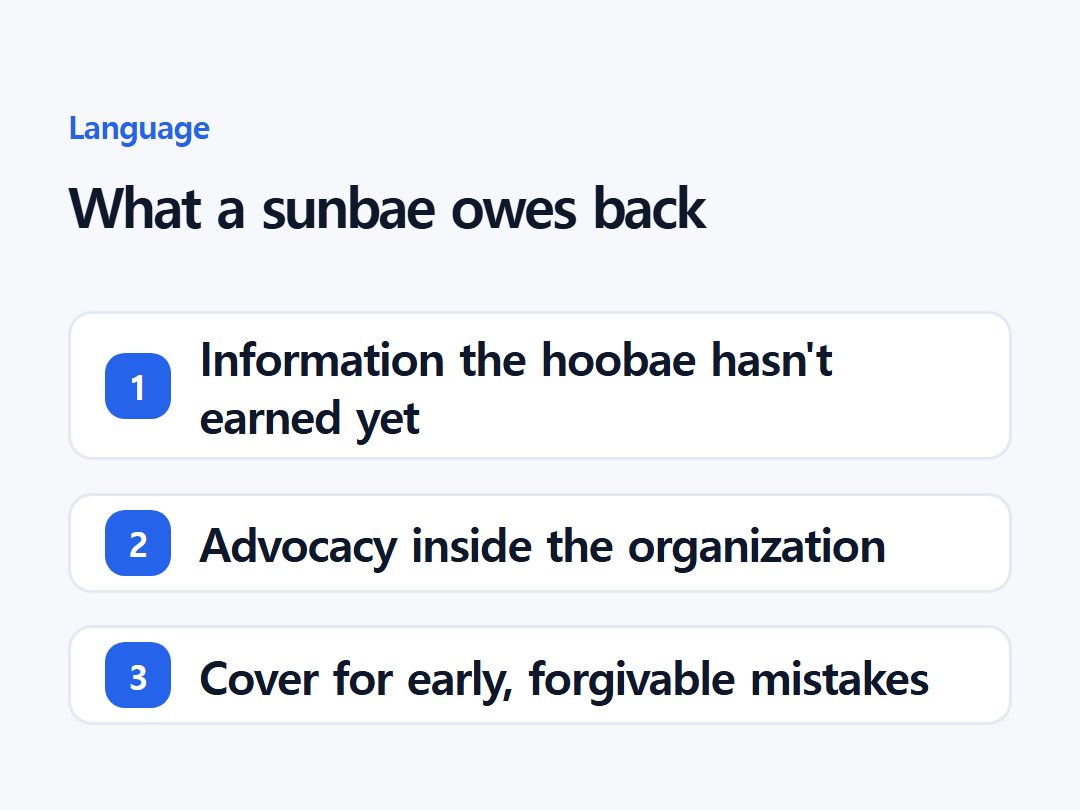
- Share information the hoobae hasn't had time to learn yet
- Advocate for the hoobae inside the organization
- Absorb some of the blame for a hoobae's early, forgivable mistakes
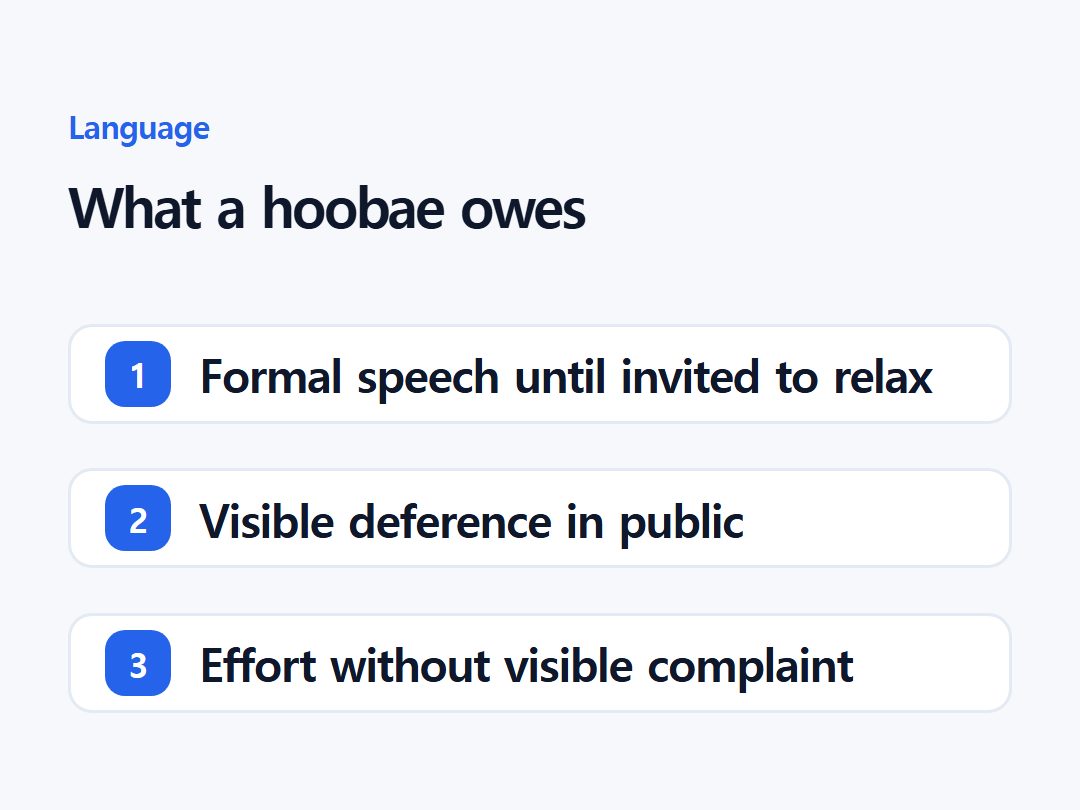
A hoobae owes the visible half back: correct speech level, public deference, and effort without complaint, until the sunbae signals it's safe to relax. Neither English "senior" nor "junior" carries any of this — they describe a rank, not a running account of favors owed.
Where the rule is loudest: idol debut order
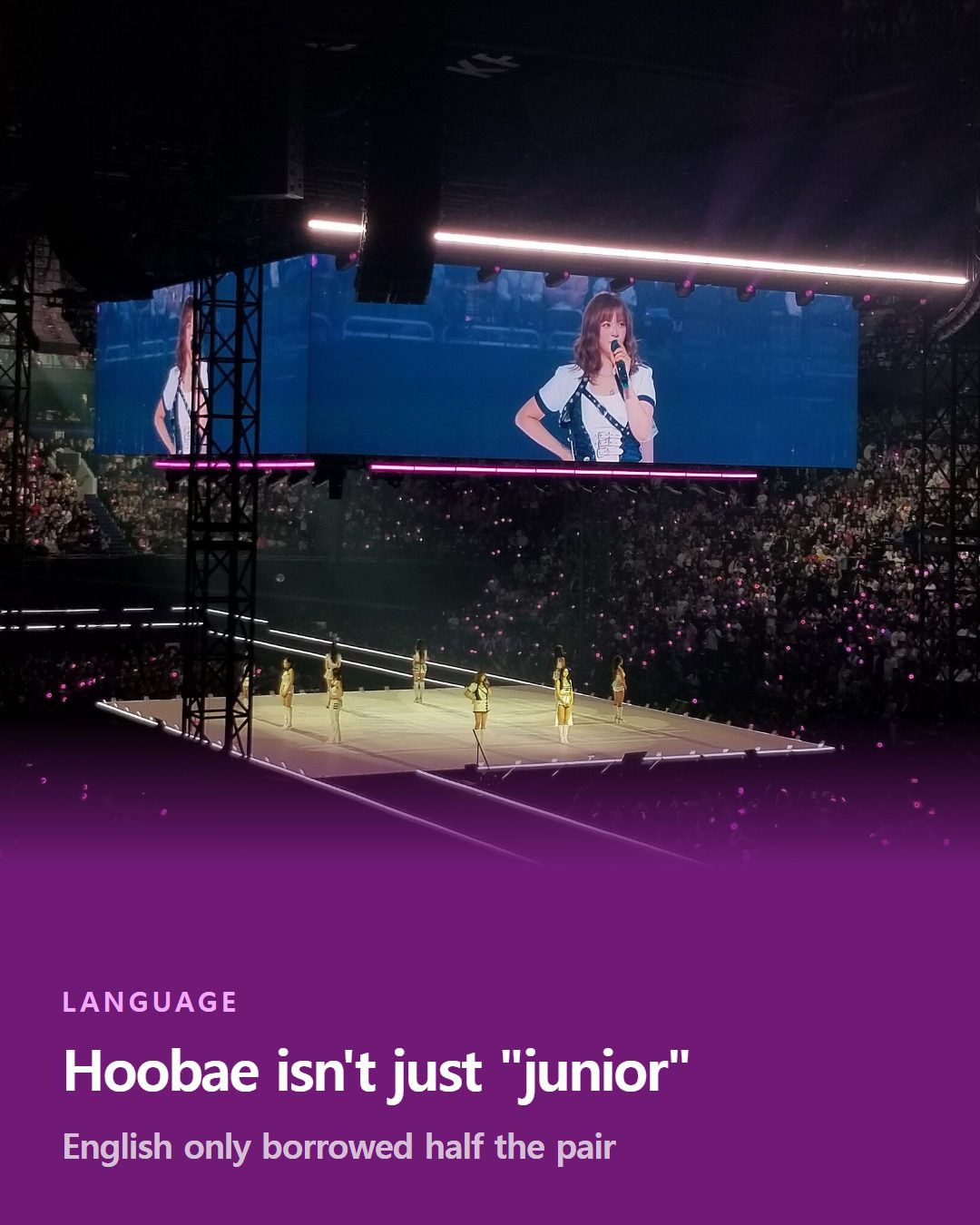
Korean entertainment stages this hierarchy on camera more than almost any other industry. At televised music shows, newly debuted groups are expected to visit the waiting rooms of established acts, bow, and formally introduce themselves — even when the "junior" idol happens to be older in age.
"In fact, there would be no problem if we drew a clear line between sunbae and hoobae relations, but recently since the idol groups became more competitive, that distinction is becoming less apparent and it is beginning to cause problems."
That line, from an entertainment-company official quoted by Soompi, points to a real strain: as debut schedules compress and age gaps between generations of idols shrink, the entry-order rule and the age-based instincts of ordinary Korean social life increasingly pull in different directions.
Oxford added "sunbae" in 2026 — hoobae still hasn't made it in
In January 2026, the Oxford English Dictionary added eight Korean-origin words, among them sunbae, defined by Oxford's Korean-language consultant as "a senior member of a group based on age or experience." Coverage of the update specifically framed the entry as necessary because sunbae describes a hierarchical social title that plain English "senior" doesn't capture.
Sunbae joined earlier Korean relational terms Oxford has added in recent years, including hyung, maknae, and nuna. Hoobae was not part of this batch, or any earlier one.
English Wiktionary, the crowdsourced dictionary, already tracks "hoobae" as a borrowed noun, with citations in English-language text going back to at least 2010.
But being logged by Wiktionary is different from being certified by Oxford: one records that a word has occasionally been used in English, the other confirms that ordinary readers no longer need it explained. By that measure, hoobae still needs the explanation every time.
Subtitles force a choice English scripts don't require
The gap shows up constantly in K-drama and K-pop content translated for global streaming. Korean routinely sorts relationships into address terms tied to rank, age, and closeness; English defaults to first names.
Academic analysis of English-language fan subtitles for Korean dramas has found that translators most often keep the original Korean term — sunbae, hoobae, oppa — rather than force an English stand-in, because no single English word survives the transplant intact.
The stakes aren't cosmetic. In a workplace drama, a hoobae detective who starts speaking to a sunbae less formally can be signaling that respect has broken down, or that a professional bond has turned personal. Flatten both lines to plain English, and that signal disappears along with the honorific.
Old characters, a habit that's newer than it looks
The word looks ancient because its building blocks are. 後 ("after") and 輩 ("a cohort of people") combine to form 後輩, literally "the group that came after," mirrored by 先輩 (sunbae), "the group that came before."
The same two characters, read senpai and kōhai, produced Japanese's version of the same concept — and gave English the loanword "senpai," which Merriam-Webster has tracked in edited English text since at least 2011. Its counterpart, kōhai, never crossed over the same way.
That asymmetry repeats exactly with the Korean pair: senpai made it into English usage, sunbae made it into Oxford, and neither kōhai nor hoobae has followed. English appears to keep the word for the person owed deference and let the word for the person owed protection stay behind.
When the unwritten deal breaks, Korea has a name for the failure
The system depends on sunbae actually fulfilling their half of it. When deference is demanded without mentorship or protection offered back, Korean has a separate, widely used word for that failure mode: 갑질 (gapjil), the abuse of hierarchical power by a senior over a junior.
The problem became serious enough to produce legislation. An amendment to Korea's Labor Standards Act took effect in July 2019 — the country's first law to explicitly define and regulate workplace harassment — requiring employers to investigate reports and barring retaliation against employees who file them. Further amendments strengthened enforcement in October 2021.
What a law can regulate, and what it can't
| Arrival order | Result |
|---|---|
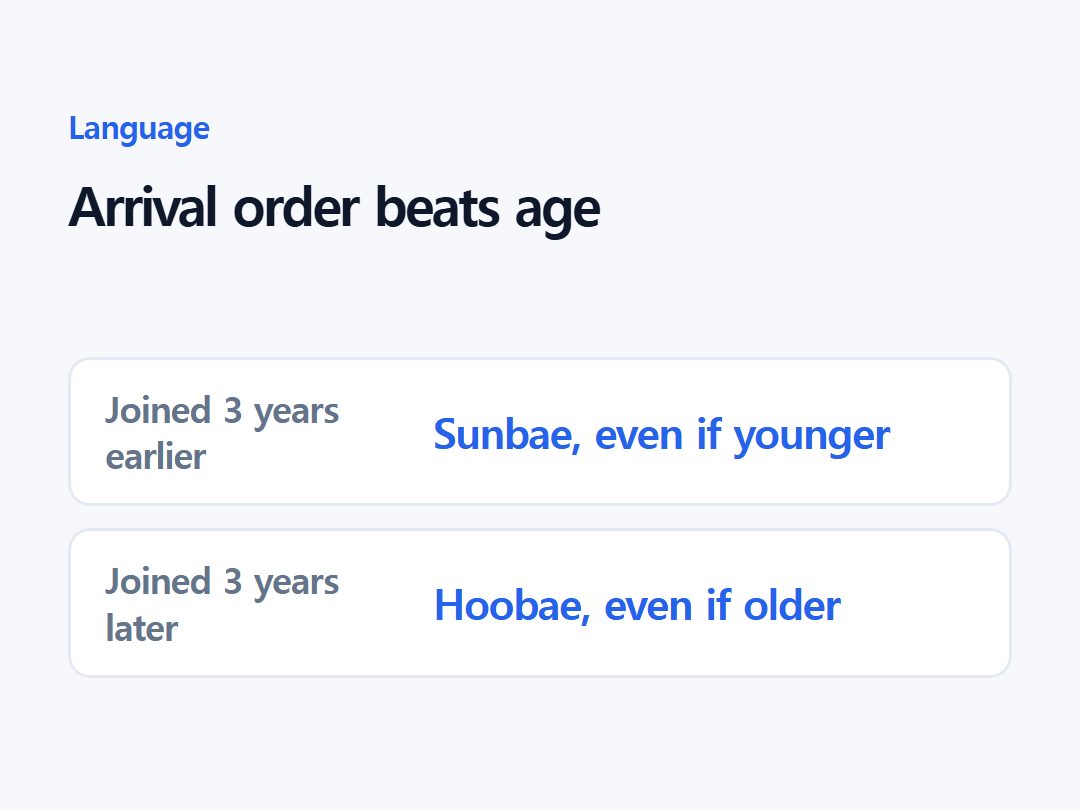
| Joined 3 years earlier | Sunbae — even if younger |
| Joined 3 years later | Hoobae — even if older |
Legislation can penalize retaliation against people who report abuse. It cannot legislate away the underlying assumption that arrival order creates a debt — and that assumption is exactly what makes hoobae resist a one-word English translation in the first place.
Survey data since the 2019 law has been mixed: only an estimated 40% of Korean workers say workplace harassment has actually decreased, while a large majority of respondents in separate polling still report experiencing some form of gapjil.
Whether that balance shifts, and whether English ever imports a word for the junior half of the relationship the way it imported "senpai" for the senior half, remain open questions.
How arrival order decides sunbae or hoobae rank
| Arrival order | Result |
|---|---|
| Joined 3 years earlier | Sunbae — even if younger |
| Joined 3 years later | Hoobae — even if older |
Frequently asked
What is the difference between sunbae and hoobae?
Sunbae is the senior half of the pair and hoobae is the junior half; the split is decided by who joined a shared school, company, or team first, not by age.
Is hoobae based on age or seniority?
It's based purely on order of entry — a 25-year-old who joined a company two years before a 30-year-old new hire is that colleague's sunbae, without exception.
Is hoobae in the Oxford English Dictionary?
No. Oxford added sunbae in January 2026 as part of a batch of eight Korean-origin words, but hoobae was not included in that update or any earlier one.
Sources
Every factual claim above is traceable. We do not translate articles — we gather facts from multiple outlets and write them ourselves.
- Ramyeon, ajumma enter Oxford English Dictionary — The Korea Herald
- How the Terms "Sunbae" and "Hoobae" Work in the K-Pop Industry — Soompi
- What Does 'Senpai' Mean? — Merriam-Webster
- hoobae — Wiktionary
- Moments of relational work in English fan translations of Korean TV drama — ScienceDirect / Journal of Pragmatics
- South Korean bosses can be jailed for dismissing bullied employees thanks to a new law — CNN
- Recent Developments in South Korea's Anti-Discrimination Laws — Littler