Watch enough "reacting to Korean for the first time" videos and the same language gets described two opposite ways in one breath — musical and sing-song, then, seconds later, sharp and clipped. Both reactions are responding to real, measurable features of Korean. The gap for international listeners isn't taste; it's not knowing what they're actually hearing.
The short version
- Korean's plain-tense-aspirated consonant split has no equivalent in English.
- Korean has no lexical stress, so syllables land with even, sing-song rhythm.
- A 2023 study found language pleasantness tracks familiarity, not acoustic properties.
Korean phonology explains both impressions at once. A rare three-way consonant system produces the sharpness, an unusual rhythm produces the melody, and a growing body of research on how humans judge language sound explains why the same phonemes land differently depending on who's listening.
None of this is about accent or dialect in the way a French or German accent shifts pronunciation. It's built into standard Korean itself, which is why the same contradictory reactions show up again and again, regardless of who is speaking.
A consonant split English doesn't have
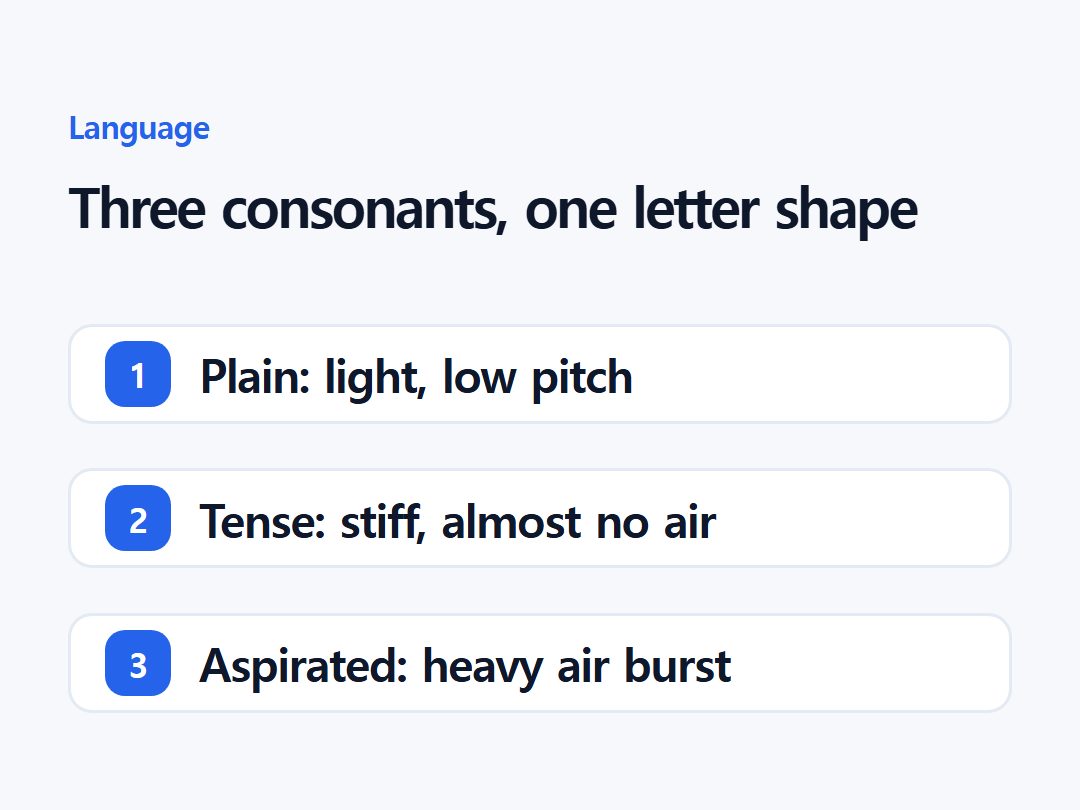
Korean marks many consonants with a three-way contrast — plain, tense, and aspirated — where English marks only two, voiced and voiceless. The three versions of "k" (ㄱ, ㄲ, ㅋ) differ by how much air and throat tension go into them, a property linguists measure as voice onset time.
- Plain (평음) — the default version: lower pitch, light air release
- Tense (경음) — a stiff throat and almost no air, written as doubled letters like ㄲ, ㄸ, ㅃ
- Aspirated (격음) — a heavy burst of air, the strongest of the three
Cross-linguistically this is rare. Most languages that distinguish stop consonants do it with voicing alone; building a third category purely out of muscular tension, without adding voicing, has no close English equivalent, which is one reason English lacks a natural way to even write the difference.
Why 빨리 lands harder than 살짝
Tense consonants are what most non-Korean listeners are reacting to when they call the language "clipped." "빨리" (ppalli, "quickly") is genuinely more forceful acoustically than a plain-consonant word of similar length — the tension is a real articulatory difference, not a listener's imagination.
Aspirated consonants sit at the other end, released with an audible puff of air. A single syllable can carry three distinct textures of the same base sound, which is part of why Korean can sound abrupt and soft within the same sentence. That contrast is also why romanization doubles the letter — pp, tt, kk — to signal the extra force in writing.
No syllable is stressed the way English stresses one
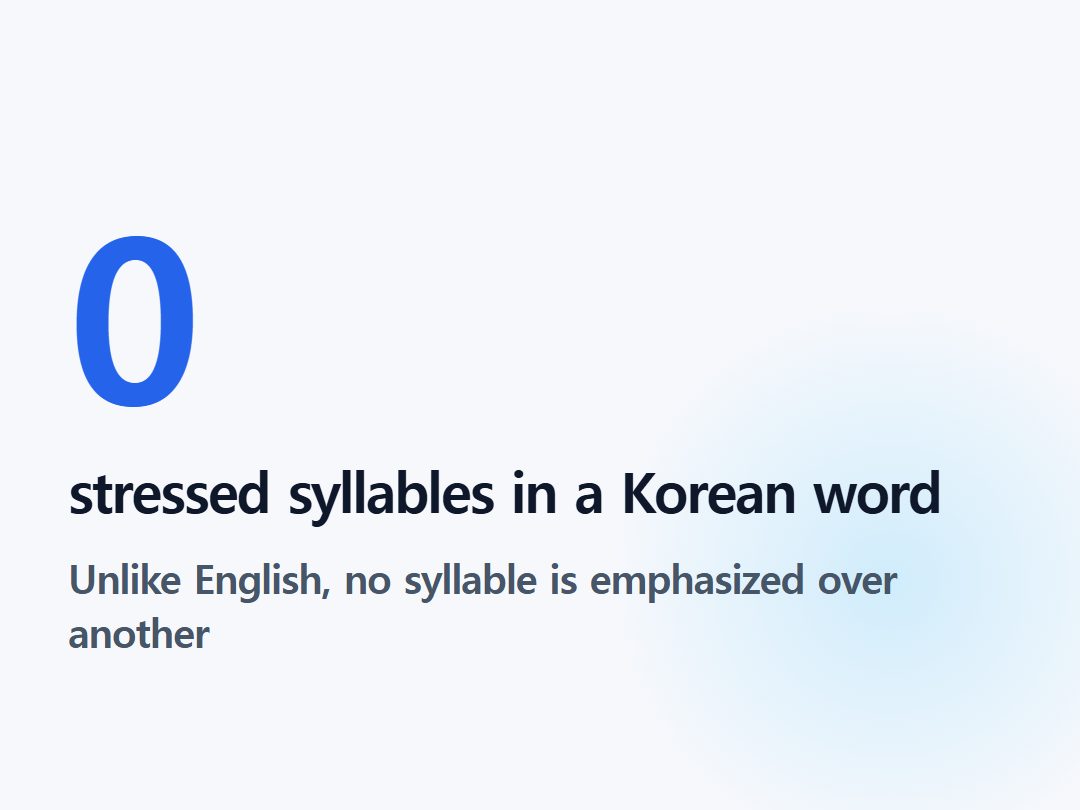
English leans on one syllable per word — PHOto, phoTOgraphy — and unstressed vowels get swallowed in the process. Korean has no lexical stress at all; syllables keep roughly equal weight, closer to what linguists call syllable-timed rhythm than English's stress-timed pattern.
To an ear trained to listen for a stressed beat, that evenness can register as speed. The syllables arrive at a steady clip with no obvious lull to anchor on, which is a separate effect from the consonant sharpness above.
The pitch pattern that makes phrases rise and fall
Instead of stress, Korean organizes prominence around pitch, in a unit linguists call the Accentual Phrase — a short stretch of speech with a characteristic low-high-low-high contour that repeats across a sentence, independent of where individual word boundaries fall.
That repeating rise and fall is very likely the source of the "sing-song" description. The pitch genuinely moves in a patterned melody — just not the pattern a stress-based ear expects to hear.
The same language can sound gentle or militant
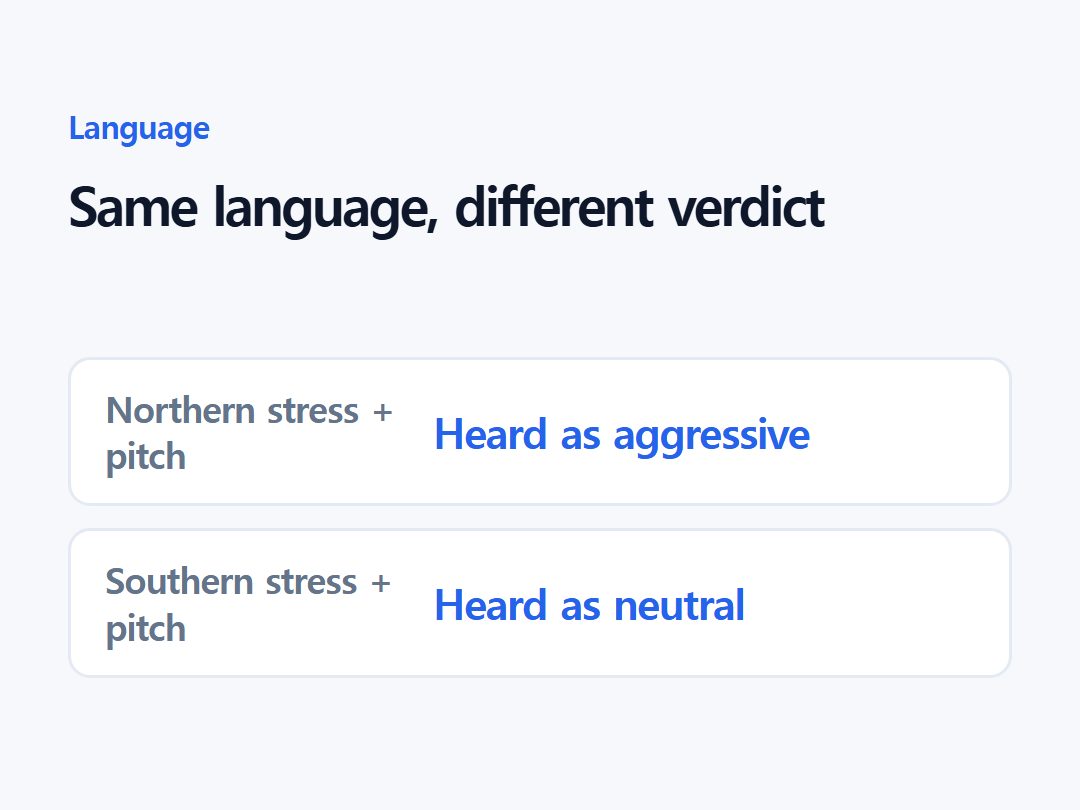
Korean itself proves that prosody, not the language, drives the "harsh" verdict. Research on North Korean speakers resettled in the South found that the heavier stress and higher pitch typical of the northern dialect gets read by southern listeners as aggressive and commanding — identical phonemes, different weight.
The same research notes that inside North Korea, those features are described as "high-spirited" and "courageous." The sound didn't change; the listener's frame did.
Standard Korean dropped pitch accent; some regions didn't
Seoul-based standard Korean, the basis for most media and language classes, lost lexical pitch accent in favor of the phrase-level pattern described above. Regional speech didn't all follow the same path — Gyeongsang Korean, spoken in the southeast, still uses pitch to tell apart words that are otherwise identical syllable for syllable.
That means two Korean speakers from different regions can sound meaningfully different to each other, not just to outsiders. What international listeners hear as "the Korean accent" in films and K-pop is really the Seoul standard that most exported media happens to use.
"Harsh" or "beautiful" is mostly about familiarity
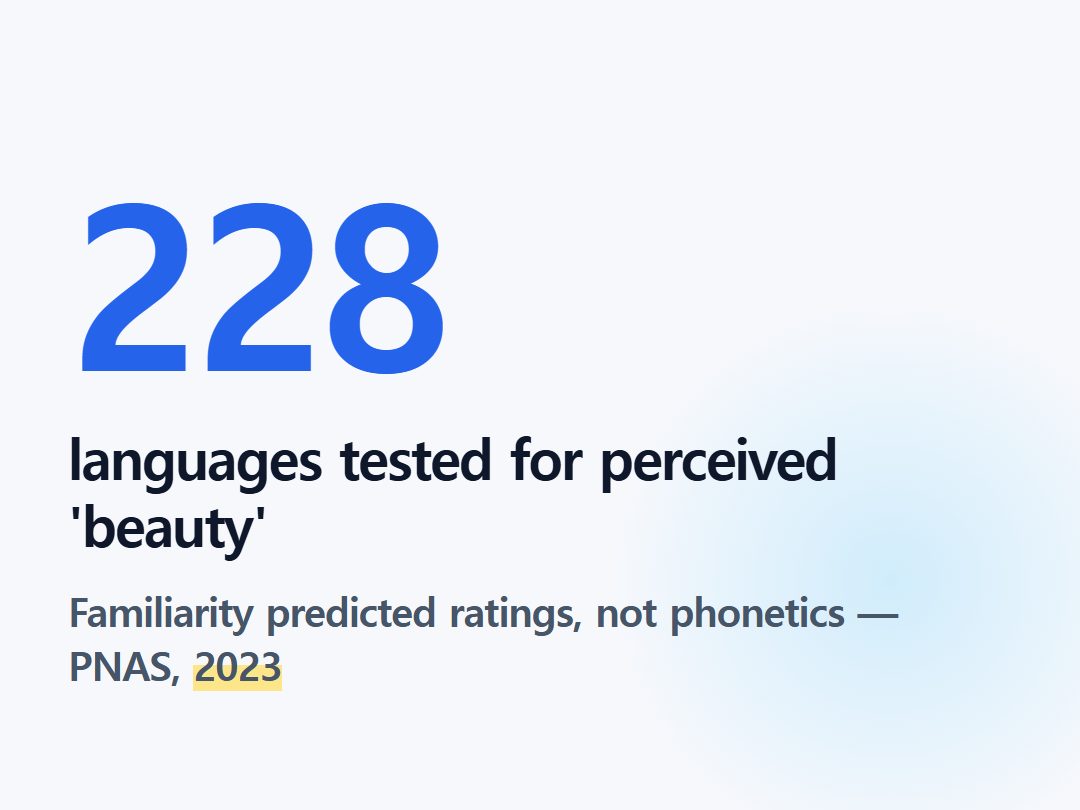
A 2023 study in the Proceedings of the National Academy of Sciences asked native speakers of English, Chinese, and Semitic languages to rate how pleasant 228 languages sounded. No phonetic feature reliably predicted the ratings — what did predict them was whether a language sounded familiar, even when listeners misidentified which one it was.
That finding undercuts the idea that Korean is objectively harsh or objectively musical. What moves the needle is exposure, not the language's acoustic properties.
Why the plain-tense-aspirated split trips up learners
The three-way contrast is one of the hardest parts of Korean pronunciation to acquire. Learners whose native languages mark only two categories — voiced and voiceless — often can't reliably produce or hear the difference, especially in the middle of a word rather than at the start.
Japanese learners, despite sharing grammar patterns with Korean, are specifically documented to struggle with the medial tense-versus-aspirated distinction. That's evidence the contrast is a genuine phonological hurdle, not just an unfamiliar accent.
English speakers tend to make the opposite mistake, hearing tense and plain consonants as the same sound and reaching for stress or volume to mark a difference that Korean doesn't encode that way.
How two decades of exposure moved the reference point
K-pop and Korean drama exports have done informally what the 2023 beauty study measured directly: raised the number of people for whom Korean now sounds familiar rather than foreign. The "reacting to Korean" video genre is itself a symptom of that shift, not a measurement of the language's inherent sound.
None of this changes the phonology. It changes how many listeners have logged enough hours to stop hearing the tense consonants as simply harsh.
Whether Korean keeps time by syllable or by stress
Linguists haven't fully settled how to classify Korean's rhythm. Most acoustic studies lean toward calling it syllable-timed, but measurements of consonant and vowel duration place Korean somewhere between syllable-timed and stress-timed languages rather than cleanly inside either category.
Simple syllable structure creates the impression of even timing, while frequent lengthening at the ends of phrases pulls the data toward stress-timed patterns. The classification debate stays open because the acoustic evidence points two directions at once.
It matters beyond theory: rhythm classification is part of what speech-recognition systems and pronunciation-teaching tools are built on, so an unsettled answer leaves those tools working from an approximation.
Whether "tense" is even a separate sound, technically
A narrower argument concerns the tense consonants themselves. Some phoneticians treat them as their own laryngeal category; others argue they're better analyzed as geminates — effectively doubled consonants — with the "tense" quality coming from length rather than a distinct manner of articulation.
Hangul's design already treats them as related: tense consonants are written as the plain letter doubled (ㄱ → ㄲ), a convention dating to the alphabet's creation in 1443 under King Sejong. Neither side of the modern debate disputes that tense consonants sound different to listeners — what's contested is the technical reason why.
Korean's three-way consonant contrast
| Consonant type | How it's produced |
|---|---|
| Plain (평음) | Lower pitch, light air release |
| Tense (경음) | Stiff throat, almost no air; written as doubled letters like ㄲ, ㄸ, ㅃ |
| Aspirated (격음) | Heavy burst of air, the strongest of the three |
Frequently asked
Why does Korean sound so harsh sometimes?
The 'harsh' impression mostly comes from Korean's tense consonants, which use real muscular tension English speakers aren't used to hearing. A 2023 PNAS study found familiarity, not a language's acoustics, is what actually predicts how pleasant it sounds to listeners.
Why does Korean sound sing-song or musical?
Korean has no lexical stress, so syllables carry roughly equal weight instead of one stressed beat per word. Prominence instead comes from a repeating low-high-low-high pitch pattern linguists call the Accentual Phrase.
Why is Korean pronunciation hard for English speakers to learn?
English only distinguishes voiced and voiceless consonants, so many learners can't reliably hear or produce Korean's three-way plain/tense/aspirated contrast, especially in the middle of a word rather than at the start.
Sources
Every factual claim above is traceable. We do not translate articles — we gather facts from multiple outlets and write them ourselves.
- Do some languages sound more beautiful than others? — Proceedings of the National Academy of Sciences
- "I'm not angry!": language ideologies, misunderstanding, and North Korean refugees' accent — Applied Linguistics Review
- Korean language: Linguistic characteristics — Encyclopaedia Britannica
- Korean phonology — Wikipedia
- Tense and Lax Stops in Korean — Journal of East Asian Linguistics
- Korean Phonetics and Phonology — Oxford Research Encyclopedia of Linguistics
- Comparison of L2 Korean pronunciation error patterns from five L1 backgrounds by using automatic phonetic transcription — arXiv preprint