In July 2026, a 22-year-old idol named Wonyi said one word in a YouTube video that pulled in a national broadcaster, two political parties, and the government body that defines the Korean language. The word was "무섭노" — "scary," with a regional sentence ending. Wonyi is from Geoje, a shipbuilding city in South Gyeongsang province, and she was simply speaking the way she grew up speaking.
The short version
- A single Gyeongsang word from idol Wonyi sparked a national language debate.
- Broadcasting law requires standard Korean; dialect is allowed only when 'unavoidable.'
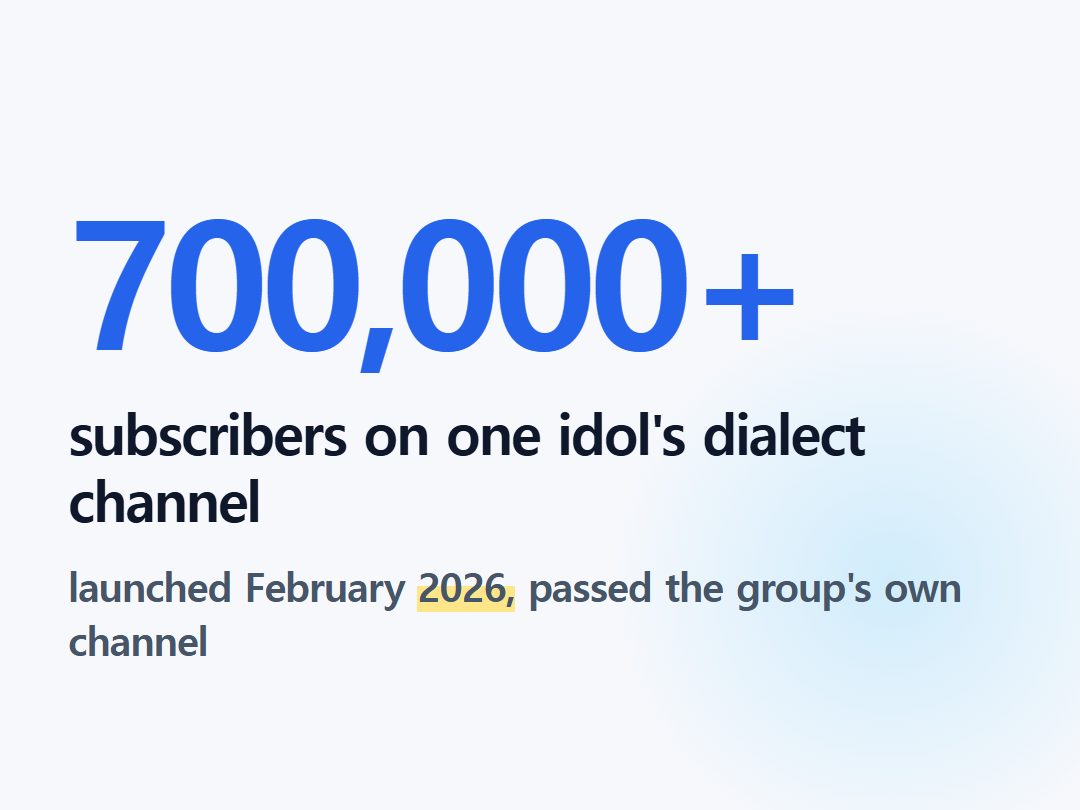
- Wonyi's YouTube channel hit 700,000 subscribers, surpassing her own group's channel.
An MBC Gyeongnam producer publicly flagged the clip as evidence of a "language crisis," arguing the "-no" ending was internet-forum slang rather than dialect. Politicians from opposing parties clashed over the claim on social media, and South Korea's National Institute of Korean Language fielded formal requests to settle it.
Wonyi was not the only member of her group drawing attention that week. Bandmate Jena, from Gyeongju, had already built an online following around her own North Gyeongsang accent, packaged as a joking "Silla princess" persona — a reference to the ancient kingdom once centered on her hometown.
A hometown word mistaken for internet slang
The dispute was never really about one word. It was about how unfamiliar an ordinary regional accent has become to a national audience that mostly hears Korean idols speak one way: standard, Seoul-accented Korean. When an authentic Gyeongsang ending showed up on camera, some viewers did not recognize it as dialect at all.
Broadcasters and fellow Gyeongsang natives eventually defended Wonyi, confirming the "-no" ending is a documented feature of the regional dialect, not slang coined online. The controversy escalated precisely because dialect is rare enough on screen that audiences no longer have a reference point for it.
Idols spend years training the accent out of their voice
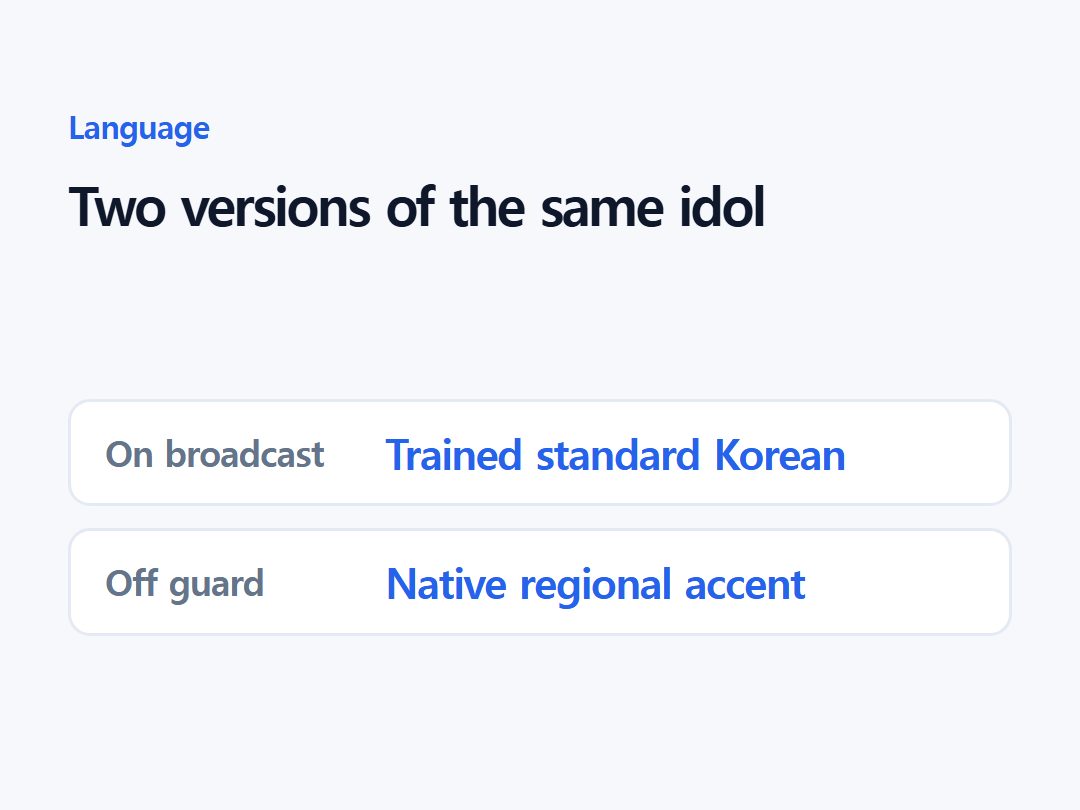
Most K-pop idols debut through the agency system — the Korean model in which a company recruits trainees as young teenagers, houses and trains them for years in singing, dancing, and media presentation, then debuts a subset of them as a group. Speech and diction coaching is part of that process for anyone who did not grow up speaking Seoul-standard Korean.
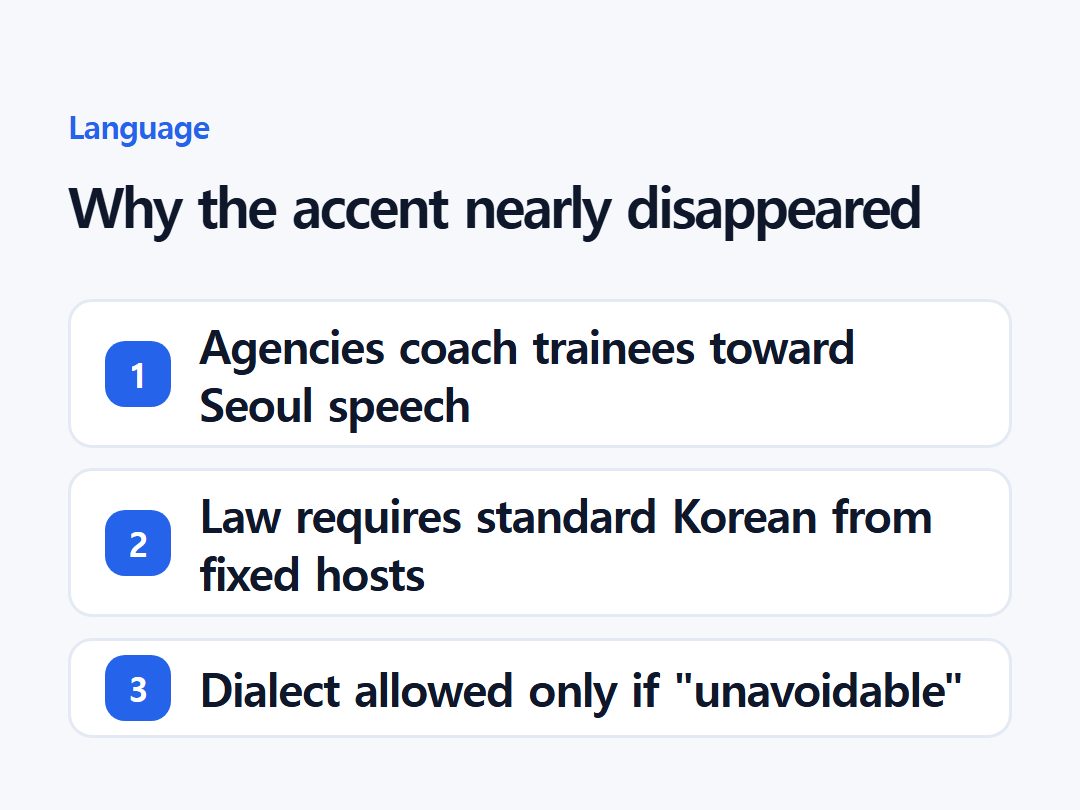
Trainees from outside the capital region typically arrive with the accent of wherever they grew up. By debut, most have spent years being coached toward standard pronunciation, because that is what Korean television and radio expect from a public figure.
That window is long enough to matter: Korean trainees commonly spend two to five years inside an agency's system before their first public appearance, time enough to replace a childhood intonation pattern with a flatter, coached one before a single interview airs.
Broadcasting rules put standard Korean first, by law
That expectation is not just industry habit. South Korea's Broadcasting Act instructs stations to contribute to the spread of standard Korean, and the Korea Communications Standards Commission's broadcast-language rule (Article 51) goes further: regular hosts and anchors "must use standard language" while on air.
Dialect is permitted, under that same rule, only when it is "unavoidable" — and even then, broadcasters are barred from using it to caricature a region or a person. The rule traces back to a 1958 broadcast guideline that treated dialect as an exception to be minimized, then tightened it further in 1988 and 1992.
Standard Korean was defined by a committee, not by a region
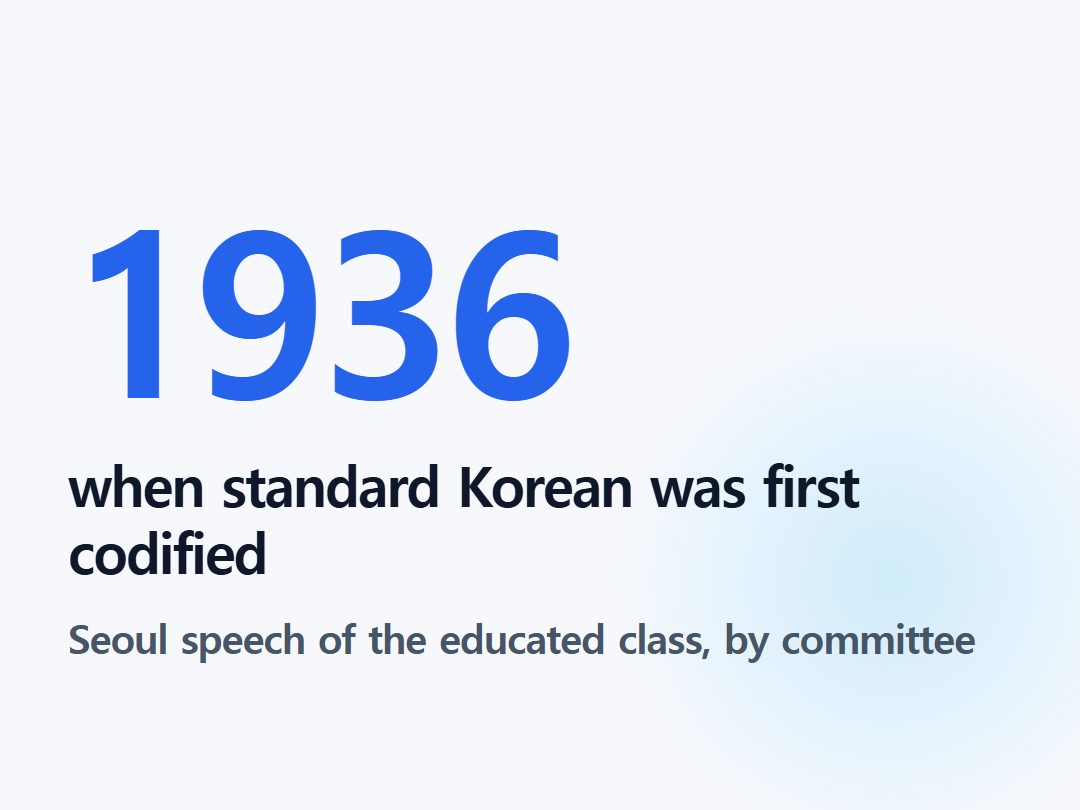
"Standard Korean" itself is a dated policy choice, not a neutral default. The Korean Language Society defined it in 1933 as "the Seoul speech currently used by the middle class," then published a standardized word list in 1936. A 1988 government revision reworded the definition to "the modern Seoul speech broadly used by educated people" — the version still in force today.
Every other way of speaking Korean was, by that same act of definition, filed as a regional variation to be corrected on air. That is the backdrop against which both idol training and broadcast regulation operate.
South Korea's Constitutional Court has separately ruled that the definition clause itself carries no independent legal force over any individual. In practice that matters less than the fact that broadcasters, and the agencies preparing idols for broadcast, still treat the same definition as the working standard for what sounds camera-ready.
The accents that survived debut anyway
Despite years of coaching, some idols' regional accents are well documented as still surfacing on camera:
- BTS's Jungkook and Jimin, both from Busan, have used Busan dialect at hometown events — Jungkook greeted a 2022 Busan stadium crowd with a Busan-inflected line meaning he grew up there.
- Red Velvet's Irene, from Daegu, and TREASURE's Jihoon, from Busan, are both regularly noted by fans and outlets for accent slips during unscripted broadcast moments.
- Solo artist Kang Daniel, also from Busan, has built part of his public image around using satoori deliberately in fan-facing content.
None of these were agency-sanctioned choices. In each case the accent surfaced in an unscripted moment — a hometown concert, a burst of enthusiasm, a fan interaction — rather than as planned content, which is exactly why fans treat the footage as rare rather than ordinary.
Jungkook has responded to fan questions about his own accent in a way that undercuts his own denial, insisting mid-interview that he no longer uses satoori — while still using it as he says so.
From private accent to public teaching tool
TVXQ's Yunho, from Gwangju, offers the clearest reversal. In June 2026, on MBC's "Hangout with Yoo" — a variety show, the unscripted talk-and-games format that anchors most Korean entertainment programming — he was cast as the designated instructor teaching Yoo Jae-suk and other hosts proper Jeolla-province dialect, declaring "this is the first lesson" as they fumbled the unfamiliar pronunciation.
Months earlier, for a villain role in the Disney+ series "Fine: Country Bumpkins," Yunho used an even stronger, 1970s-style Mokpo dialect rather than his native Gwangju accent — a performance host Jeon Hyun-moo said left him "so scared I almost peed myself." What was once simply how Yunho talked at home became a specific professional skill.
Why a slipped accent reads as proof of something real
Because the standard-Korean voice is the trained, camera-ready one, a regional slip functions differently for an idol than it would for an ordinary person. Fans and outlets consistently frame these moments as the idol being caught off guard — too tired, excited, or comfortable to keep the coached voice going.
That framing helps explain why Wonyi's personal YouTube channel, launched only in February 2026, passed 700,000 subscribers and outgrew RESCENE's own official group channel. The renewed attention also pushed the group's earlier single "LOVE ATTACK" back into a major streaming chart's top 100 more than 300 days after its original release.
What the fight over "-no" never actually settled
The National Institute of Korean Language was asked to rule on whether Wonyi's "-no" ending was legitimate Gyeongsang dialect or internet slang, but no single public verdict closed the debate. What is documented is that regional linguists and broadcasters defended it as dialect, while the original complaint kept circulating regardless.
A lawmaker later summarized the episode as an idol being publicly shamed overnight for "using her hometown's language" — a framing that turned a linguistics dispute into a question of regional dignity, which is arguably the more durable story than the grammar itself.
Whether the next generation of trainees will be coached differently
RESCENE's members now hold honorary tourism-ambassador titles for four cities tied to their hometowns — Geoje, Suwon, Gyeongju, and Goyang — a promotional outcome that would have been unthinkable for an agency actively coaching accents out of its trainees a decade ago. Whether that changes how future trainees are trained, or stays an exception built around one viral channel, is not yet answered.
The broadcast rule requiring standard Korean from fixed hosts has not changed. What changed, for a few weeks in 2026, is that a mainstream idol's regional voice reached an audience large enough that part of it no longer recognized the accent as Korean at all.
K-pop idols whose regional accents have surfaced publicly
| Idol | Hometown | How the accent showed up |
|---|---|---|
| Jungkook (BTS) | Busan | Greeted a 2022 Busan stadium crowd with a Busan-inflected line |
| Jimin (BTS) | Busan | Used Busan dialect at hometown events |
| Irene (Red Velvet) | Daegu | Noted by fans and outlets for accent slips on unscripted broadcasts |
| Jihoon (TREASURE) | Busan | Noted by fans and outlets for accent slips on unscripted broadcasts |
| Kang Daniel | Busan | Uses satoori deliberately in fan-facing content |
| Yunho (TVXQ) | Gwangju | Taught Jeolla dialect on "Hangout with Yoo"; used Mokpo dialect for a Disney+ villain role |
Frequently asked
What did Wonyi say that caused controversy?
She said "무섭노" ("scary" with a Gyeongsang dialect ending) in a YouTube video, and an MBC Gyeongnam producer flagged it as internet slang rather than recognizing it as regional dialect.
Are K-pop idols allowed to speak in regional dialect on broadcast TV?
South Korea's broadcast-language rule (Article 51) requires regular hosts and anchors to use standard Korean, permitting dialect only when "unavoidable" and never to caricature a region or person.
Which K-pop idols are known for using satoori (regional dialect)?
BTS's Jungkook and Jimin (Busan), Red Velvet's Irene (Daegu), TREASURE's Jihoon (Busan), solo artist Kang Daniel (Busan), and TVXQ's Yunho (Gwangju) have all been documented using their regional accents.
Sources
Every factual claim above is traceable. We do not translate articles — we gather facts from multiple outlets and write them ourselves.
- 리센느, '新 국민 아이돌' 탄생…'거제 야호'서 시작된 열풍 — Newsis
- 거제 출신 리센느 원이, '무섭노' 일베 공방 — Herald Biz
- '거제 야-호!' 열풍, 리센느 원이가 뜬 이유 — Harper's Bazaar Korea
- 걸그룹 리센느, 거제 사투리가 만든 '역주행' 인기 — OhmyNews
- BTS 지민·정국, 고향은 부산 "설레고 이상한 기분" — Hankook Ilbo
- 방송심의에 관한 규정 (제51조 방송언어) — Korea Communications Standards Commission / Wikisource
- 유노윤호, 전라도 사투리 꿀팁 전수…"이것이 첫 번째 레슨" — TV Report
- 유노윤호 사투리 연기에 전현무 "무서워 오줌 쌀 뻔" — Newsis
- 대한민국 표준어 — Wikipedia (Korean)