At least seven of K-pop's most prominent rap-line members spent years in South Korea's underground hip-hop scene before any agency signed them. BTS's RM performed as Runch Randa; groupmate Suga rapped as Gloss with the Daegu crew D-Town. BIGBANG's T.O.P battled under the name Tempo, and Block B's Zico built a reputation in Japan as Scribble.
The short version
- Underground rap credentials give idols proof trainee training alone can't provide.
- At least seven major K-pop rappers built reputations before signing with agencies.
- Show Me the Money keeps turning underground rap battles into idol auditions.
None of this surfaced by accident after debut. It was documented, sometimes prolific, work that agencies specifically sought out — and the reason has less to do with raw talent than with a credibility gap.
A trainee is someone signed to a company and put through years of company-run singing, dancing and language lessons before ever debuting. That pipeline is very good at producing polish, and structurally bad at producing street credibility on its own.
A shortlist that keeps repeating the same résumé
The pattern is not limited to one generation or one company. iKON's Bobby won a national rap survival show a year before his official debut, releasing diss tracks aimed at senior artists as a competing trainee rather than a finished idol. Winner's Mino placed second on the same show the following season.
Stray Kids' Bang Chan, Changbin and Han ran a self-released trio called 3RACHA years before they were introduced as a group, accumulating dozens of self-produced songs while still unknown to the public.
Two of the earliest cases were women: Brown Eyed Girls' Miryo rapped with the crew Honey Family starting in 1999, and EXID's LE was the only female member of Jiggy Fellaz, a crew that also produced Simon Dominic and Sleepy.
What "underground" means before a trainee contract
In Korean hip-hop, "underground" (언더그라운드) describes artists who release music independently — through self-funded mixtapes, hip-hop clubs, and forums like HipHople — without a major agency's money or promotion behind them. Many worked day jobs or part-time jobs alongside performing, since the scene offered no salary and no company housing.
The scene runs on its own credibility system. Lyricism, self-production and reputation among peers carry weight there in a way that company marketing cannot buy. That is precisely the currency a standard trainee program is not built to generate.
It is also a system with gatekeepers of its own. Zico and his future Block B groupmate Park Kyung were discovered as underground performers Scribble and Hol-ke by producer Cho PD, who offered them a spot training under his label — but only after they had already spent years writing, producing and performing without company support.
Two paths into the same debut stage
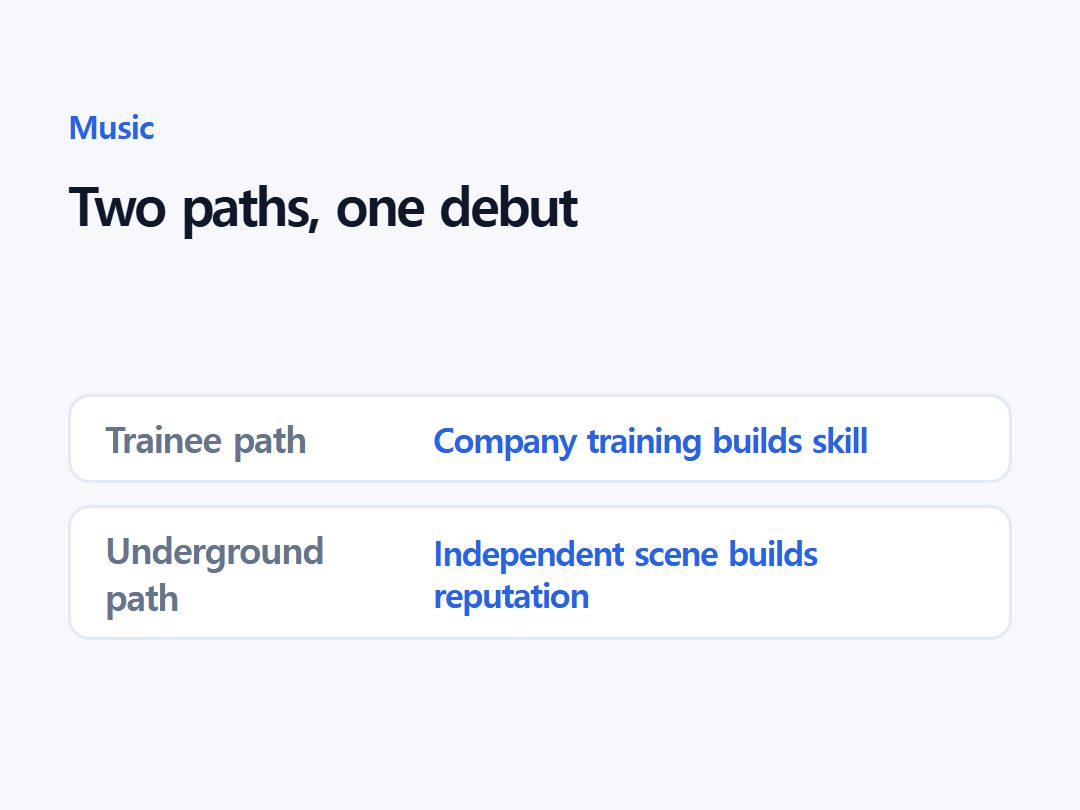
Most K-pop trainees and underground-recruited rappers end up performing side by side in the same group, but they arrive by different routes.
| Standard trainee path | Underground-recruited path | |
|---|---|---|
| Where skill is built | Company dance and vocal training | Independent mixtapes, hip-hop clubs |
| Who judges early work | Company evaluations | Underground scene, peer crews |
| What debut adds | Polish, choreography, image | Pre-existing catalogue and reputation |
Agencies are buying a credential they can't build in-house
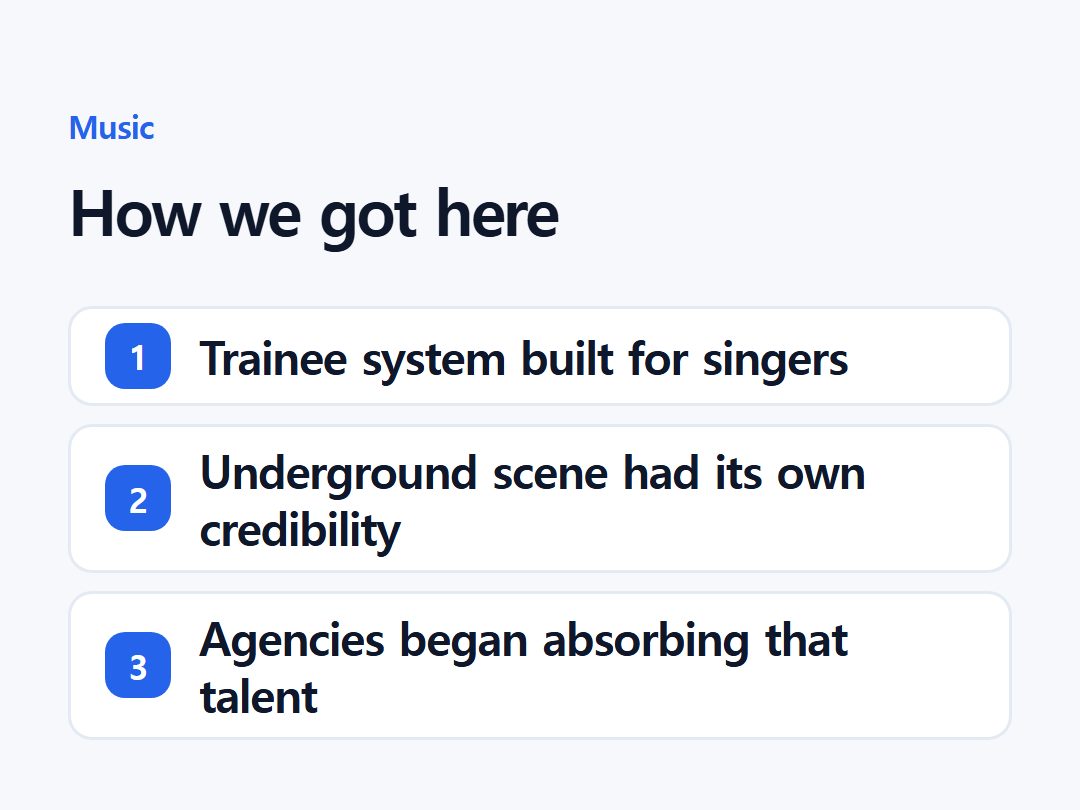
South Korea's agency system — the model in which a company scouts trainees, houses and trains them for years, then debuts them as a coordinated group — is built to produce singers and dancers with a consistent, marketable image. It was not designed to produce rappers with street credibility.
Researchers studying K-pop have described the fix idol rappers face as "conditional authenticity": unlike solo hip-hop artists, idol rappers are assumed by default to lack credibility, so it has to be proven and re-proven in public. A pre-debut underground catalogue is the fastest way to enter a group already holding that proof.
The arrangement works both directions. Idols gain a shortcut to that proof, and underground artists gain exposure and income that an independent release rarely matches — a trade that helps explain why the underground scene keeps supplying names instead of resisting the pipeline.
From Honey Family's only woman to 3RACHA's secret trainee crew
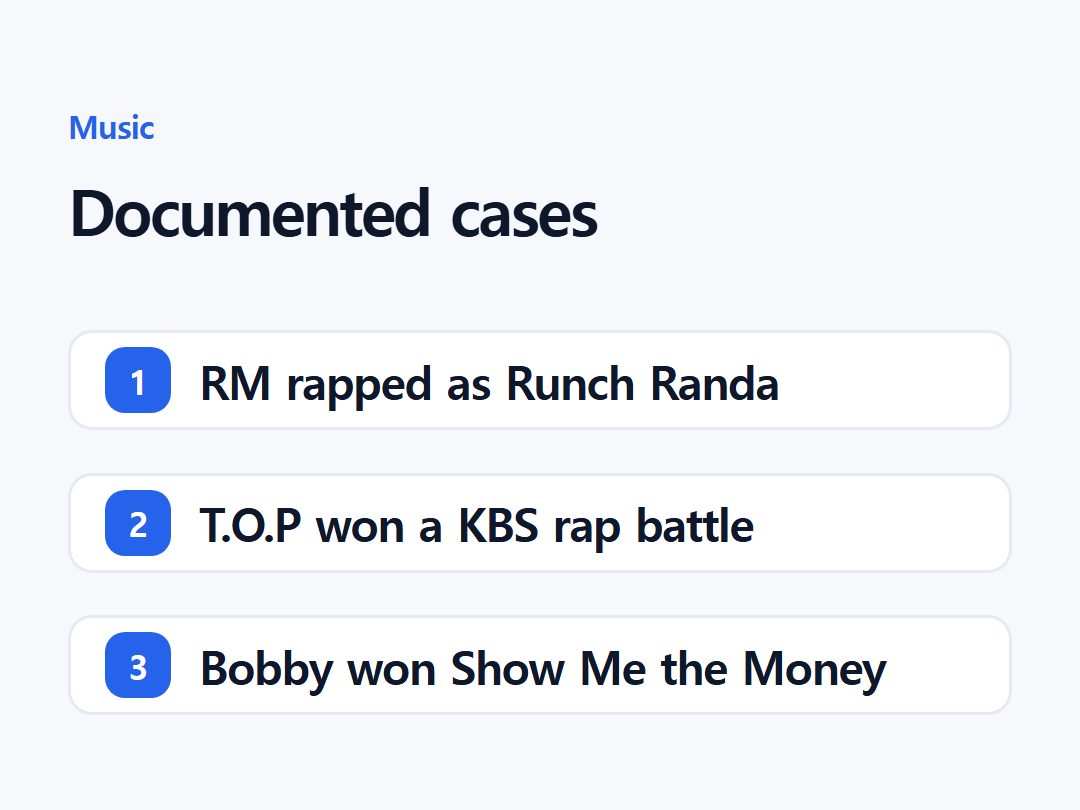
The recruiting pattern spans two decades and both genders. A partial list of documented cases:
- Miryo (Brown Eyed Girls) rapped with crew Honey Family before her 2006 debut
- LE (EXID) was the sole woman in the crew Jiggy Fellaz
- T.O.P (BIGBANG) won a KBS radio rap battle as Tempo before YG signed him
- Zico (Block B) performed for three years in Japan as Scribble
- Bobby and Mino (iKON, Winner) built public profiles on a televised rap competition before debuting
Stray Kids' case adds a twist. Bang Chan, Changbin and Han were already JYP trainees when they formed 3RACHA, releasing mixtapes under aliases including "SpearB" without the company's knowledge. There, the underground credibility was built quietly inside the system rather than imported from outside it.
A survival show turned recruiting into a public audition
Show Me the Money, Mnet's televised rap competition, turned this pipeline into something audiences could watch happen in real time. Bobby won season 3 in 2014, a year before his official iKON debut; Mino placed as runner-up on season 4 the following year.
The traffic hasn't reversed. On the show's twelfth season, which aired in early 2026, four already-debuted idols — YOUNG POSSE's Jung Sun-hye, Ichillin's Jackie, Nine.i's Vahn and virtual group Skinz's Kwon Ilang — auditioned specifically to prove they could compete against artists without an idol background. None placed; the season was won by Haon, a non-idol rapper.
That four members chose to audition after debut, with nothing structurally required of them, shows how much value the credential still carries. A televised loss to a non-idol rapper is treated as a smaller risk than never testing the claim at all.
Underground credentials work as a defense against "sellout" claims
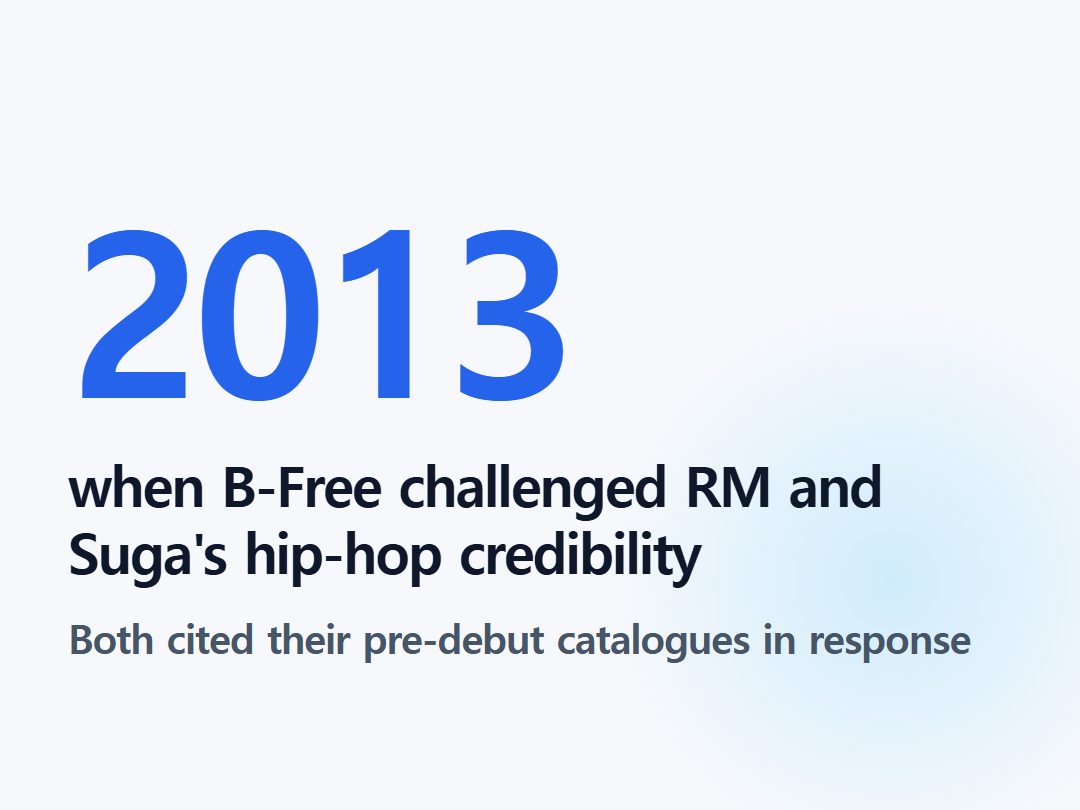
The credential does more than pad a debut biography — it functions as a defense that gets used later. In 2013, established underground rappers B-Free, Okasian, Don Mills and Deepflow publicly questioned whether RM and Suga had earned the right to call themselves hip-hop artists at all, criticizing the idol format itself as inauthentic.
Much of that criticism centered on image rather than skill — idol styling, makeup and a largely female fanbase were treated as evidence against the two rappers, regardless of their technical ability. RM and Suga responded by pointing to their own years writing and performing before Big Hit signed them, rather than defending BTS as a group.
That exchange is the mechanism agencies are counting on: when a member's rap identity is publicly challenged, the underground résumé is what he or she answers with, not the group's chart performance.
Does the underground still have anyone left to recruit?
What is unresolved is how long the supply lasts. Each high-profile absorption — Zico, T.O.P, Bobby, Mino — removes a recognized name from the pool of artists agencies can point to as proof of unmanufactured credibility.
3RACHA suggests one direction this could go: instead of scouting rappers who already have a reputation, agencies may increasingly let trainees build one themselves, quietly, before revealing it as part of a debut story.
Whether international audiences read that as authentic once they learn it was strategic from the start is a question the industry has not had to answer at scale yet. For now, the underground résumé still opens a door that a company training room alone cannot.
Two paths into the same debut stage
| Standard trainee path | Underground-recruited path | |
|---|---|---|
| Where skill is built | Company dance and vocal training | Independent mixtapes, hip-hop clubs |
| Who judges early work | Company evaluations | Underground scene, peer crews |
| What debut adds | Polish, choreography, image | Pre-existing catalogue and reputation |
Frequently asked
Why do K-pop agencies recruit underground rappers?
Trainee programs are built to produce polish, not street credibility, so agencies seek out rappers who already proved themselves in the underground scene before signing.
What was RM's underground rapper name?
RM performed as Runch Randa before debuting with BTS, while groupmate Suga rapped as Gloss with the Daegu crew D-Town.
What is 3RACHA and how does it connect to Stray Kids?
3RACHA is a self-released trio formed by Bang Chan, Changbin and Han while they were already JYP trainees, releasing mixtapes under aliases like SpearB without the company's knowledge before debuting as Stray Kids.
Sources
Every factual claim above is traceable. We do not translate articles — we gather facts from multiple outlets and write them ourselves.
- RM (musician) — Wikipedia
- The life of BTS' Suga: from underground rapper to global K-pop star — South China Morning Post
- Zico (rapper) — Wikipedia
- T.O.P — Wikipedia
- Bobby (rapper) — Wikipedia
- Mino (rapper) — Wikipedia
- 7 Things To Know About Stray Kids' Changbin — EnVi Media
- Elly (rapper) — Wikipedia
- From Underground Hip-Hop To K-Pop And Beyond: A Q&A With Rapper Miryo — Vice
- 'Show Me The Money': K-pop idols trying to break free — The Korea Herald
- "Show Me The Money 12": Why K-Pop Idols Audition For Rap Shows Even After Debut — Kpopmap
- Authenticity Essay #4: Gatekeepers and Idol Rappers — Stitch Media Mix
- Idol Rapper: K-Pop and the Production of Authenticity — Springer