Watch enough K-pop news and a pattern shows up: a group hits its seventh year together, and within months there is either a renewal announcement, a partial renewal with some members leaving, or a full breakup. International fans often chalk this up to bad luck — the so-called "seven-year curse." It isn't luck.
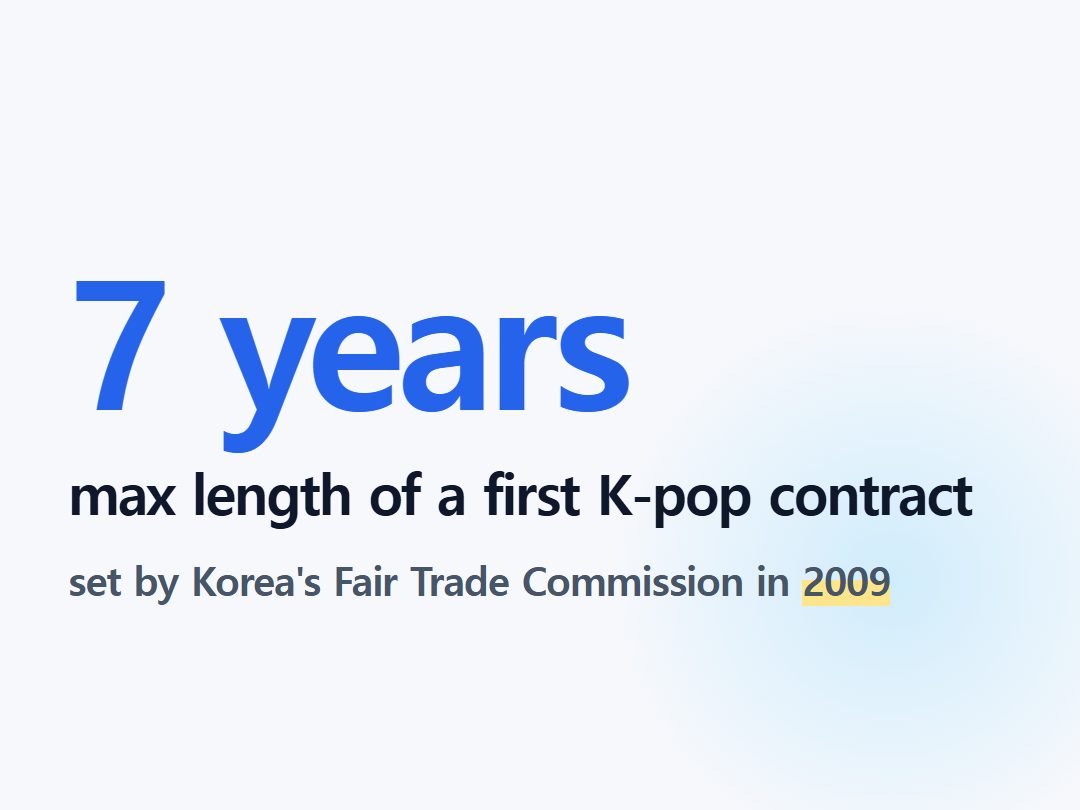
It is the direct, traceable effect of a 2009 rule from Korea's Fair Trade Commission (KFTC, 공정거래위원회), the government agency that polices competition and contract fairness, which caps the first term of a K-pop exclusive contract at seven years.
The rule was written to protect artists, not to schedule breakups — but seventeen years later, it has become the industry's most reliable clock.
The short version
- A 2009 KFTC rule caps K-pop exclusive contracts at seven years.
- TVXQ's 2009 lawsuit over a 13-year deal triggered the rule.
- BTS and TWICE both renewed early, avoiding the seven-year curse.
Why do K-pop contracts all expire together?
To understand why one legal clause shapes so much of K-pop's public life, you need to understand the agency system first.
Korean entertainment companies typically recruit and train performers for years — sometimes most of their adolescence — covering vocal lessons, dance training, housing, styling and media coaching before a debut ever happens.
That upfront spending is why agencies push for a long exclusive contract (전속계약, jeonsok gyeyak): the longer the term, the more time a company has to recover its investment and profit from an idol's promotional activities, merchandise and endorsements.
Before 2009, that logic produced contracts of ten, thirteen, even longer years, with agencies controlling nearly every aspect of an artist's schedule and earnings. The KFTC's response was the "Standard Exclusive Contract Form for Pop Culture Artists" (대중문화예술인 표준전속계약서).
Its best-known clause states that an initial exclusive contract should not exceed seven years; if an agency writes a longer term, the artist gains the right to terminate the portion beyond seven years.
The form also added baseline protections around privacy, working hours and profit division that were often missing from earlier deals.
Here is the part international readers usually miss: the standard contract is a recommended template, not a law that binds every company. Agencies are not required to use it word for word.
In practice, though, it became the default anyway, because writing a contract that visibly ignores the KFTC's seven-year benchmark invites exactly the kind of public backlash, regulatory attention and courtroom risk that the industry had just watched play out.
Seven years became the number every new idol contract gravitates toward, whether or not a company formally adopts the government's paperwork.
That single number now governs an enormous amount of K-pop's calendar. Members individually reassess their futures around the same time — weighing solo offers, acting roles, or, for male members, the timing of South Korea's mandatory military service.
Disputes over how profits were split during the debut years often surface only once a renewal is on the table.
And because a debut lineup's original contracts nearly all start and end together, the seventh anniversary becomes a single, visible cliff-edge rather than a series of quiet individual decisions spread across years.
Fans call it the "seven-year curse" (7년의 저주) precisely because so many beloved debut-era lineups have fractured at that exact point: 2NE1 disbanded in 2016, seven years after its 2009 debut; Sistar and Miss A both ended around the same milestone; a cluster of groups that debuted in 2015, including iKon, CLC and April, lost members or went inactive as their contracts came due.
Full-lineup renewals are treated as major news for the same reason — they are the exception, not the rule. When all seven members of BTS re-signed with Big Hit Entertainment (now HYBE) in October 2018, months ahead of their contracts' scheduled end, the announcement trended worldwide.
When all nine members of TWICE renewed with JYP Entertainment in July 2022, roughly three months before their original seven-year term expired, JYP and entertainment outlets explicitly framed it as TWICE escaping the "seven-year curse." Groups such as Red Velvet, SHINee and Dreamcatcher have also managed full or near-full renewals, but industry watchers still describe an intact, all-original-member renewal as unusual rather than typical.
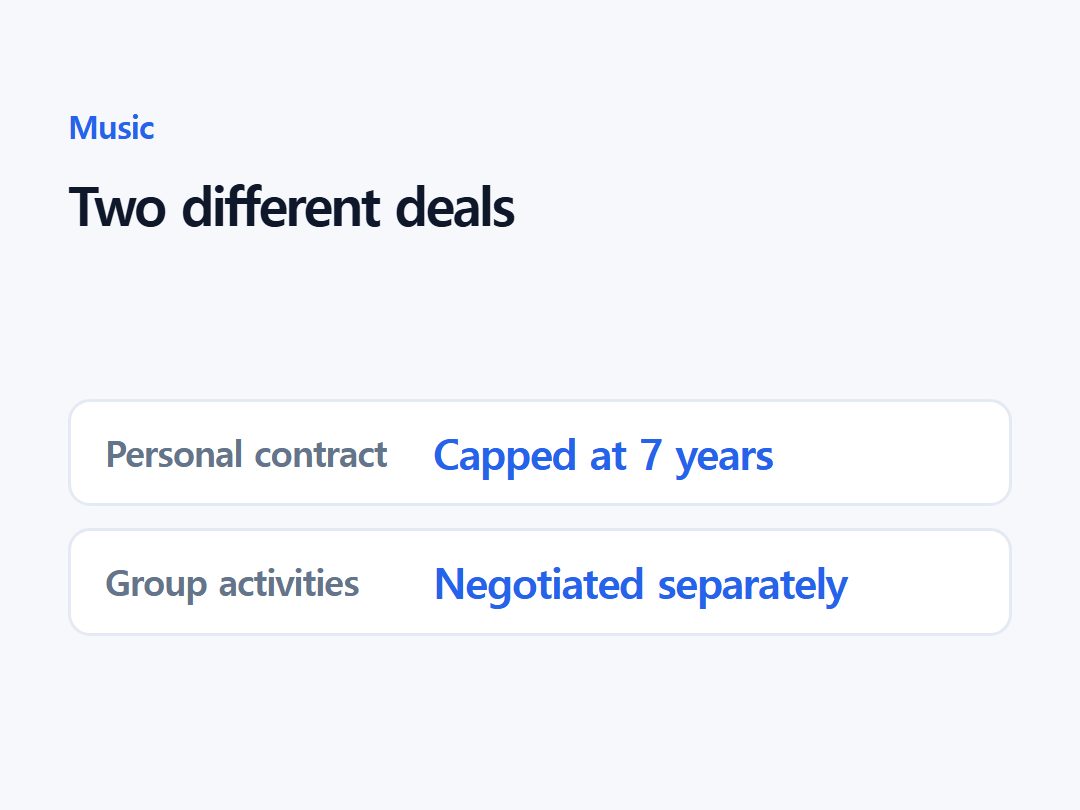
There is also a layer international fans sometimes conflate: a member's personal exclusive contract with an agency is a separate legal document from any agreement covering ongoing group promotions.
That is why it is possible for an idol's individual deal with a label to lapse or end while the group itself keeps performing under a separate arrangement, or for a member to leave the company yet remain, contractually, part of the group's activities for a defined window.
The seven-year cap applies to the individual exclusive contract; what happens to the group brand around it is negotiated separately, which is part of why breakup announcements can look messier than a single expired contract would suggest.
The 2009 lawsuit that created the seven-year rule
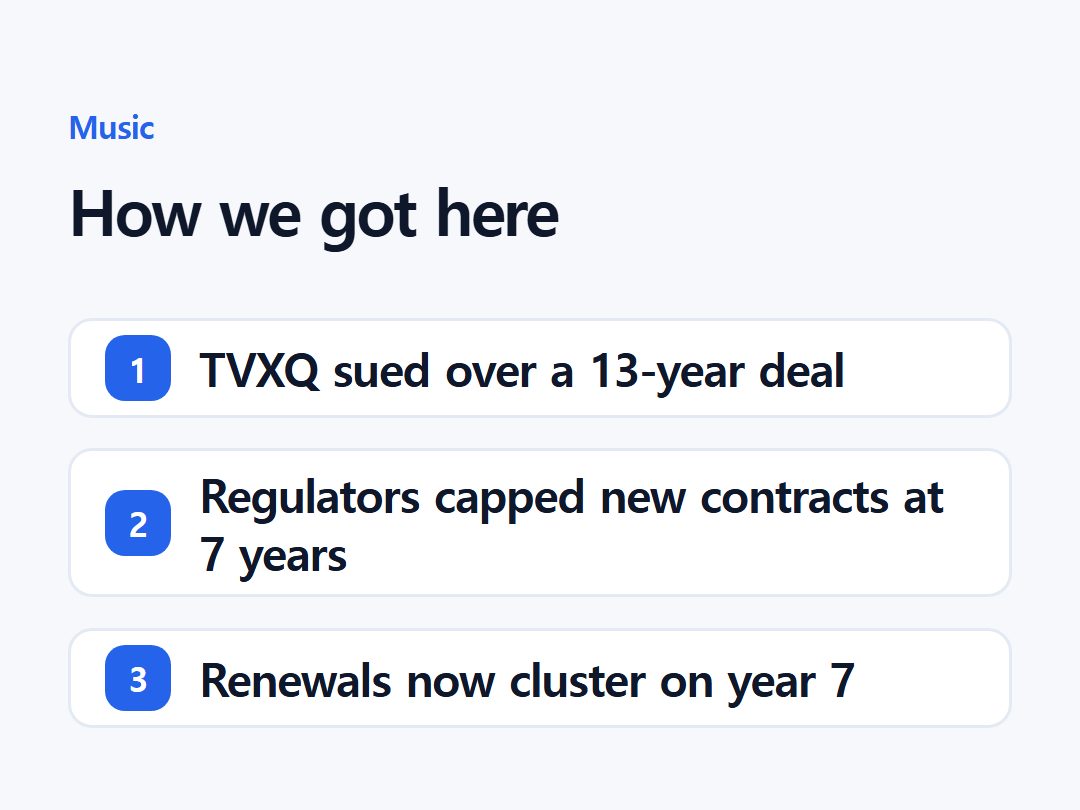
The rule has a specific origin story. TVXQ (also known as DBSK), one of SM Entertainment's flagship boy bands, debuted in 2004 under a reported thirteen-year exclusive contract.
In 2009, three of its five members — Kim Jaejoong, Park Yoochun and Kim Junsu — filed suit seeking to have that contract voided, arguing it was excessively long, gave them minimal say over their own schedules, and divided profits unfairly.
The case became the industry's most-cited "slave contract" dispute, and it landed in the same year the entertainment industry was already under scrutiny following the death of actress Jang Ja-yeon, whose case exposed how coercive and opaque some agency contracts could be.
Against that backdrop, the KFTC published its standard exclusive contract form for pop-culture artists in July 2009, explicitly capping initial contract terms at seven years and building in an artist's right to exit any excess term.
The TVXQ members who sued eventually prevailed in court and went on to form the group JYJ.
New idol contracts signed after 2009 converged on the seven-year benchmark almost immediately, even at agencies that never formally adopted the KFTC's exact template, because deviating from it had just proven expensive and reputationally costly for one of Korea's biggest labels.
The framework kept evolving. South Korea passed the Culture Industry Development Act in 2014, folding additional artist and minor protections into law rather than leaving them as a voluntary template.
A 2017 revision, prompted by a separate contract dispute involving singer Song So-hee, lowered the financial penalties artists faced for early termination and restricted clauses that forced automatic renewal.
In 2019, regulators added a distinct standard contract for trainees and a supplementary agreement covering underage idols and trainees, addressing a stage of an idol's career the original 2009 form barely touched.
As recently as June 2025, the KFTC finalized a consent decision with five of the industry's largest agencies — HYBE, SM, YG, JYP and Starship — over suspected violations of subcontracting rules, a reminder that regulators are still actively enforcing fair-dealing standards in the same lineage of reform that produced the seven-year cap.
Will the seven-year cap change?
The economics that made seven years a workable number in 2009 have shifted.
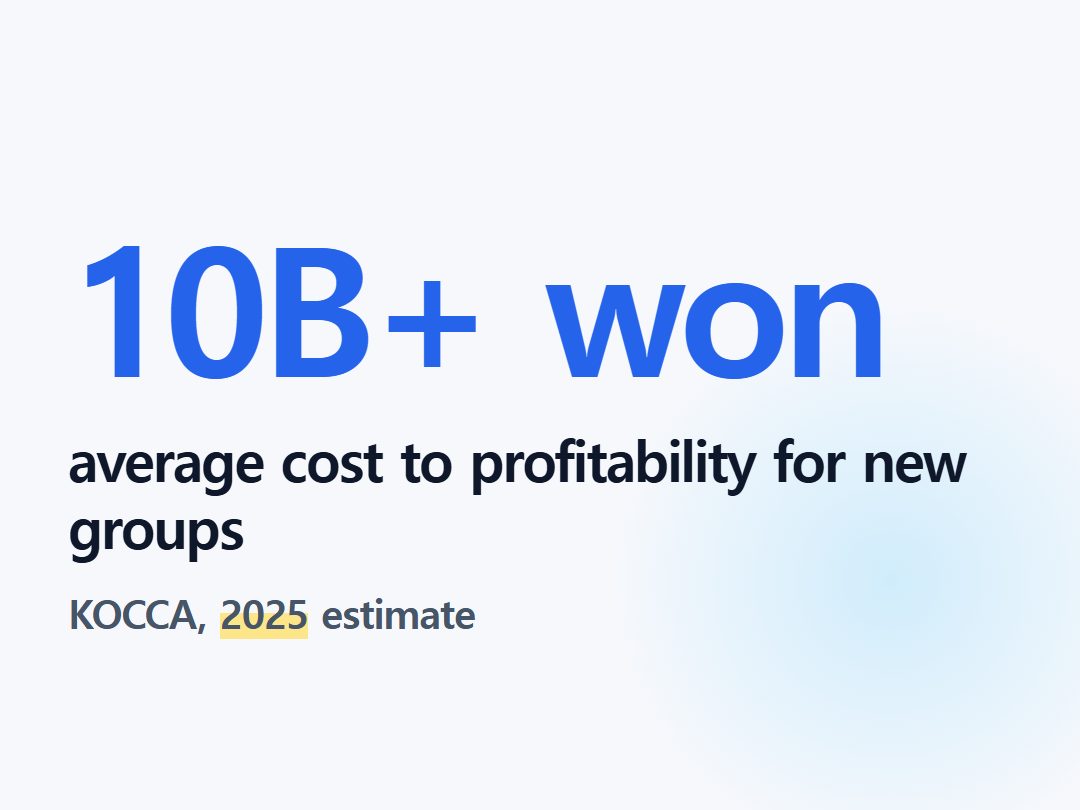
The Korea Creative Content Agency (KOCCA) estimated in 2025 that taking a fourth- or fifth-generation idol group to profitability now costs more than 10 billion won on average, and that agencies typically need four to five years to recoup that investment, up from two to three years in earlier eras of the industry.
That leaves a shrinking window of two to three profitable years inside a fixed seven-year term, and it has revived debate over whether the standard contract's core number still fits a K-pop business built around global touring, streaming and higher production budgets than the form's 2009 authors anticipated.
Some industry figures have floated lengthening the cap to match rising costs; at least one idol-labor advocacy voice has instead argued for shortening it to five years, warning that some idols are left in career limbo by agencies unwilling to either invest further or let them go.
Meanwhile, several major agencies appear to be trying to defuse the seven-year flashpoint before it arrives: groups including ITZY, TOMORROW X TOGETHER and ATEEZ, all of which debuted between 2018 and 2019, have already renewed their contracts ahead of their scheduled seven-year expirations rather than waiting for the deadline to force the issue.
Whether the KFTC eventually revises its now sixteen-year-old standard template, and whether more agencies follow the early-renewal pattern set by BTS and TWICE, are the two threads worth following the next time a fandom starts counting down to a group's seventh anniversary.
How Korea's seven-year contract rule evolved
| Year | Development |
|---|---|
| 2004 | TVXQ debuts under a reported thirteen-year exclusive contract |
| 2009 | Three TVXQ members sue; KFTC publishes standard contract form capping initial terms at seven years |
| 2014 | Culture Industry Development Act folds artist protections into law |
| 2017 | Revision after the Song So-hee dispute lowers termination penalties and curbs automatic renewal clauses |
| 2019 | KFTC adds a standard contract for trainees and underage idols |
| 2025 | KFTC reaches a consent decision with HYBE, SM, YG, JYP and Starship over subcontracting rules |
Frequently asked
Why do K-pop groups always break up after seven years?
A 2009 KFTC rule caps the first term of an idol's exclusive contract at seven years, so an entire debut lineup's contracts tend to expire at the same time.
What is the seven-year curse in K-pop?
It's fan shorthand for the pattern of groups renewing, partially renewing, or disbanding right around their seventh anniversary because of Korea's standard exclusive contract rule.
Which K-pop groups have fully renewed their contracts?
BTS re-signed with Big Hit/HYBE in October 2018 and TWICE renewed with JYP in July 2022, both framed as escaping the seven-year curse; Red Velvet, SHINee and Dreamcatcher have also managed full or near-full renewals.
Sources
Every factual claim above is traceable. We do not translate articles — we gather facts from multiple outlets and write them ourselves.
- Is the '7-year itch' a thing of the past? — The Korea Herald
- K-pop stars punished by unfair contracts — The Korea Times
- The 7-year jinx: K-pop bands with contracts expiring soon — The Korea Herald
- All 7 BTS Members Renew Contracts With BIGHIT MUSIC — Soompi
- BTS Extend Contracts With Big Hit Entertainment Until 2026 — Forbes
- All 9 members of TWICE renew their contracts with JYP Entertainment — allkpop
- All nine members of Twice renew their contracts with JYP Entertainment — Korea JoongAng Daily
- South Korea's FTC Releases New Rules For K-Pop Companies And Subcontractors — CelebrityAccess
- 공정위, 연예인 표준전속계약서 2종 제정 공시 — Star News
- 전속계약 7년의 딜레마…어쩌다 케이팝 발목 잡는 '족쇄'됐나 [표준계약서 도입 16년①] — Dailian