
In May 2025, TWICE released #Twice5, their fifth Japanese-language compilation album, through Warner Music Japan. It debuted at No. 3 on the Oricon Albums Chart and sold more than 80,000 copies in its first week, according to Billboard Japan.
A few months later, the group's Korean-language album Enemy also topped a Japan sales chart — the first time a TWICE Korean release had done so in roughly three and a half years.
Around the same period, BTS's post-military-service comeback album, Arirang, topped Oricon's Combined Album Ranking, making BTS the first non-Japanese act ever to lead that chart.
The short version
- Japan is K-pop's biggest overseas market for physical albums, worth $80.6 million in 2025.
- Japan's handshake-event retail system rewards repeat purchases, driving Oricon chart rankings directly.
- China's exports are rising fast, narrowing Japan's long-standing lead in K-pop album sales.
These are not one-off promotional stunts. Nearly every major K-pop act — TWICE, BTS, BLACKPINK, Stray Kids, LE SSERAFIM, SEVENTEEN — maintains a parallel catalog of Japanese-language material: sometimes Japanese-lyric versions of Korean songs, sometimes music written for Japan alone.
To an international fan encountering this for the first time, it can look like needless duplication. To the agencies producing it, it functions closer to a second product line built for the company's most valuable overseas customer.
Why physical CDs make Japan a separate market
Japan is, by a clear margin, the largest single overseas market for physical K-pop album sales.
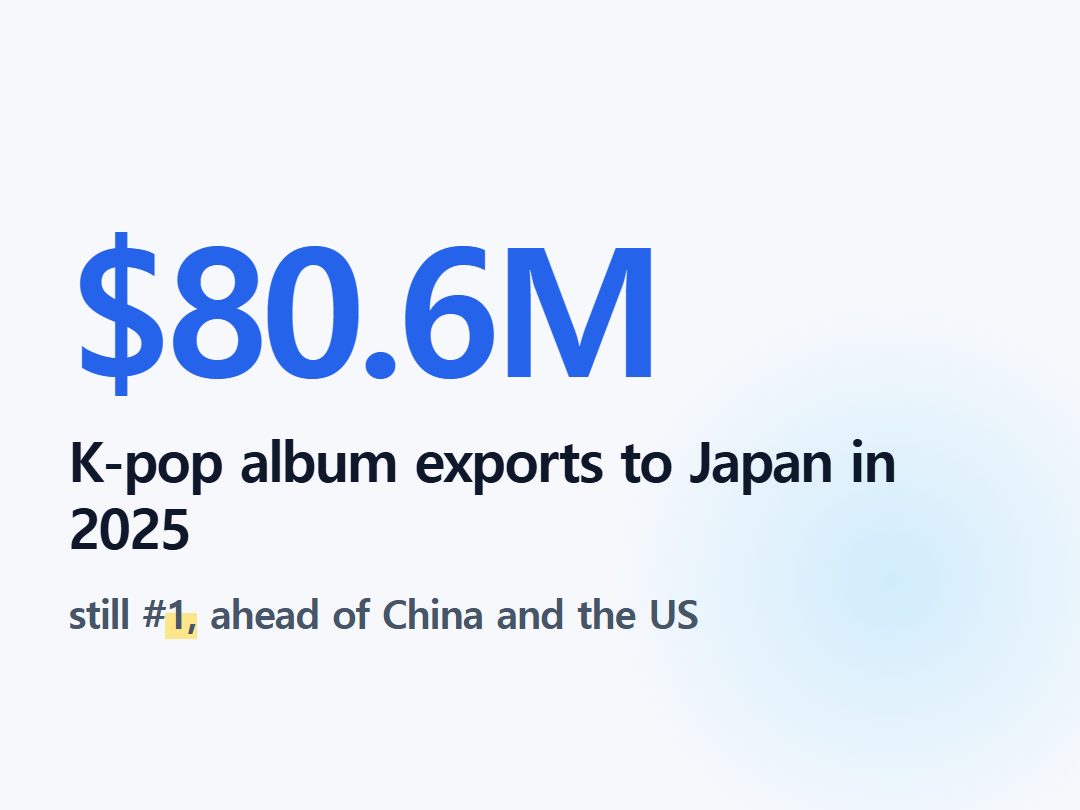
According to Korea Customs Service data reported by Yonhap News Agency, South Korea's album exports to Japan were worth $80.6 million in 2025 — more than exports to China ($69.7 million) or the United States ($64 million) — even though Japan's total fell 10.2% from the year before while China's rose 16.6%. Total K-pop album exports worldwide passed $300 million for the first time that year.
That figure sits inside a much larger structural fact: Japan is the world's second-largest recorded-music market after the United States, according to the IFPI's Global Music Report, and one of the very few major markets where physical formats still generate the bulk of revenue.
Japan's overall recorded-music revenue grew 8.9% in 2025, driven largely by physical sales, at a time when most of the world had already shifted to streaming.
That physical-format dominance is not incidental — it is the reason Japanese-language releases exist as a distinct business category rather than a translation exercise.
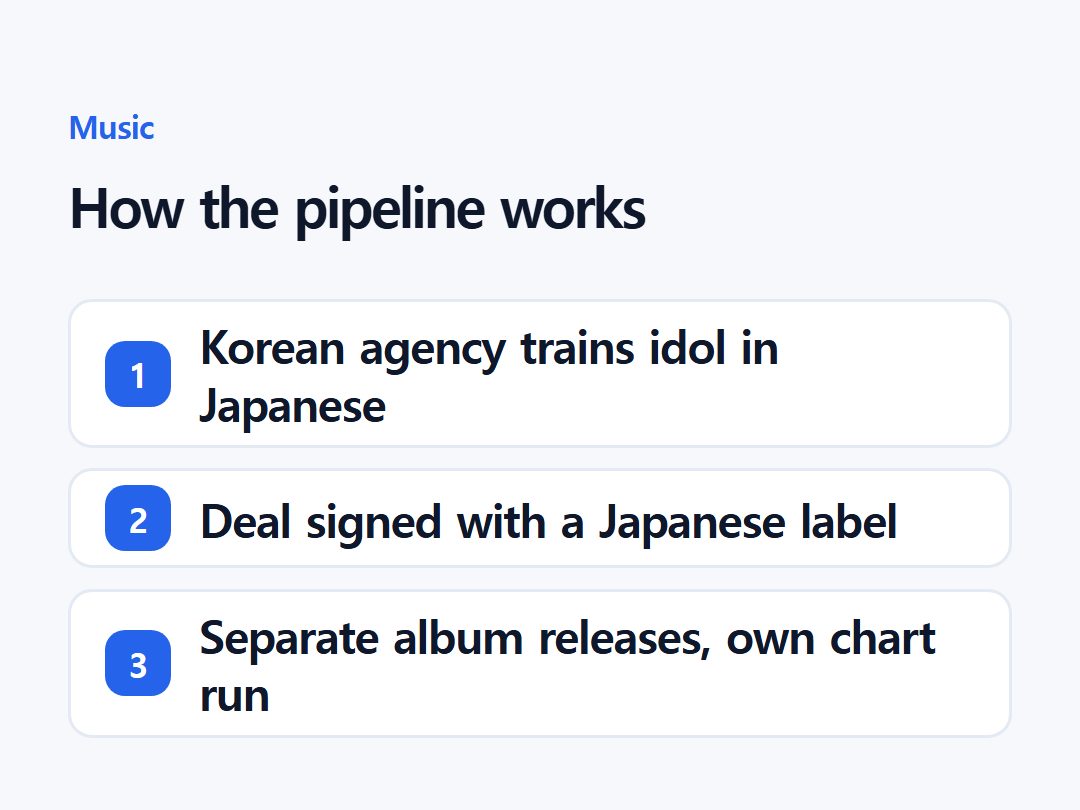
Japan's idol and CD retail system, popularized by acts like AKB48, bundles physical singles with tickets to fan “handshake events,” lottery entries, or voting slips, giving devoted fans a reason to buy the same release many times over.
Oricon's chart methodology counts each individual copy sold, so this repeat-purchase behavior directly drives chart position and revenue in a way that streaming numbers do not.
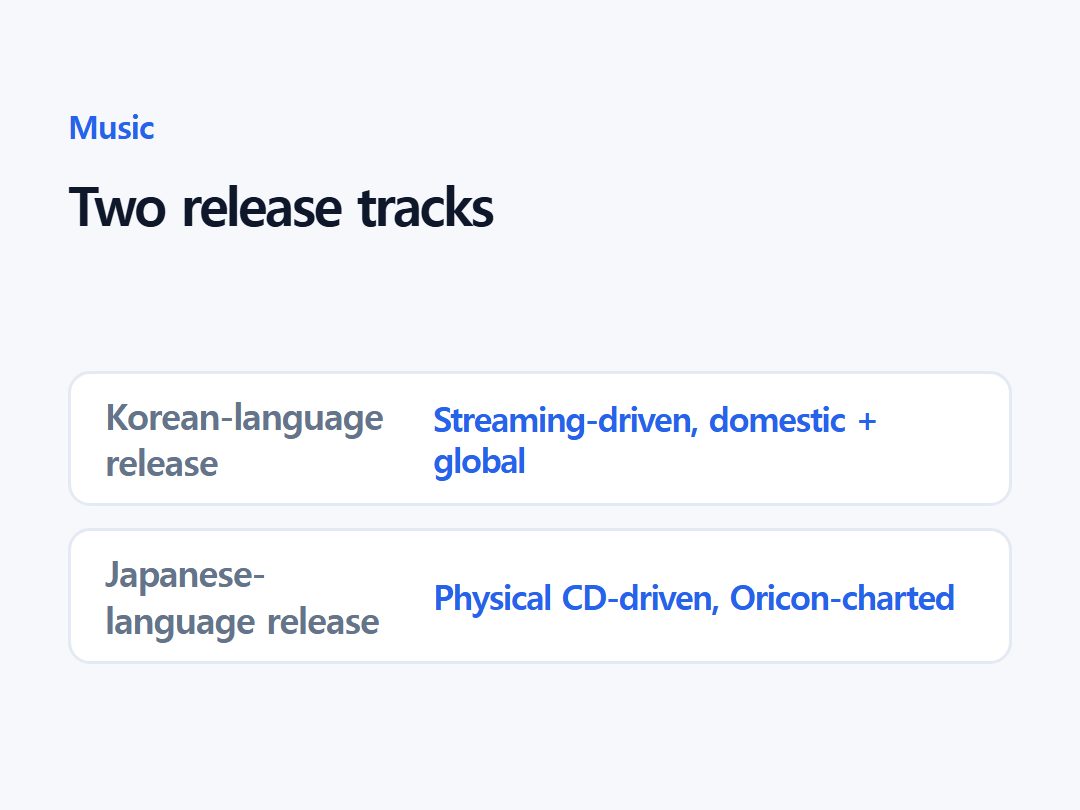
A Japanese-language single, released as its own physical product through a Japanese label, gives K-pop agencies a way to plug directly into that system — something a Korean-language digital release cannot do in the same way.
This is also why the practice runs through formal corporate structures, not informal translation.
Korean entertainment companies operate under what is often called the agency system: firms such as HYBE, SM, YG and JYP scout, train and manage idols under long-term exclusive contracts that cover music production, image management and — critically — international distribution rights.
Because Japan's retail, broadcast and chart ecosystems are largely closed to outside labels, Korean agencies typically cannot simply ship a Korean-language album into Japanese stores and expect it to compete. Instead, they license, joint-venture or sign with an established Japanese label.
YG Entertainment did this by co-founding YGEX with Avex Group in 2011 — the first time a Korean company set up its own record label inside Japan. TWICE's Japanese catalog runs through Warner Music Japan. Other acts have worked through Universal Music Japan or its idol-focused subsidiary.
Each of these deals brings its own separate release schedule, retail relationships and revenue split, which is why “the Japanese version” so often arrives with its own promotional cycle, months apart from the Korean original.
In short: for international fans, a Japanese-language single can look like a footnote in a group's discography. For the agency, it is a legally and commercially separate release, aimed at the market that has generated the single largest share of the company's overseas income for two decades.
From BoA's solo bet to Japan-native idols
The template was set in the early 2000s by SM Entertainment and Avex, the Japanese dance-label group known for artists like Ayumi Hamasaki. SM was a small independent company at the time, and the partnership with Avex gave it distribution muscle it did not have on its own.
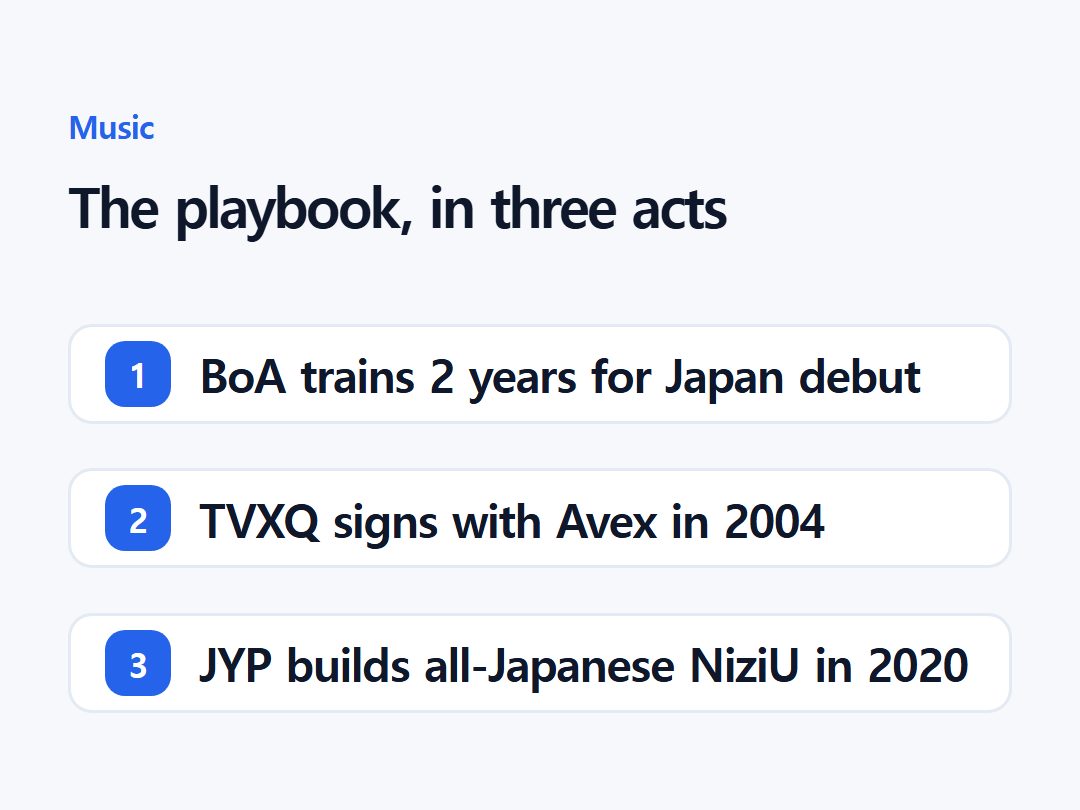
SM's first bet was BoA: signed as a young teenager, she trained in Japanese language and performance for roughly two years before her 2001 Japanese debut, and became the first Korean solo artist to top the Oricon chart.
TVXQ followed the same path, signing with Avex in 2004 and debuting in Japan in 2005 — though unlike their instant success in Korea, they spent several years largely unknown there before eventually topping Oricon's albums chart with their final release as a five-member group in 2010.
BoA and TVXQ's slow-built, language-first approach became the industry template.
Agencies concluded that success in Japan required treating it as a market to be entered on its own terms — with local-language material, local promotion, and idols who could speak and perform in Japanese — rather than simply exporting Korean-language hits.
SM, JYP, YG and later HYBE built Japanese-language training into standard trainee programs, and by the 2010s a Japanese version had become close to mandatory for any group with serious overseas ambitions.
Girl groups such as Kara and Girls' Generation, working with Universal Music Japan's idol-focused arm, extended the model in the following decade, adopting Japan-specific tactics like handshake events that had no real equivalent in Korea's music scene at the time.
The logic has since gone a step further than translated songs.
In 2019, JYP Entertainment partnered directly with Sony Music Entertainment Japan to hold open Japanese-only auditions, under a strategy JYP founder Park Jin-young called “K-pop 3.0: globalization by localization.” Roughly 10,000 people auditioned.
The result, NiziU, is a nine-member group made up entirely of Japanese trainees, trained partly in Korea but built from the outset for the Japanese market; it debuted in Japanese in December 2020 and only released Korean-language music three years later.
Rather than translating a Korean group's output, JYP and Sony built a Japan-native group using the K-pop production system — the furthest extension yet of the same market logic that once produced Japanese-language BoA singles.
Is Japan's K-pop dominance starting to fade?
The gap that made Japan a special case is narrowing from two directions. On the export side, 2025 data shows Japan's lead shrinking: album exports there fell 10.2% while exports to China jumped 16.6%, closing most of the roughly $20 million gap between the two markets.
Separately, a study by K-Pop Radar and the Korea Creative Content Agency's Japan office found that Japan's share of global K-pop YouTube consumption slipped from 8.77% in 2022 to 8.54% in 2024, even as Japan's own viewing numbers kept growing — the report describes a market that has “already achieved saturation,” with most activity now coming from long-established fans rather than new ones.
Neither trend has broken the underlying economics: Japan's physical-CD, handshake-driven retail system is still unmatched anywhere else K-pop sells, and no agency has walked away from its Japanese-language pipeline.
What remains unresolved is whether agencies keep investing at the same scale in dedicated Japanese-language releases, joint ventures and idol-training tracks as China's import numbers rise and younger, more digitally native fan bases grow faster in Southeast Asia, Latin America and the United States.
If Japan's share of the business keeps shrinking relative to these newer markets, the four-decade-old playbook that runs from BoA to NiziU to TWICE's Japanese compilations may start to look less like a fixed rule of the industry and more like one strategy among several.
Japan market entry timeline for K-pop acts
| Act | Japan Debut | Key Facts |
|---|---|---|
| BoA | 2001 | First Korean solo artist to top the Oricon chart |
| TVXQ | 2005 | Slow build in Japan; topped Oricon's albums chart in 2010 as a five-member group |
| Kara / Girls' Generation | 2010s | Worked with Universal Music Japan; introduced handshake-event tactics to K-pop |
| NiziU | December 2020 | All-Japanese lineup built by JYP and Sony Music Japan; first Korean-language release came three years later |
Frequently asked
Why do K-pop groups release Japanese versions of their songs?
Japan is the world's second-largest recorded-music market and still runs mostly on physical CD sales tied to handshake events and lottery slips, so a Japanese-language release lets agencies plug into that repeat-purchase system in a way a Korean-language release cannot.
How much money do K-pop album exports to Japan generate?
South Korea's album exports to Japan were worth $80.6 million in 2025, more than exports to China ($69.7 million) or the United States ($64 million), according to Korea Customs Service data reported by Yonhap.
What is NiziU and how is it different from other K-pop groups?
NiziU is a nine-member group made up entirely of Japanese trainees, created by JYP Entertainment and Sony Music Japan through open auditions rather than by translating an existing Korean group's songs into Japanese.
Sources
Every factual claim above is traceable. We do not translate articles — we gather facts from multiple outlets and write them ourselves.
- K-pop rules its 2025: global album exports topped US$300m — Outlook Respawn (citing Korea Customs Service / Yonhap)
- Japan's K-pop market grows, while global share slips: study — The Korea Herald
- Korea, Japan, Indonesia top K-pop markets in 2025: data — The Korea Herald
- Global Music Report 2026: Global recorded music revenues grow 6.4% — IFPI
- Japan and China's Recording Industries Dwarf That of South Korea — Digital Music News
- Twice5 (album) — Wikipedia
- Enemy (Twice album) — Wikipedia
- BTS tops 2 categories on Japan's Oricon music chart in 1st half of year — Korea JoongAng Daily
- Handshake event — Wikipedia
- How AKB48 turned Japan's Oricon chart into a science — and changed the music industry — Martin Cid Music
- YGEX — Wikipedia
- 20 Years And Counting: The Story Of TVXQ — POP TOKKI
- Transcript Episode 60: The Rise and Fall and Rebirth of TVXQ Part 2 — The Idol Cast
- NiziU — Wikipedia
- JYP Announces Season 2 Of Japanese Audition Program "Nizi Project" For New Boy Group — Soompi