In September 2025, two Korean girl and boy groups ended up in a formal intellectual property dispute over something that, to an outsider, might look like a toy: a lightstick.
Girl group QWER unveiled a white, megaphone-shaped official lightstick that fans immediately compared to the one used by boy group The Boyz, whose heart-shaped white megaphone stick had been on the market since 2021.
The Boyz's agency, One Hundred, said it had asked QWER's agency to change the design, got no resolution, and confirmed legal action was under review.
Two industry associations, the Korea Entertainment Producer's Association and the Korea Management Federation, weighed in publicly, warning that the industry needed formal rules to prevent this kind of conflict.
The short version
- Agencies, not fans, legally own most fandom names and lightstick designs.
- Trademark infringement in Korea can mean prison time or fines up to $72,000.
- Beast and NewJeans show groups can lose rights to their own name.
The dispute was not really about a piece of plastic.
It was about who owns a symbol that fans spend money on, wave at concerts, and use to identify themselves — and the answer, in the K-pop industry, is almost never "the fans." It is the agency, or 기획사 ("gihoeksa"), the management company that recruits, trains, and contractually controls the artist for years under Korea's agency system.
Fandom names and lightstick designs are official brand assets, planned and registered the same way a company would protect a logo.
Do K-pop fans choose their own fandom names?
International fans often assume terms like ARMY (BTS), BLINK (BLACKPINK), or ONCE (TWICE) grew organically, the way Western fandom nicknames sometimes do. In most cases, they did not.
A fandom name is typically confirmed and announced directly by the agency, sometimes after narrowing the choice to a shortlist that fans vote on, but the final decision and the announcement itself are corporate.
This is not a fringe practice — it happens for debuting acts and for solo artists years into their careers alike.
In July 2025, for example, singer Chuu's agency ATRP formally unveiled her fandom name, KKOTI, through a staged social media rollout, treating the name reveal as a branding event rather than letting it emerge from fan chatter.
The same logic applies, even more explicitly, to lightsticks.
Unlike the improvised glow sticks or balloons fans once brought to concerts themselves, a modern K-pop lightstick is an engineered consumer product: a specific shape, a specific color when lit, sold at a specific price, usually manufactured under contract with the agency.
Because it is a manufactured good tied to a specific group's identity, agencies treat its design the same way a company treats packaging or a logo — as something to register and defend.
Legal and industry analysis of the sector describes this explicitly: agencies typically register trademarks covering both the group's name and its visual identity, and that protection is extended to official goods including lightsticks, clothing, and albums.
HYBE, the agency behind BTS, has been especially aggressive about this; according to WIPO's own trade publication, BTS-related trademarks filed with Korea's Intellectual Property Office in 2021 outnumbered those of any other pop act, and HYBE holds registered design rights over three separate generations of BTS's "ARMY Bomb" lightstick.
The Boyz-QWER case shows what is actually at stake legally. The Boyz's megaphone-shaped lightstick was registered as intellectual property by its manufacturer, Copan Global, in 2022.
Under Korean law, if a rival design is found to infringe on that registration, the infringing company's agency can face criminal penalties of up to seven years in prison or fines of up to 100 million won (about $72,000).
This is not a symbolic slap on the wrist — it is the same legal machinery used to fight product counterfeiting.
There is an important nuance, though: not every color associated with a fandom was handed down by a corporate memo. BTS's association with purple is the clearest example.
It began in 2016 when member V, during a fan meeting, said "I purple you" and improvised an explanation that purple was the color of trust and lasting love. Fans embraced the phrase and the color on their own; it was not a scripted marketing rollout.
In 2022, when a public debate broke out over whether purple was "officially" BTS's color, member Suga stated plainly that purple was not officially trademarked to the group.
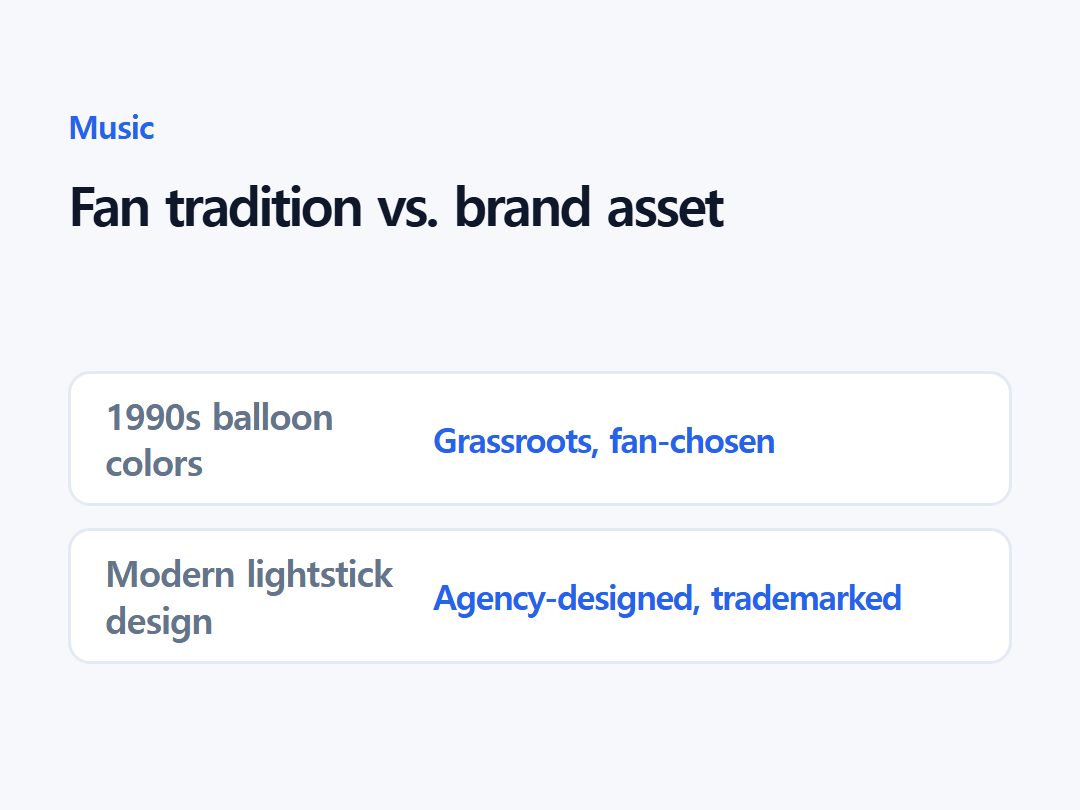
The distinction matters: a fandom's emotional attachment to a color can grow from a spontaneous moment between an idol and fans, while the physical lightstick's shape, its default lit color, and the fandom's official name are the parts agencies formally own, register, and enforce as commercial property.
Can K-pop groups lose rights to their own name?
The idea that a color belongs to a fandom predates lightsticks entirely.
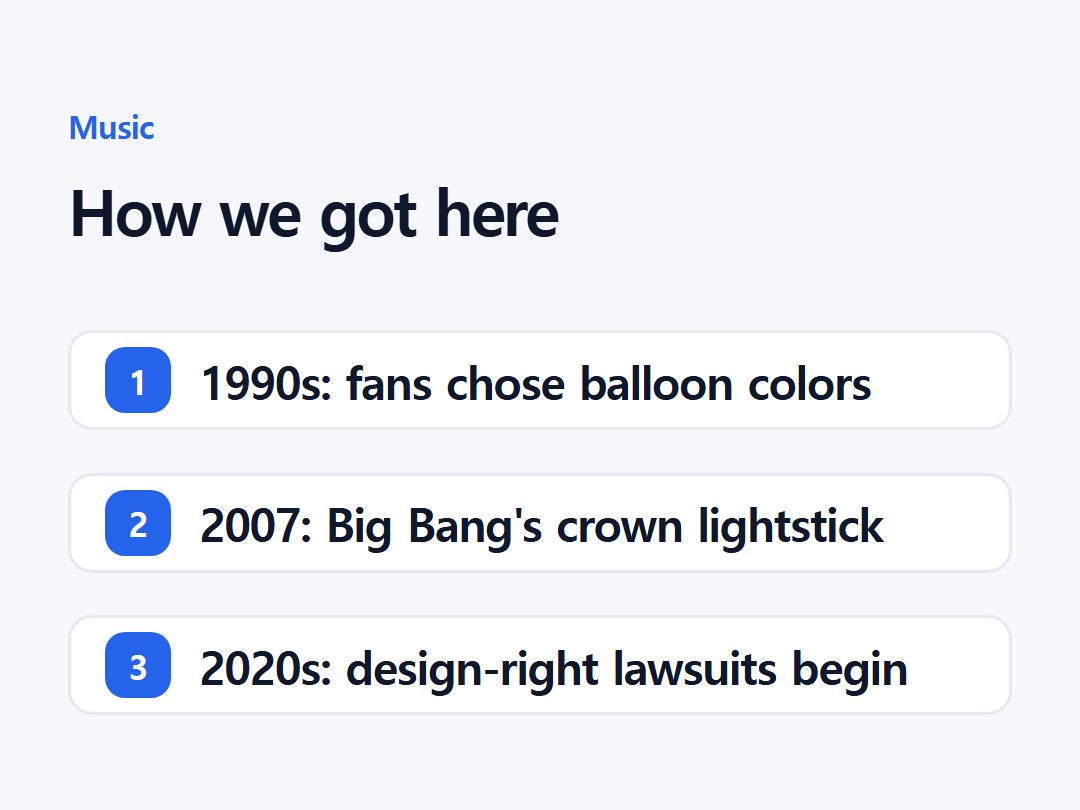
In the late 1990s, Korea's first generation of idol fandoms distinguished themselves with colored balloons at concerts: white for H.O.T., yellow for rival group Sechskies, sky blue for g.o.d., orange for Shinhwa, and pink for Fin.K.L. This rivalry was intense enough that it was later dramatized in the hit Korean drama "Reply 1997." At this stage, the color system was closer to a genuine grassroots tradition — fans chose or adopted a color to visually claim their side in a crowded arena.
That changed with the arrival of the branded lightstick. Solo singer Se7en is generally credited with introducing the first group-specific glow item, a "7"-shaped penlight, during a Japanese tour in 2006.
The bigger turning point came almost immediately after, when Big Bang released an official lightstick nicknamed the "Bang Bong": a yellow, crown-shaped stick reportedly designed with input from member G-Dragon, tying the group's self-styled "royalty" concept directly to a piece of merchandise fans had to purchase rather than improvise.
Other agencies quickly understood the commercial logic, and within a few years, nearly every major K-pop act had its own manufactured, branded lightstick, effectively ending the balloon era.
As lightsticks and fandom names became valuable, ownership disputes followed — and they are what taught the industry to formalize protection from the start.
Some of the clearest cases: H.O.T. and Shinhwa both fought lengthy legal battles in the early 2000s just to reclaim the right to use their own group names after leaving SM Entertainment.
Girl group T-ara clashed with former agency MBK Entertainment after MBK filed to trademark "T-ARA" in December 2017, around the time the group was preparing to leave.
GFRIEND's agency, Source Music, filed trademark applications over the group's name in 2021, months before the group disbanded, though the Korean Intellectual Property Office initially refused them.
Boy group GOT7 reached an amicable trademark transfer with JYP Entertainment in 2021, widely reported as a rare, fan-friendly resolution. Beast, forced to perform for years as "Highlight" after a name dispute, only regained trademark rights to "BEAST" in April 2024.
And most recently, members of NewJeans publicly acknowledged they could lose the right to perform under that name because the trademark is held by their agency, ADOR, a live issue during their broader contract dispute with the company.
Each of these cases reinforced the same lesson for management companies: a group's name, its fan club name, and its merchandise designs are not incidental branding — they are assets that determine who controls millions of dollars in future revenue, and who has leverage if an artist ever tries to leave.
Unresolved disputes as agencies expand trademarks abroad
The Boyz-QWER lightstick dispute remained unresolved as of early October 2025, with The Boyz's agency still weighing formal legal action and no design change confirmed from QWER's side.
Industry associations have called for a pre-registration and mediation system for merchandise design specifically to prevent repeat conflicts, but no such formal system exists yet.
Separately, the NewJeans naming dispute with ADOR remains an open question, testing how far a trademarked group name can follow — or restrict — artists after they attempt to leave their agency.
As Korean agencies expand merchandise sales overseas, expect continued use of the Madrid Protocol, an international trademark filing system, to lock down group names and lightstick designs in markets like the United States, Japan, and Europe, extending this distinctly Korean model of brand control to a global fan base.
K-pop name and trademark disputes
| Case | What Happened | Outcome |
|---|---|---|
| H.O.T. & Shinhwa | Fought to reclaim rights to use their own group names after leaving SM Entertainment | Won back naming rights in the early 2000s |
| T-ara | Former agency MBK Entertainment filed to trademark "T-ARA" in December 2017 as the group prepared to leave | Clash between group and agency |
| GFRIEND | Source Music filed trademark applications over the group name in 2021, months before disbanding | Korean Intellectual Property Office initially refused the filings |
| GOT7 | Trademark dispute with JYP Entertainment over the group name | Amicable trademark transfer in 2021 |
| Beast | Forced to perform as "Highlight" for years after a name dispute | Regained trademark rights to "BEAST" in April 2024 |
| NewJeans | Trademark for the group name is held by agency ADOR | Members risk losing the right to perform under the name amid a contract dispute |
Frequently asked
Do K-pop fans choose their own fandom names?
Usually not — fandom names like ARMY or KKOTI are typically confirmed and announced by the agency, sometimes after narrowing choices to a shortlist fans vote on.
Who owns K-pop lightstick designs?
Agencies (and manufacturers under contract with them) register lightstick shapes and colors as trademarks or design rights, the same way a company protects a logo or packaging.
Can a K-pop group lose the rights to its own name?
Yes — agencies often hold the trademark, as when Beast had to perform as "Highlight" for years, and NewJeans members say they risk losing their name amid a dispute with ADOR.
Sources
Every factual claim above is traceable. We do not translate articles — we gather facts from multiple outlets and write them ourselves.
- Who owns rights to K-pop group names? — The Korea Times
- The Boyz, QWER's clash over light stick designs exposes K-pop's gray areas — The Korea Times
- 5 K-pop Groups That Retained Name, Trademark Rights After Leaving Agency — KpopStarz
- Visual Design and Brand Protection in the K-Pop Industry — Advocate Turkey (law firm)
- How BTS is Using Intellectual Property to Build its Legacy — WIPO Magazine
- Chuu's Agency Announces Official Fan Club And Light Stick Names — Soompi
- BTS members give their opinion on the recent 'purple is BTS's color' debate — allkpop