On January 7, 2026, CNBLUE released 3LOGY, its first full-length album in eleven years. All ten tracks, including the title song "Killer Joy," were written and composed by the group's three members. For a band marketed inside Korea's idol system, that credit line is still the detail worth pausing on.
The short version
- CNBLUE's three members wrote and played all ten tracks on 3LOGY, their 2026 album.
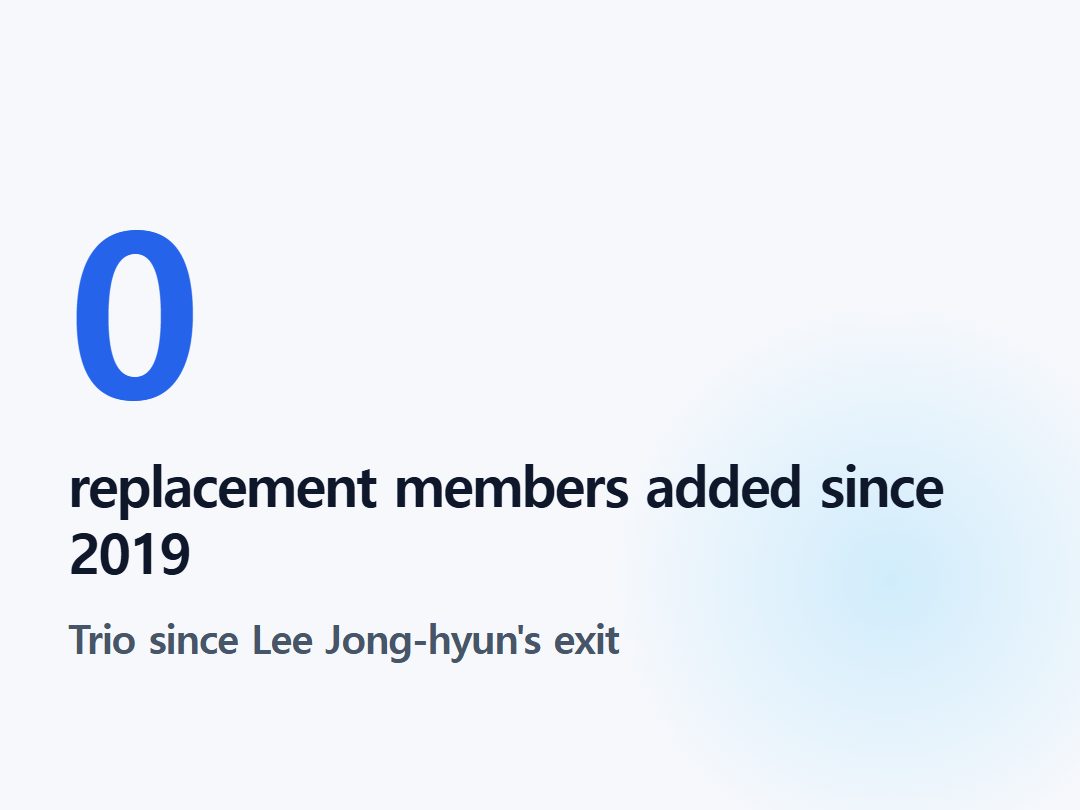
- Guitarist Lee Jong-hyun left the band in 2019 after a scandal; no replacement was added.
- In 2012, CNBLUE became the first foreign band in 41 years to top Oricon's chart.
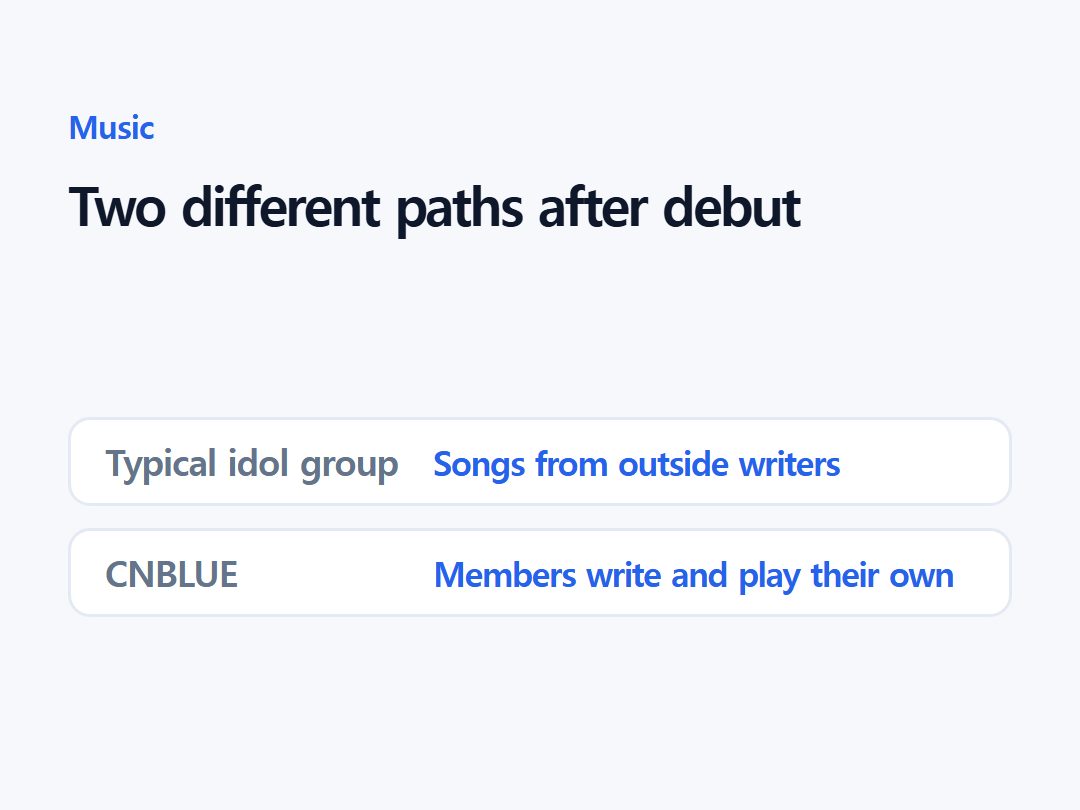
CNBLUE debuted in January 2010 through FNC Entertainment, the same kind of agency that trains and launches most K-pop idol groups. Sixteen years later, three of its original members still write their own songs, play their own instruments on record, and toured the world in 2026 behind an album with no outside songwriter credited anywhere on it.
The same trainee system as any K-pop hopeful
Before they were a band, CNBLUE went through Korea's standard trainee system — the practice, used by nearly every K-pop agency, of signing teenagers to years of unpaid vocal, dance, and performance training before a debut is even scheduled.
Leader Jung Yong-hwa and drummer Kang Min-hyuk had trained at FNC since 2007. Bassist Lee Jung-shin joined in 2008, replacing an earlier bassist who left before the group's Korean debut.
Nothing about that path distinguished them from any other idol act forming at the same agency. What changed the outcome was what FNC did with them next.
FNC sent them busking in Tokyo before Seoul ever saw them
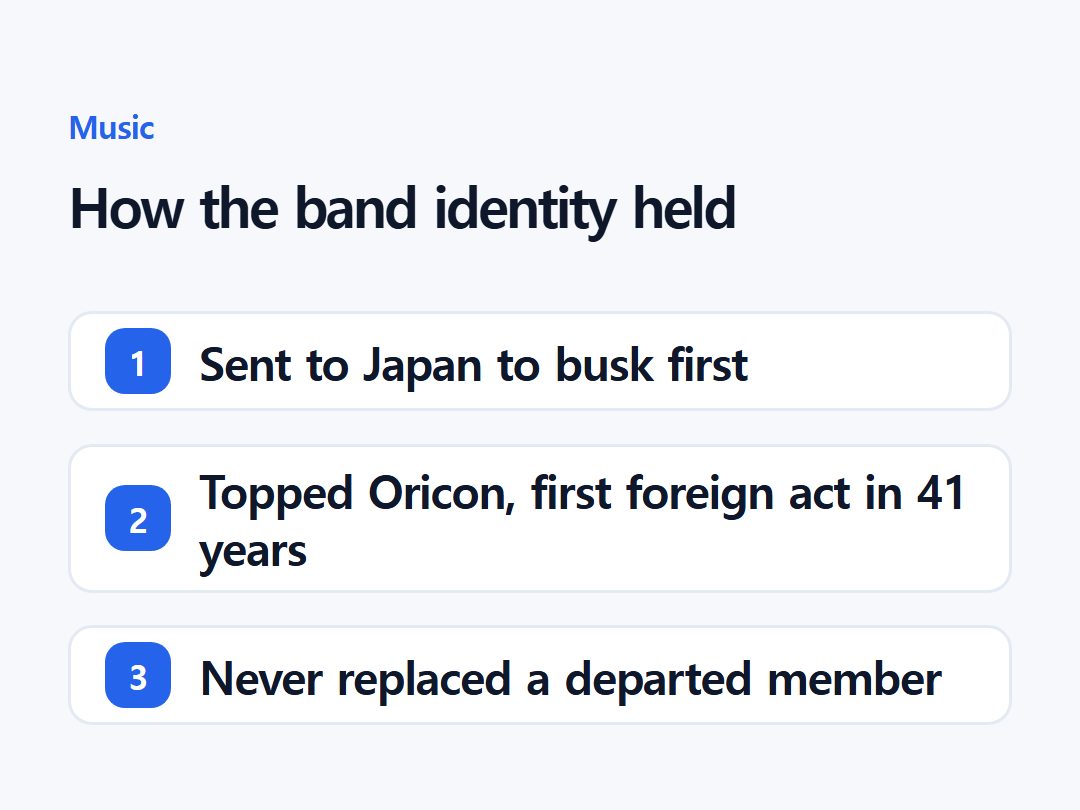
Rather than debut CNBLUE in Korea first, FNC sent the group to Japan in mid-2009 to work as an independent act, releasing two indie mini-albums and performing more than a hundred small club and street shows around Tokyo's Shibuya and Shinjuku districts. Japanese media nicknamed the run "Music Warrior Training."
The reasoning, by FNC's own later account, was that Japan's music scene already recognized band culture — an act that writes, plays, and performs its own material — in a way Korea's idol market at the time largely did not. CNBLUE's Korean debut EP, Bluetory, followed in January 2010, only after that groundwork was in place.
Half the songs on their debut EP already had a member's name on them
Self-composition was not added later as a selling point; it was there from the first releases. Of the ten songs across CNBLUE's two Japanese indie mini-albums, five were co-written or composed by the members themselves. On Bluetory, three of the five Korean tracks involved a member in the songwriting or composing credits.
That pattern held as the catalog grew. Drummer Kang Min-hyuk and then-guitarist Lee Jong-hyun also picked up writing and composing credits on later EPs, not just Yong-hwa.
One frontman wrote seventeen songs in six months
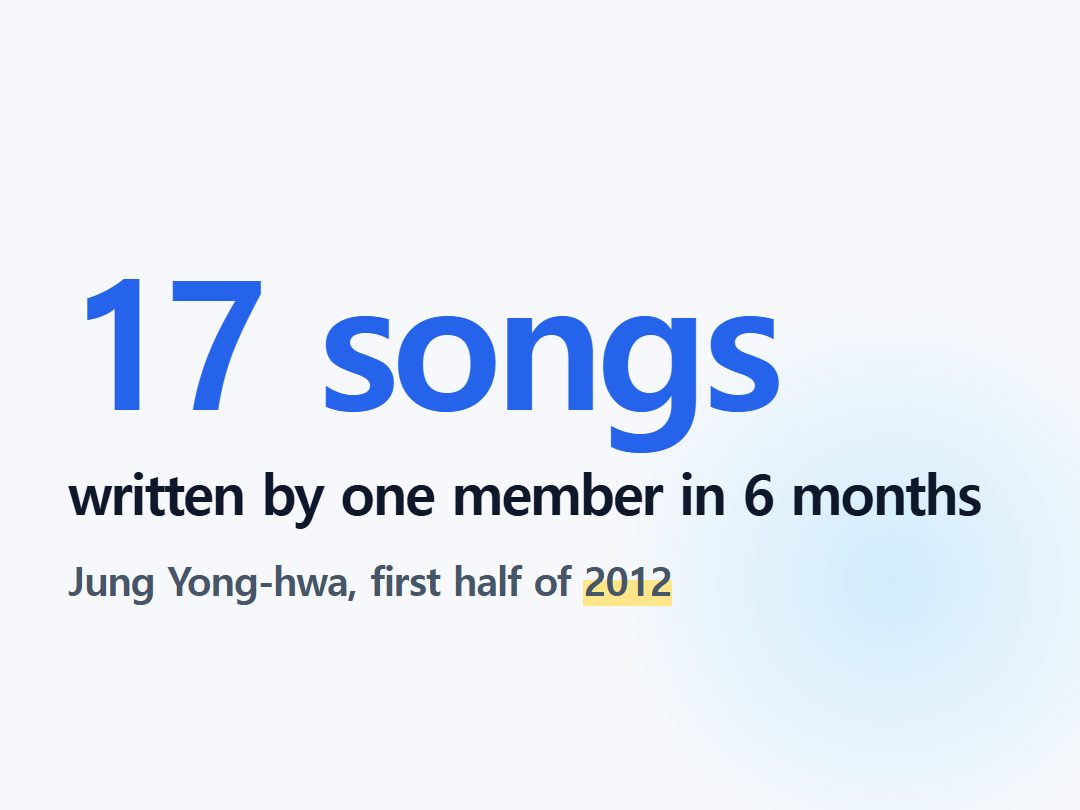
Yong-hwa became the clearest face of that identity. In the first half of 2012 alone, he wrote or composed 17 tracks — five of them on CNBLUE's own EP Ear Fun — while also writing for FNC labelmates, including Juniel's "Fool" and AOA's "Love Is Only You."
Music outlets at the time described him as a "songwriting genius," a label unusual for an idol frontman rather than a credited composer working behind the scenes.
A number one no foreign band had touched in 41 years
The clearest proof the strategy worked came from the Japanese charts CNBLUE had been building toward since 2009. In February 2012, "Where You Are" — written and composed by Yong-hwa — topped Oricon's weekly singles chart, making CNBLUE the first foreign band to do so in 41 years, since Canadian group Mashmakhan in 1971.
It gave FNC concrete evidence for the argument it was already making back home: the band format was not just a marketing angle.
The agency had to argue that its idols were a real band
That argument needed making because, inside Korea, the label did not stick automatically. In a 2013 interview with the Korea Times, FNC CEO Han Seong-ho said he believed there was "a bias when a group is born pre-planned, and its members are good-looking, that somehow the music would lag" — describing a skepticism aimed squarely at his own artists.
He returned to the point in 2015, telling reporters that CNBLUE and labelmate FTISLAND "compose many of their own songs and perform all the instrumentals when recording, and give live performances," but still faced a domestic prejudice that fans overseas did not share.
Military service pulled in four members, only three came back to the group
South Korea requires nearly all able-bodied men to complete mandatory military service, typically 18 to 21 months, usually pausing a celebrity's career mid-run. CNBLUE's four members entered service across 2018: Yong-hwa in March, guitarist Lee Jong-hyun in August, and Min-hyuk and Lee Jung-shin together on July 31.
Their discharges did not run in parallel:
- Yong-hwa was discharged in November 2019
- Min-hyuk and Jung-shin were released early, in March 2020, under pandemic-related measures
- Jong-hyun never returned to the group at all
While still enlisted, Jong-hyun was questioned by police over sharing illegally filmed videos through a chat room tied to the 2019 Jung Joon-young chatroom scandal, part of the wider "Burning Sun" case that also implicated other Korean entertainers. He was not criminally charged.
Renewed public backlash followed after a YouTuber published inappropriate direct messages he had sent her. On August 28, 2019, FNC announced that Jong-hyun was leaving CNBLUE by mutual agreement with the agency and his bandmates.
In his statement, he apologized for "inappropriate words and actions" and said he was "ashamed to have disappointed the fans." He has not returned to entertainment since; a later report described him working in beauty-industry marketing.
No replacement, unlike almost any other idol group
What happened next is where CNBLUE's band identity showed up structurally, not just musically. Idol groups that lose a member typically recruit a replacement to preserve the lineup and choreography. CNBLUE did not.
Since August 2019, the group has continued as a trio — Yong-hwa on vocals and guitar, Min-hyuk on drums, Jung-shin on bass — releasing music, touring, and recording without adding a fourth member. For a band whose appeal rests on fixed instrumental roles rather than an interchangeable idol lineup, that gap simply stayed a gap.
Fifteen years in, they are still writing the whole tracklist
CNBLUE's most recent comeback — the industry term for a new release cycle from an already-debuted act — arrived on January 7, 2026, with the studio album 3LOGY, its first full-length release in eleven years. FNC confirmed all ten tracks were written and composed by the three remaining members, continuing the pattern set on their first EP in 2010.
The rollout included a world tour that opened in Seoul that January and continued through Oceania dates in March, with the group performing the album's full ten-track set live each night — the same instrumental claim FNC's CEO was making about them more than a decade earlier.
What still isn't settled
CNBLUE has not publicly confirmed whether its three members have re-signed long-term contracts with FNC, and the agency has never said whether a fourth member could be added back.
Jong-hyun's case also remains unresolved in one narrow sense: he was questioned by police but never charged, and neither he nor FNC has commented further on it since his 2019 statement.
What is documented is the throughline: a group trained inside Korea's idol system that chose, from its earliest Japanese indie shows through its 2026 world tour, to keep functioning as a band that writes and plays its own material — even after losing a quarter of its original lineup.
CNBLUE members' military service timeline (2018–2020)
| Member | Enlisted | Discharged |
|---|---|---|
| Jung Yong-hwa | March 2018 | November 2019 |
| Lee Jong-hyun | August 2018 | Never returned to the group |
| Kang Min-hyuk | July 31, 2018 | March 2020 (early, pandemic-related) |
| Lee Jung-shin | July 31, 2018 | March 2020 (early, pandemic-related) |
Frequently asked
Why did CNBLUE never replace Lee Jong-hyun?
Idol groups usually recruit a replacement when a member leaves, but CNBLUE has continued as a trio since August 2019, releasing music and touring without adding a fourth member.
Why did Lee Jong-hyun leave CNBLUE?
He was questioned by police over sharing illegally filmed videos tied to the 2019 Jung Joon-young chatroom scandal, though never charged, and after a YouTuber published inappropriate messages he had sent her, FNC announced on August 28, 2019 that he was leaving by mutual agreement.
Do CNBLUE members really write their own music?
Yes. All ten tracks on their 2026 album 3LOGY were written and composed by the group's three members, continuing a pattern set on their 2010 debut EP.
Sources
Every factual claim above is traceable. We do not translate articles — we gather facts from multiple outlets and write them ourselves.
- CNBLUE Announces Comeback Schedule For 3rd Album "3LOGY" And Pre-Release Track — Soompi
- CNBLUE Unveils "Killer Joy" MV As Part Of Third Full Album '3LOGY' — allkpop
- CNBLUE Ignites A New Era With Third Full-Length Album '3LOGY' — hellokpop
- CNBLUE Wraps Oceania Leg of '3LOGY' World Tour — allkpop
- CN Blue Breaks 41-Year Chart Record In Japan — Soompi
- CNBLUE's Jung Yong Hwa Emerges As "Songwriting Genius" — Soompi
- Carving out niche with pop rock bands — The Korea Times
- Lee Jong Hyun Departs K-Pop Group CNBLUE Following Chatroom Controversy — Billboard
- Breaking: Lee Jong Hyun Announces Departure From CNBLUE — Soompi
- Ex-CNBlue guitarist Lee Jong-hyun resurfaces, says he now works in beauty marketing — Korea JoongAng Daily
- CNBLUE's Kang Minhyuk and Lee Jungshin Will Both Enlist In The Military July 31 — Koreaboo
- CNBLUE's Jung Yong Hwa Discharged From Military Service — Koala's Playground
- CNBLUE's Jungshin & Minhyuk Revealed To Have Returned From Mandatory Service Early Due To Coronavirus Prevention Measures — allkpop
- CNBLUE Officially Announces Comeback With Release Schedule For 10th Mini Album 'X' — allkpop