A Korean idol's Instagram bio might read “Kim Minji” one month and “Minji Kim” the next, and both are treated as correct. That is not carelessness. It is two naming systems colliding — one Korean, one Western — that put the same information in opposite order. Understanding how a Korean name is actually built, from surname to clan to generation, explains far more than which word comes first.
The short version
- Korean names put family name first, given name second — the reverse of Western order.
- Kim, Lee, and Park together make up 44.6 percent of all Koreans.
- A forgotten 1894 reform, not ancient tradition, explains why so many share those names.
Family name first, given name last
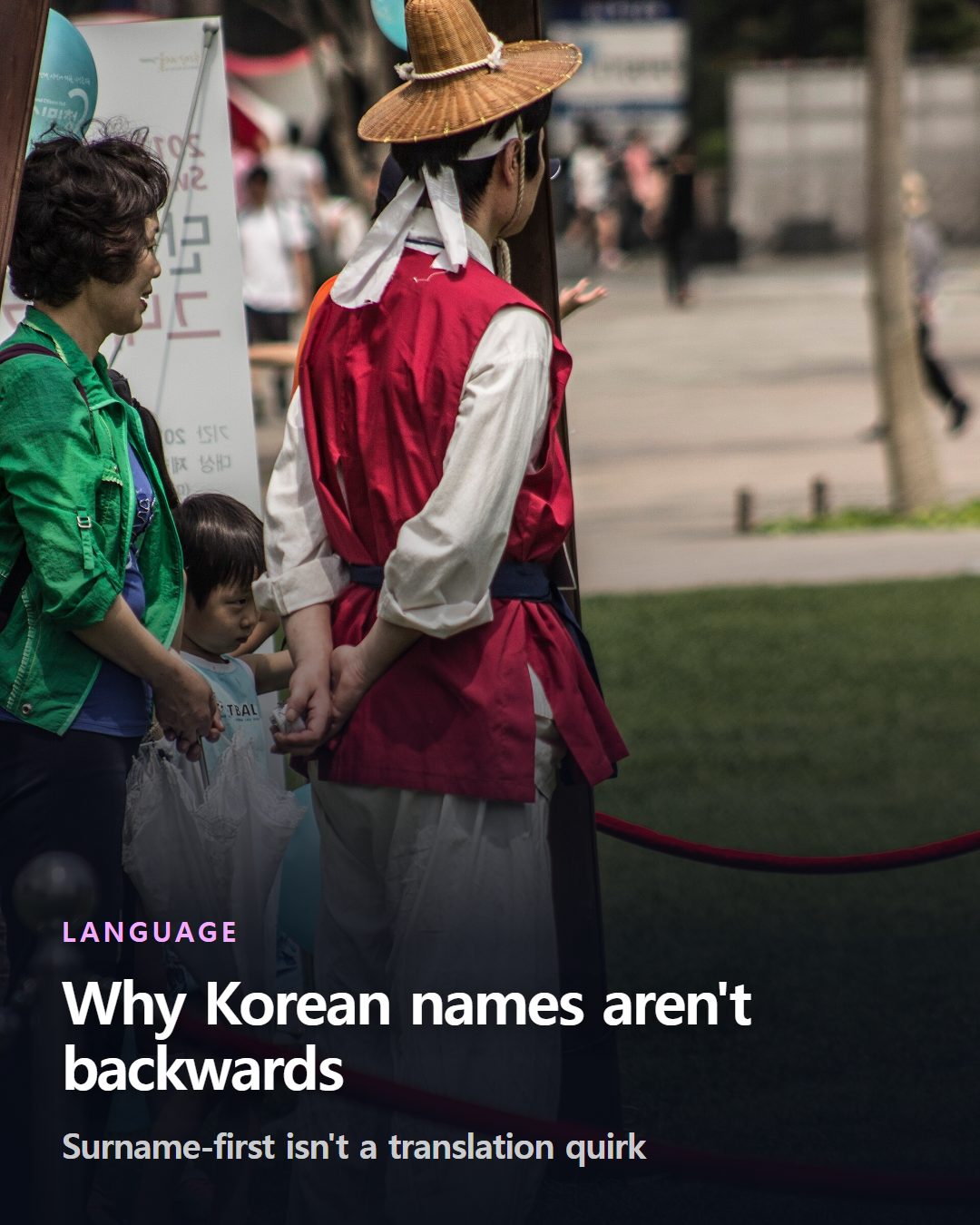
Korean follows the order used across East Asia: the family name (성) comes first and the given name (이름) comes second. A person named Kim Minji is surnamed Kim; Minji is the given name, not a middle name. English speakers who assume the last word is the surname get it backwards almost every time.
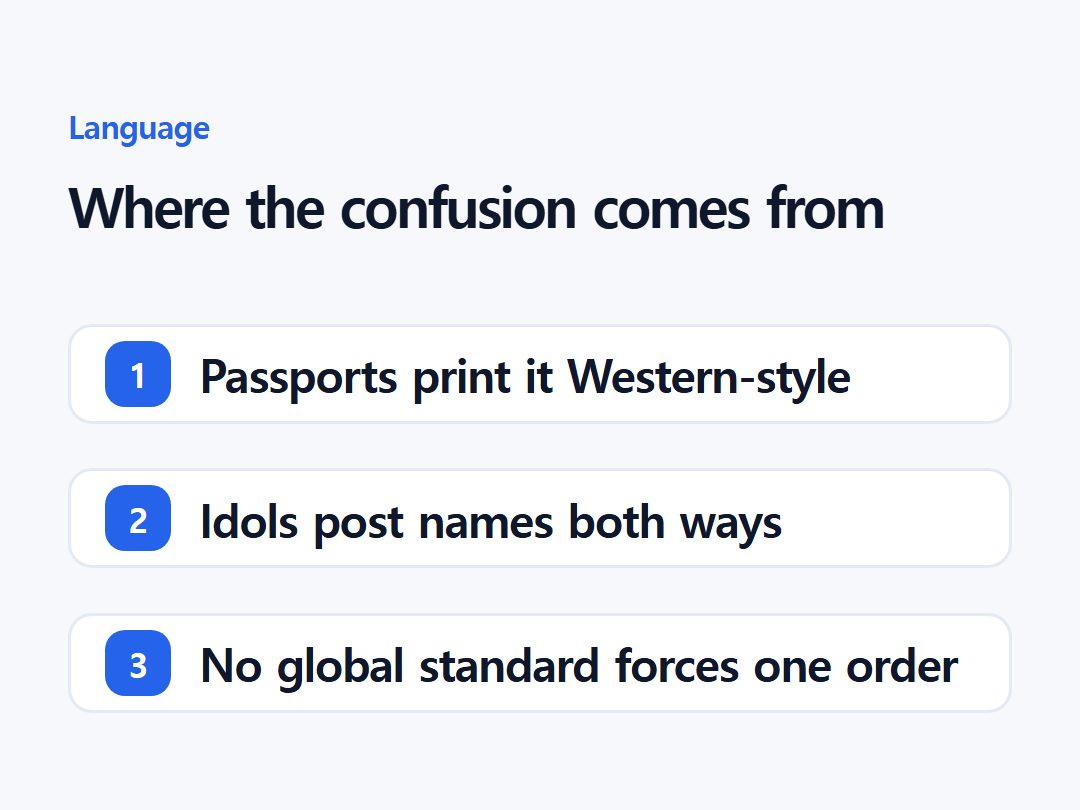
The family name is almost always a single syllable, and the given name is traditionally two syllables, though single-syllable given names exist too. On a passport, the printed “Surname” and “Given Name” fields follow this rule regardless of Korean order — but the machine-readable strip at the bottom doesn't always visually match what a human reads above it, which is a real source of confusion at border control.
K-pop adds another layer: some idols post their names in Western order on social media even while writing in Hangul, a habit Korean commentators themselves have called inconsistent. There is no rule forcing one order online, just competing conventions.
Kim, Lee, and Park cover nearly half the country
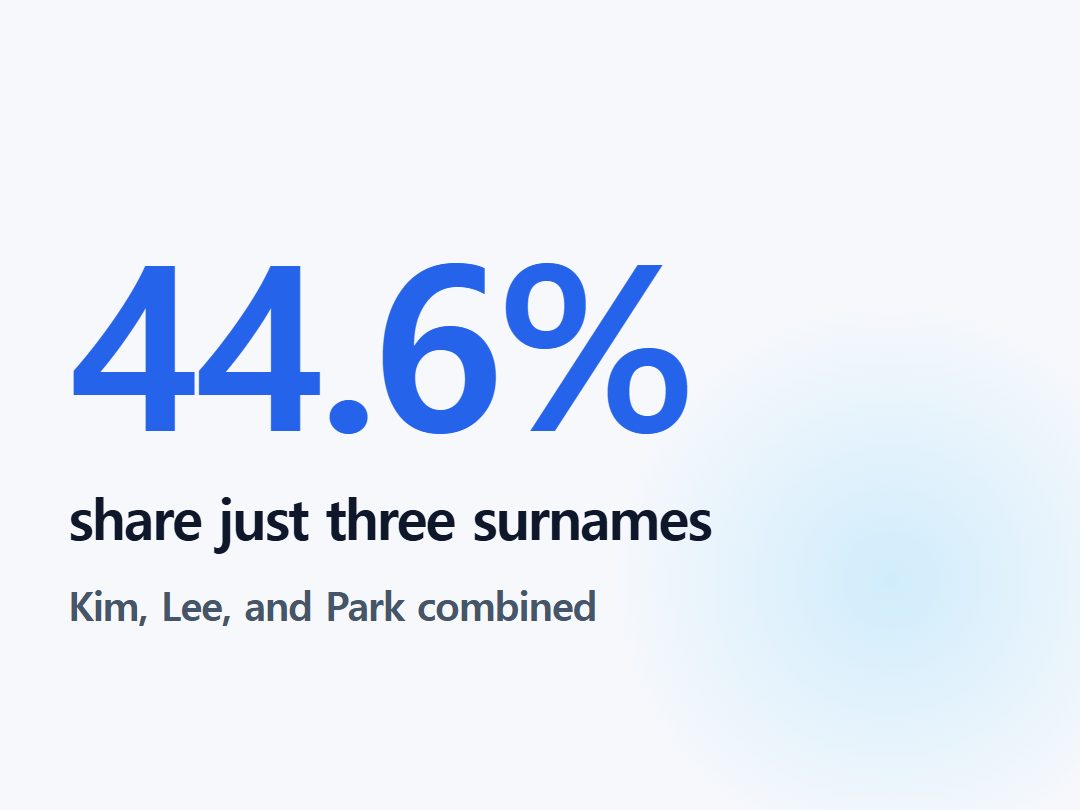
Statistics Korea's most recent full surname count — released in 2016 from a census covering roughly 51 million people — found that Kim, Lee, and Park together account for 44.6 percent of the population. Kim alone covers 21.5 percent, or about 10.69 million people; Lee is 14.7 percent; Park is 8.4 percent.
The ten most common surnames combined cover 63.9 percent of the country:
- Kim
- Lee (Yi)
- Park
- Choi
- Jeong (Chung)
- Kang
- Cho
- Yoon
- Jang
- Im (Lim)
Korea is not actually short on surnames overall — the same count registered 5,582 distinct family names nationwide, including names newly brought in by naturalized citizens. The concentration sits entirely at the top.
Why so many Koreans share a surname
Before 1894, a surname was a legal marker of privilege, not a birthright. Only the yangban aristocracy and royal lines were formally entitled to one; commoners and enslaved people typically had none at all.
The 1894 Gabo Reform abolished Korea's rigid caste system and, with it, opened surname registration to the entire population for the first time. Most newly surnamed commoners didn't invent something new — they adopted the surnames of the noble clans they had served or lived near, especially Kim, Lee, and Park, for the social legitimacy those names carried.
That single administrative shift, now more than 130 years old, is the direct reason a fifth of the country answers to “Kim” today.
Bon-gwan: the ancestral hometown hidden inside every Kim
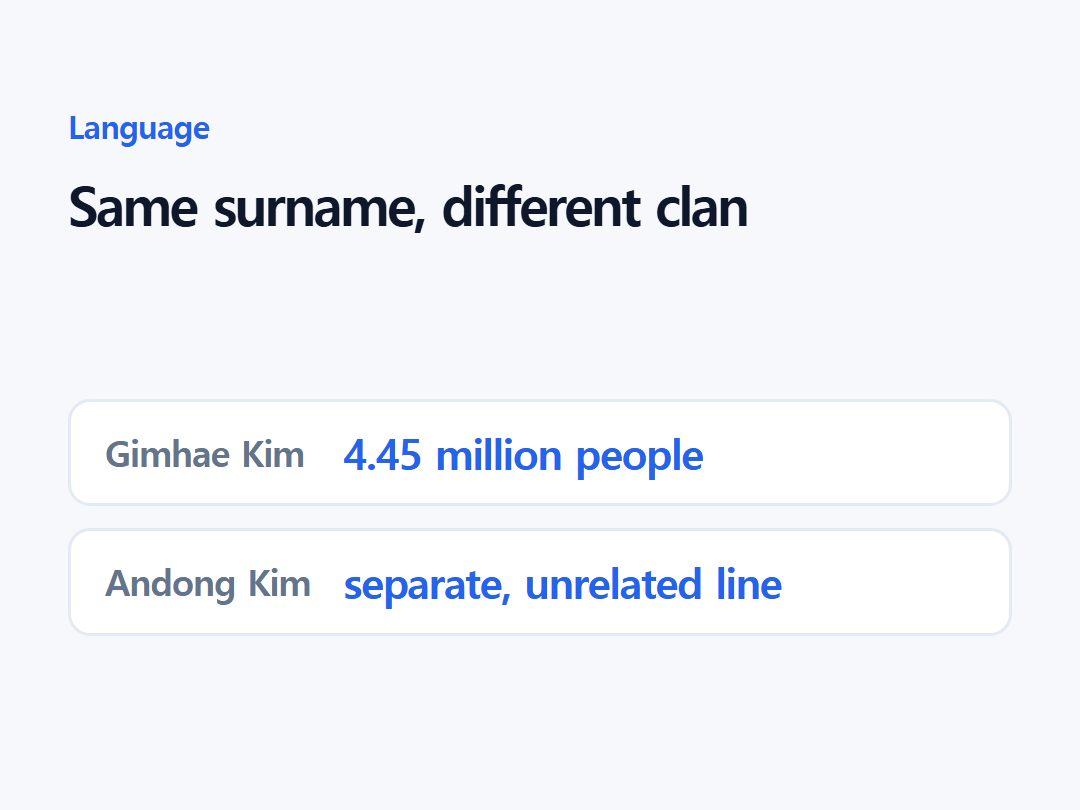
Because so many unrelated families adopted the same surnames, Korea leans on a second identifier: bon-gwan (본관), the clan's ancestral seat, usually a place name. Two people surnamed Kim are not assumed to be related unless they also share a bon-gwan.
The Kim surname alone has more than 300 registered bon-gwan. The largest, Gimhae Kim, traces its lineage to the semi-legendary King Suro of the ancient Gaya confederacy and today counts roughly 4.45 million members — about 9 percent of the entire country, from one clan line.
The distinction used to carry legal weight. Korean law banned marriage between people who shared both surname and bon-gwan, even total strangers with no traceable blood connection, until the Constitutional Court ruled the ban unconstitutional in 1997; the National Assembly abolished it outright in 2005.
The syllable that ties siblings and cousins together
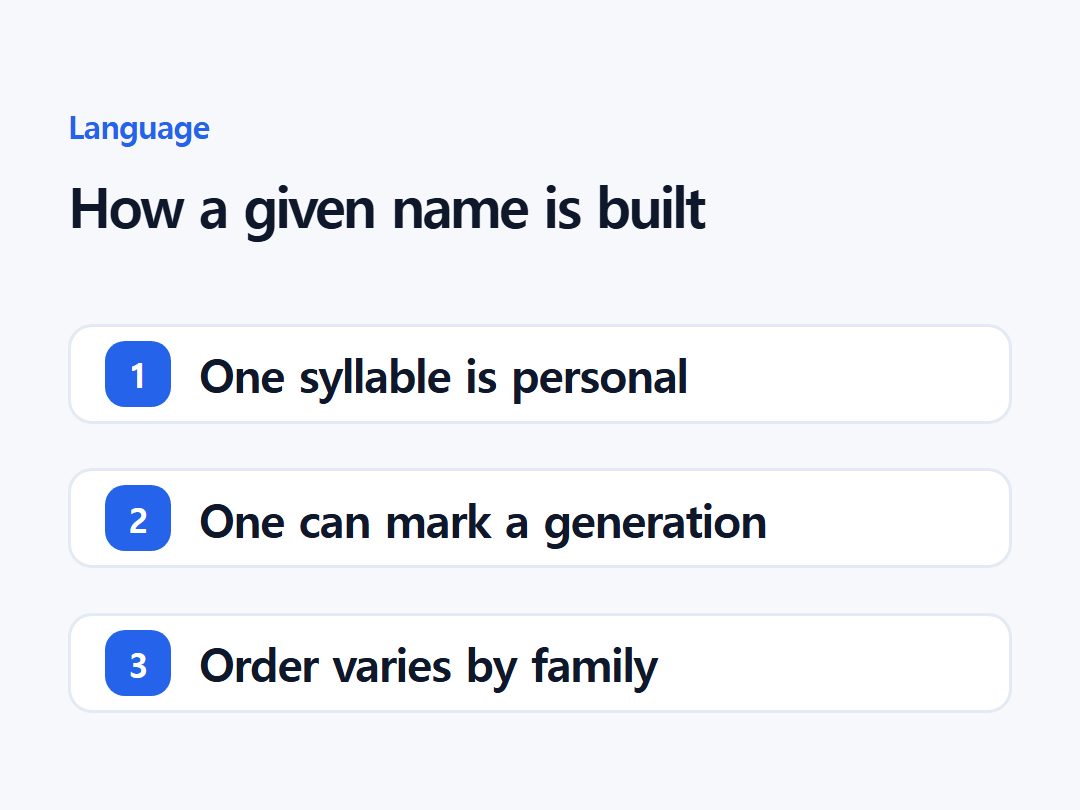
Traditional Korean given names split their two syllables into two jobs. One syllable belongs to the individual; the other, called hangnyeolja (항릂자) or dollimja, is fixed by the clan's genealogy book to mark a specific generation.
Everyone born into that generation of the clan — siblings, and often paternal cousins too — shares the generation syllable. Singer Lee Hyori's sisters are Lee Yuri and Lee Aeri; “ri” is the shared generation character across all three.
Which syllable does the job can vary by family, and even by generation within the same family, since the sequence is set by a preassigned “generation poem” recorded in the clan register. South Korea traditionally shares this syllable across an entire generation of the extended clan; North Korea, where tracing clan origin is discouraged, generally limits it to siblings only.
The formal version is fading. An informal echo survives instead — a girl named Minji might have sisters Mina and Minyoung, sharing “Min” with no clan register behind it at all. Most Koreans who became parents after the late 1980s don't consult a genealogy book when naming a child, though a handful of conservative clans still enforce hangnyeolja strictly for their main family lines.
What a Korean name legally can and cannot be
South Korea's Family Registry Act sets real limits on what parents can name a child.
- Any hanja (Chinese-derived character) used in a given name must come from a Supreme Court-approved list, now more than 5,000 characters — a list that was far shorter before the 1990s.
- Pure Hangul given names with no hanja are equally legal and increasingly common.
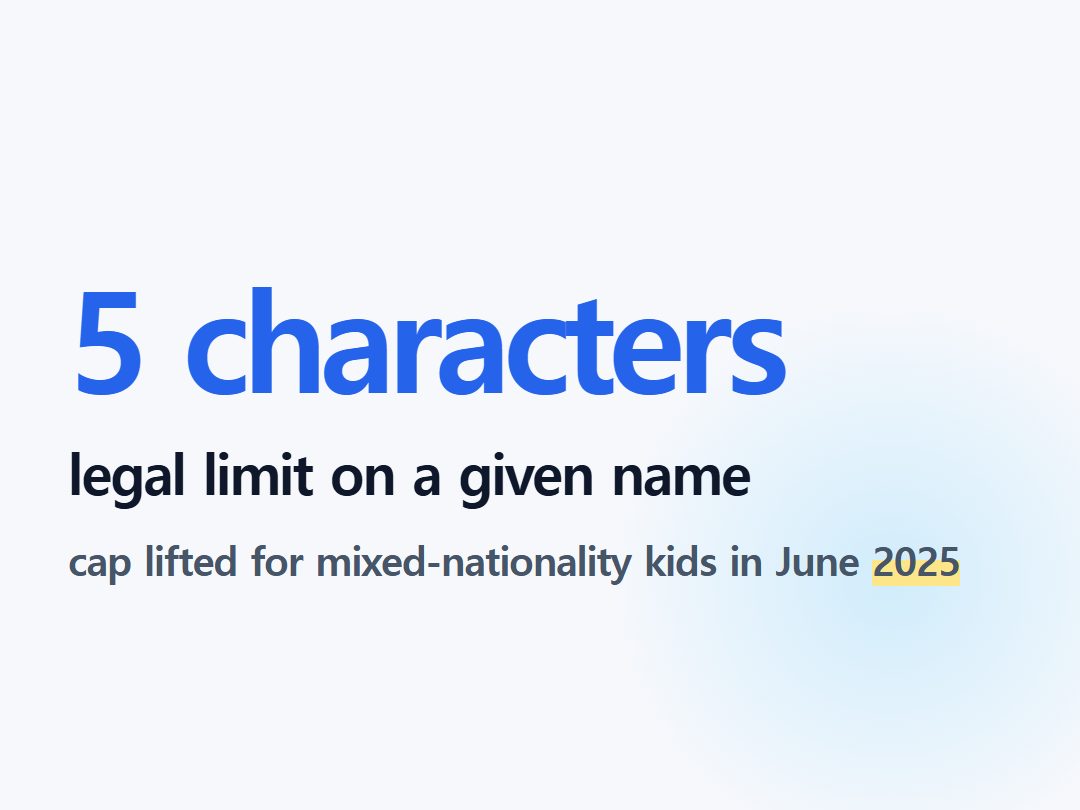
- A given name generally cannot exceed five Hangul characters, not counting the surname.
- Names using non-Korean letters or symbols are rejected outright.
That length cap used to apply unevenly to children with one Korean and one foreign parent. On June 20, 2025, the Supreme Court removed the character limit entirely for mixed-nationality children, so long as the given name matches the one already on the foreign parent's home civil registry.
Why K-pop makes the order look even more confusing
Stage names complicate the picture further. Some, like G-Dragon, are invented for branding. Others just sound invented — BLACKPINK's Jennie, TWICE's Momo, and ATEEZ's San are all real given names, simply presented Western-style, first name only, with no surname attached.
EXO's D.O. is a simpler case: the initials stand for his own surname, Do. Meanwhile idols and agencies routinely post names in Western given-name-first order on international social media, even when the text underneath is written in Hangul — a mismatch that leaves international fans with no consistent rule to follow.
What's changing, and what's still unresolved
Surname diversity is quietly increasing at the margins: naturalized citizens and international marriages have pushed the national count of distinct family names well past its historic core of a few hundred native Korean surnames, even as Kim, Lee, and Park keep their grip on the top.
Passport order remains genuinely unresolved.
What a border officer reads and what a scanner reads don't always follow the same convention, and no international standard forces Korean order into non-Korean systems the way, for instance, Japan's government has formally pushed for “surname-first” romanization in its own official documents.
South Korea has made no equivalent formal move, so the order a given Korean name appears in — on a passport, a boarding pass, or an Instagram bio — still depends on which system, and which person, is doing the writing.
Legal timeline of Korean naming rules
| Year | Change |
|---|---|
| Before 1894 | Surnames legally reserved for yangban aristocracy and royal lines; commoners had none |
| 1894 | Gabo Reform abolishes the caste system and opens surname registration to all Koreans |
| 1997 | Constitutional Court strikes down the ban on marriage between people sharing surname and bon-gwan |
| 2005 | National Assembly formally abolishes the same-surname, same-bon-gwan marriage ban |
| June 20, 2025 | Supreme Court removes the five-character given-name limit for mixed-nationality children |
Frequently asked
Is the surname first or last in a Korean name?
The family name comes first and the given name comes second, the opposite of Western order, though some idols post names Western-style online.
Why do so many Koreans have the surname Kim?
Before 1894 only aristocrats could legally hold a surname; the 1894 Gabo Reform opened surname registration to everyone, and most commoners adopted names like Kim, Lee, and Park from the nobility they had served or lived near.
What is bon-gwan in a Korean name?
Bon-gwan is a clan's ancestral hometown used alongside the surname to tell unrelated families apart — two people named Kim aren't assumed to be related unless they also share the same bon-gwan.
Sources
Every factual claim above is traceable. We do not translate articles — we gather facts from multiple outlets and write them ourselves.
- Kim, Lee, Park remain three most common surnames — The Korea Times
- Generation name — Wikipedia
- How the 1894 Gabo Reform Act Defined Korean Family Names — Koreabridge
- Gimhae Kim clan — Wikipedia
- Name length limit lifted for kids with mixed nationality — The Korea Herald
- The order of surnames and given names in East Asian languages — Language Log
- Wait, that's not their real name? K-Pop idols' real names vs. their stage names — allkpop