Fans following a K-pop comeback (the promotional relaunch of an artist or group with new music) often see three different numbers circulating on the same day: a Melon ranking, a Circle Chart ranking, and a Hanteo ranking.
They frequently disagree — a song can sit at number one on one chart while barely registering on another. This is not a data error. Melon, Circle Chart, and Hanteo Chart are three separate systems built by three separate organizations, and each one is designed to count a different thing.
The short version
- Melon, Circle Chart, and Hanteo Chart measure different things, not the same popularity.
- Hanteo counts real album sales scanned at shipment; Melon only counts app streams.
- Sajaegi is illegal chart manipulation, punishable by fines or up to two years in prison.
Korea has three charts, not one Billboard
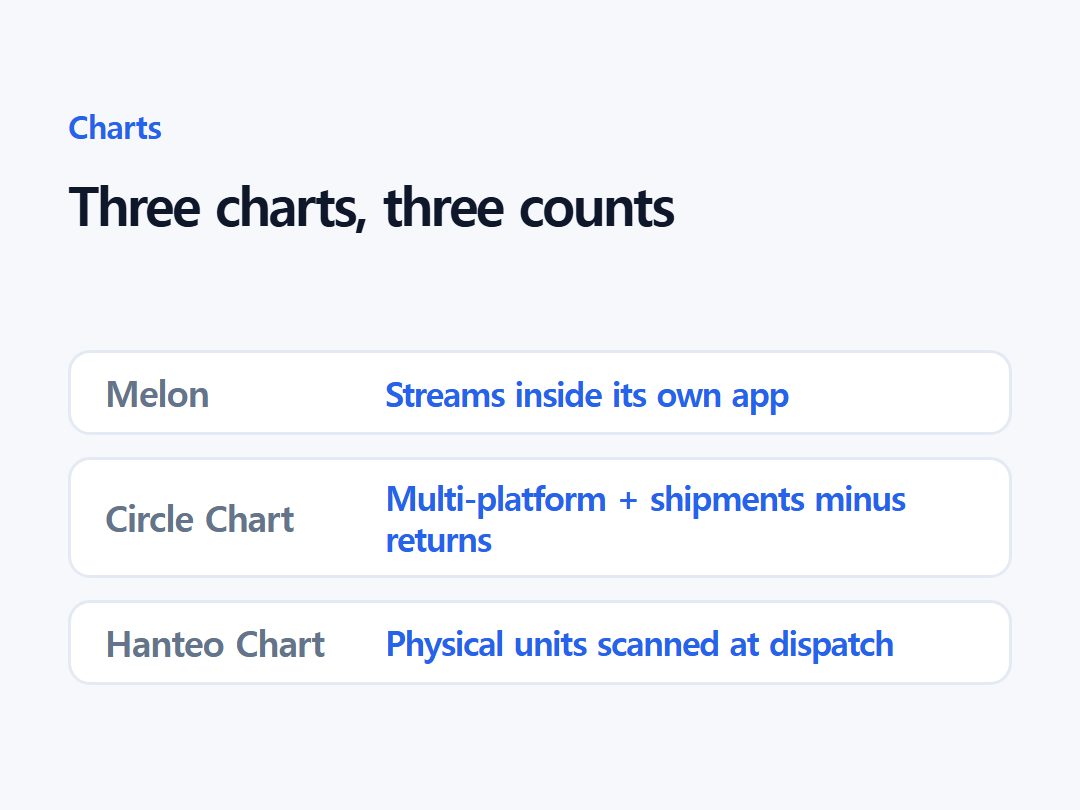
South Korea does not have one national music chart the way the United States has Billboard. It has several, run by different companies for different purposes, and none of them is required to agree with the others. Melon is a streaming app's internal popularity list.
Circle Chart is an industry-association aggregate covering streaming, downloads, and album shipments. Hanteo Chart is a private company's real-time count of physical album sales.
International coverage often cites whichever one produced the most dramatic-sounding number, without saying which chart it came from — leaving readers to assume all three measure the same thing. They do not.
Why do Melon, Circle Chart, and Hanteo disagree?
The confusion starts with a basic distinction international readers often miss: in Korea, "chart performance" can mean digital streaming, digital downloads, or physical album sales, and each of the three major charts weighs these differently.
Melon is South Korea's largest domestic music-streaming app, roughly comparable to a Korean Spotify, and its in-app chart reflects only what people are streaming and downloading inside Melon itself — nothing from rival apps, and nothing from physical stores.
After years of manipulation controversies, Melon abolished its old minute-by-minute "Real-time" chart in 2020 and replaced it with charts such as "24Hits" and "TOP100," which blend a song's streams over the past 24 hours with its streams over the past hour, and reduce the weight of overnight listening hours when manipulation was historically easiest.
Circle Chart, known until 2022 as the Gaon Chart, is run by the Korea Music Content Association and is the closest thing Korea has to an official national chart — the one most often used for major industry awards like the Golden Disc Awards and Seoul Music Awards.
Unlike Melon, Circle Chart does not collect its own listening data.
It aggregates figures reported by multiple platforms, including Melon, Genie, Bugs, Flo, and Vibe, and since its 2022 rebrand it has folded in data from global platforms such as Spotify and Apple Music, reflecting the fact that K-pop's audience is now largely outside Korea.
In 2023, Circle Chart also stopped counting streams played on "mute" — background plays with the volume off, used by some fans to farm play counts — which it said had made up over 7% of weekly domestic streaming.
For physical albums, Circle Chart's number is a chart most readers don't expect: shipment volume minus returns, meaning it can include copies a distributor has sent to stores that have not yet actually sold to a fan.
Hanteo Chart is different again. Founded in 1993, well before streaming existed, Hanteo is a private company that certifies retail stores — from small Korean shops to online sellers like Aladin and Ktown4u — to scan a barcode the moment an album is dispatched to a buyer.
Only that scan counts as a sale; a pre-order or a payment alone does not register until the item actually ships. Because that scan can happen within minutes of a release, Hanteo's chart updates hour by hour, which is why it is treated as the fastest real-time gauge of how hard a fandom is buying on release day.
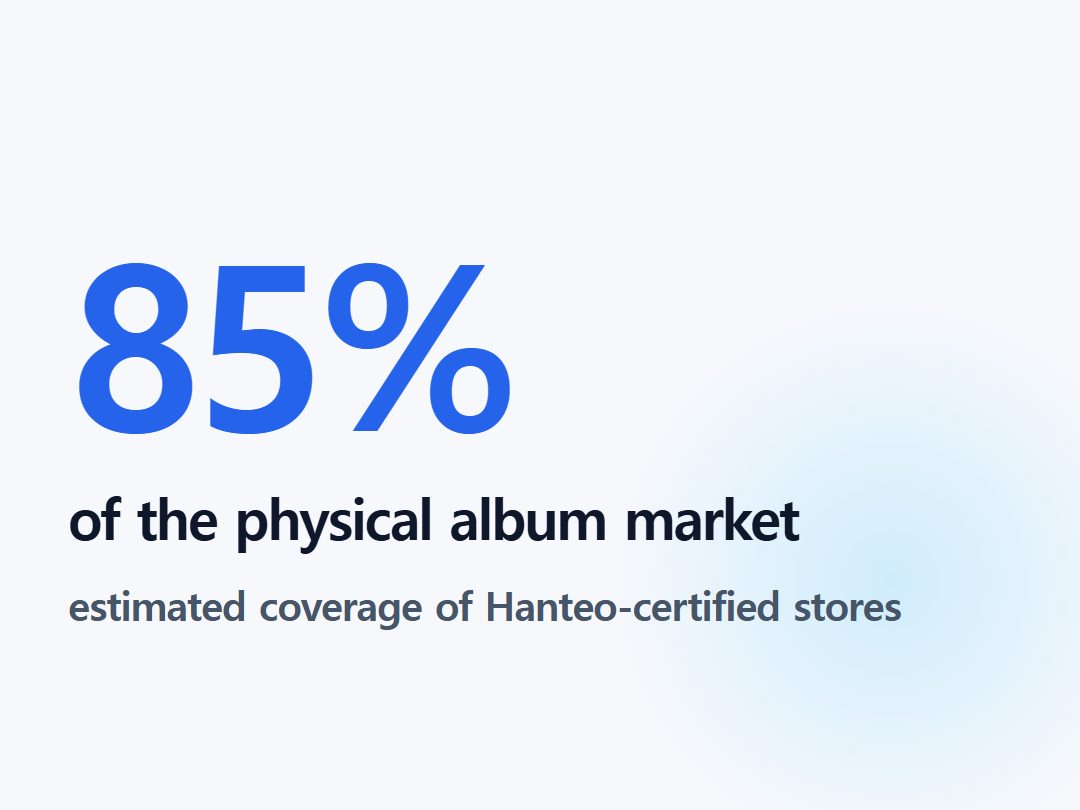
Hanteo has said its network covers roughly 85% of the physical album market, not all of it, since not every retailer pays for Hanteo certification.
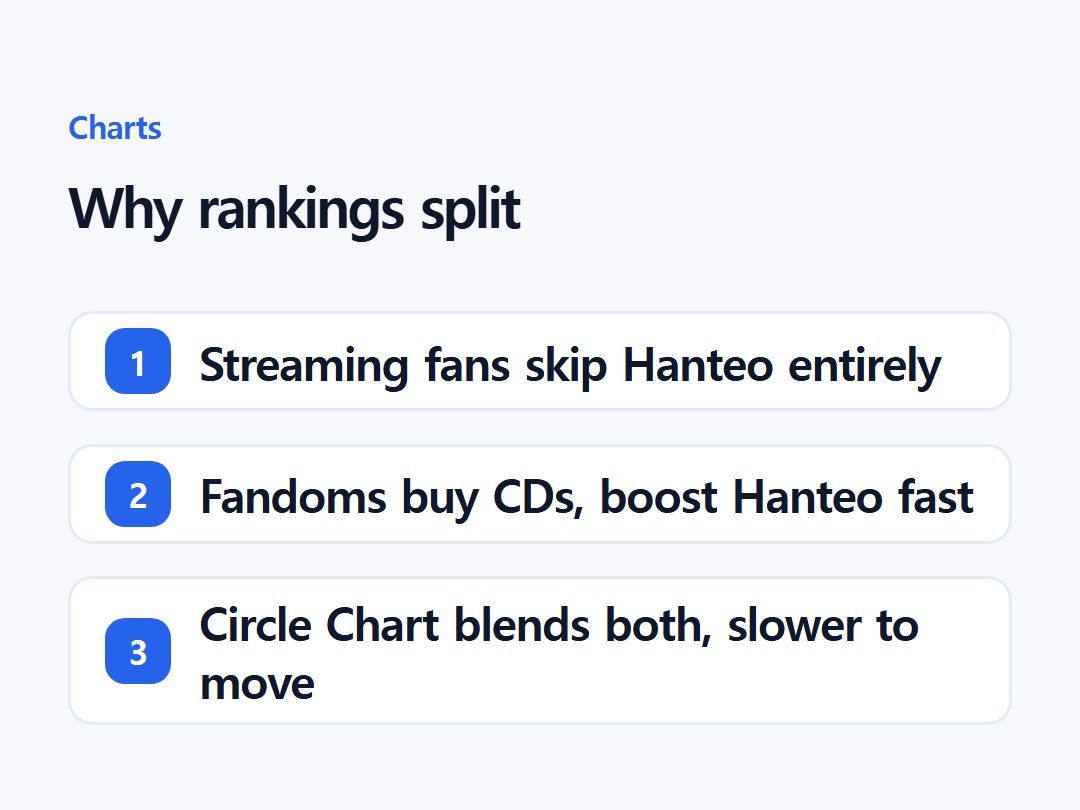
These different definitions explain why rankings split. A group with an older or more casual listener base can dominate Melon and Circle Chart's streaming rankings while barely moving Hanteo's physical chart, because that audience listens on Spotify or YouTube rather than buying CDs.
A group with a young, highly organized fandom can do the opposite: post enormous first-week numbers on Hanteo within hours of a comeback, driven by fans buying multiple copies for photocards or lightsticks, while its streaming numbers build more slowly over following weeks.
Neither pattern makes one group more "popular" than the other in any single, uncontested sense — it depends which chart, and which kind of consumption, is being measured.
Because a number-one chart position carries real commercial weight — it factors into weekly trophies on television music programs such as M Countdown, Music Bank, Show Champion, and The Show, and into year-end industry awards — it has also long been a target for manipulation.
The Korean term for this is sajaegi (사재기): a scheme in which an agency or its associates bulk-buy their own artist's album or streams, often overnight when fewer real listeners are online, purely to inflate the chart position.
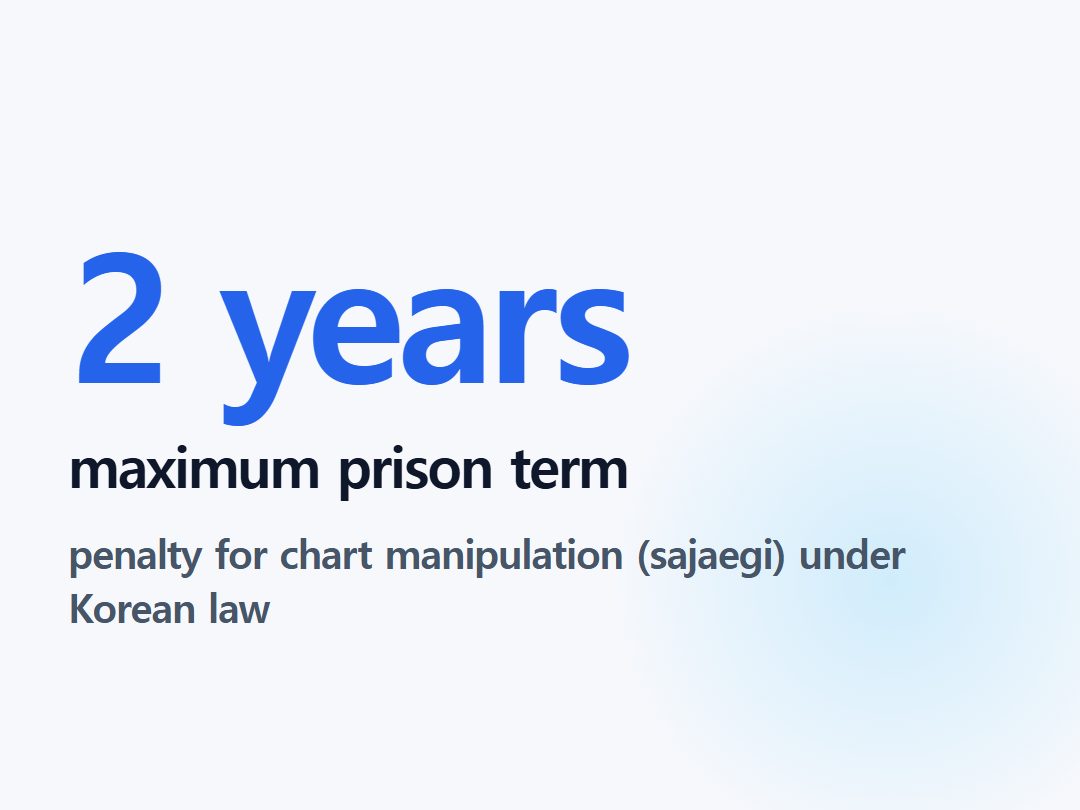
Under South Korea's Music Industry Promotion Act, this is a criminal offense, punishable by fines of up to 20 million won or up to two years in prison.
A 2020 investigative report by broadcaster SBS detailed how such schemes worked in practice, and it was one of the pressures that pushed Melon to scrap its old real-time chart that same year.
Hanteo has since added its own anti-fraud layer, a scratch-off QR code checked through its Whosfan app, intended to confirm that a scanned sale corresponds to a real, individually verified purchase rather than a bulk order run through the back door.
| Chart | Run by | What it counts |
|---|---|---|
| Melon | Melon (streaming app) | Streams and downloads inside the Melon app only |
| Circle Chart | Korea Music Content Association | Multi-platform streaming plus album shipments minus returns |
| Hanteo Chart | Hanteo Global (private company) | Physical album units scanned at dispatch, from certified retailers |
How three rival charts emerged since 1993
Hanteo is the oldest of the three, built in 1993 purely to track physical record sales in an era before streaming existed.
Melon launched in 2004, originally under telecom company SK Telecom, and grew alongside Korea's early and aggressive adoption of smartphones and mobile broadband into the country's dominant paid streaming service — giving one company's in-app numbers outsized public visibility, even though they reflected only its own users.
The Korea Music Content Association set up the Gaon Chart in 2010 specifically to solve the problem this created: no single, industry-wide number that could be used consistently for awards, certifications, and market data, the way Billboard functions in the United States or the Oricon chart does in Japan.
Repeated sajaegi scandals through the 2010s, culminating in the 2020 SBS exposé and Melon's decision to drop its real-time chart that year, pushed all three organizations toward tighter anti-manipulation rules, including scheduled "chart freezing" during low-traffic overnight hours.
In July 2022, Gaon Chart rebranded as Circle Chart and formally expanded to include international streaming platforms, acknowledging that a large share of K-pop's audience — and therefore its legitimate streaming activity — now lives outside Korea.
Hanteo underwent its own overhaul that same year, moving to what it calls "Chart 4.0," which shifted its ranking from a raw sales count to an internal "album index" and introduced a dedicated world chart to track sales reported from outside Korea.
What could change about these charts next?
The three-chart system is not static, and none of the reforms so far have fully closed the debate.
Sajaegi accusations still surface around individual comebacks, usually traded between rival fandoms on social media rather than proven in court, and it remains difficult for an outside reader to verify such claims without an official investigation.
Circle Chart's expanding weight toward global platforms like Spotify and Apple Music is likely to keep shifting how much a group's overseas streaming counts relative to domestic plays on Melon or Genie, which is worth watching as K-pop's audience continues to grow outside Korea.
Hanteo has not published the exact formula behind its post-2022 "album index," so how much that calculation differs from a simple unit count is still something outside researchers and fans continue to press the company on.
And because television music shows and year-end awards each combine chart data with their own additional criteria — broadcast points, judging panels, sometimes social media activity — a "number one" claim should generally be read with one follow-up question attached: on which chart, exactly.
How Korea's three-chart system took shape
| Year | Event | Why it mattered |
|---|---|---|
| 1993 | Hanteo founded | Tracked physical record sales, years before streaming existed |
| 2004 | Melon launches | Grew into Korea's dominant in-app streaming chart under SK Telecom |
| 2010 | Gaon Chart launched | Korea Music Content Association creates an industry-wide aggregate chart |
| 2020 | Melon drops real-time chart | Replaced with 24Hits/TOP100 after an SBS sajaegi exposé |
| 2022 | Gaon rebrands as Circle Chart | Adds global platforms like Spotify and Apple Music |
| 2022 | Hanteo launches "Chart 4.0" | Shifts to an internal "album index" and adds a world chart |
Frequently asked
Why do Melon, Circle Chart, and Hanteo show different rankings for the same song?
Each chart measures something different: Melon counts only streams and downloads inside its own app, Circle Chart aggregates multiple platforms plus album shipments minus returns, and Hanteo counts only physical albums scanned at dispatch by certified retailers.
What is sajaegi in K-pop?
Sajaegi is the Korean term for an agency or its associates bulk-buying their own artist's album or streams, often overnight, purely to inflate chart position; it's a criminal offense under South Korea's Music Industry Promotion Act.
Which Korean music chart is considered the most official?
Circle Chart, run by the Korea Music Content Association and formerly known as Gaon Chart, is the closest thing to an official national chart and is the one most often used for awards like the Golden Disc Awards and Seoul Music Awards.
Sources
Every factual claim above is traceable. We do not translate articles — we gather facts from multiple outlets and write them ourselves.
- Circle Chart — Wikipedia
- Circle Digital Chart — Wikipedia
- HANTEO CHART — official site — Hanteo Global
- K-pop 101: Hanteo chart vs. Gaon chart — Sportskeeda
- Korea Moves to Stop Real-Time Chart Manipulation — Billboard
- Just How Rampant is Chart Manipulation in South Korea? — Digital Music News
- Chart manipulation — Wikipedia